ISO 50001 is an international standard for Energy Management Systems (EnMS). It helps organisations establish a structured approach to managing energy use, improving energy performance, reducing waste, and supporting continual improvement. ISO 50001 certification demonstrates that an organisation has implemented a systematic energy management framework and is committed to improving its energy efficiency.
Global Quality Services (GQS) provides ISO 50001 certification consultancy and audit support for organisations in Malaysia. Our services help businesses understand the standard, prepare their Energy Management System, identify gaps, and get ready for an independent certification audit.
What Is ISO 50001 Certification?
ISO 50001 provides a framework for organisations to manage energy systematically. It covers areas such as energy planning, energy performance monitoring, energy consumption, operational controls, measurement, and continual improvement. The standard follows a management-system approach, allowing organisations to establish an energy policy, conduct an energy review, identify significant energy uses, set energy objectives and targets, monitor performance, and take corrective action where required. Certification can be useful for manufacturing companies, commercial buildings, logistics companies, data centres, hotels, healthcare organisations, and other energy-intensive businesses in Malaysia.
Benefits of ISO 50001 Certification
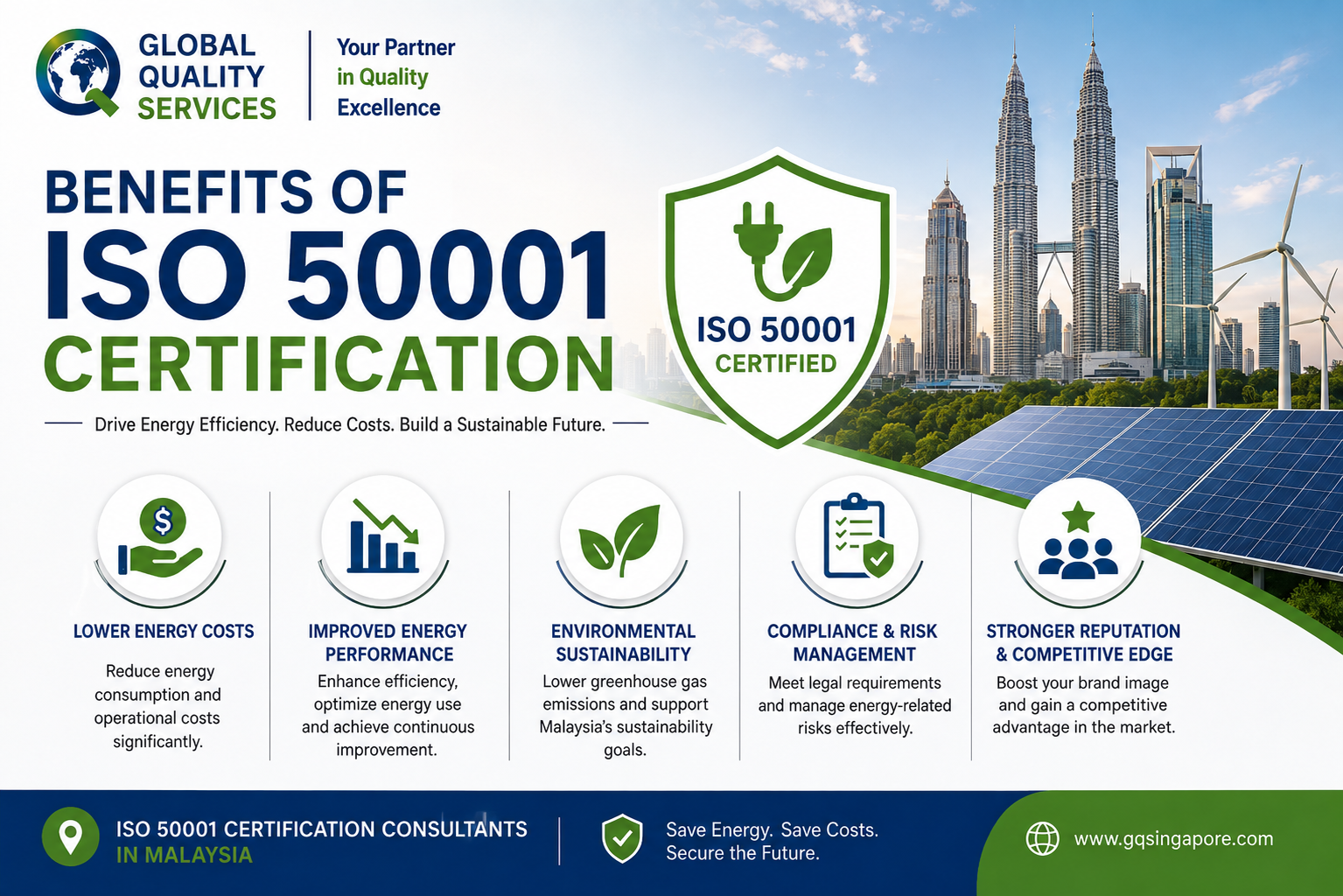
Implementing ISO 50001 can provide both operational and business benefits.
Better Energy Performance
The standard helps organisations understand where and how energy is being consumed. This allows businesses to identify opportunities to improve energy efficiency and reduce unnecessary consumption.
Reduced Energy Costs
By monitoring significant energy use and improving energy performance, organisations can identify opportunities to reduce energy costs over time.
Improved Environmental Performance
Better energy efficiency can help reduce greenhouse gas emissions associated with energy consumption and support broader environmental objectives.
Stronger Operational Control
ISO 50001 encourages organisations to establish clear controls, responsibilities, monitoring methods, and performance indicators for energy management.
Support for Sustainability Goals
A structured energy management system can support corporate sustainability programmes, ESG initiatives, and organisational targets related to energy efficiency and emissions reduction.
Improved Stakeholder Confidence
Certification provides evidence that an organisation follows a recognised international framework for managing and continually improving energy performance.
ISO 50001 Certification Process in Malaysia
Obtaining ISO 50001 certification involves more than preparing documents. An organisation must establish, implement, monitor, and continually improve an effective Energy Management System (EnMS). The process usually begins by understanding the organisation’s current energy performance and ends with an independent certification audit.
1. Initial Assessment and Gap Analysis
The first step is to assess the organisation’s existing energy management practices against the requirements of ISO 50001. This includes reviewing energy consumption, existing policies, monitoring methods, operational controls, responsibilities, and available records. A gap analysis then identifies what is already in place and what needs to be developed or improved. This gives the organisation a clear roadmap for achieving certification.
2. Establish the Energy Management System
Once the gaps are identified, the organisation establishes its ISO 50001 Energy Management System. This includes developing an energy policy and defining responsibilities, objectives, targets, processes, and controls. The organisation also needs to understand how energy is being used across its operations and establish suitable methods for managing and improving energy performance.
3. Conduct an Energy Review
An important part of ISO 50001 is understanding the organisation’s energy profile. The organisation reviews relevant energy data to determine where energy is consumed and identify Significant Energy Uses (SEUs). Energy performance indicators, energy baselines, relevant variables, and opportunities for improving energy performance are established based on the organisation’s operations and available data.
4. Set Objectives, Targets and Action Plans
After understanding its energy performance, the organisation establishes measurable energy objectives and targets. Action plans are then developed to achieve them. For example, an organisation may focus on improving the efficiency of production equipment, reducing unnecessary energy consumption, optimising operating conditions, or improving monitoring and control systems.
5. Implement and Monitor the System
The Energy Management System is then implemented across relevant departments and operations. Employees are given appropriate awareness and responsibilities, while operational controls are implemented for significant energy uses. Energy consumption and performance are regularly monitored and measured to determine whether the organisation is achieving its planned objectives.
6. Internal Audit and Corrective Action
Before applying for certification, the organisation conducts an internal audit to verify that its Energy Management System conforms to ISO 50001 and operates effectively. Any nonconformities or weaknesses identified during the audit are addressed through corrective actions. This gives the organisation an opportunity to resolve issues before the external certification audit.
7. Management Review
Top management reviews the performance of the Energy Management System. The review considers energy performance, objectives and targets, audit results, nonconformities, monitoring results, opportunities for improvement, and other relevant factors. Management review demonstrates that energy management is being actively overseen at the organisational level rather than treated only as an operational activity.
8. Certification Audit
Once the organisation is ready, an independent certification body conducts the ISO 50001 certification audit. The audit generally takes place in two stages. Stage 1 focuses on reviewing the organisation’s documented Energy Management System and assessing its readiness for the main audit. Stage 2 evaluates whether the system has been effectively implemented and meets the applicable ISO 50001 requirements. Auditors may review records, interview employees, examine processes, and evaluate evidence of energy performance and system implementation. If nonconformities are identified, the organisation must address them in accordance with the requirements of the applicable certification body.
9. Certification and Surveillance Audits
When the certification audit is successfully completed and the certification decision is made, the organisation receives its ISO 50001 certificate from the certification body. However, certification is not the end of the process. Surveillance audits are conducted periodically to confirm that the Energy Management System continues to meet ISO 50001 requirements and remains effectively implemented.
Why Choose GQS for ISO 50001 Certification?
Global Quality Services supports organisations in Malaysia throughout their ISO 50001 certification journey. Our approach focuses on understanding your organisation’s energy management requirements, identifying gaps, supporting documentation and system preparation, and helping your team prepare for certification and surveillance audits. Our experienced consultants work with businesses across different sectors and help make the certification process clear, structured, and practical.
Frequently Asked Questions
1. Is ISO 50001 mandatory in Malaysia?
ISO 50001 certification is generally voluntary. However, specific customers, contracts, sustainability programmes, or organisational requirements may make energy management certification commercially valuable.
2. Who needs ISO 50001 certification?
Manufacturers, industrial facilities, commercial buildings, data centres, hotels, logistics companies, and other organisations with significant energy consumption can benefit from ISO 50001.
3. How long does ISO 50001 certification take?
The timeline depends on the organisation’s size, complexity, energy consumption, existing management systems, and level of preparedness.
4. Can ISO 50001 be integrated with ISO 9001 or ISO 14001?
Yes. ISO 50001 can be integrated with other ISO management systems because they share several common management-system principles and structures.
5. Does GQS provide ISO 50001 certification?
GQS can provide consultancy and certification-related support. The formal certification audit and certification decision should be performed by an appropriately independent and accredited certification body.