TISAX gives Singapore-based automotive suppliers a single, verified label that demonstrates information security compliance to all OEM partners — replacing repeated, costly individual audits with a single accepted, shared result on the ENX Exchange platform.
Developed by the German Association of the Automotive Industry (VDA) and operated by the ENX Association, TISAX (Trusted Information Security Assessment Exchange) is the globally recognized information security standard for the automotive supply chain. For Singapore companies supplying parts, software, engineering services, or logistics to OEMs such as BMW, Volkswagen, Mercedes-Benz, or Stellantis, TISAX is no longer a differentiator — it is a commercial prerequisite. Since April 2024, all new TISAX assessments are conducted exclusively under ISA Catalog 6.0, which introduced strengthened controls for ransomware resilience and advanced persistent threat (APT) defense. Global Quality Services guides Singapore organizations through every stage of TISAX readiness, assessment, and verified label exchange on the ENX portal.
Who Needs TISAX Certification in Singapore?
Any Singapore-registered organization that handles confidential automotive data on behalf of an OEM or Tier 1 supplier is a candidate for TISAX assessment — and in most cases, a contractual requirement already exists in your supply agreement.
The following Singapore-based organizations are most commonly required to hold a valid TISAX label:
Automotive parts and component suppliers providing Tier 1 or Tier 2 assemblies to OEMs with German or European origin require TISAX to remain eligible for supply contracts. IT and software vendors offering cloud platforms, SaaS solutions, or embedded systems integrated into OEM production or design environments are increasingly mandated to demonstrate ISA 6.0 compliance. Engineering and R&D consultancies that access vehicle prototype specifications, CAD data, or pre-launch development blueprints under NDA are assessed at the highest protection levels.
Logistics and third-party providers handling prototype vehicles or confidential pre-launch automotive goods must demonstrate that their facilities and information systems meet TISAX’s physical and digital security requirements. Marketing and communications agencies receiving unreleased model imagery, prototype access, or embargoed launch material from OEM clients are also subject to TISAX requirements — a category frequently overlooked until a contract is already at risk.
TISAX Assessment Levels: Selecting the Right Level for Your Singapore Entity
Your assessment level is determined by the sensitivity of the information your Singapore entity handles — and selecting the wrong level at registration wastes time and cost before a single auditor is engaged.
Assessment Level 1 (AL1 — Normal Protection) applies to organizations handling standard confidential business information with low protection requirements. Assessment is conducted through self-assessment only, with no external auditor involvement. This level is rarely applicable to Singapore entities active in the OEM supply chain.
Assessment Level 2 (AL2 — High Protection) is the most common level for Singapore-based suppliers and service providers. It applies to organizations handling high-protection data including customer personal information, technical specifications, and financial data. Assessment involves a remote plausibility check conducted by an ENX-accredited auditor who reviews documentation and conducts structured interviews.
Assessment Level 3 (AL3 — Very High Protection) requires a full on-site audit by an ENX-accredited assessor and applies to organizations handling prototype vehicles, top-secret development data, or pre-production assets. Major OEMs including PACCAR mandate AL3 for suppliers whose operations directly impact production continuity.
TISAX and Singapore’s Regulatory Landscape
Achieving a TISAX label in Singapore does not exist in isolation from local law. For Singapore entities, the controls required by ISA 6.0 directly satisfy core obligations under Singapore’s data protection and cybersecurity frameworks — making TISAX a dual-purpose compliance investment.
The Personal Data Protection Act 2012 (PDPA), administered by the Personal Data Protection Commission (PDPC), governs how Singapore organizations collect, use, and protect personal data. TISAX assessments covering customer PII and prototype-related personal data directly address the PDPA’s Protection Obligation and the mandatory Data Breach Notification requirement introduced under the 2021 amendments. The Cyber Security Agency of Singapore (CSA) promotes baseline cybersecurity standards across Singapore’s supply chain through frameworks including the CSA Cybersecurity Labelling Scheme. TISAX’s ISA 6.0 controls for network security, access management, and incident response align directly with CSA’s supply chain security guidance for technology vendors serving regulated industries. Additionally, Singapore-based companies holding ISO/IEC 27001 certification have a significant head start — many ISA 6.0 controls map directly to existing ISMS documentation, reducing gap remediation time and assessment preparation cost considerably.
Our TISAX Certification Process for Singapore
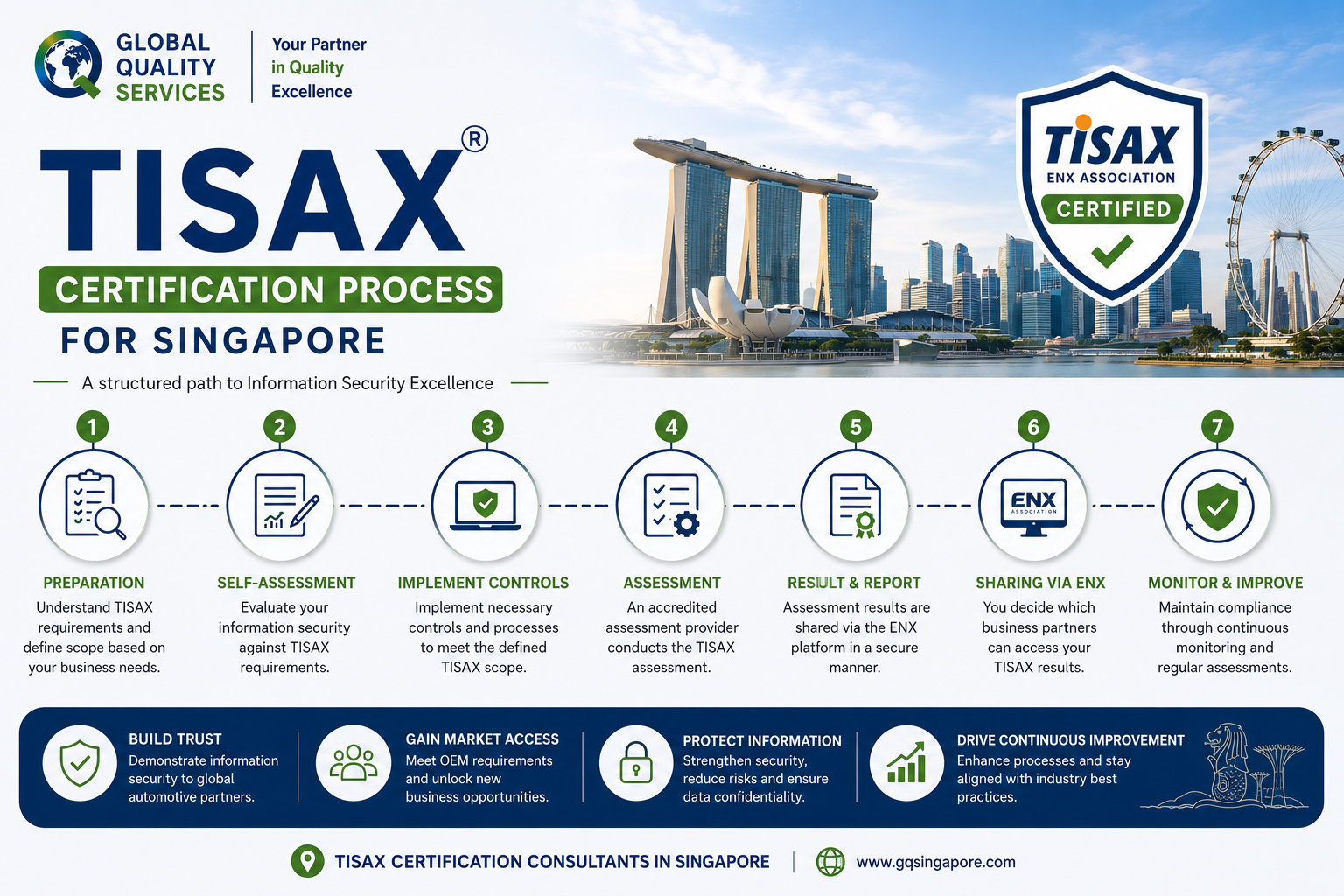
Every Singapore entity working with Global Quality Services moves from compliance gap to verified ENX label through a structured five-stage process — scoped to Singapore’s regulatory context and your OEM’s specific assessment requirements.
Step 1 — Gap Assessment and Level Selection You know your gaps, your correct assessment level, and your full remediation roadmap before any cost is committed to ENX registration. We evaluate your existing ISMS against the VDA ISA 6.0 questionnaire, confirm your applicable assessment level, and produce a prioritized remediation plan — preventing misregistration on the ENX portal that delays your label and adds unnecessary cost.
Step 2 — ENX Registration and Scope Definition Your ENX registration is accurate, your scope is correctly defined, and your Singapore entity is mapped to the right assessment objects from day one. We manage your registration on the ENX portal, define organizational scope, and confirm your protection need categories — including prototype protection and connection to third-party networks — so your label reflects your actual business operations.
Step 3 — Self-Assessment and Evidence Preparation Your ISA self-assessment is fully evidenced, maturity-rated, and structured to the standard ENX-accredited auditors expect before any external review begins. Our consultants work alongside your Singapore team to complete the ISA questionnaire, document controls across all ISA 6.0 domains, and build the evidence portfolio — including policies, access logs, and incident response records — to the required maturity level.
Step 4 — Auditor Liaison and Assessment Support Your team is fully briefed and your documentation is auditor-ready before the ENX-accredited assessor conducts their remote or on-site review. We coordinate with your chosen ENX-accredited audit service provider, prepare your Singapore stakeholders for AL2 remote interviews or AL3 on-site inspections, and manage all pre-assessment communication on your behalf.
Step 5 — Label Exchange and Ongoing Maintenance Your TISAX label is live on the ENX Exchange, visible to every OEM partner that requires it, with a three-year maintenance plan that prevents the label from lapsing. Following successful assessment, we configure your result-sharing settings on the ENX portal, brief your team on the ISA 6.0 reassessment cycle, and build a maintenance roadmap covering change control reviews, internal assessment schedules, and PDPA-aligned data breach notification procedures.
Why Choose Global Quality Services for TISAX in Singapore?
Global Quality Services brings together ISO 27001-aligned ISMS consulting expertise, deep familiarity with the ENX portal and ISA 6.0 requirements, and direct knowledge of Singapore’s PDPA and CSA cybersecurity obligations — making us the partner of choice for Singapore automotive suppliers who need a TISAX label that holds up to OEM scrutiny and local regulatory expectations simultaneously. We do not apply a generic template to every engagement. Every TISAX project is scoped to your organization’s assessment level, existing ISMS maturity, and the specific data categories your Singapore entity handles. From the first gap review to the final label on the ENX Exchange, our team is with you at every stage — and our three-year maintenance program ensures your label never becomes a liability when your next OEM contract renewal is on the line.
TISAX FAQs
Q1: Is TISAX legally required under Singapore law?
TISAX is not a statutory requirement under Singapore law, but it is a contractual obligation imposed by OEMs and Tier 1 clients. Its controls directly satisfy obligations under Singapore’s PDPA and CSA cybersecurity guidance for supply chain participants.
Q2: Our Singapore entity already holds ISO 27001. Do we still need a TISAX label?
Yes, if your OEM client requires it. ISO 27001 significantly reduces preparation time and closes many ISA 6.0 gaps, but TISAX is automotive-specific and the ENX label is a separate deliverable that ISO 27001 certification alone cannot substitute.
Q3: Can one TISAX label satisfy multiple OEM clients at the same time?
Yes. A single TISAX assessment result can be shared with any number of automotive partners through the ENX Exchange portal, eliminating repeated audits with each individual OEM client and reducing long-term compliance cost.
Q4: What changed with ISA 6.0 and does it affect Singapore entities with existing labels?
ISA 6.0, effective April 2024, strengthened ransomware and APT resilience controls. Labels issued under ISA 5.1 remain valid until their individual expiry dates. All new and renewal assessments from April 2024 onward must be conducted exclusively under ISA 6.0.
Q5: How long does the TISAX process take for a Singapore entity starting from scratch?
Typically six to twelve months, depending on ISMS maturity, assessment level, and organizational size. Singapore companies with an existing ISO 27001 ISMS in place can often complete the process toward the shorter end of this range.