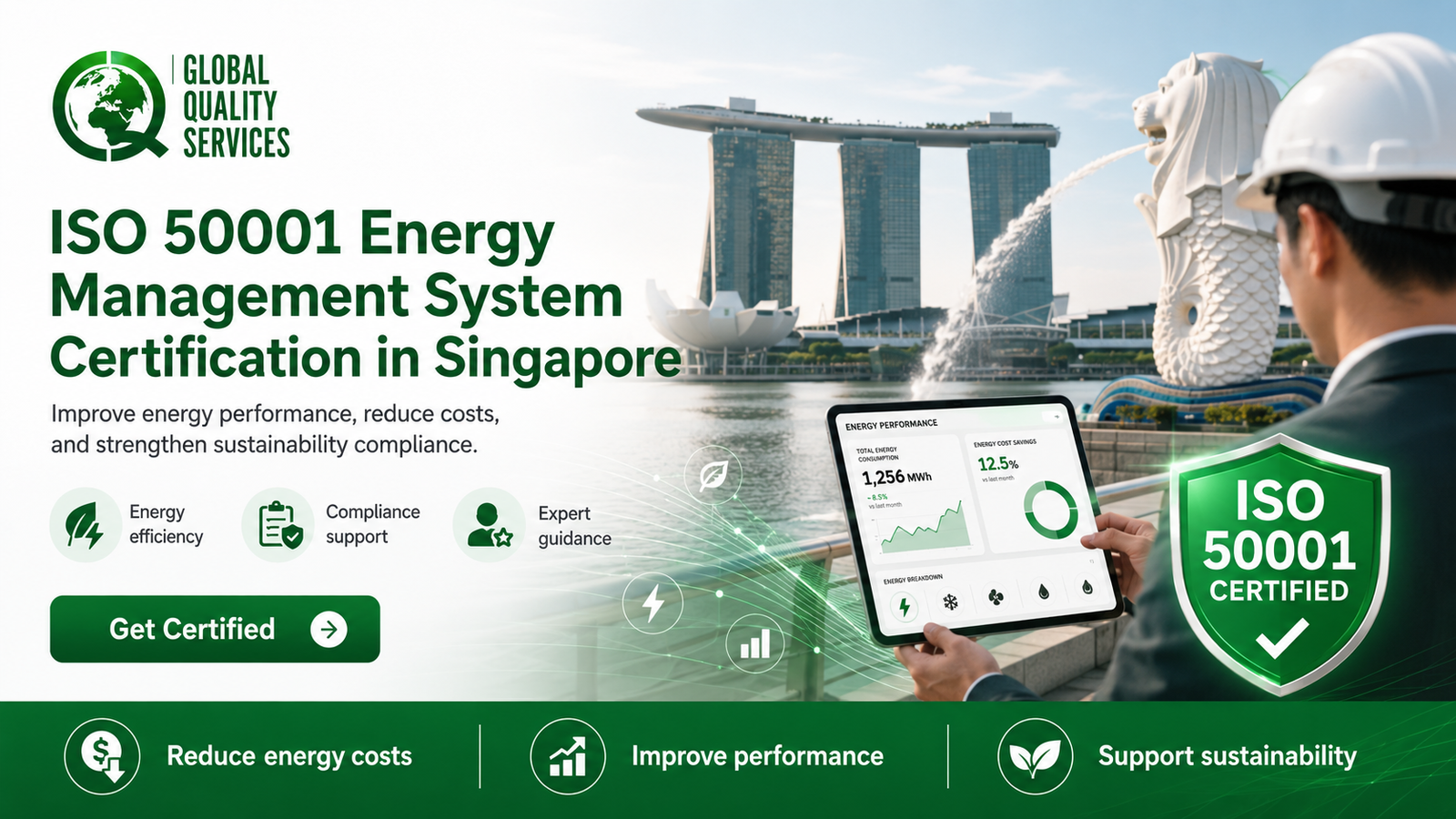
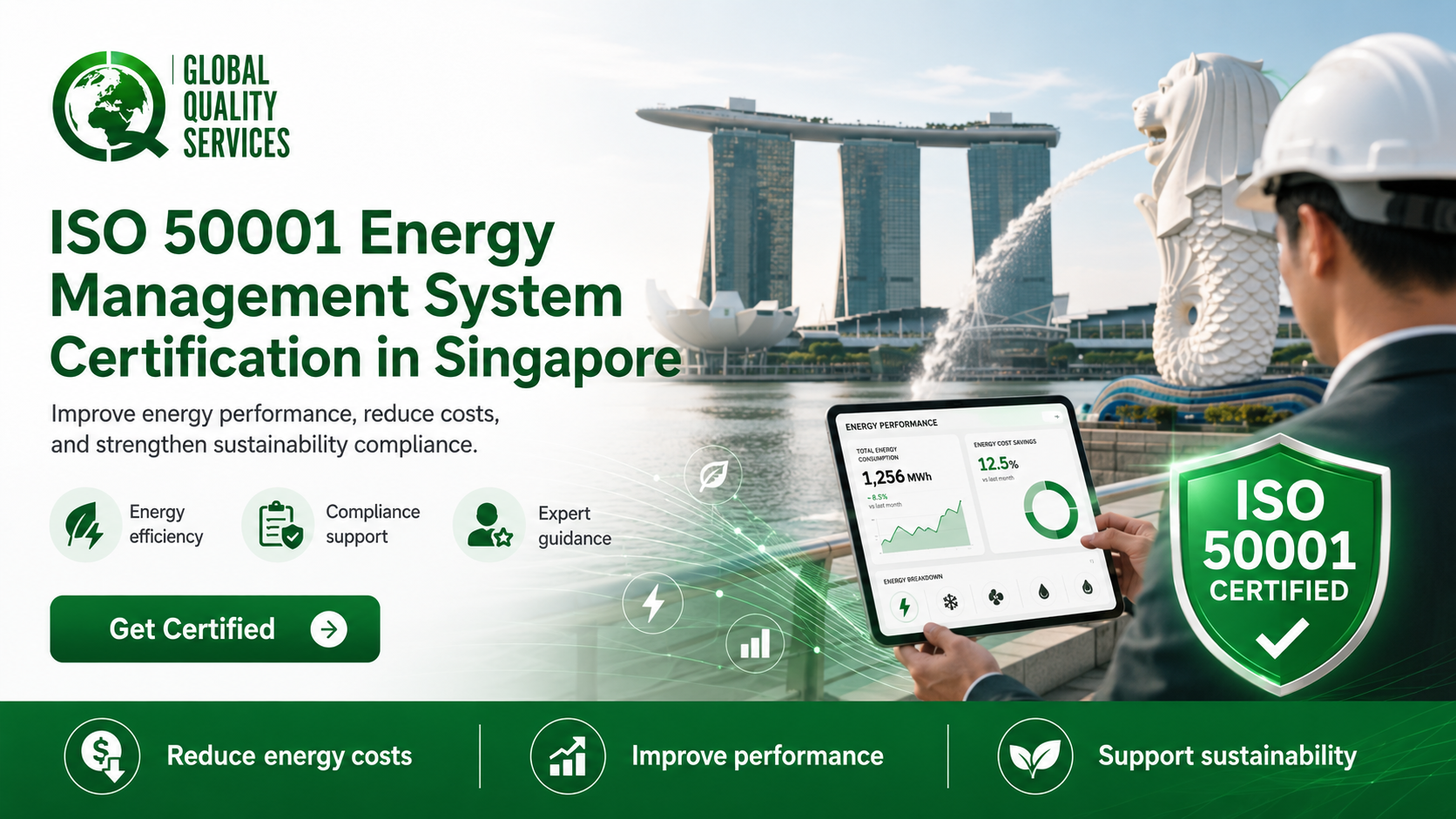
Is your organisation spending more on energy than it should? Are you unsure whether Singapore’s Energy Conservation Act applies to your business? GQS Singapore helps organisations across all industries get ISO 50001 certified, cutting energy costs, meeting regulatory requirements, and building a credible sustainability story.
What Is ISO 50001?
ISO 50001 is the international standard for Energy Management Systems (EnMS). It gives your organisation a structured, proven framework to monitor, control, and continuously reduce energy consumption — across your entire operation.
In simple terms — instead of guessing where energy is being wasted, ISO 50001 helps you measure it, understand it, and systematically reduce it year after year. It is published by the International Organization for Standardization (ISO) and adopted in Singapore as SS ISO 50001:2018+A1:2024 — available through the Singapore Standards eShop.
ISO 50001 uses the same Plan-Do-Check-Act structure as ISO 9001 and ISO 14001, making it easy to integrate with management systems your organisation may already have in place.
Does ISO 50001 Apply to My Organisation in Singapore?
Yes — and for large energy users, parts of it are legally mandatory.
Singapore’s Energy Conservation Act (ECA), administered by the National Environment Agency (NEA), makes energy management practices mandatory for corporations in the industrial sector consuming 54 terajoules (TJ) or more of energy per year. This covers organisations in:
- Manufacturing and manufacturing-related services
- Supply of electricity, gas, steam, compressed air, and chilled water
- Water supply, sewage, and waste management
If your organisation crosses the 54 TJ threshold in at least two out of three preceding calendar years, you must appoint a Singapore Certified Energy Manager (SCEM), monitor and report energy use and greenhouse gas emissions annually, and submit an energy efficiency improvement plan every year.
The good news: ISO 50001 certification satisfies your ECA Energy Management System obligation. Once NEA verifies your valid, accredited ISO 50001 certificate, no further NEA EnMS audit is required. It is the most efficient route to ECA compliance available. Even if you are below the 54 TJ threshold, ISO 50001 is worth pursuing — the energy cost savings alone justify the investment for most organisations.
Why Does ISO 50001 Matter Beyond Legal Compliance?
ISO 50001 directly reduces your energy bills — and opens doors to global markets and sustainability recognition.
- It aligns with Singapore’s Green Plan 2030. Singapore’s national sustainability roadmap — the Singapore Green Plan 2030 — sets ambitious targets for energy efficiency and carbon reduction. ISO 50001 positions your organisation ahead of the curve on these national goals.
- It meets MEES requirements. From December 2025, NEA’s updated Minimum Energy Efficiency Standards (MEES) for water-cooled chilled water systems apply to industrial facilities in Singapore. ISO 50001 gives you the systematic framework to monitor and meet these evolving obligations.
- It supports your ESG reporting. Investors, clients, and regulators increasingly demand verified energy performance data as part of ESG disclosures. ISO 50001 gives your ESG report credibility that self-reported numbers simply cannot match.
- It is recognised by the Energy Market Authority (EMA), Singapore’s energy market regulator, as a demonstration of serious commitment to energy efficiency across all sectors.
Who in Singapore Needs ISO 50001 Certification?
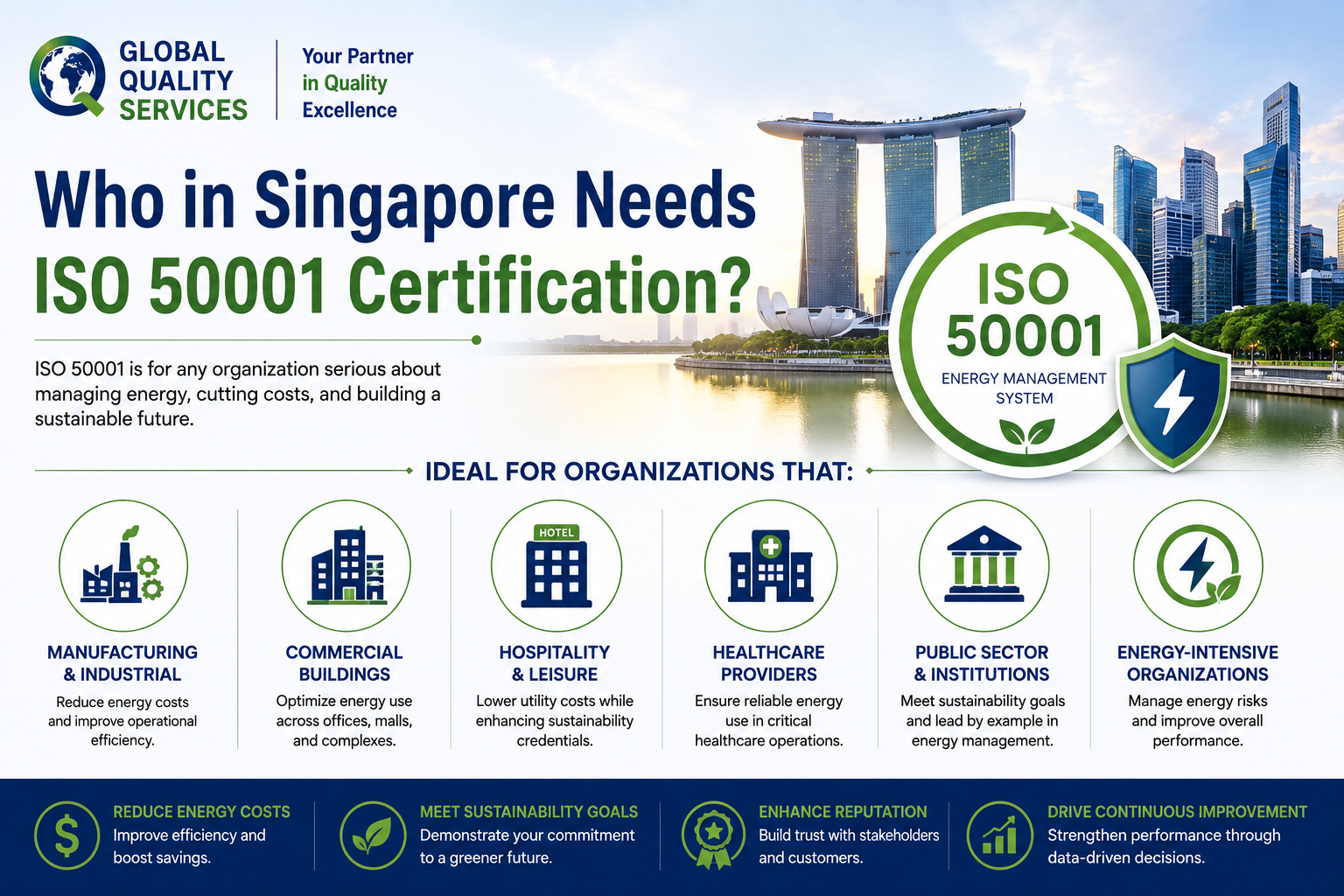
Any organisation with significant energy costs or ECA obligations should pursue ISO 50001. Specifically:
- Large industrial manufacturers consuming 54 TJ or more annually — ISO 50001 is the most recognised way to meet your mandatory ECA EnMS requirements and avoid further NEA audits.
- Data centres — Singapore is Asia’s data centre hub. These facilities are among the most energy-intensive in the world. ISO 50001 provides the framework for systematic energy reduction and supports Singapore’s Green Data Centre standards.
- Commercial buildings, hotels, hospitals, and shopping malls — Large facility operators with significant energy footprints benefit from ISO 50001 alongside our ISO 41001 Facility Management certification.
- Utilities and energy suppliers in the electricity, gas, steam, and chilled water sectors are directly covered by the ECA’s mandatory energy management requirements.
- Manufacturers pursuing export markets — Many international buyers, tender requirements, and sustainability-linked contracts now require suppliers to demonstrate certified energy management.
- Organisations building an ESG programme — ISO 50001 pairs directly with ISO 14001 Environmental Management, ISO 14064 Carbon Footprint certification, and ESG Reporting — all delivered by GQS Singapore in integrated programmes.
What Does ISO 50001 Actually Require?
ISO 50001 covers everything in your organisation that influences how energy is used and managed. Here are the core requirements in plain language:
- Energy Policy — Senior management commits formally to improving energy performance and provides the resources to do so.
- Energy Review and Planning — You identify where energy is used, what drives consumption, and where the biggest opportunities for reduction exist. From this, you establish measurable Energy Performance Indicators (EnPIs) that track whether performance is genuinely improving.
- Energy Baseline — A documented starting point against which future performance is compared. Without a baseline, you cannot prove improvement.
- Objectives and Targets — Specific, measurable energy targets — for the whole organisation and for significant energy uses — supported by action plans with clear timelines and responsibilities.
- Operational Controls — Procedures for all activities that significantly affect energy use — equipment operation, maintenance, procurement of energy-efficient products, and design of new facilities.
- Monitoring and Measurement — Regular measurement of EnPIs and energy consumption, with data that is accurate, reliable, and systematically analysed.
- Internal Audit — Regular internal audits to verify controls are working in practice and targets are being met — not just on paper.
- Management Review — Senior management reviews EnMS performance at planned intervals and drives strategic decisions on energy targets and resources.
- Continual Improvement — ISO 50001 requires ongoing, documented improvement in energy performance year after year — not just at certification time.
How GQS Singapore Gets You ISO 50001 Certified
GQS Singapore delivers end-to-end ISO 50001 certification support — from your first energy review to a fully functioning, audit-ready EnMS.
Step 1 — Gap Assessment We review your current energy consumption, management practices, and documentation against ISO 50001:2018 requirements. You get a clear, prioritised action plan — not a generic checklist.
Step 2 — EnMS Design and Documentation We build your complete Energy Management System — energy policy, EnPI framework, energy baseline, objectives and targets, operational controls, monitoring plan, and all supporting procedures and records.
Step 3 — EnPI Setup and Energy Baseline We work with your team to identify the right EnPIs for your operations, set up your energy monitoring system, and establish your documented energy baseline — the foundation of your continual improvement programme.
Step 4 — Staff Training We train your energy management team, operational staff, and internal auditors on ISO 50001 requirements, monitoring procedures, and their individual roles in maintaining the EnMS.
Step 5 — Internal Audit We conduct a full internal audit before your certification audit — identifying and closing remaining gaps so you walk into Stage 1 and Stage 2 audits with full confidence.
Step 6 — Certification Audit Support We prepare your team and documentation for the certification audit — briefing management, organising records, and supporting professional responses to auditor queries.
Step 7 — Post-Certification Maintenance ISO 50001 requires annual surveillance audits and three-year recertification. GQS Singapore provides ongoing support — EnPI monitoring, management reviews, internal audits, and continual improvement planning — keeping your certification active and your energy performance genuinely improving.
Frequently Asked Questions
1. Is ISO 50001 mandatory in Singapore?
It is mandatory for industrial corporations consuming 54 TJ or more annually under Singapore’s Energy Conservation Act. For others it is voluntary — but the energy cost savings and ESG benefits make it worthwhile regardless.
2. Does the 54 TJ threshold apply to my business?
It applies to manufacturing, utilities, and water and waste management sectors. If you consumed 54 TJ or more in two of the last three years, you are a registrable corporation under the ECA.
3. How long does ISO 50001 certification take with GQS Singapore?
Most organisations complete the full process in 3 to 5 months — from gap assessment to certification audit. Organisations with existing energy monitoring systems already in place can move faster.
4. Can small businesses benefit from ISO 50001?
Yes. ISO 50001 applies to any organisation regardless of size or sector. Energy cost savings, stronger ESG reporting, and improved tender competitiveness make certification valuable well below the legal 54 TJ threshold.
5. Can GQS Singapore combine ISO 50001 with ISO 14001 or ESG reporting?
Yes — this is one of our most requested integrated programmes. ISO 50001, ISO 14001, and ESG reporting share significant common ground, making a combined engagement faster, more cost-effective, and more comprehensive.