Singapore holds itself to an exceptionally high standard when it comes to food safety. As a nation that imports over 90% of its food supply, the integrity of every link in the food chain — from raw material sourcing to final consumption — carries profound public health and economic significance. For food businesses operating in this environment, implementing a credible, internationally recognized Food Safety Management System is not merely a compliance exercise — it is a fundamental business responsibility. ISO 22000 certification provides that foundation, and Global Quality Services (GQS) helps Singapore food businesses achieve it with precision and confidence.
What ISO 22000 Addresses and Why It Matters in Singapore
ISO 22000 is a comprehensive international standard that brings together HACCP principles, prerequisite programs, and systematic management controls into a single, unified framework covering the entire food supply chain. Unlike standalone HACCP implementation, ISO 22000 embeds food safety into an organization’s broader management system — creating structures for leadership accountability, continuous improvement, emergency preparedness, and supply chain communication that go well beyond hazard control alone.
In Singapore, the Singapore Food Agency (SFA) serves as the national authority overseeing food safety regulation across import, manufacture, distribution, and retail. SFA’s introduction of the Safety Assurance for Food Establishments (SAFE) Framework from January 2026 has further elevated the importance of structured, verifiable food safety management — with ISO 22000 certification directly supporting stronger compliance outcomes and grading performance under the new framework.
Food businesses in Singapore seeking productivity and capability support may also explore funding opportunities through Enterprise Singapore — making ISO 22000 certification an investment with both operational and financial upside.
Where ISO 22000 Applies Across Singapore’s Food Industry
ISO 22000 is designed for every organization that touches the food supply chain, regardless of size or sector:
- Food manufacturers and processors operating under SFA licensing requirements
- Catering companies and central kitchens supplying hospitals, schools, airlines, and corporate clients
- Cold chain logistics and temperature-controlled warehousing providers
- Food packaging and contact material manufacturers
- Importers and distributors managing cross-border food supply chains into Singapore
- Retail food businesses and supermarket chains with private label manufacturing operations
- Food ingredient, additive, and flavoring suppliers serving the manufacturing sector
Business Advantages of ISO 22000 Certification in Singapore
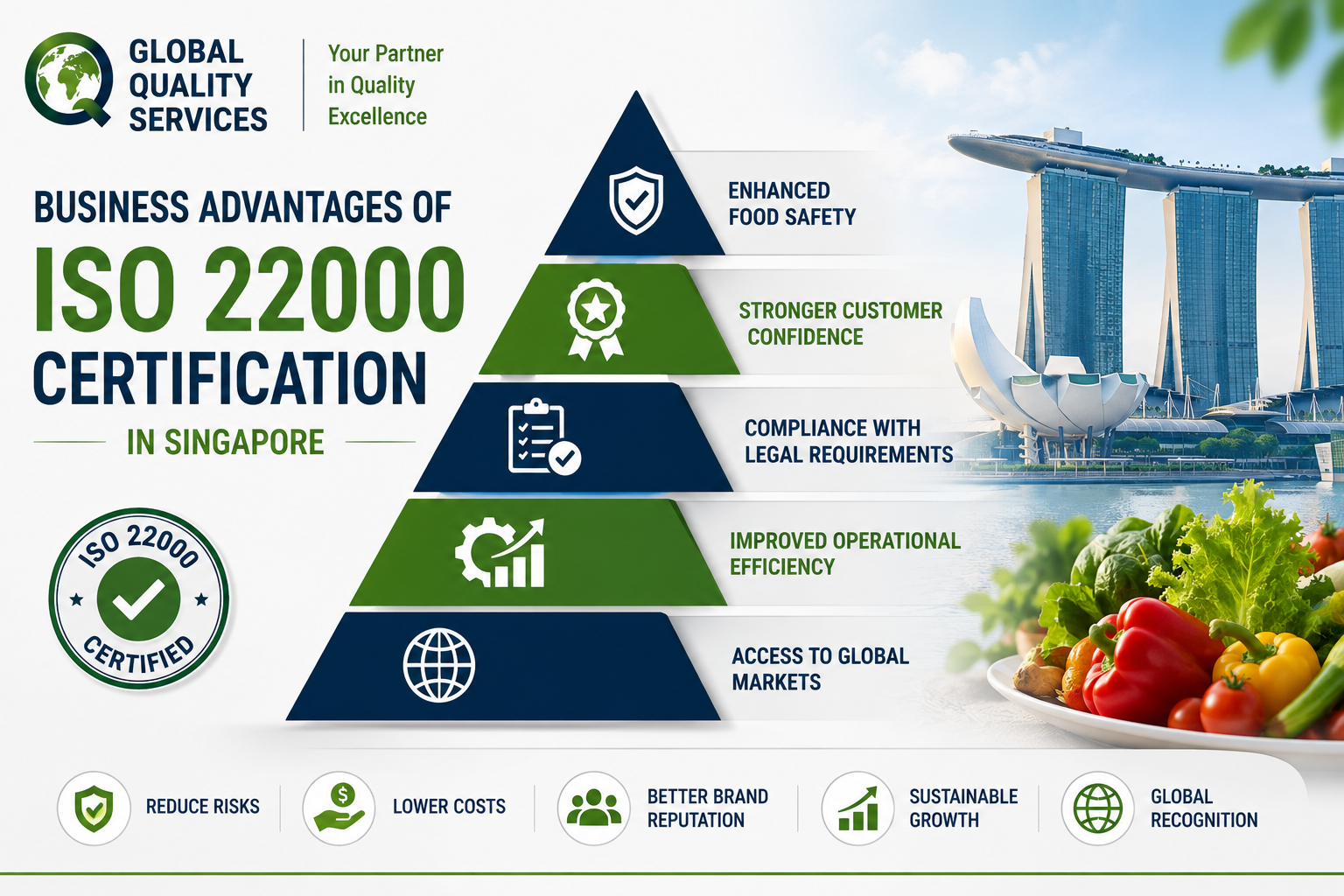
ISO 22000 certification gives Singapore food businesses a documented food safety management system that satisfies buyer requirements, reduces recall risk, and opens access to export markets that mandate certified suppliers.
Market access and buyer requirements
Many retailers, food service groups, and export markets in Singapore and the wider region require ISO 22000 certification before they will approve a supplier. Certification demonstrates that a business has a functioning food safety management system covering hazard analysis, prerequisite programs, and traceability, which removes a common barrier during vendor onboarding and tender evaluation.
Stronger regulatory alignment
ISO 22000 aligns closely with Singapore Food Agency (SFA) licensing expectations and HACCP-based requirements. Businesses that hold certification typically find SFA audits and inspections easier to pass because their documentation, hazard controls, and corrective action records are already structured to a recognized standard.
Reduced risk of contamination and recalls
The standard requires systematic hazard identification across the entire food chain, from raw material sourcing to final delivery. This lowers the likelihood of contamination incidents and product recalls, both of which carry direct financial cost and reputational damage in Singapore’s food industry.
Improved operational consistency
Certified businesses operate with standardized procedures for hygiene, storage, temperature control, and supplier verification. This consistency reduces variation between shifts, sites, and staff, which matters for multi-outlet food businesses and central kitchens operating across Singapore.
Competitive differentiation
ISO 22000 certification signals credibility to B2B buyers, distributors, and institutional clients such as hospitals, schools, and airlines that require verified food safety practices. It positions a certified business ahead of competitors who rely only on baseline SFA licensing.
Foundation for integration with other standards
Because ISO 22000 follows the same high-level structure as ISO 9001 and ISO 14001, businesses already certified to those standards can integrate food safety management with quality and environmental management, reducing duplicate audits and administrative overhead.
What Sets GQS Apart in ISO 22000 Certification Support
Singapore’s food industry is diverse, fast-moving, and heavily scrutinized — and ISO 22000 implementation demands more than a documentation exercise. GQS brings a hands-on, operations-first approach to every engagement:
- Map your existing food safety practices against the full ISO 22000 requirements to identify genuine compliance gaps
- Design and document a tailored FSMS framework including HACCP plans, PRPs, operational PRPs, and emergency response procedures
- Embed food safety controls into your day-to-day operations through practical staff training and process integration support
- Build internal audit capability so your team can sustain compliance independently beyond the initial certification
- Prepare your organization for third-party certification audits through rigorous mock assessments and corrective action support
- Align your FSMS documentation with SFA’s regulatory expectations and the SAFE Framework grading criteria
Singapore’s food industry deserves food safety systems that match its reputation for excellence. Contact GQS today and build an ISO 22000-certified Food Safety Management System your clients, regulators, and consumers can trust.
Frequently Asked Questions
1. How does ISO 22000 differ from Singapore’s existing HACCP certification requirements?
HACCP targets specific hazard control points within production, while ISO 22000 builds a complete management system around those controls, adding leadership accountability, supplier management, and continual improvement structures.
2. Will ISO 22000 certification improve our grading under SFA’s new SAFE Framework?
Yes, a certified and structured FSMS directly supports stronger performance under SAFE Framework assessments, demonstrating systematic food safety management beyond basic compliance.
3. How long does ISO 22000 certification typically take for a Singapore food business?
Most Singapore food businesses complete the certification process within four to eight months, depending on operational complexity and the maturity of existing food safety practices.
4. Can ISO 22000 be integrated with ISO 9001 if we are already certified?
Yes, both standards follow the Harmonized Structure, making integration of documentation, audits, and management reviews straightforward and operationally efficient.
5. Does GQS provide ongoing support after ISO 22000 certification is achieved?
Yes, GQS offers post-certification support including surveillance audit preparation, internal audit assistance, and FSMS review services to ensure sustained compliance over time.