ISO 9001:2026 Certification is the world’s most widely recognized standard for Quality Management Systems (QMS), helping organizations establish structured processes, improve operational efficiency, enhance customer satisfaction, and maintain consistent quality across products and services.
Issued by the International Organization for Standardization (ISO), ISO 9001:2026 certification will apply to organizations of all sizes and industries. Whether you are a manufacturing company, service provider, IT firm, healthcare organisation, or government entity, ISO 9001 certification demonstrates your commitment to quality, process control, and continual improvement.
What Is ISO 9001:2026 Certification?
ISO 9001:2026 is an internationally accepted standard that defines the requirements for a Quality Management System. It focuses on meeting customer expectations, complying with regulatory requirements, and improving internal processes through a risk-based approach.
The 2015 revision introduced a stronger emphasis on:
-
Leadership involvement
-
Risk-based thinking
-
Process consistency
-
Data-driven decision-making
-
Continuous improvement
ISO 9001 certification confirms that an organization has implemented a documented, auditable, and effective quality framework aligned with global best practices.
Why ISO 9001:2026 Certification Is Important
ISO 9001 certification is not just a compliance requirement, it is a business improvement tool. Organizations that implement ISO 9001 correctly see measurable gains in efficiency, reliability, and customer confidence.
Key reasons businesses pursue ISO 9001 certification include:
-
Improved operational control and reduced errors
-
Higher customer satisfaction and repeat business
-
Better supplier and stakeholder confidence
-
Eligibility for government tenders and global contracts
-
Stronger internal accountability and performance tracking
Many international buyers and corporate clients require ISO 9001 certification as a baseline qualification before engaging with vendors.
Who Should Get ISO 9001:2026 Certification?
ISO 9001:2026 certification is suitable for organizations across all sectors, including:
-
Manufacturing and production units
-
IT, software, and SaaS companies
-
Healthcare and medical service providers
-
Construction and engineering firms
-
Educational institutions
-
Logistics and supply chain companies
-
Financial and professional service firms
-
Government bodies and public sector organizations
The standard is scalable and flexible, making it equally relevant for startups, SMEs, and large enterprises.
What ISO 9001:2026 Will Actually Require
The requirements of ISO 9001:2026 are built around seven interconnected themes:
Understanding Your Business Environment
Your QMS will need to be grounded in a clear understanding of what affects your ability to deliver market conditions, regulatory pressures, organisational capabilities, and from 2026 onwards, climate-related factors that could disrupt your operations or supply chain.
Leadership That Means Something
The 2026 version will raise the bar on leadership commitment. It will not be enough for top management to approve a quality policy. Leaders will need to demonstrably shape and sustain a quality culture one where expectations are clear, behaviours are consistent, and accountability is real.
Doing the Right Thing Formally
Ethical behaviour will become a documented requirement for the first time. Organisations will need to articulate what ethical conduct looks like in their context and show evidence that it is embedded in how they operate.
Risk Management With Teeth
Risk-based thinking has been part of ISO 9001 since 2015, but the 2026 version will sharpen the requirements making it clearer how risks and opportunities must be identified, prioritised, and addressed within the QMS.
Processes That Deliver Consistently
Defined, documented, and controlled processes will remain at the heart of the standard ensuring that quality outcomes do not depend on which person happens to be doing the job on a given day.
Evidence-Based Decision Making
Organisations will need to measure what matters, analyse what the data tells them, and use those insights to drive decisions at both the operational and leadership level.
A System That Gets Better Over Time
ISO 9001:2026 will require genuine continual improvement not a box-ticking exercise, but a systematic approach to identifying gaps, taking corrective action, and raising performance year on year.
What to Expect when transitioning from ISO 9001:2015 to ISO 9001:2026
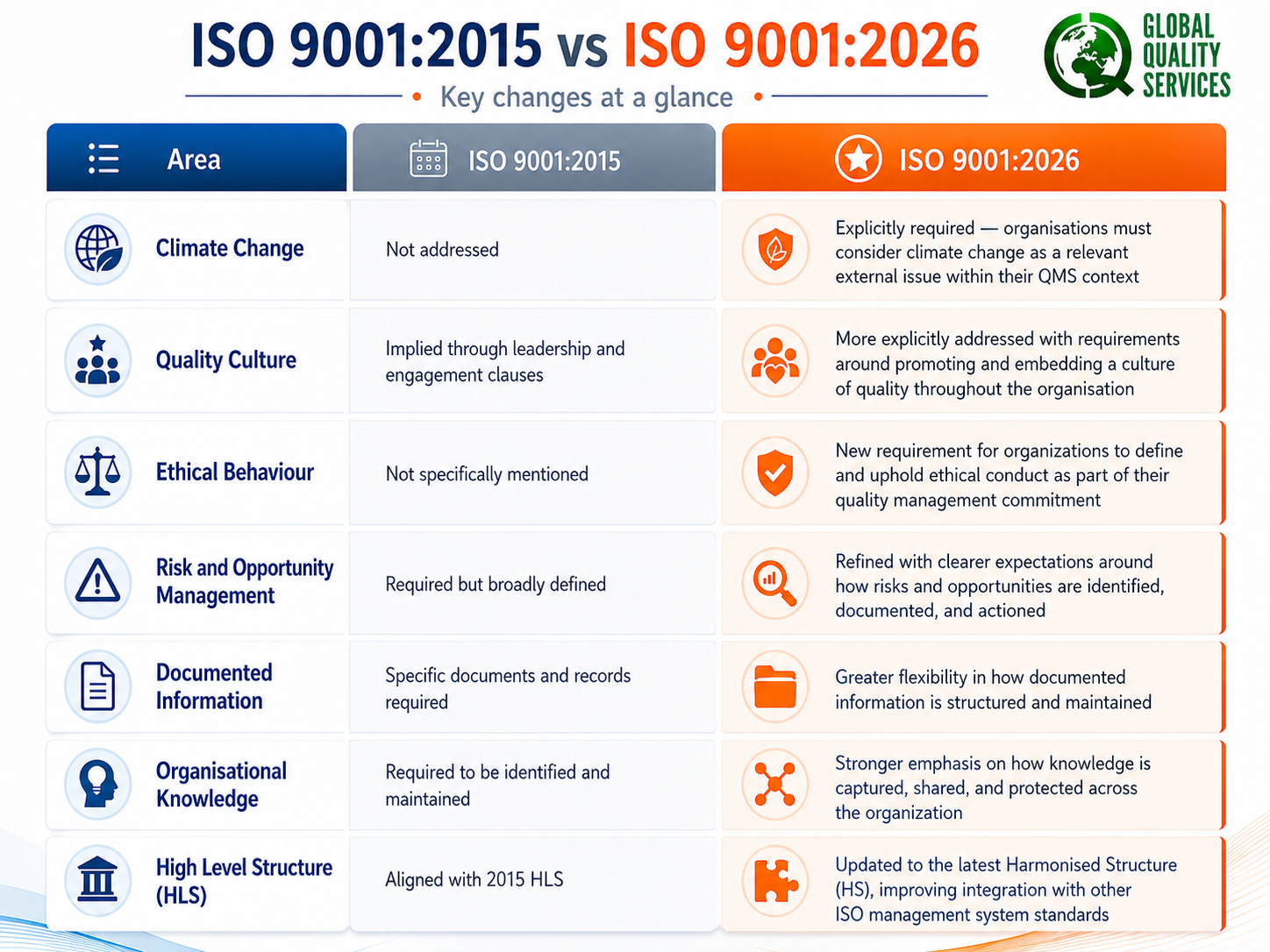
Think of ISO 9001:2026 less as a new standard and more as a matured one. The foundation your organisation built under the 2015 version will still stand the process approach, the PDCA cycle, the risk-based mindset. What the 2026 version will do is push organisations to go deeper, be more explicit, and address realities that the 2015 version left largely unspoken.
Here is what the transition will actually involve:
Bringing Climate Into the Room
The 2015 version asked organisations to understand their external context. The 2026 version will explicitly name climate change as something the context must account for. Singapore businesses will need to ask honestly whether shifting weather patterns, tightening environmental regulations, or climate-driven supply disruptions could affect their ability to deliver quality. For many, the answer will be yes, and the QMS will need to reflect that.
From Quality Policy to Quality Culture
Having a quality policy pinned to the notice board will no longer be sufficient. ISO 9001:2026 will draw a clear line between organisations where quality is a stated intention and those where it is a lived reality. Leaders will be accountable not just for signing off on objectives but for actively shaping the behaviours, attitudes, and norms that determine whether quality actually happens day to day.
Putting Ethics on the Record
This is entirely new territory for ISO 9001. The 2026 version will require organisations to articulate their ethical standards and more importantly, to demonstrate that those standards influence real decisions. For Singapore businesses operating in regulated industries or managing complex stakeholder relationships, this will mean formalising what many already practice informally.
Risk Management Gets More Precise
Risk-based thinking has been part of ISO 9001 since 2015, but organisations have interpreted and applied it with varying degrees of rigour. The 2026 version will close that gap. Expectations around how risks are evaluated, prioritised, and linked to specific actions within the QMS will be tighter, leaving less room for vague registers that satisfy auditors but do little else.
Knowledge as a Managed Asset
The 2026 version will treat organisational knowledge with greater seriousness recognising that in knowledge-intensive economies like Singapore, the expertise, institutional memory, and operational know-how held within a workforce is itself a quality-critical resource. Organisations will need to show how that knowledge is documented, transferred, and protected against loss.
A Structure Built for Integration
The shift from the 2015 High Level Structure to the updated Harmonised Structure will make it considerably easier to run ISO 9001:2026 alongside ISO 14001, ISO 45001, and ISO 27001 within a single integrated management system reducing duplication, simplifying audits, and lowering the overall cost of multi-standard compliance.
The honest reality of the transition is this organisations that treated ISO 9001:2015 as a genuine management tool will adapt with relatively little friction. Those that treated it as a documentation exercise will find ISO 9001:2026 asks questions their current system simply cannot answer.
How GQS Supports ISO 9001:2026 Certification in Singapore
We do not hand you a documentation template and leave you to figure it out. Our consultants work alongside your team through every stage from the first gap assessment to the moment the certificate lands.
Stage 1: Where Are You Now?
We conduct a detailed gap analysis against ISO 9001:2026 requirements, mapping what your organisation already does well against what will need to change. The output is a practical action plan not a generic report.
Stage 2: Building the Right Foundations
We define your certification scope with precision, establish quality objectives that connect to real business goals, and develop documentation that reflects how your organisation actually operates not how an ISO textbook says it should.
Stage 3: Making It Real
We train your teams, embed the processes, and make sure that what is documented is what is actually happening on the floor, in the office, and across your supply chain.
Stage 4: Testing Before It Counts
Our internal audit goes deep. We audit against ISO 9001:2026 not 2015 and close every non-conformance before an external auditor sees it.
Stage 5: Through the Certification Audit
We coordinate with your chosen SAC-accredited certification body, support you through Stage 1 and Stage 2 audits, and make sure there are no surprises.
Stage 6: Keeping It
Certification is a three-year cycle. We stay with you through surveillance audits, system reviews, and continual improvement so your QMS remains a living system, not a filing cabinet.
The Transition Mandates to Watch Out For ISO 9001:2015 to ISO 9001:2026
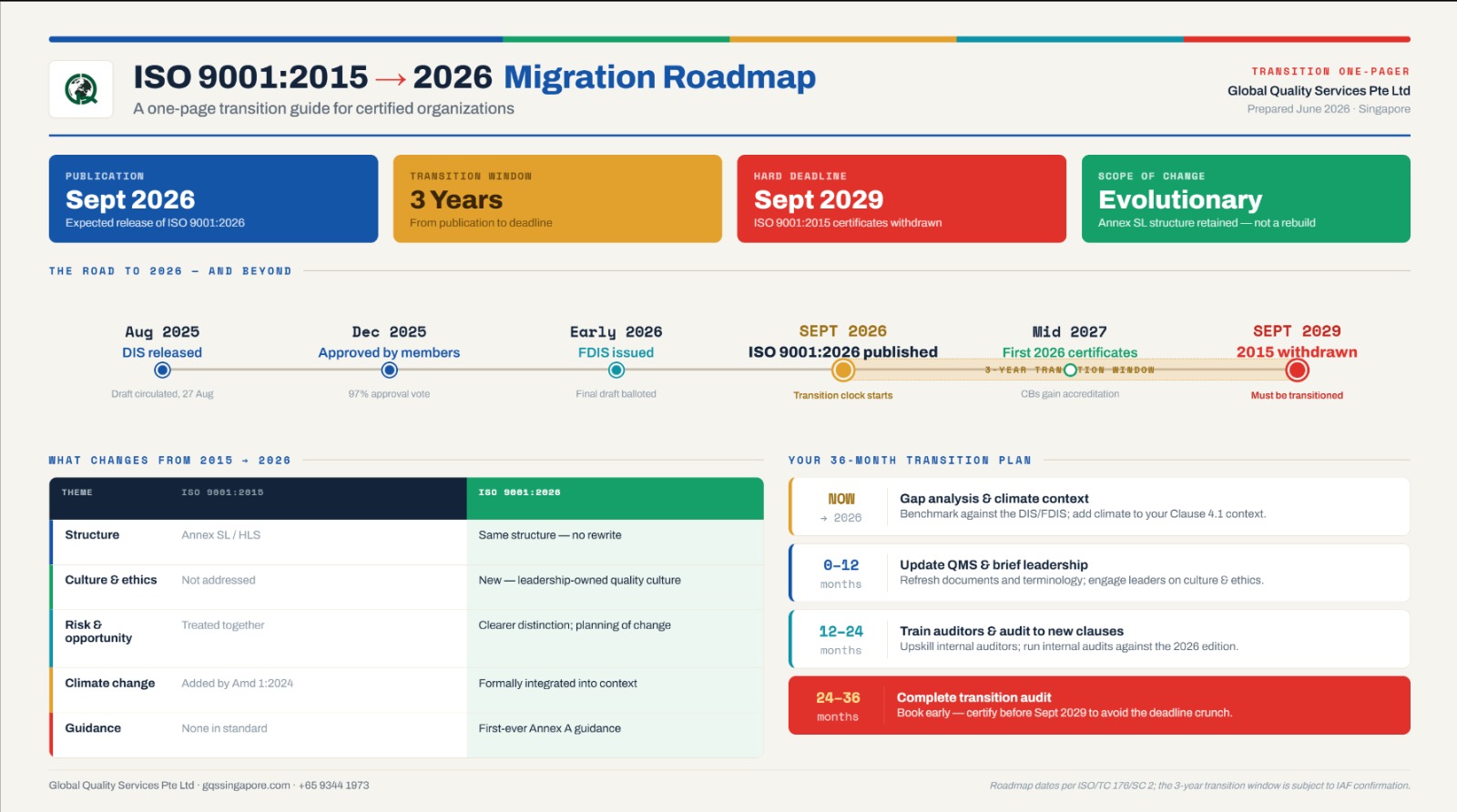
ISO 9001:2026 will be published in September 2026. The International Accreditation Forum (IAF) will confirm a three-year transition window closing approximately September 2029. Every ISO 9001:2015-certified organization in Singapore will need to complete migration before that date or face certification lapse.
Three years feels like a long runway. It will not be.
Months 0–12: Diagnose and Redesign
Gap analysis must be completed including the new climate change context and ethical behaviour requirements. QMS documentation will need to be revised, and leadership training will need to be delivered. Organisations that skip this phase will pay for it later.
Months 12–24: Embed and Audit
Updated processes will need to be operational and internally audited against ISO 9001:2026 not the 2015 version. Non-conformances must be closed before progressing to the transition audit. Supply chain alignment may also be required during this phase.
Months 24–36: Certify and Close
This will be the final window for formal transition audits. Certification bodies will be managing high volumes of transition clients simultaneously. Organisations that arrive late will face limited audit availability, compressed timelines, and heightened risk of non-conformance findings they do not have time to close.
Do Not Let the Deadline Make Your Decisions for You
The organisations that will transition smoothly are the ones that treat this as a business project not a compliance deadline. They will start early, plan properly, and arrive at their transition audit prepared.
The ones that wait will find themselves making rushed decisions, cutting corners on documentation, and hoping their certification body has an available slot before September 2029.
GQS exists to make sure you are in the first group not the second.
Our ISO 9001:2026 transition programme for Singapore organisations is structured, sector-aware, and built around your timeline not a generic template. We have navigated multiple ISO revision cycles with clients across Singapore’s key industries, and we know exactly what the transition will demand.
Talk to GQS today and start your ISO 9001:2026 transition on your terms, not the deadline’s.
Migration Process from ISO 9001:2015 to ISO 9001:2026 in Singapore
Singapore’s competitive business environment demands that companies stay ahead of global quality benchmarks. As ISO 9001:2015 nears the end of its validity period, enterprises across Singapore must now adopt ISO 9001:2026 to demonstrate their commitment to excellence. GQS provides end-to-end ISO 9001:2026 migration consulting designed specifically for Singapore’s diverse industries including logistics, finance, and technology sectors.
- Strengthen your quality management foundation to meet evolving international benchmarks relevant to Singapore’s export-driven economy
- Work alongside a certified ISO 9001:2026 consultant who brings hands-on experience with Singapore-based businesses across multiple sectors
- Seamlessly transition your existing QMS documentation, processes, and controls with zero disruption to daily operations
- Secure your ISO 9001:2026 transfer certification through a proven methodology backed by deep ISO 9001:2026 consultancy expertise
Take the next step toward quality excellence reach out to GQS and begin your migration to 2026 version today.
Global Quality Services offers practical, end-to-end support for ISO 9001:2026 certification with more than 26 years of experience, focusing on building a Quality Management System that aligns with your actual business operations. Our approach emphasizes clear documentation, realistic implementation, and audit readiness without unnecessary complexity. With experienced ISO consultants and a structured certification roadmap, we help organizations achieve certification efficiently while ensuring the system remains effective, maintainable, and compliant over the long term.
ISO 9001:2026 Certification FAQs
1. Singapore already has strong regulatory frameworks does ISO 9001:2026 add anything beyond what compliance already requires?
Regulatory compliance tells the market you meet the minimum. ISO 9001:2026 certification tells the market you have built a system designed to consistently exceed it. Singapore’s regulatory environment governed by bodies like Enterprise Singapore and the Singapore Business Federation sets the floor. ISO 9001:2026 raises you above it. For organisations competing for enterprise contracts, government tenders, or international partnerships, that distinction will matter considerably.
2. We operate across multiple locations in Singapore will one certification cover all of them?
It depends on how the certification scope is defined. A multi-site organisation can achieve a single ISO 9001:2026 certificate that covers all locations, provided the QMS is consistently implemented and auditable across each site. During the scoping stage, GQS will assess your operational structure and recommend the most practical and commercially advantageous approach whether that is a unified scope, phased rollout, or site-specific certifications.
3. Our industry moves fast will maintaining ISO 9001:2026 slow us down?
A well-implemented QMS should accelerate your operations, not burden them. The organisations that find ISO 9001 cumbersome are typically those that built their system around documentation rather than actual process improvement. ISO 9001:2026 will place even greater emphasis on practical effectiveness over paperwork meaning a properly designed system will integrate into how your teams already work rather than creating a parallel compliance layer alongside it.
4. How will ISO 9001:2026 certification affect how we work with suppliers and subcontractors?
ISO 9001:2026 will require organisations to manage the quality of externally provided products and services meaning your QMS will need to address how suppliers and subcontractors are selected, evaluated, and monitored. For Singapore organisations operating regional supply chains, this is particularly relevant. The upside is that a structured supplier management process under ISO 9001:2026 will reduce delivery risk, improve consistency, and give you documented evidence of due diligence that clients and regulators will value.
5. What happens if our organisation misses the ISO 9001:2026 transition deadline?
If your organisation does not complete the transition before the IAF deadline expected around September 2029 your ISO 9001:2015 certificate will no longer be recognised as valid. This will affect your standing in procurement databases, your eligibility for tenders that require current ISO 9001 certification, and your credibility with clients who rely on your certification as part of their own supplier qualification process. Reinstatement after a lapse is possible but significantly more disruptive and costly than a planned, timely transition.