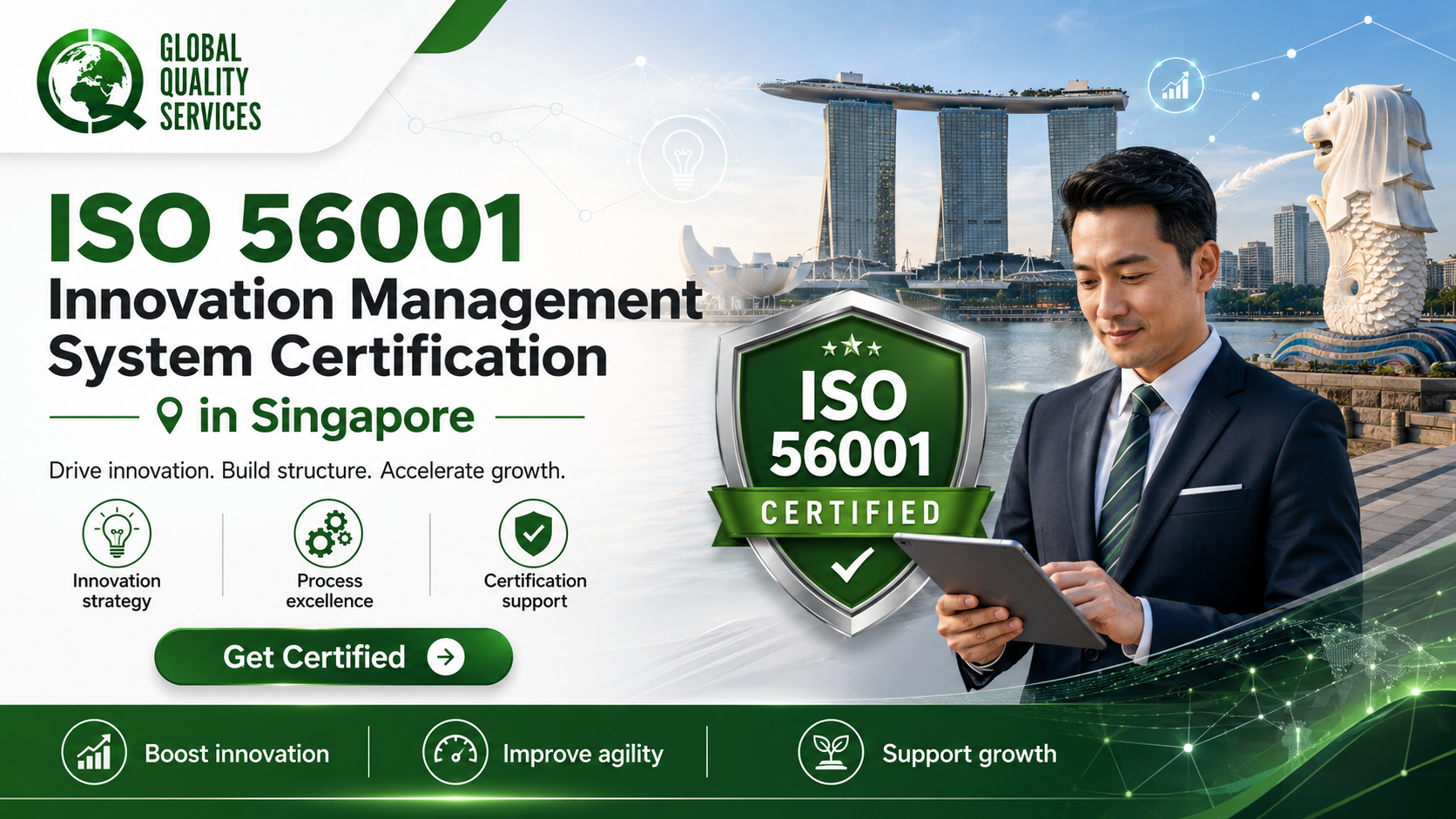
Does your organisation innovate — but without a structured, repeatable system behind it? Most businesses in Singapore rely on individuals to drive innovation rather than building it into the organisation itself. ISO 56001 certification changes that. GQS Singapore helps organisations across all sectors implement and get certified to ISO 56001 — turning innovation from a happy accident into a managed, measurable, and repeatable capability.
What Is ISO 56001?
ISO 56001 is the world’s first international standard for Innovation Management Systems (IMS). It outlines requirements for organisations to systematically manage innovation activities, ensuring consistent value creation and enhanced innovation performance.
In simple terms — ISO 56001 gives your organisation a structured framework to find, evaluate, develop, and deliver innovative ideas consistently — whether those ideas relate to new products, services, processes, or business models. It takes innovation out of the realm of luck and puts it under managed, measurable control.
The 2024 release introduces rigorous structures for managing innovation governance, risk, measurement, and continual improvement — making it the world’s most comprehensive management system for innovation excellence.
ISO 56001 is part of the broader ISO 56000 family of innovation management standards. ISO 56002 provides guidance; ISO 56001 contains the formal, certifiable requirements. It follows the same Plan-Do-Check-Act structure and Annex SL high-level structure as ISO 9001, ISO 14001, and ISO 27001 — making it straightforward to integrate with management systems your organisation already holds.
The official standard is published by the International Organization for Standardization (ISO) and adopted in Singapore through Enterprise Singapore as the national standards body.
Why Does ISO 56001 Matter in Singapore?
Innovation is a national strategic priority in Singapore — and ISO 56001 is the framework that turns that priority into a certified, verifiable organisational capability.
Singapore’s Research, Innovation and Enterprise 2025 Plan (RIE2025) — Singapore has invested S$25 billion — or 1 per cent of its GDP — in research, innovation, and enterprise across four domains: manufacturing, trade and connectivity; human health and potential; urban solutions and sustainability; and Smart Nation and digital economy. ISO 56001 provides the management system that allows your organisation to participate meaningfully in this national agenda and demonstrate structured innovation capability to government partners and investors. Wikipedia
Enterprise Singapore actively supports innovation capability development. The Enterprise Development Grant (EDG), administered by Enterprise Singapore, supports projects under its Innovation and Productivity pillar — covering process redesign, automation, and product development. ISO 56001 certification consultancy costs may qualify under the EDG’s standards adoption support category, making certification more affordable for Singapore-registered companies.
It gives your innovation a competitive edge. In a market where businesses compete for the same talent, clients, and government contracts, ISO 56001 certification signals clearly that your organisation innovates in a structured, reliable, and internationally recognised way — not just when someone has a good idea.
It reduces innovation risk. Most innovation initiatives fail not because the idea was bad but because the process around it was weak. A systems approach can reduce the level of uncertainty and increase the feasibility of achieving desired results from your innovation initiatives.
It attracts investors and partners. Innovation is one of the top criteria investors and global partners assess when evaluating Singapore companies. ISO 56001 certification provides documented, third-party verified evidence of your organisation’s innovation maturity.
It integrates with your existing certifications. ISO 56001 certification can be integrated with existing systems such as ISO 9001, ISO 14001, or ISO 27001, enabling a more joined-up and efficient approach to management. GQS Singapore delivers all of these and runs them together with ISO 56001 in integrated programmes.
Who Needs ISO 56001 Certification in Singapore?
ISO 56001 applies to any organisation of any size or sector that wants to manage innovation systematically. It is particularly valuable for:
Technology and digital companies building new products or platforms who need to demonstrate to clients and investors that their innovation pipeline is structured, governed, and reliably productive.
Manufacturing companies pursuing Industry 4.0 transformation, new product development, or process innovation — pairs naturally with our ISO 9001 Quality Management certification and ISO 13485 Medical Device certification.
Life sciences and pharmaceutical organisations conducting R&D and commercialising new therapies, medical devices, or health technologies — where structured innovation management directly supports regulatory submissions and investor confidence.
Professional services and consulting firms that sell innovation capability to clients and need certified evidence of their own innovation management maturity.
Government-linked companies and statutory boards expected to demonstrate innovation governance as part of their public accountability and national development mandate.
SMEs scaling up that want to embed repeatable innovation processes before rapid growth makes ad-hoc approaches unmanageable. ISO 56001 is scalable and suitable for startups, SMEs, and large organisations. Singapore Food Agency
Any organisation applying for government innovation grants — a certified Innovation Management System strengthens your application credibility significantly with Enterprise Singapore and the National Research Foundation (NRF).
What ISO 56001 Requires — The Key Elements
ISO 56001 covers every part of your organisation that influences how innovation is initiated, managed, evaluated, and delivered. Here are the core requirements in plain language:
- Organisational Context — Understanding the internal and external factors that affect your organisation’s ability to innovate — including market forces, stakeholder expectations, and your current innovation culture and capability.
- Leadership and Innovation Culture — Senior management must visibly commit to innovation — setting strategic direction, allocating resources, defining an innovation vision, and actively promoting a culture where new ideas are encouraged, explored, and rewarded.
- Innovation Strategy — A documented innovation strategy aligned with your broader organisational strategy — defining what kinds of innovation your organisation pursues, where you focus your innovation efforts, and how innovation contributes to your strategic objectives.
- Innovation Portfolio Management — A structured approach to managing your pipeline of innovation initiatives — evaluating ideas, selecting the most promising ones, allocating resources across early-stage and mature projects, and balancing risk across the portfolio.
- People and Collaboration — Defining the skills, roles, and behaviours needed to support innovation — and putting systems in place to develop, attract, and retain innovative talent. Collaboration with external partners, customers, and ecosystems is also addressed here.
- Innovation Processes — Defined, repeatable processes for generating insights, creating concepts, validating ideas, developing solutions, and deploying innovations to market — from idea to value realisation.
- Risk and Opportunity Management — A structured approach to identifying, assessing, and managing the risks inherent in innovation — including technology risk, market risk, and execution risk — while systematically capturing and pursuing the opportunities that innovation creates.
- Measurement and Evaluation — Defined innovation metrics — covering inputs, processes, outputs, and outcomes — that allow your organisation to track whether its innovation system is working and continuously improving.
- Internal Audit and Management Review — Regular internal audits of the IMS to verify that processes are working in practice, and structured management reviews to drive strategic decisions about your innovation programme.
- Continual Improvement — ISO 56001 requires ongoing improvement of the innovation management system itself — not just the innovations it produces.
How GQS Singapore Gets You ISO 56001 Certified — Step by Step
Step 1 — Innovation Readiness Assessment
We assess your current innovation practices, culture, processes, and documentation against ISO 56001 requirements. You receive a clear, honest picture of your innovation maturity and a prioritised action plan for what needs to be built or strengthened.
Step 2 — Innovation Strategy and Context Definition
We work with your leadership team to document your organisational context for innovation — your strategic intent, the types of innovation you pursue, your key stakeholders, and the internal and external factors that shape your innovation environment.
Step 3 — Innovation Management System Design
We design your complete IMS — innovation policy, strategy document, portfolio management framework, innovation process map, collaboration model, metrics framework, and governance structure — tailored to your organisation’s size, sector, and strategic priorities.
Step 4 — Documentation Development
We develop all required documentation — innovation policy, procedures, process guides, portfolio records, risk registers, and management review templates — ensuring your system is complete, practical, and audit-ready.
Step 5 — Staff Training and Culture Development
We train your innovation champions, team leaders, and management on ISO 56001 requirements, innovation process tools, and their individual roles in maintaining the IMS. We also train your internal auditors. Building genuine innovation culture — not just documented processes — is central to this step.
Step 6 — Internal Audit
We conduct a full internal audit of your IMS before the certification audit — identifying and closing any remaining gaps so you approach your Stage 1 and Stage 2 certification audits with complete confidence.
Step 7 — Certification Audit Support
We prepare your team and documentation for the certification assessment — briefing leadership, organising evidence, and supporting professional responses to auditor observations throughout the process.
Step 8 — Post-Certification Support
ISO 56001 requires annual surveillance audits and a three-year recertification cycle. GQS Singapore provides ongoing support — metrics review, portfolio governance, internal audits, and IMS updates as your organisation grows — keeping your certification active and your innovation capability genuinely improving.
Ready to certify your innovation capability in Singapore? Global Quality Services (GQS) Singapore makes innovation management certification straightforward for businesses of all sizes. Whether you are building your innovation system from scratch or formalising what already exists, our team guides you every step of the way.
Frequently Asked Questions
1. What is ISO 56001 and why does my Singapore business need it?
ISO 56001 is the international standard for Innovation Management Systems. It gives your organisation a structured, certifiable framework to manage innovation consistently — reducing the risk of failed initiatives and demonstrating to clients, investors, and government partners that your innovation capability is real, governed, and verifiable.
2. Is ISO 56001 only for large companies?
No. ISO 56001 is designed for organisations of any size and any sector. GQS Singapore tailors the implementation to your scale — a lean IMS for an SME looks very different from an enterprise-wide innovation governance programme, and both are valid and certifiable.
3. How is ISO 56001 different from ISO 56002?
ISO 56002 is a guidance document — it gives recommendations and good practices but is not certifiable. ISO 56001 contains formal requirements that can be independently audited and certified by a third-party certification body. If your organisation needs a certifiable credential, ISO 56001 is the right standard.
4. How long does ISO 56001 certification take with GQS Singapore?
Most organisations complete the process — from readiness assessment to certification audit — in 4 to 6 months. Organisations with existing innovation processes and documentation already in place can move faster. GQS Singapore provides a realistic timeline after the initial assessment.
5. Can ISO 56001 be combined with ISO 9001 or ISO 27001 certification?
Yes — and this is one of our most efficient integrated programme offerings. ISO 56001, ISO 9001, and ISO 27001 all follow the same Annex SL high-level structure. Running them together in a single integrated management system engagement saves significant time, reduces duplication, and lowers total certification cost.