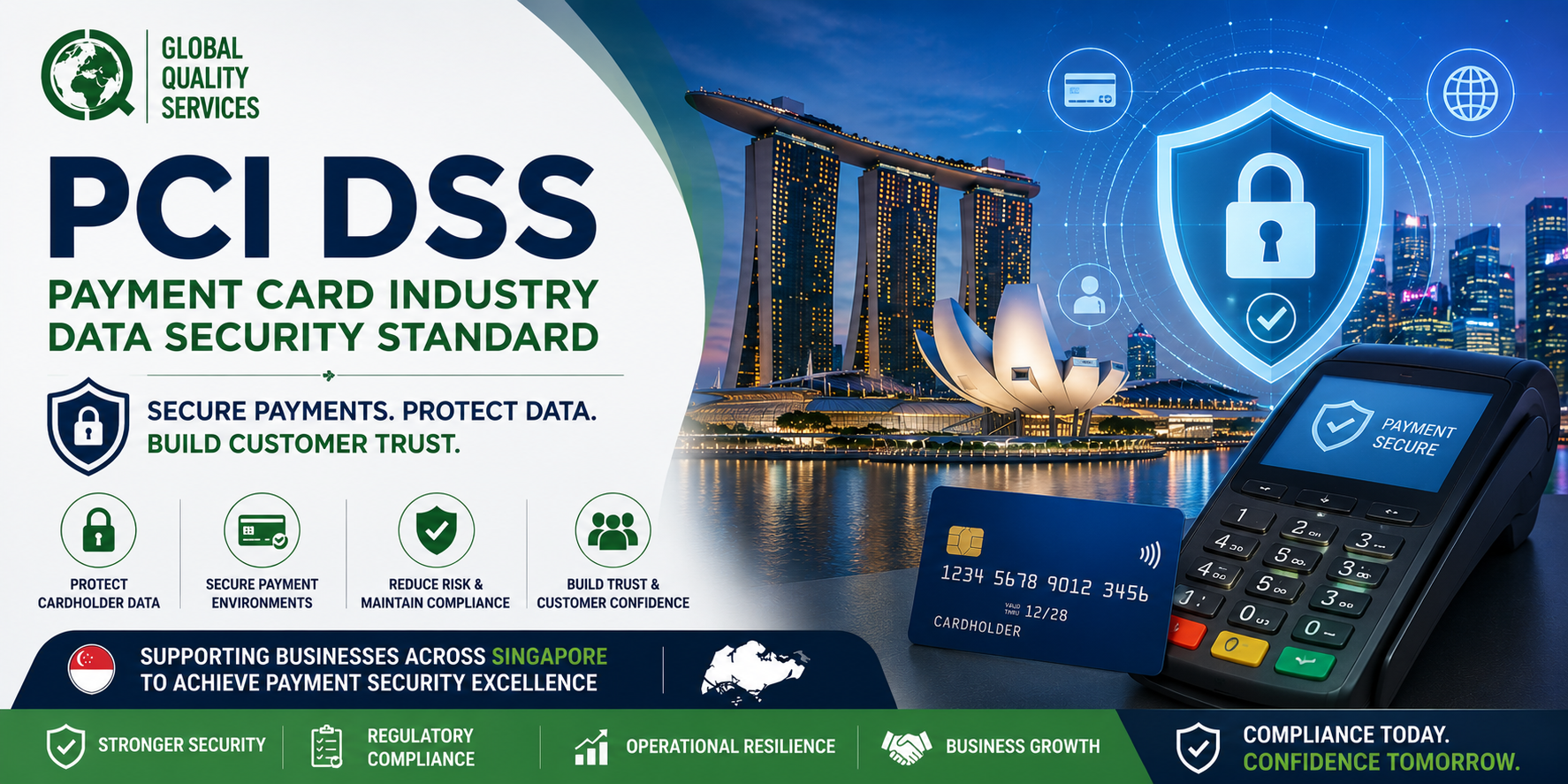
Protecting payment card data is no longer just an IT concern—it is a business requirement. As organizations process more card transactions across websites, mobile apps, POS terminals, and third-party payment gateways, the exposure to fraud, data theft, and compliance violations increases. Even one weak point—an unpatched server, misconfigured access controls, or poor internal procedures—can compromise the entire payment environment.
PCI DSS compliance is the global security baseline created to reduce these risks. It provides clear technical and operational requirements for securing systems that store, process, or transmit cardholder data. Meeting PCI DSS requirements helps organizations reduce the likelihood of breaches, demonstrate security maturity to stakeholders, and operate more confidently in today’s transaction-driven economy.
What Is PCI DSS Compliance?
PCI DSS (Payment Card Industry Data Security Standard) is a set of security standards developed by the Payment Card Industry Security Standards Council (PCI SSC). These standards are designed to protect cardholder data and sensitive authentication data wherever it is stored, processed, or transmitted.
A key concept in PCI DSS is the Cardholder Data Environment (CDE)—the people, processes, and technologies that store, process, or transmit cardholder data, plus any connected systems that could impact its security. The goal of PCI DSS is not simply “passing an audit.” It is ensuring that the organization operates a secure payment environment with verifiable controls. The scale of payment card risk is not abstract. These figures from authoritative sources show what is at stake for organizations handling cardholder data.
- The global average cost of a data breach is $4.44 million, rising to $10.22 million in the United States, with a mean detection time of 241 days. For organizations in scope for PCI DSS, a breach in the Cardholder Data Environment carries additional card scheme fines and forensic investigation costs on top of that baseline.
- All 51 future-dated PCI DSS v4.0 requirements became mandatory on March 31, 2025 and are now fully in force. Organizations that validated against v3.2.1, which retired on March 31, 2024, must now assess against v4.0.1. Penalties for non-compliance can reach $100,000 per month until compliance is achieved.
- PCI DSS v4.0 represents the most significant update to the standard in over a decade, dramatically expanding its scope with new requirements designed to address phishing, web skimming, and supply chain risks.
PCI DSS is a global security standard that any business storing, processing, or transmitting payment card data must follow. In Singapore, compliance is enforced by acquiring banks, card networks (Visa, Mastercard, Amex, JCB, Discover), and payment processors — not by a single government law — and the current version, PCI DSS v4.0.1, has been fully mandatory since March 31, 2025.
Benefits of PCI DSS Compliance
PCI DSS compliance reduces breach risk, avoids processor penalties, and gives Singapore businesses a documented security baseline that banks, acquirers, and enterprise customers increasingly require before they’ll process your transactions.
Lower Breach Exposure
PCI DSS Requirement 3 (protect stored cardholder data) and Requirement 4 (encrypt transmission across open networks) directly target the two failure points most breach investigations trace a compromise back to: unencrypted card data sitting in a database, and card data intercepted in transit. Layering in Requirement 1’s network segmentation shrinks the blast radius further — a compromised web server outside the cardholder data environment can no longer reach systems that store card numbers.
Fewer Penalties and Fees
Non-compliance isn’t enforced by a Singapore court — it’s enforced by your acquiring bank and the card networks through your merchant agreement. Consequences can include monthly non-compliance fines levied by the acquirer (commonly in the range of a few hundred to a few thousand dollars per month until remediated), higher per-transaction interchange or processing rates, and in serious or repeated cases, suspension of your ability to accept card payments altogether.
Faster Bank and Enterprise Onboarding
Singapore acquiring banks increasingly ask new merchants to confirm their PCI DSS level and compliance status as part of onboarding, particularly for e-commerce and card-not-present businesses, which carry higher fraud risk than in-person transactions. The same applies on the B2B side: enterprise customers and platform partners running vendor security reviews frequently list PCI DSS compliance as a gating requirement before they’ll integrate your payment flow or share transaction data.
A Structured Security Baseline
Without a common framework, security decisions tend to happen ad hoc — one team encrypts a database, another doesn’t; one system gets patched promptly, another gets missed. PCI DSS’s 12 requirements give every team touching payment data — engineering, IT operations, customer support, and third-party vendors — the same reference point for what “secure” means in your environment.
Reduced Fraud and Chargeback Losses
The fraud losses MAS and SPF report — an average of S$2.1 million a year in credit card fraud alone between 2021 and 2023, plus a further S$1.2 million lost to phished card credentials in just Q4 2024 — trace back to exactly the control gaps PCI DSS closes: weak authentication, unmonitored access, and insufficient logging that lets fraudulent activity go undetected.
The PCI DSS Compliance Process
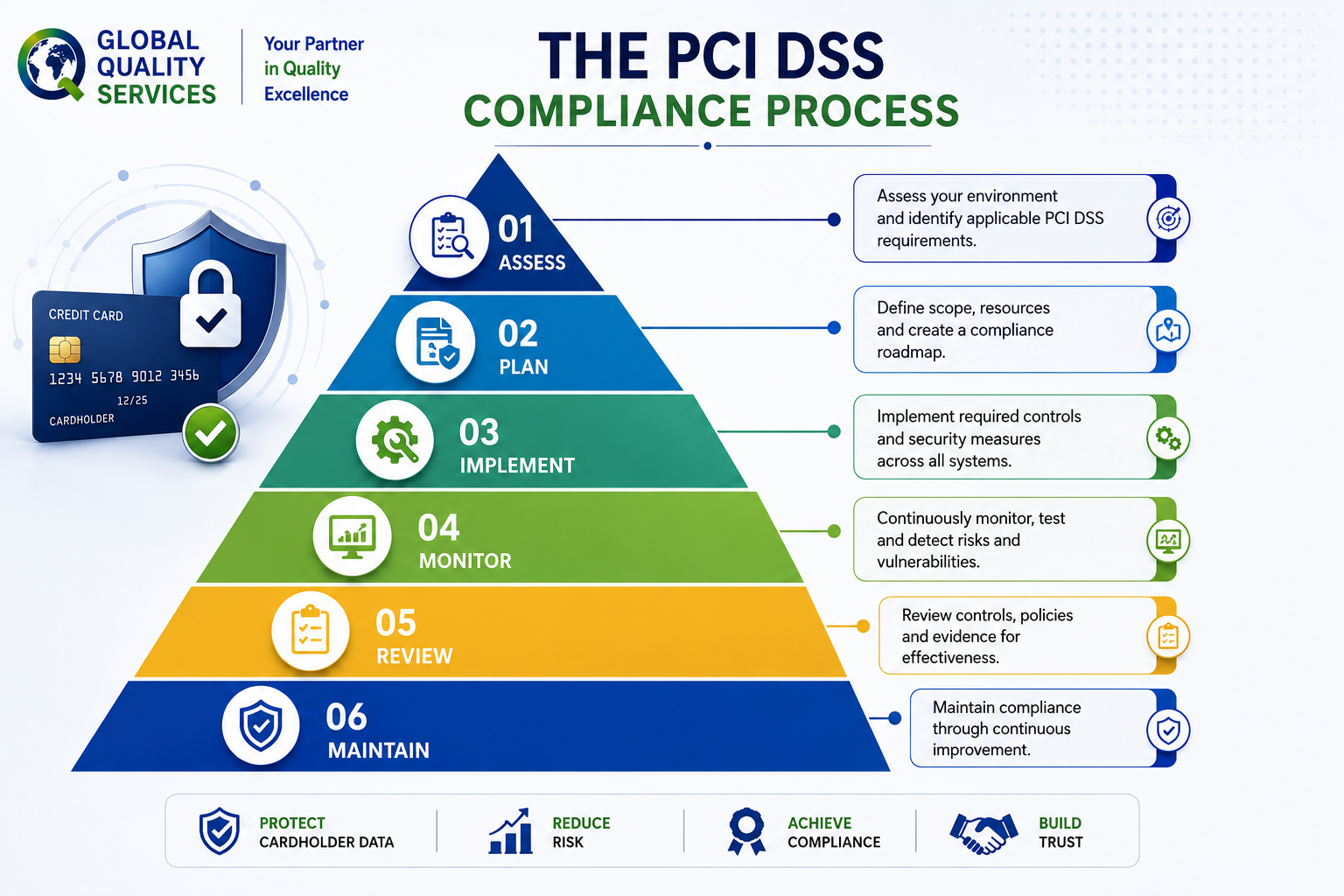
PCI DSS compliance follows five stages: scope the cardholder data environment, assess gaps, remediate, validate through an SAQ or QSA assessment, and maintain compliance continuously.
- Define scope and map card data flows. Identify every point card data is collected — checkout pages, POS terminals, call centers, invoicing — and map how it moves through your networks, applications, and vendors. Incorrect scoping is the single most common reason Singapore businesses fail their first PCI assessment.
- Run a gap assessment. Compare current controls — network segmentation, access management, encryption, logging, patching — against the applicable PCI DSS requirements for your merchant or service provider level.
- Remediate. Harden systems, tighten access controls, encrypt card data in transit and at rest, and centralize logging based on the gap assessment’s findings.
- Validate compliance. Depending on your transaction volume and level, this means completing a Self-Assessment Questionnaire (SAQ), undergoing a Qualified Security Assessor (QSA) audit, or arranging quarterly scans through an Approved Scanning Vendor (ASV).
- Maintain compliance. PCI DSS is not a one-time certificate. Ongoing vulnerability scanning, access reviews, and periodic reassessments are required to remain compliant as systems and vendors evolve.
PCI DSS 4.0 Readiness Checklist
PCI DSS v4.0.1 is the current active version of the standard. All 51 future-dated requirements introduced in v4.0 became mandatory on March 31, 2025 and are now enforceable in every assessment. This checklist covers the requirements that organizations most commonly leave unresolved during GQS readiness assessments. Use it as a starting point to identify gaps before a formal assessment begins.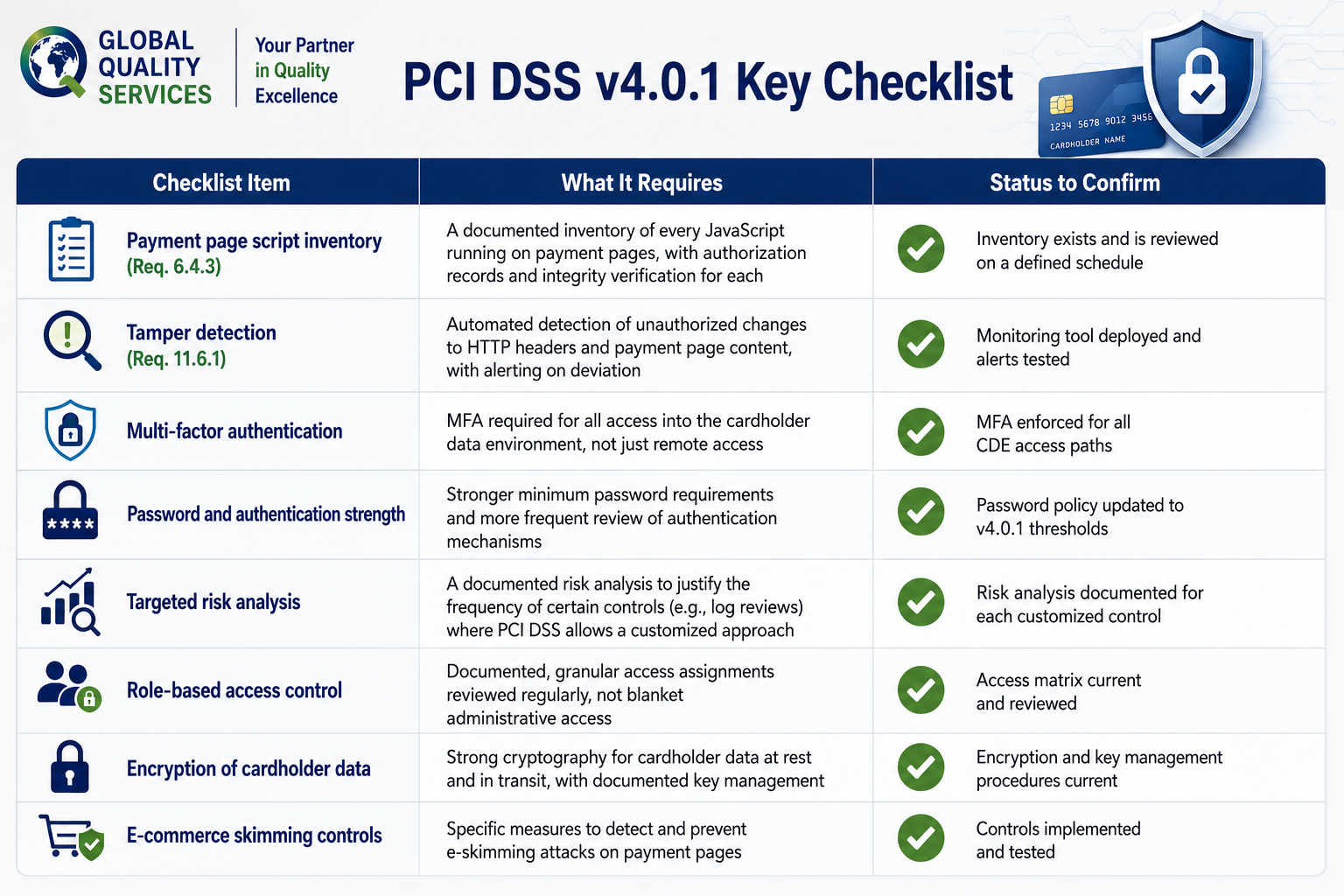
PCI DSS Rules and Regulations
PCI DSS itself is an industry standard, not a Singapore law — but it interacts directly with the Payment Services Act 2019 and MAS’s Technology Risk Management Guidelines, and it is enforced contractually through your acquiring bank and the card networks.
- PCI SSC governs the standard. The PCI Security Standards Council publishes and updates PCI DSS. There is no government body that “issues” PCI DSS compliance in Singapore — validation is carried out by Qualified Security Assessors (QSAs) and Approved Scanning Vendors (ASVs) certified by PCI SSC.
- Enforcement runs through your acquirer. Compliance is a contractual requirement between merchants, service providers, and their acquiring bank or payment processor. Non-compliance can result in fines, higher transaction fees, or termination of your ability to accept card payments — not a criminal or civil penalty under Singapore law.
- MAS layers additional requirements on top. Payment service providers licensed under the Payment Services Act 2019 must also meet MAS’s risk management, AML/CFT, and technology risk expectations. For MAS-regulated financial institutions specifically, the Technology Risk Management (TRM) Guidelines apply alongside PCI DSS, not instead of it.
- Compliance levels are set by transaction volume. Each card network sets its own thresholds. Under Visa’s structure, Level 1 applies to merchants processing over 6 million transactions annually; Level 4 covers merchants processing under 20,000 online transactions. Your level determines whether you self-assess (SAQ) or require a QSA-led audit.
PCI DSS and TVRA: Hardening the Physical Data Environment
PCI DSS addresses the logical and procedural security of cardholder data environments. It covers network controls, access management, encryption, and monitoring. What it does not fully address is the physical infrastructure that underpins those environments — the data centers, server rooms, and network facilities where cardholder data is processed.
Organizations in the payment processing, fintech, and e-commerce infrastructure sectors might also require TVRA certification in addition to PCI DSS to validate that physical data environments are completely hardened against operational and structural threats.
- Threat, Vulnerability, and Risk Assessment (TVRA) evaluates a facility’s physical environment against a defined set of threat scenarios and structural risk criteria. For payment processing organizations in Singapore, TVRA is relevant for:
- Data centers and co-location facilities that process, store, or transmit cardholder data and must demonstrate physical environment security to card schemes, enterprise clients, or MAS-regulated partners
- Fintech companies with on-premises infrastructure in scope for PCI DSS where physical access controls, environmental resilience, and site-level threat scenarios must be independently assessed
- Payment gateways and switching infrastructure operators whose physical facilities are subject to card scheme or regulatory audit requirements
E-commerce operators running hybrid environments where physical server infrastructure remains in scope alongside cloud-based components
PCI DSS Requirement 9 covers physical security controls within the CDE. TVRA goes further. It provides an independent structural and operational risk assessment of the physical facility itself, covering physical access threats, environmental risks, building resilience, and site-level vulnerabilities that Requirement 9 does not address.
How GQS Singapore Can Help
GQS Singapore brings 26 years of experience guiding organizations through demanding certification and compliance standards, and that depth is exactly what a standard as technical and fast-moving as PCI DSS 4.0.1 calls for. We’ve built our reputation on getting the fine print right, the kind of scoping judgment, documentation discipline, and audit readiness that only comes from decades of doing this work across industries and regulatory environments.
When you work with GQS Singapore, you’re not getting a generic checklist; you’re getting a team that has seen how PCI DSS plays out in practice, again and again, and knows exactly where businesses stumble and how to keep them off that path. Contact Global Quality Services to discuss your requirements.
FAQs: PCI DSS Compliance
1) Who needs PCI DSS compliance?
Any organization that accepts, processes, stores, or transmits payment card data must comply with PCI DSS. This includes online stores, retail businesses, subscription services, call centers, and service providers supporting payment processing.
2) Is PCI DSS compliance a legal requirement?
PCI DSS is not typically a government law, but it is an industry standard enforced through contracts with payment processors and acquiring banks. Non-compliance can trigger penalties, increased fees, or restrictions on card payment processing.
3) How long does PCI DSS compliance take?
Timelines vary based on scope, system complexity, and existing controls. Some organizations can close gaps and validate compliance in a few months, while more complex environments may take longer due to remediation and testing requirements.
4) What is the biggest mistake companies make with PCI DSS?
The most common mistake is incorrect scoping—either missing systems that should be included or keeping too many systems in scope unnecessarily. Both lead to compliance failures, wasted effort, and increased risk.
5) How do we maintain PCI DSS compliance after certification or validation?
Ongoing compliance requires routine vulnerability scans, patch management, access reviews, logging and monitoring, employee training, and periodic reassessments. PCI DSS should be treated as an operational security program rather than a one-time audit event.