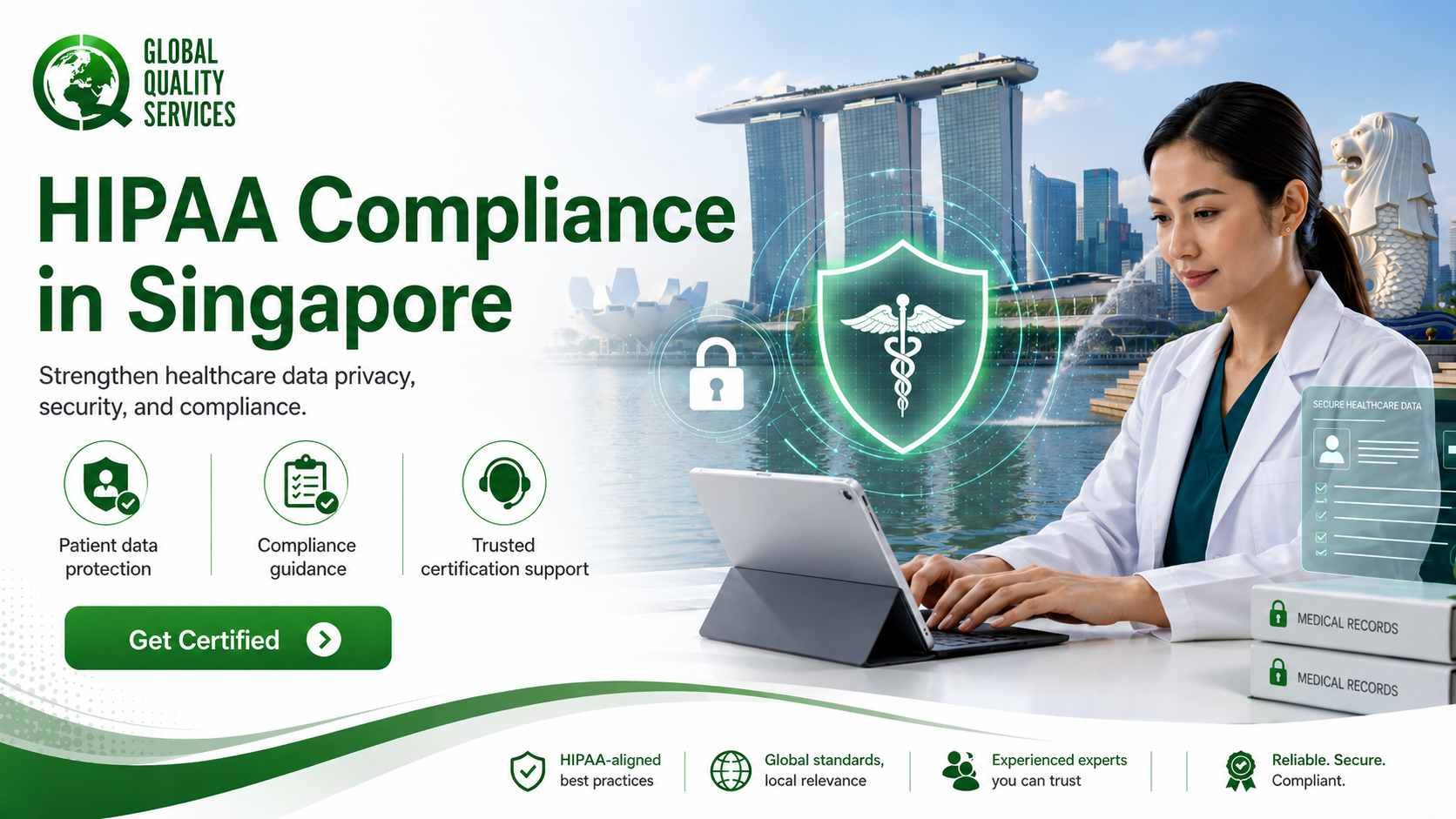
If your healthcare organisation handles patient data and you are unsure whether you are doing it right, you are not alone. HIPAA compliance can feel overwhelming — but it does not have to be. GQS Singapore simplifies the entire process, from gap assessment to full audit readiness, so your organisation stays protected, trusted, and legally covered.
With over 21 years of experience and 1,450+ satisfied clients across Singapore, Philippines, Indonesia, and Malaysia, GQS Singapore is your trusted partner for HIPAA compliance consultancy in Singapore.
What Is HIPAA and Why Does It Matter in Singapore?
HIPAA — the Health Insurance Portability and Accountability Act — is a US federal law that sets the gold standard for protecting sensitive patient health information. Any organisation that handles, stores, transmits, or processes Protected Health Information (PHI) must comply with HIPAA — including Singapore-based companies that work with US healthcare clients, insurers, hospitals, or cloud platforms.
HIPAA is built on three core rules that every covered organisation must understand and implement:
The Privacy Rule governs how Protected Health Information can be used and disclosed. It gives patients rights over their own health data — including the right to access their records, request corrections, and know who has seen their information. Organisations must establish clear policies on minimum necessary use, meaning staff should only access the PHI they genuinely need to perform their job.
The Security Rule applies specifically to electronic PHI (ePHI). It requires organisations to put in place administrative, physical, and technical safeguards to ensure that ePHI is kept confidential, its integrity is maintained, and it remains available to authorised users. This covers everything from server room access controls to encryption of data transmitted over the internet. Our ISO 27001 certification consultancy in Singapore maps directly onto these technical safeguard requirements, making a combined engagement highly efficient.
The Breach Notification Rule sets out exactly what your organisation must do when PHI is exposed, stolen, or accidentally disclosed. Covered entities must notify affected individuals, the US Department of Health and Human Services, and in some cases the media — within specific timeframes depending on the scale of the breach. Our ISO 22301 Business Continuity Management consultancy strengthens your breach response capability significantly.
Non-compliance exposes your organisation to contract losses, financial penalties up to USD 1.9 million per year for repeated violations, criminal liability in serious cases, and reputational damage that is extremely difficult to recover from.
Who Needs HIPAA Compliance Consultancy in Singapore?
HIPAA’s reach extends well beyond US borders. In Singapore, the following types of organisations are frequently required to demonstrate HIPAA compliance:
IT service providers and cloud vendors that store, process, or transmit electronic health records on behalf of US healthcare clients are classified as Business Associates under HIPAA. This triggers full compliance obligations including a signed Business Associate Agreement (BAA). Our ISO 27001 certification and ISO/IEC 27017 cloud security certification services are natural complements for this category of organisations.
Private hospitals and specialist clinics that receive international patients from the US, participate in US-linked insurance networks, or use US-developed health platforms may find HIPAA requirements embedded in their service contracts. These organisations also need to be aware of their obligations under Singapore’s DPTM SS 714:2025 certification framework.
Health-tech startups and telehealth platforms whose software connects patients and providers across borders must ensure their data architecture, access controls, and breach response procedures meet HIPAA standards. ISO 27701 Privacy Information Management System certification is strongly recommended for this group alongside HIPAA.
Medical device companies certified under ISO 13485 Quality Management for Medical Devices and supplying devices to US healthcare facilities are increasingly required to demonstrate HIPAA compliance for any software or connectivity components of their devices.
Pharmaceutical companies and clinical research organisations running US-linked clinical trials involving patient data must protect that data in full compliance with HIPAA’s Privacy and Security Rules. Good Laboratory Practice (GLP) certification is also relevant for many organisations in this category.
Third-party administrators, billing companies, and coding service providers working with US health insurers or hospitals are directly classified as Business Associates. These organisations often simultaneously require SOC 2 certification and PCI DSS compliance alongside HIPAA — all of which GQS Singapore delivers in integrated programmes.
If you have signed — or are preparing to sign — a Business Associate Agreement with any US healthcare organisation, HIPAA compliance is not optional. It is contractual, auditable, and enforceable.
Singapore’s Regulatory Framework — How It Works Alongside HIPAA
Singapore has its own strong healthcare data protection ecosystem. GQS Singapore ensures your HIPAA programme is fully integrated with every applicable local requirement.
Personal Data Protection Act (PDPA) — Singapore’s primary data protection law, administered by the Personal Data Protection Commission (PDPC), covers all personal data including patient health records. The PDPC has issued specific Advisory Guidelines for the Healthcare Sector that clarify consent obligations, data breach notification timelines, and the responsibilities of healthcare organisations when engaging third-party data processors. Our ISO 27701 PIMS certification programme is designed to satisfy PDPA obligations structurally and documentably.
Health Information Act (2026) — Singapore’s first comprehensive health data law, passed in January 2026, mandates that all licensed healthcare providers contribute patient data to the National Electronic Health Record (NEHR) system from early 2027. It also introduces strict cybersecurity and data governance obligations across the entire healthcare sector. Full details are available at the Ministry of Health Singapore.
Cyber Security Agency of Singapore (CSA) — The CSA oversees cybersecurity standards for healthcare Critical Information Infrastructure. Our TVRA — Threat, Vulnerability and Risk Assessment certification service directly addresses the technical security obligations that CSA imposes on healthcare organisations operating critical digital infrastructure.
US HHS Official HIPAA Requirements — All GQS Singapore HIPAA engagements are built directly from the official HIPAA guidance published by the US Department of Health and Human Services, ensuring complete accuracy and audit readiness.
HIPAA and Singapore’s PDPA share significant common ground — consent management, data minimisation, access controls, breach notification, and staff accountability all appear in both frameworks. GQS Singapore exploits this overlap to build one integrated compliance programme that satisfies both simultaneously, reducing your total cost and timeline significantly.
GQS Singapore’s HIPAA Compliance Services — What We Do
1. HIPAA Gap Assessment
We conduct a thorough review of your current systems, policies, data flows, and vendor relationships against the full HIPAA Privacy Rule, Security Rule, and Breach Notification Rule. You receive a clear, prioritised action plan specific to your organisation — not a generic checklist. This process closely parallels the gap analysis we conduct for ISO 27001 certification, and organisations pursuing both simultaneously benefit from significant efficiencies.
2. Formal Risk Analysis and Risk Management Planning
A documented risk analysis is a mandatory HIPAA requirement. We identify every point where PHI could be exposed, quantify the likelihood and impact of each risk, and build a practical risk management plan your team can implement and maintain. This risk analysis also forms the foundation of ISO 27001’s Statement of Applicability and TVRA assessments, making combined engagements significantly more efficient.
3. Policy and Procedure Development
We draft the complete set of HIPAA-required documentation: Privacy Policy, Information Security Policy, Breach Notification Procedure, Employee Sanctions Policy, Minimum Necessary Use Guidelines, Media Disposal Policy, and Business Associate Agreements for all third-party vendors. For organisations also pursuing DPTM SS 714:2025 or ISO 27701, much of this documentation serves multiple frameworks simultaneously.
4. Technical Safeguard Implementation Guidance
We work directly with your IT team to implement the controls required under the HIPAA Security Rule — role-based access controls, audit logging, automatic session timeout, encrypted data transmission, integrity verification, and emergency access procedures. Organisations simultaneously pursuing ISO/IEC 27018 certification for cloud privacy will find that these technical controls satisfy both frameworks with minimal additional effort.
5. Staff Awareness Training
We deliver customised HIPAA training for every level of your organisation — clinical staff, administrative teams, and IT personnel. Training covers what PHI is, how to handle it correctly, how to identify phishing and social engineering attacks, and how to report incidents promptly. This training is also aligned with the awareness requirements of ISO 27001 and ISO 27701.
6. Internal Compliance Audit Before any third-party review, we conduct a full internal audit to verify that your controls are working in practice and that your documentation matches your actual operations. This mirrors the internal audit process we conduct for ISO 27001, SOC 2, and HITRUST CSF certification — all of which are frequently required alongside HIPAA by US healthcare clients.
7. Business Associate Agreement Management
We review all existing BAAs with your vendors and partners, identify those that are outdated or non-compliant, and draft updated agreements that meet current HIPAA requirements — protecting your organisation from liability arising from third-party breaches.
8. Ongoing Compliance Maintenance
We provide continued support through annual reviews, updated training, policy revisions, and breach response simulation exercises — keeping your compliance programme genuinely effective. For organisations maintaining ISO 22301 Business Continuity certification, these exercises are integrated directly into your existing business continuity testing schedule.
Integration with ISO 27001, ISO 27701, DPTM, HITRUST, and SOC 2
One of the strongest advantages of choosing GQS Singapore is our ability to run fully integrated compliance programmes. HIPAA shares substantial common ground with several other frameworks your organisation may need:
ISO 27001 — Information Security Management System certification and HIPAA’s Security Rule share nearly identical control categories. Running both together eliminates duplication and produces a stronger overall security posture for your organisation.
ISO 27701 — Privacy Information Management System directly extends ISO 27001 to cover privacy obligations, making it a natural companion to HIPAA’s Privacy Rule and Singapore’s PDPA simultaneously.
DPTM SS 714:2025 — Singapore’s Data Protection Trust Mark certification demonstrates to clients and regulators that your organisation meets the highest local standards for personal data protection — a powerful complement to HIPAA compliance for Singapore-facing business.
HITRUST CSF — The HITRUST Common Security Framework is the most widely recognised healthcare-specific security certification in the US. Many US healthcare clients now require HITRUST CSF certification alongside or instead of a standalone HIPAA audit. GQS Singapore delivers both.
SOC 2 Type 1 and Type 2 — For IT service providers and cloud vendors, SOC 2 attestation is frequently required alongside HIPAA by US healthcare clients. GQS Singapore delivers both in a single coordinated engagement.
ISO 27031 — ICT Readiness for Business Continuity complements HIPAA’s requirements for contingency planning, data backup, and disaster recovery — all mandatory elements of the HIPAA Security Rule.
NAID AAA Certification — For organisations that handle physical PHI or decommission old hardware containing patient data, NAID AAA certification for secure data destruction directly satisfies HIPAA’s media disposal requirements.
Running these programmes in parallel — rather than one after another — dramatically reduces total time, cost, and disruption to your operations.
Frequently Asked Questions
1. Does HIPAA apply to Singapore-based companies?
Yes. Any Singapore organisation handling US patient data as a Business Associate — including IT vendors, cloud providers, and billing firms — must comply with HIPAA fully.
2. What is the penalty for HIPAA non-compliance?
Fines range from USD 100 to USD 50,000 per violation, capped at USD 1.9 million annually per violation category. Wilful neglect carries the heaviest penalties and potential criminal liability.
3. How is Singapore’s PDPA different from HIPAA?
PDPA covers all personal data across all industries in Singapore. HIPAA focuses specifically on health information with a US connection. Both apply simultaneously to many Singapore healthcare organisations.
4. How long does HIPAA compliance take with GQS Singapore?
Small organisations typically complete the process in six to ten weeks. Larger hospitals or multi-site networks generally require three to five months depending on complexity.
5. Can GQS Singapore combine HIPAA with ISO 27001 or DPTM certification?
Absolutely. GQS Singapore specialises in integrated programmes combining HIPAA with ISO 27001, ISO 27701, DPTM SS 714:2025, and SOC 2 — saving time, cost, and duplication significantly.