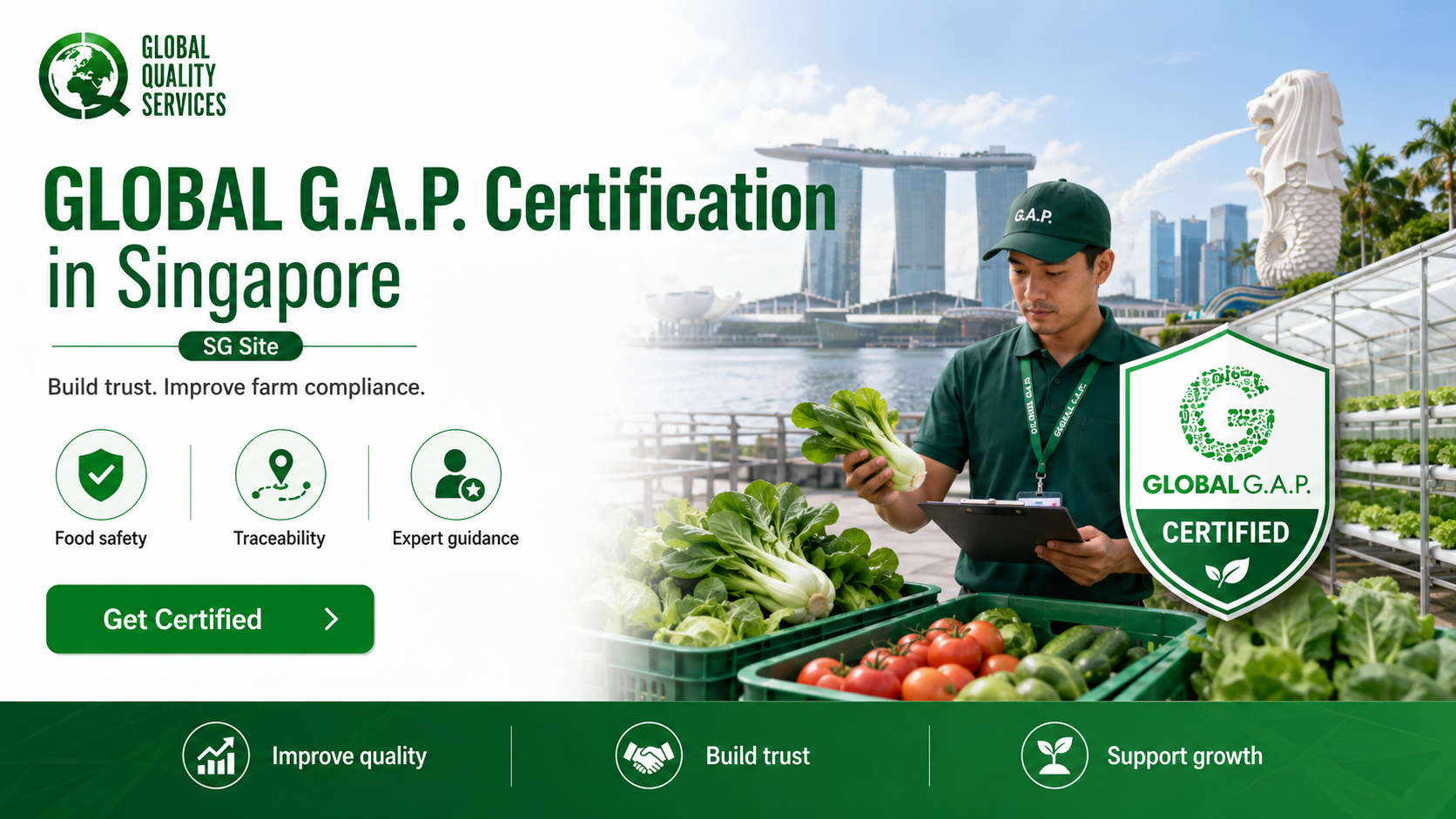
Are your international buyers or supermarket chains asking for GLOBAL G.A.P. certification before they work with you? For farms, aquaculture producers, and food supply chain businesses in Singapore, GLOBAL G.A.P. is the entry ticket to global markets. GQS Singapore helps you get certified — clearly, practically, and without unnecessary complexity.
What Is GLOBAL G.A.P. Certification?
GLOBAL G.A.P. is the world’s leading farm assurance standard, certifying that agricultural products are produced safely, sustainably, and responsibly.
It is a globally recognised certification system based on Good Agricultural Practices covering over 135 countries — maintained by FoodPLUS GmbH and benchmarked by the Global Food Safety Initiative (GFSI). It is a business-to-business certification — your trade buyers and international retailers will always ask for it.
The current mandatory standard is GLOBAL G.A.P. IFA v6 Smart, which replaced version 5 in 2024. If your organisation still holds a v5 certificate, you must transition immediately. GQS Singapore manages this transition for all clients.
Why Does It Matter in Singapore?
Singapore’s Food Safety and Security Act (FSSA) 2025 introduced stronger traceability and food safety requirements across the supply chain. GLOBAL G.A.P. certification directly supports these obligations.
The Singapore Food Agency (SFA) is also driving the 30 by 30 goal — producing 30% of Singapore’s nutritional needs locally by 2030. Local farms, aquaculture operators under the Singapore Aquaculture Plan, and urban agriculture producers all benefit from GLOBAL G.A.P. certification for both domestic supply and regional export markets.
Without certification, you simply cannot get onto the approved supplier lists of major international retailers, food distributors, and hotel and restaurant supply chains operating in Singapore.
Who Needs It?
- Local farms and urban agriculture producers supplying Singapore supermarkets and food service buyers
- Aquaculture operators seeking to supply certified seafood to premium retailers and export markets
- Food importers, distributors, and processors handling GLOBAL G.A.P. certified produce — who need Chain of Custody (CoC) certification
- Exporters supplying ASEAN, European, or US markets where GLOBAL G.A.P. IFA v6 is a mandatory supplier requirement
What GLOBAL G.A.P. IFA v6 Covers
Food Safety — Hygiene, traceability, pesticide management, and water quality. All Major Musts must be fully compliant to pass.
Environmental Sustainability — Integrated pest management, water and energy use, biodiversity, and waste management.
Worker Health, Safety and Welfare — Risk assessments, PPE, training records, and fair labour practices.
Animal Welfare — Species-specific standards for livestock and aquaculture covering housing, feeding, and health management.
How GQS Singapore Gets You Certified
We handle everything — gap assessment, documentation, staff training, internal audit, and certification support. After certification, we provide annual maintenance support to keep your certificate active and your practices current as v6 requirements evolve. Ready to get GLOBAL G.A.P. certified in Singapore? Global Quality Services (GQS) Singapore makes farm assurance certification straightforward for producers and supply chain operators of all sizes. Talk to our team today for a free initial consultation. Contact GQS Singapore
Frequently Asked Questions
1. Is GLOBAL G.A.P. mandatory in Singapore?
It is voluntary — but effectively mandatory if you supply major international retailers or food service companies in Singapore. It is fast becoming a baseline requirement for premium market access.
2. What changed from IFA v5 to v6?
IFA v6 strengthens environmental sustainability, updates social practice requirements through GRASP, and tightens traceability obligations. v5 certificates are no longer valid. GQS Singapore manages your full transition.
3. Do food importers and distributors need GLOBAL G.A.P. certification?
Yes — if you handle certified produce, you need Chain of Custody (CoC) certification to maintain product integrity and continue making GLOBAL G.A.P. claims.
4. How long does certification take?
Most organisations complete the process in 2 to 4 months. GQS Singapore gives you a clear timeline after the initial gap assessment.
5. Can GLOBAL G.A.P. be combined with FSSC 22000 or BRC?
Yes — and this is one of our most common combined programme requests. Running FSSC 22000 and BRC alongside GLOBAL G.A.P. gives your supply chain complete farm-to-processing GFSI coverage at lower total cost.