Cybersecurity is not only about installing firewalls, antivirus software or endpoint protection. A system may appear secure and still contain weaknesses that an attacker can exploit through an exposed application, outdated component, misconfigured cloud service, vulnerable API, weak authentication or excessive user privileges.
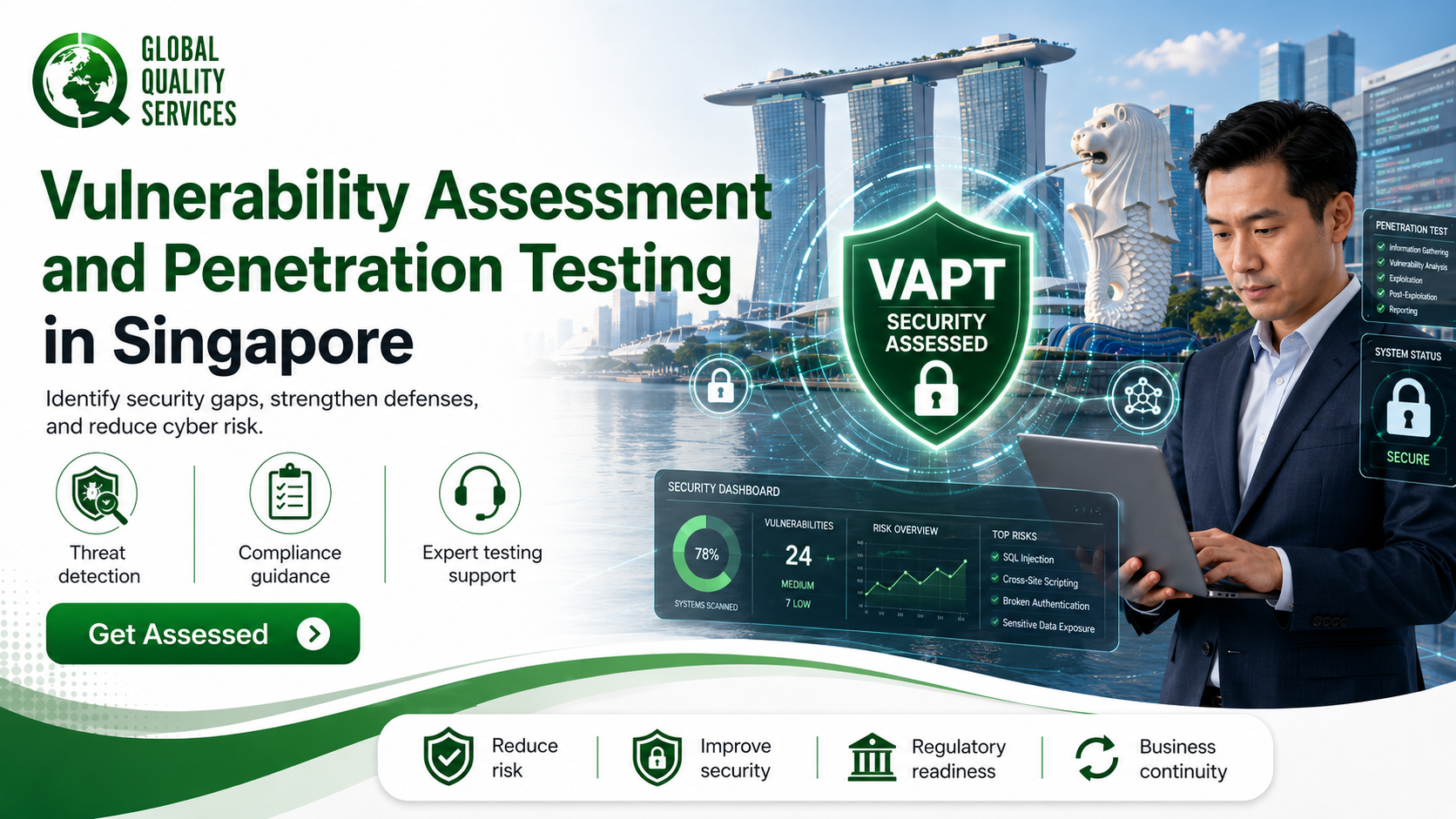
VAPT Certification in Singapore helps organisations identify such weaknesses before criminals discover them. A professional VAPT engagement combines automated vulnerability discovery with controlled security testing to determine which weaknesses are genuinely exploitable and what impact they could have on business operations and sensitive information.
Global Quality Services (GQS) Singapore helps organisations assess their technology environments, understand security gaps, prioritise remediation and prepare evidence for cybersecurity, compliance and customer assurance requirements.
What Is Vulnerability Assessment and Penetration Testing?
Vulnerability Assessment and Penetration Testing are related but different activities.
A Vulnerability Assessment (VA) systematically identifies security weaknesses across defined systems, networks, applications or infrastructure. It can uncover issues such as missing security patches, unsupported software, exposed services, insecure configurations, weak protocols and other known vulnerabilities.
Penetration Testing (PT) takes the process further. It involves an authorised and controlled attempt to exploit security weaknesses to determine whether an attacker could gain access, escalate privileges, move through the environment or reach sensitive information.
Singapore’s Cyber Security Agency describes penetration testing as an authorised and intentional attack on a system to identify vulnerabilities that could be exploited by threat actors.
CSA also distinguishes vulnerability assessment from penetration testing: vulnerability assessment identifies flaws through scanning without compromising the client’s defences, whereas penetration testing actively attempts exploitation. (csa.gov.sg)
Why VAPT Certification Matters for Singapore Organisations
Singapore has a highly connected digital economy, with organisations depending on cloud infrastructure, online applications, digital payment systems, APIs, remote access and third-party technology providers.
CSA’s Singapore Cyber Landscape 2025/2026 highlights a threat environment characterised by increasing complexity, speed and scale. The publication also reports a rise in ransomware attacks and notes how expanded attack surfaces, including unpatched IoT devices and default passwords, contribute to risk. (csa.gov.sg)
For a business, the problem is rarely limited to one vulnerable server. A weakness in an internet-facing application could provide an initial entry point, while poor access controls, network segmentation or privilege management could allow an attacker to move further into the environment. VAPT helps organisations test this chain of risk in a controlled manner.
VAPT Certification and Singapore’s Cybersecurity Regulations
VAPT is particularly relevant in Singapore because penetration testing is a regulated cybersecurity service.
Under Singapore’s Cybersecurity Act, penetration testing is one of the two types of cybersecurity service providers subject to licensing by CSA. The licensing framework recognises that penetration testers can gain access to sensitive client systems and information during an engagement.
This is an important consideration when selecting a VAPT provider. Organisations should distinguish between simply purchasing a vulnerability scanning service and engaging a provider for an actual penetration test.
For Critical Information Infrastructure (CII), the requirements are even more specific. CSA’s 2026 Cybersecurity Code of Practice for CII states that CII owners must conduct penetration testing on IT systems at least once every 12 months and on OT systems at least once every 24 months, with additional testing following major system changes.
It also requires appropriate accreditation and certification for third-party penetration testing providers and testers performing tests on CII. (csa.gov.sg) Therefore, CII owners should establish their testing programme around their specific regulatory obligations rather than treating annual VAPT as a generic recommendation.
VAPT Certification and the Singapore PDPA
Organisations handling personal data also need to consider security testing as part of their broader protection programme.
The Personal Data Protection Act requires organisations to make reasonable security arrangements to protect personal data from unauthorised access, collection, use, disclosure, copying, modification or disposal. PDPC decisions have also emphasised that security measures need to be sufficiently robust and comprehensive in relation to the risks involved. (pdpc.gov.sg)
VAPT does not by itself make an organisation compliant with the PDPA. Instead, it can provide practical evidence that technical safeguards are being tested and that identified weaknesses are being addressed. This is especially relevant for organisations handling customer accounts, employee information, financial information, healthcare-related information or other sensitive personal data.
What Types of VAPT Certification Can GQS Singapore Provide?
A VAPT programme should be based on the organisation’s actual attack surface. Testing only one server may provide little value if the main exposure is a web application or cloud environment.
External Network Penetration Testing
External testing examines systems accessible from outside the organisation. This can include internet-facing servers, remote access services, firewalls, VPN infrastructure, exposed ports and other publicly accessible assets. The objective is to understand what an external attacker could discover and potentially exploit without authorised internal access.
Internal Network Penetration Testing
Internal testing assumes that an attacker or malicious user has already obtained some level of access to the internal environment. The assessment can examine network segmentation, authentication, privilege escalation, insecure services, exposed administrative interfaces and opportunities for lateral movement. This approach is useful because perimeter security alone cannot prevent damage if an attacker gains an initial foothold.
Web Application Security Testing
Modern businesses frequently depend on customer portals, e-commerce platforms, employee applications and cloud-hosted web services. Web application VAPT can examine areas such as:
- Authentication and session management
- Access control
- Input validation
- Injection vulnerabilities
- Cross-site scripting
- File handling
- Security misconfigurations
- Business logic weaknesses
- Sensitive information exposure
- Insecure application interfaces
Manual testing is particularly important for business logic weaknesses because automated scanners may identify technical flaws but cannot always understand how an application’s intended business process can be abused.
API Security Testing
APIs increasingly connect mobile applications, web platforms, payment systems, SaaS applications and internal services. API testing can examine authentication, authorisation, object-level access controls, input handling, rate limiting and exposure of sensitive information. An API may be technically functional while still allowing one authenticated user to access another user’s information. Testing such scenarios helps identify weaknesses that ordinary infrastructure scanning may miss.
Cloud Security Assessment
Cloud adoption changes the attack surface. Security responsibilities are distributed across cloud providers, customers, administrators and third-party services. Cloud-focused VAPT can review externally exposed resources, identity and access configurations, storage exposure, network controls, application interfaces and other in-scope security weaknesses. The exact scope should be agreed carefully with the organisation and relevant cloud provider before testing begins.
Mobile Application VAPT
Mobile applications can expose sensitive business and customer information through insecure authentication, weak storage, inadequate transport protection, insecure API communication or application-level weaknesses. Testing can cover the mobile application itself as well as its supporting backend services where authorised.
Wireless Security Testing
Where wireless infrastructure is included in scope, testing can assess authentication mechanisms, network segregation, access controls and configuration weaknesses. The goal is to determine whether an attacker could use wireless infrastructure as a route into sensitive corporate resources.
Configuration and Vulnerability Assessment
Automated scanning can identify known vulnerabilities and configuration issues across servers, network devices, applications and other assets. However, scan output should not simply be handed to management as a long list of CVE numbers. Findings need to be validated, prioritised and translated into business-relevant remediation actions.
Our VAPT Certification Process in Singapore
A good VAPT engagement is controlled from beginning to end. Testing without clearly defined boundaries can create unnecessary operational risk.
Step 1: Define Scope and Rules of Engagement
The first stage establishes exactly what can and cannot be tested. This includes IP addresses, domains, applications, APIs, cloud resources, testing windows, permitted techniques, exclusions, emergency contacts and rules for handling sensitive information. For production systems, special care may be required to prevent testing activities from affecting availability.
Step 2: Asset Discovery and Reconnaissance
The assessment team develops an understanding of the authorised environment. This can include identifying technologies, exposed services, application entry points, domains, network relationships and other information relevant to the agreed scope. The objective is to understand the attack surface before attempting exploitation.
Step 3: Vulnerability Identification
Automated tools and manual techniques are used to identify potential vulnerabilities. Findings may involve outdated components, insecure configurations, weak authentication, exposed services, missing patches or application-level weaknesses. At this stage, a vulnerability is a potential security problem. It still needs appropriate validation.
Step 4: Manual Validation and Penetration Testing
Security professionals validate relevant findings and attempt controlled exploitation. This helps distinguish between a vulnerability that looks serious in a scanner and one that can actually be used to compromise an asset. Where authorised, testers may also investigate privilege escalation, lateral movement and access to sensitive resources.
Step 5: Risk Analysis
Not every vulnerability represents the same level of business risk. A critical vulnerability on an isolated test server may present less immediate risk than a medium-rated weakness on an internet-facing application containing customer information. GQS therefore recommends considering factors such as exploitability, exposure, affected assets, data sensitivity, business importance and potential attack impact when prioritising remediation.
Step 6: Detailed Reporting
The final report should be useful to both management and technical teams. A comprehensive VAPT report can include:
- Executive summary
- Scope and limitations
- Testing methodology
- Assets assessed
- Vulnerability findings
- Severity ratings
- Technical evidence
- Business impact
- Remediation recommendations
- Risk prioritisation
- Retest requirements
The report should clearly separate confirmed vulnerabilities from observations and limitations so management can make informed decisions.
Step 7: Remediation
The purpose of VAPT is not to produce a long list of vulnerabilities. The real value comes from fixing the weaknesses that create meaningful risk. Depending on the finding, remediation could involve patching software, changing configurations, strengthening authentication, correcting application logic, improving network segmentation, restricting privileges or modifying secure development practices.
Step 8: Retesting
After remediation, important findings should be retested. Retesting confirms whether the original weakness has been addressed and provides evidence for closing the finding. This also creates a useful security improvement cycle:
Discover → Validate → Prioritise → Remediate → Retest → Improve
How VAPT Supports ISO 27001
VAPT can form an important part of an organisation’s broader ISO 27001 Information Security Management System. ISO 27001 is not simply a technical security standard. It requires organisations to manage information security risks through a systematic management system. VAPT can provide technical evidence that security controls are being evaluated in practice. Findings can also contribute to risk treatment, corrective actions and continual improvement. GQS can help organisations connect VAPT findings with their wider information security programme instead of treating security testing as a standalone technical exercise.
VAPT for PCI DSS Compliance
For organisations processing payment card information, security testing is also an important part of PCI DSS compliance. GQS Singapore provides PCI DSS compliance support, including assistance with vulnerability management, penetration testing coordination, scope definition and compliance evidence. A PCI-focused VAPT engagement should be scoped around the applicable cardholder data environment and PCI DSS testing requirements rather than relying on a generic penetration test.
VAPT and SOC 2
Technology and SaaS organisations often need to demonstrate security controls to enterprise customers. A properly documented VAPT programme can support the evidence required within a broader SOC 2 compliance programme. The value is not simply having a report. Organisations should be able to demonstrate a repeatable process for identifying vulnerabilities, prioritising findings, addressing significant issues and validating remediation.
VAPT and Data Protection
Where systems process personal information, VAPT can complement a broader privacy and data protection programme. GQS also supports ISO 27701 Privacy Information Management and DPTM / SS 714:2025 certification. VAPT can provide technical evidence that systems processing personal information are being tested for security weaknesses, while privacy frameworks address governance, accountability and personal-data management.
How Often Should VAPT Be Conducted?
There is no single testing frequency that is appropriate for every organisation. A VAPT programme should consider:
- Regulatory requirements
- Business risk
- System criticality
- Exposure to the internet
- Frequency of application changes
- Cloud adoption
- New technology deployments
- Major infrastructure changes
- Security incidents
- Customer or contractual requirements
For CII, specific penetration-testing frequencies apply under the current CSA Code of Practice. IT CII systems are subject to penetration testing at least every 12 months, while OT CII systems are subject to testing at least every 24 months, with additional testing after major system changes. For other organisations, a risk-based testing schedule is more appropriate than automatically applying one frequency to every system.
What Makes a VAPT Report Useful?
A VAPT report should help people make decisions. Senior management needs to understand:
- What is our overall exposure?
- Which weaknesses present the greatest business risk?
- What could happen if they are exploited?
- Which issues need immediate attention?
Technical teams need more detailed information, including affected assets, evidence, reproduction details where appropriate, severity, root cause and remediation guidance. A useful report therefore serves two audiences without compromising technical accuracy.
Benefits of VAPT for Singapore Businesses
Identifies Security Weaknesses Before Attackers Exploit Them
Testing provides an opportunity to find vulnerabilities proactively instead of waiting for a breach or security incident.
Prioritises Remediation
Organisations can focus resources on weaknesses that create the greatest realistic risk instead of attempting to fix every scanner result in the same order.
Tests Whether Security Controls Work
A firewall, authentication mechanism or access-control rule may exist on paper. Penetration testing helps determine whether those controls actually resist authorised simulated attacks.
Supports Regulatory and Contractual Requirements
VAPT reports can provide evidence for relevant regulatory, certification, customer and supplier-assurance requirements, depending on the organisation and scope.
Strengthens Customer Confidence
Customers increasingly ask technology providers and vendors for evidence of security testing. A professional VAPT programme can provide objective evidence of security due diligence.
Reduces the Impact of Security Incidents
No security assessment can guarantee that an organisation will never be breached. However, identifying exploitable weaknesses early can reduce avoidable exposure and improve security preparedness.
Why Choose GQS Singapore for VAPT?
Global Quality Services (GQS) Singapore provides cybersecurity assessment and compliance support for organisations operating across different technology environments. Our approach focuses on understanding what you operate, what is exposed, what information is at risk and what would happen if a vulnerability were exploited.
GQS can support organisations with VAPT planning, scope definition, vulnerability assessment, penetration testing coordination, reporting, remediation planning and retesting. VAPT can also be integrated with related programmes such as ISO 27001, PCI DSS, SOC 2, ISO 27701 and DPTM / SS 714:2025 where relevant. For penetration testing engagements in Singapore, organisations should also verify the provider’s applicable licensing and regulatory requirements under the Cybersecurity Act. (csa.gov.sg)
Frequently Asked Questions
1. What is the difference between vulnerability assessment and penetration testing?
Vulnerability assessment identifies and evaluates potential security weaknesses, usually through systematic scanning and analysis. Penetration testing involves authorised attempts to exploit identified weaknesses and determine their actual impact. Using both provides a more complete view of security exposure.
2. Is penetration testing a regulated service in Singapore?
Yes. Singapore’s Cybersecurity Act provides a licensing framework for penetration testing service providers. CSA identifies penetration testing as one of the cybersecurity services subject to licensing. (csa.gov.sg)
3. Is VAPT mandatory for all businesses in Singapore?
No. There is no single VAPT requirement that applies identically to every Singapore business. Specific sectors and regulated environments can have their own obligations. For example, CII owners have defined penetration-testing requirements under CSA’s Code of Practice, while organisations may also undertake VAPT to meet contractual, certification, risk-management or customer requirements. (csa.gov.sg)
4. Can VAPT be performed on cloud environments?
Yes, provided the testing scope is properly defined and authorised. Cloud VAPT should account for the shared-responsibility model, provider restrictions, exposed services, identities, configurations, applications and APIs.
5. How long does a VAPT engagement take?
There is no fixed duration. A small web application may require considerably less time than a large environment involving external and internal networks, APIs, mobile applications, cloud infrastructure and multiple business-critical systems. Scope, number of assets, testing depth and rules of engagement determine the timeline.