Every product tells a story. Behind the devices we use, the clothes we wear, and the components that power modern industry lies a vast, interconnected supply chain involving thousands of factories, workers, and communities across the globe. The question that multinational buyers, institutional investors, and conscious consumers are asking with increasing urgency is simple but profound — is that story one you are proud of?
The Responsible Business Alliance (RBA) certification gives Singapore businesses the internationally recognized framework to answer that question with confidence, transparency, and independently verified evidence. Global Quality Services (GQS) helps Singapore organizations implement RBA standards and achieve certification through a consulting approach that goes beyond compliance paperwork to drive genuine, lasting change in how their supply chains operate.
What the Responsible Business Alliance Stands For

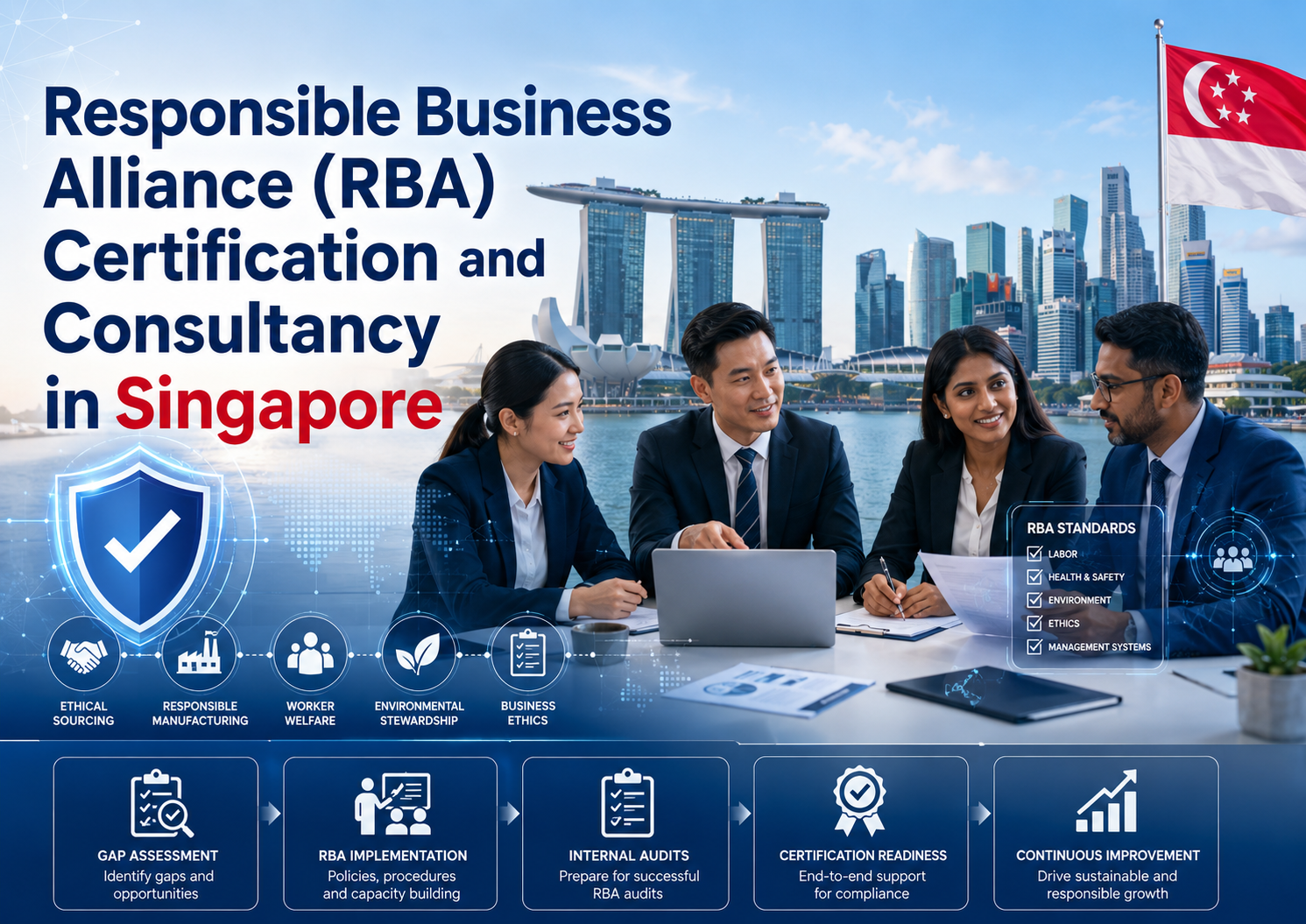
The Responsible Business Alliance — formerly known as the Electronic Industry Citizenship Coalition (EICC) — is the world’s largest industry coalition dedicated to corporate social responsibility in global supply chains. The RBA Code of Conduct establishes comprehensive standards across five critical dimensions of responsible business practice:
- Labor — fair working hours, freely chosen employment, prohibition of child and forced labor, humane treatment, and non-discrimination
- Health and Safety — occupational safety, emergency preparedness, industrial hygiene, and worker health protection
- Environment — environmental permits, pollution prevention, hazardous substance management, and greenhouse gas emissions reduction
- Ethics — business integrity, anti-corruption, responsible sourcing, and whistleblowing protection
- Management Systems — company commitment, accountability, corrective action processes, and continuous improvement frameworks
In Singapore, where supply chain transparency has become a boardroom-level priority and where the Singapore Exchange (SGX) now mandates climate and sustainability-related disclosures for listed companies, RBA certification provides a structured, globally recognized framework that directly supports your broader ESG and corporate governance commitments.
Singapore’s Ministry of Manpower (MOM) enforces rigorous labor standards across all industries, including workplace safety, fair employment practices, and foreign worker protections — all areas directly addressed by the RBA Code of Conduct’s labor and health and safety dimensions. Alignment with RBA standards reinforces compliance with MOM’s Employment Act and Workplace Safety and Health Act, creating a unified responsible employment framework.
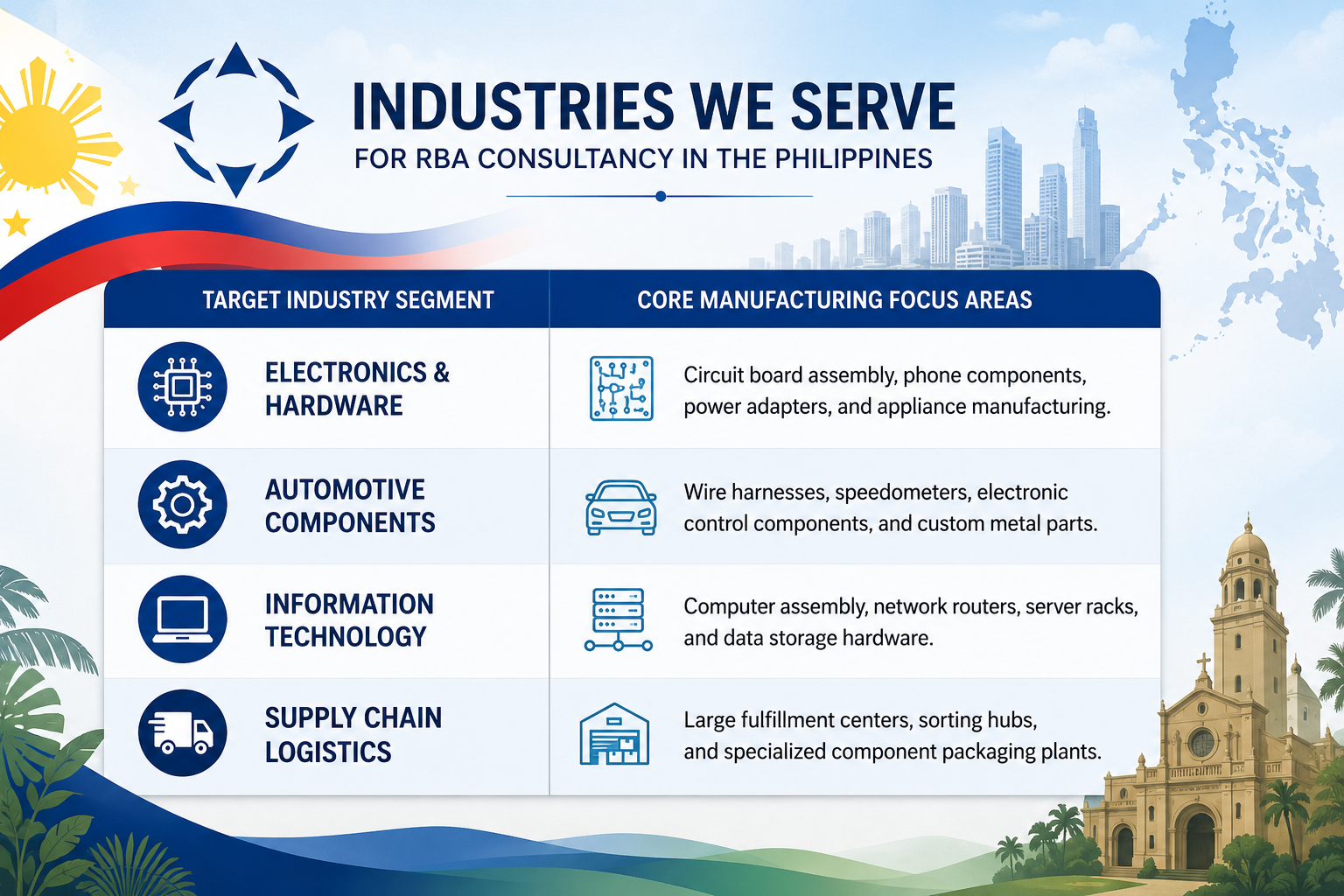
Industries That Need RBA Certification in Singapore
What RBA Certification Delivers for Singapore Businesses
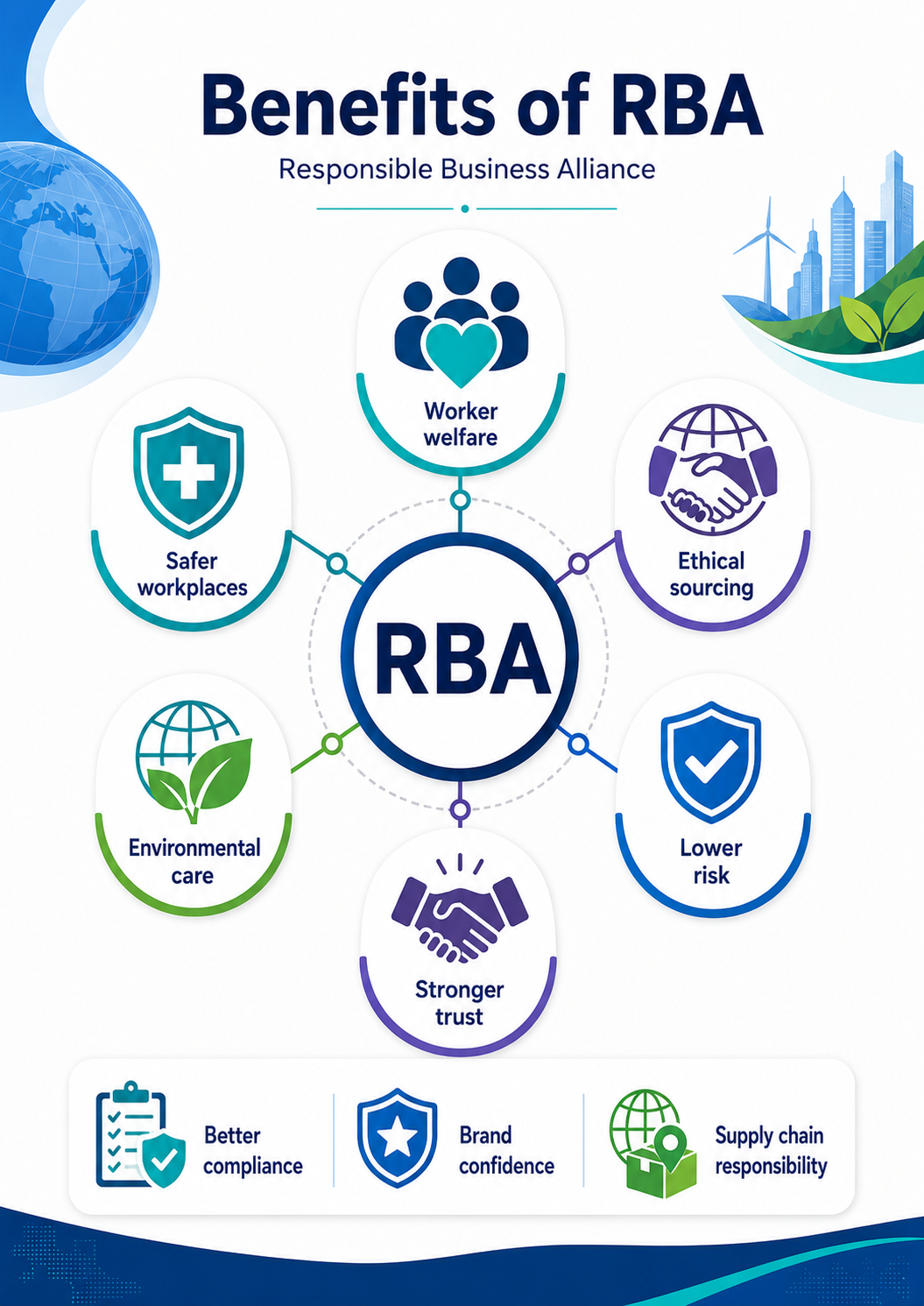
- Secure and strengthen commercial relationships with global technology and consumer goods brands that mandate RBA compliance from Singapore suppliers
- Satisfy SGX sustainability disclosure requirements and institutional investor ESG expectations with independently verified responsible supply chain credentials
- Build a genuine ethical supply chain culture that reduces labor, environmental, and governance risk across your Singapore and regional operations
- Demonstrate to employees, communities, and civil society that your organization’s commitment to responsible business is real, structured, and externally verified
- Position your Singapore business as a responsible sourcing partner of choice in an increasingly transparency-conscious global marketplace
- Integrate RBA compliance with ISO 14001 environmental management, ISO 45001 occupational health and safety, and ISO 37001 anti-bribery certifications within a unified responsible business governance framework
Why Singapore Businesses Cannot Afford to Overlook RBA Certification
Singapore sits at the crossroads of global trade. As a regional headquarters hub, a major electronics and semiconductor manufacturing base, and Southeast Asia’s premier logistics gateway, Singapore businesses are embedded in supply chains that stretch across Asia, Europe, and the Americas — supply chains that are under unprecedented scrutiny from regulators, investors, and buyers who take responsible sourcing seriously.
The electronics, semiconductor, technology hardware, and precision manufacturing sectors — all significant contributors to Singapore’s export economy — are particularly affected. Major global technology brands including Apple, Dell, HP, Intel, and Samsung require their Singapore-based suppliers and contract manufacturers to demonstrate RBA compliance as a condition of doing business. Singapore’s Economic Development Board (EDB) actively supports the growth of Singapore’s electronics and advanced manufacturing ecosystem — an ecosystem where RBA certification is increasingly a baseline commercial requirement rather than an optional credential.
Beyond the technology sector, Enterprise Singapore supports local businesses in building sustainability and responsible business capabilities through various grant schemes and capability development programs — making this an ideal time for Singapore companies to invest in RBA certification with potential financial support available.
The Human Story Behind RBA Certification
Certification frameworks can feel abstract — clauses, audits, corrective action reports. But RBA certification is ultimately about people. It is about the worker on a factory floor in Johor who goes home at a reasonable hour to her family. It is about the technician in a Singapore precision engineering workshop who knows that his employer takes his safety seriously. It is about the community around a manufacturing facility that breathes cleaner air because environmental controls are genuinely implemented rather than nominally documented.
Singapore’s Tripartite Alliance for Fair and Progressive Employment Practices (TAFEP) champions fair, responsible, and progressive employment practices across Singapore’s workforce — values that sit at the very core of what RBA certification demands from organizations and their supply chains.
When GQS works with Singapore organizations on RBA certification, we keep that human dimension at the center of every gap assessment, every training session, and every management system we help build. Because the organizations that embed responsible business practices most successfully are not the ones chasing audit scores — they are the ones that genuinely believe their supply chains should reflect the values their brand promises.
How GQS Supports RBA Certification and Consultancy in Singapore
GQS takes a structured yet human-centered approach to RBA implementation — building systems that work in practice, not just on paper:
- Conduct a comprehensive RBA Code of Conduct gap assessment across all five dimensions — labor, health and safety, environment, ethics, and management systems — calibrated to your specific industry sector and supply chain footprint
- Develop a prioritized corrective action roadmap that addresses compliance gaps in a sequence aligned with audit timelines and operational feasibility
- Build and document management system frameworks covering policy commitments, risk assessment processes, supplier qualification procedures, and continuous improvement mechanisms
- Deliver engaging, practical training for leadership, operations, HR, and procurement teams on RBA requirements and responsible business practice in the Singapore context
- Establish worker grievance mechanisms, speak-up channels, and labor rights protection systems aligned with both RBA requirements and MOM’s fair employment guidelines
- Prepare your organization for RBA Validated Assessment Program (VAP) audits through structured mock assessments and documentation readiness reviews
- Support supplier engagement and development programs to extend RBA compliance across your upstream supply chain beyond your own facilities
- Align RBA environmental requirements with Singapore’s National Environment Agency (NEA) regulatory framework covering pollution control, waste management, and hazardous substance handling
- Provide ongoing consultancy support through surveillance cycles, corrective action follow-up, and continuous improvement advisor
The world is watching how businesses treat their people, their communities, and their planet. Singapore’s most forward-thinking organizations are not waiting to be asked — they are stepping forward with verified, credible evidence that their supply chains reflect the values their brand stands for. Contact GQS today and build a Responsible Business Alliance certified operation that your clients, investors, employees, and communities can genuinely be proud of.
Frequently Asked Questions
1. Is RBA certification mandatory for Singapore electronics manufacturers supplying global technology brands?
While not legally mandated by Singapore law, RBA compliance is a contractual requirement imposed by most major global technology brands on their Singapore-based suppliers, making certification effectively essential for businesses in this sector.
2. What is the RBA Validated Assessment Program (VAP) and how does it differ from self-assessment?
The VAP is the RBA’s official third-party audit mechanism conducted by accredited auditors who independently verify your compliance with the RBA Code of Conduct across all five dimensions — providing a credible, externally validated compliance record that self-assessment cannot replicate.
3. How does RBA certification support SGX sustainability disclosure requirements for listed Singapore companies?
RBA certification provides independently verified evidence of responsible supply chain governance across labor, environmental, and ethics dimensions — directly supporting the supply chain transparency disclosures now required under SGX’s sustainability reporting framework.
4. How does RBA alignment support compliance with Singapore’s Ministry of Manpower regulations?
RBA’s labor and health and safety requirements closely mirror MOM’s Employment Act and Workplace Safety and Health Act obligations, meaning RBA certified organizations build compliance with Singapore’s domestic employment regulatory framework into their supply chain governance simultaneously.
5. Can GQS help Singapore companies extend RBA compliance requirements to their overseas suppliers?
Yes, GQS provides supplier development and engagement support to help Singapore regional headquarters build RBA compliance capability across multi-country supply chains in Southeast Asia and beyond.