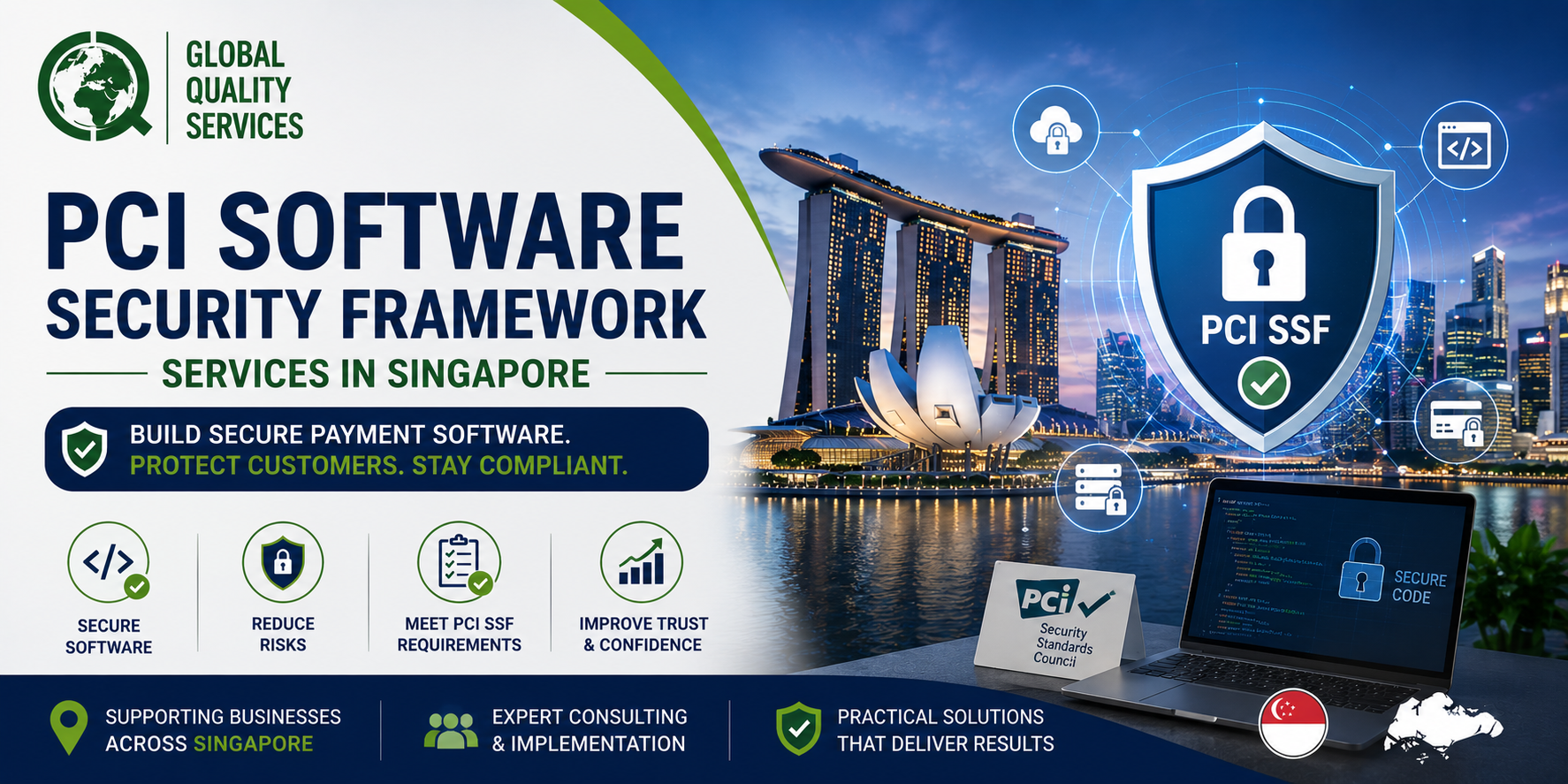
PCI SSF validation gives Singapore-based payment software vendors a publicly listed, globally recognized proof of security that card brands, acquiring banks, and enterprise merchants require before they will integrate or recommend your software — and in Singapore’s tightly regulated payments environment, it directly supports compliance with the Monetary Authority of Singapore’s technology risk management expectations.
The PCI Software Security Framework (PCI SSF) is the global standard for secure payment software design, development, and maintenance, governed by the PCI Security Standards Council (PCI SSC). It replaced the legacy Payment Application Data Security Standard (PA-DSS) in October 2022 and now defines how payment software vendors must protect cardholder data (CHD) and sensitive authentication data (SAD) across the full software lifecycle. Singapore has emerged as one of Southeast Asia’s leading fintech and payment software development hubs, and for Singapore-registered vendors serving merchants, payment service providers, or financial institutions — whether locally or across export markets — PCI SSF validation is the commercial and technical baseline that opens and protects access to those relationships.
Global Quality Services guides Singapore payment software vendors through every stage of PCI SSF readiness, assessment, and verified listing on the PCI SSC’s publicly searchable Validated Payment Software list.
PCI SSF in Singapore’s Regulatory Context
Achieving PCI SSF validation in Singapore is not just a card brand requirement — it directly addresses obligations under Singapore’s financial services regulatory framework, making it a dual-purpose compliance investment for locally registered payment software vendors.
The Monetary Authority of Singapore (MAS) is Singapore’s central bank and integrated financial regulator. MAS Technology Risk Management (TRM) Guidelines, which took binding legal effect on 10 May 2024 through the MAS Notice on Technology Risk Management, require all MAS-licensed financial institutions — and the technology vendors that serve them — to implement robust software security controls, maintain system integrity, and protect customer information against unauthorized access. PCI SSF’s S3 and Secure SLC standards directly satisfy the software security, access control, vulnerability management, and change management expectations embedded in the MAS TRM framework.
The Payment Services Act 2019 (PS Act), amended with expanded scope effective 4 April 2024, regulates payment service providers in Singapore including Major Payment Institutions (MPIs) and Standard Payment Institutions (SPIs). Payment software vendors supplying technology to PS Act-licensed entities are expected to meet security standards consistent with MAS TRM requirements. PCI SSF validation provides documented, third-party-verified evidence of software security that MAS-licensed clients can rely on when managing their own third-party technology risk obligations.
The Personal Data Protection Act 2012 (PDPA), administered by the Personal Data Protection Commission (PDPC), governs the collection, use, and protection of personal data by private organizations in Singapore. Payment software that processes cardholder personal data — including name, card number, and transaction history — falls squarely within PDPA’s Protection Obligation. PCI SSF’s control requirements for data minimization, encryption, access control, and incident response provide a strong operational foundation for PDPA compliance alongside card brand obligations.
The Two Standards Inside PCI SSF: S3 and Secure SLC
PCI SSF is not a single standard. It contains two distinct programs, and selecting the right one — or the right combination — is the first strategic decision Global Quality Services helps Singapore vendors make correctly.
Secure Software Standard (S3) validates a specific payment software product, resulting in that product being individually listed on the PCI SSC’s List of Validated Payment Software. S3 assesses whether the software adequately protects the integrity of the application and the confidentiality of the sensitive data it captures, stores, processes, and transmits. This is the direct replacement for PA-DSS and the primary validation path for Singapore payment software vendors selling into merchant or financial institution environments. Validation is product-specific and valid for three years.
Secure Software Lifecycle Standard (Secure SLC) validates an organization’s entire software development lifecycle rather than a single product. Singapore vendors with multiple payment software products or frequent release cycles benefit most from Secure SLC — validated vendors are listed as Secure SLC Qualified Vendors on the PCI SSC website and can manage qualifying low-impact product changes internally without engaging an SSF Assessor for each release. This significantly reduces long-term compliance cost and audit overhead for development-intensive Singapore software companies.
The most strategically effective approach for many Singapore vendors is to pursue both: Secure SLC as the organizational foundation and S3 for individual product listings — combining operational efficiency with commercial credibility.
Our PCI SSF Certification Process for Singapore
Every Singapore-based payment software vendor working with Global Quality Services moves from compliance gap to a confirmed PCI SSC listing through a structured six-stage process — built around Singapore’s regulatory context and the practical realities of local software development environments.
Step 1 — Scoping, Standard Selection, and Regulatory Mapping You know from day one whether S3, Secure SLC, or both apply to your Singapore entity — and exactly how PCI SSF requirements map to your MAS TRM and PDPA obligations. We analyze your software portfolio, development practices, customer profile, and regulatory exposure to define the correct scope and select the right program before a single assessment document is prepared.
Step 2 — Gap Assessment Against PCI SSF Objectives Your compliance gaps are identified, categorized, and prioritized before any SSF Assessor Company is engaged or costs are committed. We conduct a structured readiness review against S3 objectives and, where applicable, Secure SLC requirements — producing a remediation roadmap your Singapore development and security teams can act on immediately.
Step 3 — Documentation and Evidence Preparation Your submission package is complete, evidenced, and structured to meet SSF Assessor and PCI SSC quality assurance expectations before the formal assessment begins. We work alongside your Singapore team to build the Security Guidance document, threat models, software bill of materials, change control documentation, and all supporting evidence required for a successful Report on Validation (ROV).
Step 4 — SSF Assessor Liaison and Testing Support Your Singapore development and security teams are fully prepared for the hands-on testing phase — from laboratory installation of your payment application to vulnerability analysis, forensic code review, and structured assessor interviews. We coordinate with your chosen PCI SSC-qualified SSF Assessor Company and manage all pre-assessment communication to ensure no finding at this stage comes as a surprise.
Step 5 — PCI SSC Submission and Validated Listing Your validated payment software appears on the PCI SSC’s publicly searchable list within the standard quality assurance review window — giving your Singapore sales and business development teams a verifiable, third-party-confirmed proof of security to present to merchant clients, acquiring banks, and MAS-regulated financial institution partners. We manage the final ROV submission, address any PCI SSC quality assurance iterations, and confirm your Attestation of Validation (AOV) is countersigned and your listing is live.
Step 6 — Three-Year Maintenance and Change Management Your listing remains current, your MAS TRM alignment stays intact, and your Singapore development team has a clear framework for managing software changes within PCI SSF’s compliance boundaries throughout the full three-year validation cycle. We build a post-validation maintenance program covering change control reviews, low-impact change classification for Secure SLC vendors, annual internal review scheduling, and guidance on managing product updates without triggering full reassessment.
Why Choose Global Quality Services for PCI SSF in Singapore?
Global Quality Services combines deep payment security consulting expertise with direct knowledge of Singapore’s MAS TRM framework, PS Act obligations, and PDPA requirements — making us the consulting partner of choice for Singapore payment software vendors seeking PCI SSF validation that meets both card brand requirements and local regulatory expectations. We understand how Singapore’s fintech ecosystem works: the speed of product development cycles, the compliance expectations of MAS-licensed financial institution clients, and the commercial pressure to maintain a PCI SSC listing as a condition of vendor approval. Our consultants embed with your development and security teams, translate PCI SSF’s objective-based requirements into engineering actions your Singapore team can own, and manage every interaction with your SSF Assessor Company and the PCI SSC from scoping through to final listing. Whether you are transitioning from PA-DSS, pursuing first-time S3 validation, or building a Secure SLC program to support your continuous delivery pipeline, Global Quality Services delivers a structured, cost-efficient path to your verified listing — and the three-year maintenance program to keep it there.
PCI SSF FAQs
Q1: Is PCI SSF validation a legal requirement under Singapore law?
PCI SSF is not a statutory obligation under Singapore law, but it is a contractual requirement from Visa, Mastercard, and other card brands. For Singapore vendors supplying MAS-licensed financial institutions, it also supports MAS TRM third-party technology risk management obligations expected of those clients.
Q2: Does PCI SSF validation replace our MAS TRM compliance obligations?
No. PCI SSF and MAS TRM serve different purposes and different authorities. However, PCI SSF’s software security controls — covering vulnerability management, access control, change management, and incident response — directly satisfy a significant portion of the software security expectations embedded in the MAS TRM framework.
Q3: Our Singapore product is still PA-DSS validated. What do we need to do?
No new PA-DSS submissions have been accepted since October 2022. Existing PA-DSS listings remain valid until their individual expiry dates. All new or renewal validations must proceed under PCI SSF. Global Quality Services can assess your current PA-DSS posture and build a structured transition plan to S3 validation.
Q4: Can one S3 validation cover multiple versions of our payment software?
Each product version or release may require its own assessment or a change management review, depending on the nature of the changes. Secure SLC-validated vendors benefit from a streamlined process for qualifying low-impact changes, reducing per-release assessment overhead significantly.
Q5: How long does the full PCI SSF validation process take for a Singapore software vendor?
For Singapore vendors starting from a strong existing security posture, the process typically takes six to nine months from gap assessment to confirmed PCI SSC listing. Vendors with significant remediation requirements or complex multi-product scopes should plan for nine to twelve months.