The ISO 59000 Series Certification represents the world’s most comprehensive framework for implementing circular economy principles across your organization. As businesses worldwide transition from linear “take-make-dispose” models to sustainable circular systems, these Singapore-specific standards (SS ISO 59000 series) provide the structured guidance needed to reduce waste, maximize resource efficiency, and create lasting environmental and economic value.
Whether you’re developing circular business models, measuring sustainability performance, or establishing closed-loop value chains, the ISO 59000 family of standards delivers practical methodologies that drive measurable results while positioning your organization as a leader in the circular economy transition.
Understanding the ISO 59000 Series Framework
The ISO 59000 series comprises five interconnected standards that address different aspects of circular economy implementation. Each standard serves a specific purpose while contributing to a holistic approach to circularity. Organizations can pursue certification for individual standards based on their immediate priorities or implement the complete framework for comprehensive circular economy transformation.
Industries and Applications
The ISO 59000 series supports circular economy initiatives across diverse sectors:
Education, Training, and Institutional Capacity Building: Educational institutions, training providers, and capacity-building organizations use these standards to develop and deliver circular economy curricula, upskill professionals in sustainable practices, and build organizational competencies in resource efficiency and waste reduction.
Circular Economy Policy Implementation and Circular Business Models: Government agencies, policy makers, and businesses leverage the standards to design, implement, and validate circular economy policies, develop innovative business models based on product-as-a-service, sharing platforms, and product life extension, and transition from linear to circular value creation systems.
Waste Management and Secondary Raw Material Value Chains: Waste management companies, recycling facilities, and organizations managing secondary materials utilize the framework to optimize waste collection and processing systems, establish quality standards for recycled materials, and create transparent value chains that treat waste as valuable resources rather than disposal problems.
Key Standards in the ISO 59000 Series
The ISO 59000 family includes several standards that address different aspects of circular economy management. Each standard serves a specific purpose, from establishing common principles to measuring circularity performance. Businesses can select the standards that best match their operations and sustainability goals.
ISO 59004:2024 — Principles and Implementation Guidance
This standard explains circular economy terminology, principles, and practical actions. It helps organisations understand circularity and identify ways to implement it across their operations.
Best for: Organisations starting their circular economy journey.
ISO 59010:2024 — Business Model and Value Network Transition
This standard guides organisations as they move from linear business models to circular ones. It focuses on value chains, business relationships, and opportunities to retain resource value.
Best for: Manufacturers, suppliers, and businesses redesigning their operations.
ISO 59020:2024 — Circularity Performance Measurement
This standard establishes a structured approach to measuring and assessing circularity. It helps organisations collect relevant data, select indicators, and evaluate their circular economy performance.
Best for: Businesses tracking resource efficiency and circularity results.
ISO 59014 — Recovery of Secondary Materials
This standard addresses the sustainability and traceability of recovered secondary materials. It helps organisations consider responsible recovery practices and the origin of recycled materials.
Best for: Recyclers, material recovery operators, and secondary-material suppliers.
ISO 59040:2025 — Product Circularity Data Sheet
This standard provides a methodology for sharing product circularity information through a product circularity data sheet. It supports more consistent information exchange between businesses.
Best for: Manufacturers, product suppliers, and procurement teams.
Important certification note: These standards do not all function as certifiable management system requirements. ISO 59004, ISO 59010, and ISO 59020 primarily provide guidance or assessment methods.
Before purchasing an assessment or claiming certification, confirm the exact standard, its current status, and the scheme offered by the relevant certification body. The ISO catalogue also lists ISO/AWI 59001, a circular economy management system requirements project that remains under development in the catalogue reviewed for this article.
Why is ISO 59000 Important for Businesses
Circular economy practices can help businesses move beyond basic waste reduction. They encourage organisations to rethink product design, material sourcing, manufacturing, distribution, and end-of-life management.
Here are the main reasons businesses should consider the ISO 59000 series.
1. Improve Resource Efficiency
Businesses often lose money through excess raw material use, damaged products, production waste, and inefficient processes. Circular economy practices help identify where these losses occur.
Companies can redesign production processes, reuse suitable materials, and recover valuable resources. These changes can lower material consumption and improve operational efficiency.
2. Reduce Waste Generation
Landfill disposal often represents a lost opportunity to recover material value. Circular economy strategies encourage businesses to prevent waste at the source and explore reuse, repair, refurbishment, and recycling.
For example, a manufacturing company can reuse suitable production offcuts instead of discarding them. An electronics business can recover components from returned products.
3. Support Sustainability and ESG Goals
Many organisations track environmental, social, and governance (ESG) performance to understand their broader business impact. Circularity indicators can help them measure material use, resource recovery, and waste-related performance.
ISO 59000 guidance can support sustainability planning and reporting. However, adopting these standards does not automatically demonstrate compliance with every ESG reporting requirement.
4. Strengthen Supply Chain Collaboration
Circular economy initiatives often depend on cooperation between suppliers, manufacturers, distributors, recyclers, and customers.
Businesses can work with suppliers to select reusable packaging, establish material take-back arrangements, and improve product traceability. These partnerships can help retain material value across the supply chain.
5. Encourage Product Innovation
Circularity encourages businesses to consider durability, repairability, reuse, and recovery during product development.
A manufacturer might design replaceable components rather than disposable products. A furniture company could introduce refurbishment services. These changes can create new revenue opportunities while extending product life.
6. Prepare for Customer and Market Expectations
Customers and business partners increasingly ask questions about recycled content, product lifespan, material sourcing, and waste management. A structured circular economy approach helps businesses develop evidence-based answers.
This can strengthen supplier relationships and support sustainability-related procurement decisions. Actual commercial benefits depend on customer requirements, market conditions, and the quality of implementation.
Who Should Consider ISO 59000 Standards?
ISO 59000 standards can benefit organisations across industries because almost every business uses materials, energy, equipment, packaging, or other resources.
| Industry | Practical circular economy application |
|---|---|
| Manufacturing | Reduce production waste, recover materials, and design longer-lasting products. |
| Electronics and IT asset management | Repair, refurbish, reuse, and recover valuable components from electronic equipment. |
| Recycling and waste management | Improve material recovery, traceability, and the quality of secondary materials. |
| Packaging | Explore reusable packaging, recyclable materials, and better end-of-life recovery. |
| Retail and e-commerce | Develop product return, repair, resale, and packaging recovery programmes. |
| Construction and real estate | Reuse building materials, reduce construction waste, and plan for material recovery during demolition. |
| Automotive and transport | Extend component life, remanufacture parts, and recover materials from end-of-life vehicles. |
| Food and agriculture | Reduce food losses, recover suitable organic materials, and explore productive uses for by-products. |
Small and medium-sized businesses can also adopt circular economy practices. They can begin with one product line, one facility, or one material stream before expanding their efforts.
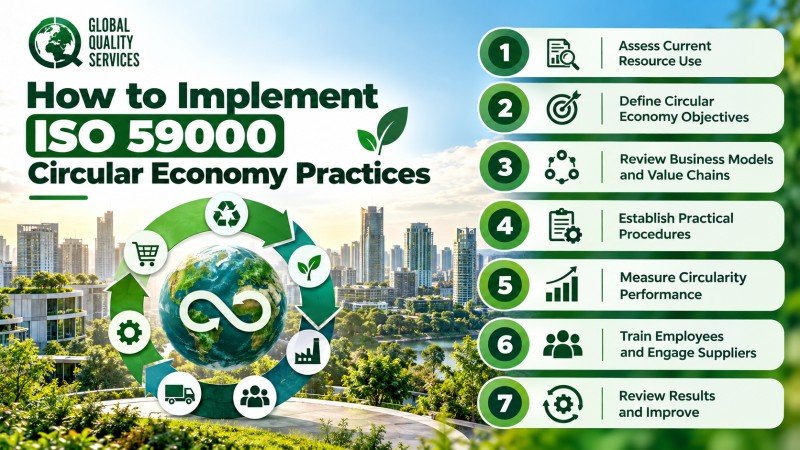
How to Implement ISO 59000 Circular Economy Practices
A successful circular economy initiative needs more than a recycling policy. Businesses should link sustainability goals to purchasing, product design, production, logistics, and performance measurement.
The following steps offer a practical starting point.
Step 1: Assess Current Resource Use
Review how your organisation purchases, consumes, stores, and disposes of materials. Review waste records, production losses, product returns, and existing reuse activities to identify opportunities for improvement.
Step 2: Define Circular Economy Objectives
Set clear goals based on your assessment. You might aim to reduce virgin material consumption, increase product reuse, recover more production waste, or improve recycled-material traceability.
Step 3: Review Business Models and Value Chains
Examine how your organisation creates and retains value. Identify opportunities for repair services, product take-back schemes, remanufacturing, reusable packaging, and partnerships with material recovery businesses.
Step 4: Establish Practical Procedures
Assign responsibilities and document relevant processes. Update purchasing criteria, product design practices, waste segregation methods, supplier requirements, and material handling procedures according to your chosen objectives.
Step 5: Measure Circularity Performance
Select suitable indicators and establish a baseline. Track material inputs, recovered resources, product life extension, reuse rates, and waste generation where relevant to your operations.
Step 6: Train Employees and Engage Suppliers
Explain new procedures to employees and involve suppliers, contractors, and recycling partners. Clear responsibilities and reliable data collection help turn circular economy objectives into daily business practices.
Step 7: Review Results and Improve
Compare actual performance with your baseline and targets. Investigate weak results, correct process gaps, and update your circular economy plan as business needs and resource opportunities change.
Choose the relevant ISO 59000 standards based on your goals. For instance, ISO 59004 can guide implementation, ISO 59010 can support business model changes, and ISO 59020 can help assess circularity performance.
What Challenges Can Businesses Face When Adopting ISO 59000
Although circular economy practices offer practical benefits, businesses may face challenges when changing established processes. Recognising these issues early helps organisations plan realistic improvements.
- Limited resource data: Businesses may lack reliable records of material consumption, waste generation, and recovered resources.
- Higher initial investment: Repair facilities, product redesign, recovery systems, and data collection may require upfront spending.
- Supplier limitations: Suppliers may not offer reusable packaging, recycled materials, or sufficient traceability information.
- Employee resistance: Teams may hesitate to change familiar procedures without clear instructions and training.
- Performance measurement: Organisations may struggle to select suitable indicators or compare results across different facilities and product lines.
Businesses can address these challenges through phased implementation, clear responsibilities, supplier engagement, and measurable targets. A consultant can help prioritise improvements based on operational needs, available resources, and commercial objectives.
Benefits of ISO 59000 Series Certification
Achieving certification across the ISO 59000 series delivers strategic advantages that extend far beyond regulatory compliance:
- Competitive Market Positioning: Differentiate your organization as a circular economy leader, attract environmentally conscious customers and investors, and gain preferential access to green procurement opportunities and sustainability-linked financing.
- Operational Excellence and Cost Reduction: Reduce raw material costs through increased recycled content and resource efficiency, minimize waste disposal expenses, and optimize asset utilization through product-as-a-service and sharing models that generate more value from existing resources.
- Risk Mitigation and Regulatory Preparedness: Proactively address emerging extended producer responsibility regulations, reduce exposure to resource price volatility and supply chain disruptions, and demonstrate due diligence on environmental impacts to insurers and legal stakeholders.
- Innovation and New Revenue Streams: Unlock circular business model opportunities that create recurring revenue, develop premium product offerings based on sustainability attributes, and build collaborative partnerships across value chains that generate shared value.
- Stakeholder Confidence and Transparency: Provide investors with credible ESG performance data, enhance brand reputation through verified sustainability commitments, and engage employees in meaningful sustainability initiatives that improve retention and attract top talent.
Why Choose Global Quality Services for Your Circular Economy Certification Journey
Our team combines deep expertise in circular economy principles with practical implementation experience across diverse industries. We understand that successful certification extends beyond documentation compliance to genuine transformation that delivers business value and environmental impact.
- Singapore Standards Expertise: Specialized knowledge of SS ISO 59000 series requirements and Singapore regulatory context, established relationships with accredited certification bodies, and a proven track record supporting organizations through successful certification.
- Industry-Specific Guidance: Tailored approaches for education and training providers, policy implementation support for government agencies and corporations, and waste management and secondary materials value chain optimization.
- Comprehensive Implementation Support: Strategy development aligned with business objectives, process design and documentation assistance, training and capacity building for internal teams, and certification audit preparation and ongoing compliance support.
- Practical Focus on Business Value: Emphasis on circular economy initiatives that generate measurable ROI, integration with existing management systems to minimize administrative burden, and support for developing circular business models that create competitive advantage.
Schedule your free consultation with Global Quality Services now and take the first step toward building a more circular, resilient, and profitable future.
Frequently Asked Questions
1. Can a company use the ISO 59000 logo on its products?
A company should not assume that implementing an ISO 59000 standard grants permission to use an ISO certification mark. Check the applicable trademark rules and any authorised assessment scheme before making certification or endorsement claims.
2. Does ISO 59000 require businesses to use a specific percentage of recycled materials?
No universal recycled-content percentage applies across the ISO 59000 family. Organisations should select suitable circularity measures based on their activities, product characteristics, resource flows, and chosen assessment approach.
3. Can a business implement ISO 59000 alongside ISO 9001 and ISO 14001?
Yes. Businesses can combine circular economy initiatives with existing quality and environmental management systems. They should map shared processes, responsibilities, objectives, and records while respecting each standard’s distinct scope.
4. How can a company verify whether its circular economy claims are credible?
Businesses should maintain traceable records of material inputs, recycled content, reuse rates, recovery activities, and calculation methods. They should also define reporting boundaries, retain supporting evidence, and avoid environmental claims that exceed verified results.
5. What happens if a company’s circularity performance does not improve after implementation?
The organisation should investigate the reasons, review its data, and identify operational barriers. It can then revise targets, improve supplier coordination, test alternative processes, and monitor whether corrective actions deliver measurable results.