Is your factory, plant, or industrial facility connected to the internet? Do your operational technology systems — the ones that control your physical processes — talk to your IT network? If yes, your organisation is exposed to a category of cyber threat that standard IT security simply was not designed to handle. GQS Singapore helps industrial organisations across Singapore implement and get certified to ISA/IEC 62443 — the global standard for Industrial Automation and Control System (IACS) cybersecurity.
What Is ISA/IEC 62443?
ISA/IEC 62443 is the international standard series for securing Industrial Automation and Control Systems (IACS). It provides a complete, structured framework for protecting the operational technology (OT) systems that run your factory, plant, utility, or critical infrastructure — from the sensors on the floor to the control room to the corporate network above.
In simple terms — when a cyberattack hits your IT systems, you might lose data or suffer downtime. When a cyberattack hits your OT systems — your PLCs, SCADA systems, DCS, and safety instrumented systems — you can lose control of physical processes. That means production shutdowns, equipment damage, environmental incidents, and in critical infrastructure, threats to public safety.
ISA/IEC 62443 is the framework specifically built to prevent that.
The standard is developed jointly by the International Society of Automation (ISA) and the International Electrotechnical Commission (IEC). The most significant recent update — ANSI/ISA-62443-2-1-2024 — was published in January 2025, introducing a maturity model approach to security programme requirements and better alignment with ISO 27001 for organisations managing both IT and OT environments. A further guidance document, ISA-TR62443-2-2-2025, was published in December 2025 providing day-to-day security protection scheme guidance for asset owners and operators.
Why Does ISA/IEC 62443 Matter in Singapore?
- Industrial cybersecurity is now a national priority in Singapore — and ISA/IEC 62443 is the framework regulators and industry leaders align with.
- Singapore’s OT Cybersecurity Masterplan 2024 — In August 2024, the Cyber Security Agency of Singapore (CSA) released an updated OT Cybersecurity Masterplan built around three pillars — People, Process, and Technology. The masterplan specifically promotes the professionalisation of the OT security workforce, enhanced threat intelligence sharing, and Secure-by-Deployment principles for industrial systems. ISA/IEC 62443 is the internationally recognised standard that operationalises all three pillars.
- Singapore’s Cybersecurity Act and CII obligations — The CSA’s Codes of Practice for Critical Information Infrastructure (CII) owners cover 11 critical sectors in Singapore including energy, water, transport, healthcare, and manufacturing. From March 2026, CSA mandates Cyber Trust Mark certification for CII owners at Level 5 by end-2027. ISA/IEC 62443 provides the OT security framework that supports these obligations — particularly now that CSA has expanded its Cyber Trust certification marks to include coverage of operational technology security. Global Compliance NewsHSA
- CSA’s Critical Information Infrastructure Sector resources specifically direct CII owners toward OT cybersecurity best practices aligned with ISA/IEC 62443 principles — covering risk assessment, zone and conduit design, security level management, and incident response.
- OT cyberattacks are rising sharply. IACS-targeted cyberattacks increased by 100% during 2024, with SCADA system ransomware incidents costing an average of USD 13 million per incident. Singapore’s industrial sector — including semiconductors, chemicals, water, energy, and advanced manufacturing — is a high-value target.
IT security alone is not enough for OT environments. A patch that needs a reboot is routine on a corporate laptop. On a PLC controlling a turbine or a chemical reactor, that same reboot could trigger a production shutdown or a safety event. Antivirus software works on workstations — it can lock up an industrial HMI at the worst possible moment. ISA/IEC 62443 was specifically designed for these realities. ISO 27001 was not.
Who Needs ISA/IEC 62443 in Singapore?
Any organisation that operates, integrates, or supplies industrial automation and control systems should be aligned with ISA/IEC 62443. The standard divides responsibilities across three roles:
- Asset Owners — organisations that own and operate IACS in their facilities. This includes manufacturing plants, power generation facilities, water treatment plants, oil and gas facilities, semiconductor fabrication plants, and pharmaceutical manufacturers. Asset owners focus primarily on ISA/IEC 62443-2-1 (security programme requirements) and 3-2 (risk assessment). Our ISO 27001 certification programme complements ISA/IEC 62443 for asset owners managing both IT and OT environments.
- System Integrators — organisations that design, build, and commission IACS for asset owner clients. System integrators are responsible for the security of the systems they deliver — including secure network architecture, zone and conduit design, and security acceptance testing. System integrators focus primarily on ISA/IEC 62443-2-4 and 3-3.
- Product Suppliers — manufacturers of industrial components, devices, and software used in IACS — including PLCs, HMIs, sensors, industrial switches, and SCADA software. Product suppliers must demonstrate that their products meet defined Security Level Capabilities (SL-C) under ISA/IEC 62443-4-1 and 4-2. Our ISO 13485 medical device certification clients in the biomedical equipment space frequently need IEC 62443-4-2 component security assurance alongside their quality management obligations.
Understanding the ISA/IEC 62443 Standard Series
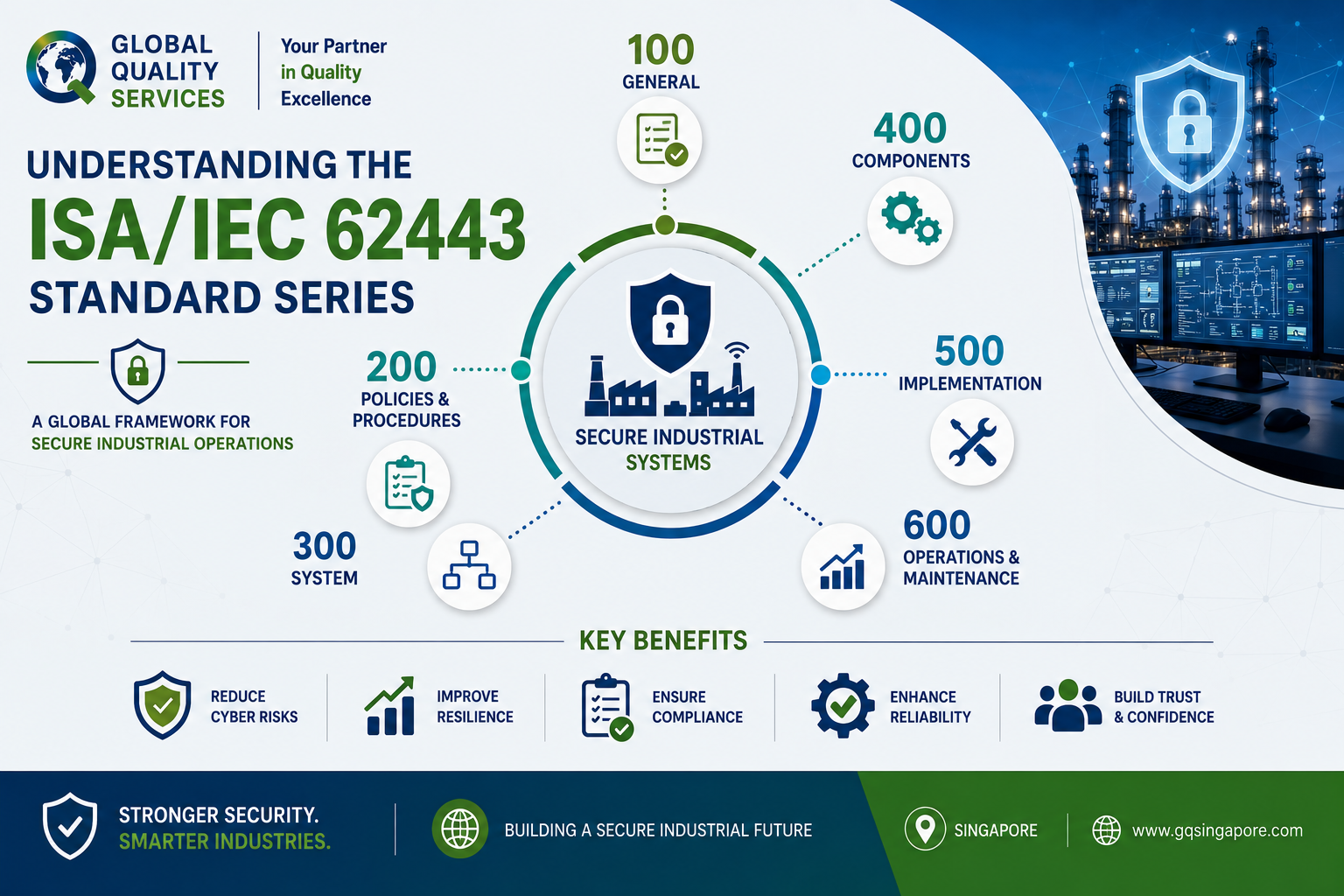
ISA/IEC 62443 is not a single document — it is a series of standards, each covering a different aspect of IACS cybersecurity. Here is what each part covers in plain language:
Series 1 — General (Terminology and Concepts)
Defines the shared vocabulary, concepts, and Security Level framework used across the entire series. Every organisation working with ISA/IEC 62443 must understand Series 1 — it is the common language that makes the rest of the standard work.
Series 2 — Policies and Procedures (Asset Owner Focus)
Covers the organisational and management requirements for operating a secure IACS. The key documents are:
- ISA/IEC 62443-2-1:2024 — Security programme requirements for asset owners. Establishes, implements, and maintains a Cybersecurity Management System (CSMS) for IACS — updated in January 2025 with a maturity model and improved alignment with ISO 27001
- ISA-TR62443-2-2:2025 — Day-to-day security protection scheme guidance for IACS asset owners and operators — published December 2025
- ISA/IEC 62443-2-4 — Security requirements for IACS service providers — what system integrators and service providers must demonstrate to asset owners
Series 3 — System Requirements (System Integrator Focus)
Covers the security requirements for the overall IACS system — including risk assessment methodology and system-level security requirements:
- ISA/IEC 62443-3-2 — Security risk assessment — the methodology for conducting a formal security risk assessment for an IACS and determining the required Security Levels for each zone and conduit
- ISA/IEC 62443-3-3 — System security requirements — the technical security requirements an integrated IACS system must meet at each Security Level
Series 4 — Component Requirements (Product Supplier Focus)
Covers the security requirements for individual IACS components and the development processes used to create them:
- ISA/IEC 62443-4-1 — Secure product development lifecycle requirements — what a product supplier’s development process must look like to produce secure IACS components
- ISA/IEC 62443-4-2 — Technical security requirements for IACS components — the specific security capabilities that embedded devices, host devices, network devices, and software applications must demonstrate
The Security Level Framework — How ISA/IEC 62443 Measures Risk
ISA/IEC 62443 uses Security Levels (SL 1 to SL 4) to define how much protection a zone, system, or component must provide — based on the sophistication of the threat actor your organisation needs to defend against.
- Security Level 1 (SL 1) — Protection against casual or unintentional violations. Basic controls for low-criticality systems where a breach would have limited operational impact.
- Security Level 2 (SL 2) — Protection against intentional violation using simple means with low resources. Appropriate for most industrial facilities where a determined individual attacker could cause significant operational disruption.
- Security Level 3 (SL 3) — Protection against intentional violation using sophisticated means with moderate resources. Required for high-criticality systems in critical infrastructure where a coordinated, well-resourced attacker could cause serious harm.
- Security Level 4 (SL 4) — Protection against intentional violation using sophisticated means with extended resources — including nation-state level threat actors. Required for the most critical systems where a successful attack could have catastrophic consequences.
GQS Singapore conducts formal Security Level determination as part of our risk assessment process — ensuring your security investments are proportional to your actual threat environment.
The Zone and Conduit Model — The Core Design Principle
The zone and conduit model is the architectural foundation of ISA/IEC 62443. Instead of treating your entire operational technology network as one flat, undifferentiated environment, ISA/IEC 62443 requires you to segment it into security zones — groups of assets with similar security requirements — connected by conduits that control and monitor what passes between them.
This is directly analogous to physical security zones in a facility. You do not give every employee access to every room. You restrict access based on the sensitivity of what is inside. Zone and conduit design does the same thing for your industrial network — limiting the blast radius of any breach and preventing attackers from moving laterally through your OT environment.
GQS Singapore designs your zone and conduit architecture as part of the ISA/IEC 62443-3-2 risk assessment process — ensuring every zone is assigned the correct Security Level and every conduit has the right controls in place.
What GQS Singapore Does for Your ISA/IEC 62443 Compliance
GQS Singapore provides end-to-end ISA/IEC 62443 consultancy — from your first OT security assessment to a fully implemented, certification-ready Cybersecurity Management System for your IACS.
Step 1 — OT Asset Inventory and Gap Assessment
We identify and document every asset in your IACS environment — PLCs, HMIs, SCADA servers, industrial switches, historians, safety systems, and remote access points — and assess your current security posture against ISA/IEC 62443 requirements. You receive a clear, prioritised gap report specific to your role — asset owner, system integrator, or product supplier.
Step 2 — Security Risk Assessment (ISA/IEC 62443-3-2)
We conduct a formal security risk assessment of your IACS — identifying threats, vulnerabilities, and consequences — and determine the required Security Level for each zone and conduit in your environment. This is the foundation of everything that follows.
Step 3 — Zone and Conduit Design
We design your OT network segmentation architecture — defining security zones, specifying conduit controls, and documenting the security level targets for each zone. This typically involves network redesign recommendations, firewall rules, and DMZ architecture between IT and OT networks.
Step 4 — Cybersecurity Management System (CSMS) Development
We build your complete CSMS aligned with ISA/IEC 62443-2-1:2024 — security policies, procedures, roles and responsibilities, patch management process, incident response plan, vendor access controls, remote access policy, and security awareness training programme — all documented and implemented.
Step 5 — Technical Control Implementation
We work with your OT and IT teams to implement the technical controls required at your determined Security Levels — network monitoring, application whitelisting, secure remote access, encrypted communications where feasible, audit logging, and backup and recovery procedures for IACS components.
Step 6 — Staff Training
We deliver customised ICS/OT cybersecurity training for all relevant personnel — control room operators, maintenance engineers, IT staff supporting OT systems, and management. Training covers the unique security challenges of OT environments, incident recognition, and reporting procedures. This complements the CSA’s OT Cybersecurity Competency Framework for workforce development.
Step 7 — Internal Audit and Certification Readiness
We conduct a full internal audit of your CSMS and technical controls before your certification assessment — identifying and closing remaining gaps. We also coordinate with accredited ISASecure certification bodies for formal assessment where ISASecure Component Security Assurance (CSA), System Security Assurance (SSA), or Security Development Lifecycle Assurance (SDLA) certification is required.
Step 8 — Ongoing Support
OT cybersecurity is not static — threats evolve, systems change, and regulations develop. GQS Singapore provides ongoing support — annual reviews, incident response support, patch management guidance, and security programme updates — keeping your CSMS genuinely effective year-round.
ISA/IEC 62443 Works Well With These Certifications
ISA/IEC 62443 is most powerful when combined with complementary cybersecurity and quality management certifications. GQS Singapore delivers all of the following in integrated programmes:
- ISO 27001 Information Security Management — The most natural companion to ISA/IEC 62443. The updated ISA/IEC 62443-2-1:2024 explicitly removed redundancies with ISO 27001, making the two standards easier and more efficient to run together. ISO 27001 covers IT; ISA/IEC 62443 covers OT — together they protect your entire digital environment
- TVRA — Threat, Vulnerability and Risk Assessment — MAS-required for financial institutions, TVRA methodology directly complements the ISA/IEC 62443-3-2 risk assessment for organisations with both OT and financial systems obligations
- ISO 27701 Privacy Information Management — For industrial organisations that also handle personal data from employees, customers, or connected products
- SOC 2 Certification — For system integrators and product suppliers whose enterprise clients require third-party security attestation alongside IEC 62443 compliance
- ISO 13485 Medical Device Quality Management — For medical device manufacturers whose connected devices carry IEC 62443-4-2 component security requirements alongside quality management obligations
- ISO 22301 Business Continuity Management — IACS incidents can cause significant operational disruption. ISO 22301 ensures your organisation can recover quickly when OT security incidents impact production
- VAPT — Vulnerability Assessment and Penetration Testing — OT-specific penetration testing validates that your zone and conduit architecture and technical controls are working as designed in practice — not just on paper
Ready to secure your industrial systems and achieve ISA/IEC 62443 certification in Singapore? Global Quality Services (GQS) Singapore specialises in making industrial cybersecurity certification practical and achievable for organisations of all sizes — from single-site manufacturers to multi-facility critical infrastructure operators. Our team guides you every step of the way.
Frequently Asked Questions
1. What is the difference between ISA/IEC 62443 and ISO 27001?
ISO 27001 is designed for IT environments — corporate networks, servers, data, and cloud systems. ISA/IEC 62443 is designed specifically for OT environments — PLCs, SCADA, DCS, and industrial control systems where a cyberattack can affect physical processes. The two standards complement each other and GQS Singapore delivers both in integrated programmes.
2. Does ISA/IEC 62443 apply to all manufacturers in Singapore?
It applies to any organisation that operates IACS — industrial automation and control systems. This includes manufacturers, utilities, energy providers, water treatment facilities, transportation operators, and any facility where computers control physical processes. Organisations in Singapore’s 11 CII sectors have additional obligations under the Cybersecurity Act that ISA/IEC 62443 directly supports.
3. What is the Security Level and how is it determined?
Security Levels (SL 1 to SL 4) define how much protection a zone, system, or component must provide based on the threat actor your organisation needs to defend against. The required Security Level for each part of your IACS is determined through a formal risk assessment under ISA/IEC 62443-3-2 — which GQS Singapore conducts as part of our engagement.
4. How long does ISA/IEC 62443 implementation take with GQS Singapore?
Timeline depends on the size and complexity of your IACS environment and your current security maturity. A focused implementation for a single manufacturing facility typically takes 4 to 6 months. A multi-site or complex critical infrastructure environment may require 9 to 12 months. GQS Singapore provides a clear timeline after the initial asset inventory and gap assessment.
5. Can GQS Singapore combine ISA/IEC 62443 with ISO 27001 in one engagement?
Yes — and this is one of our most requested programmes. The updated ISA/IEC 62443-2-1:2024 was specifically redesigned to reduce overlap with ISO 27001, making a combined engagement more efficient than ever. GQS Singapore delivers both in a single integrated programme covering your entire IT and OT security environment.