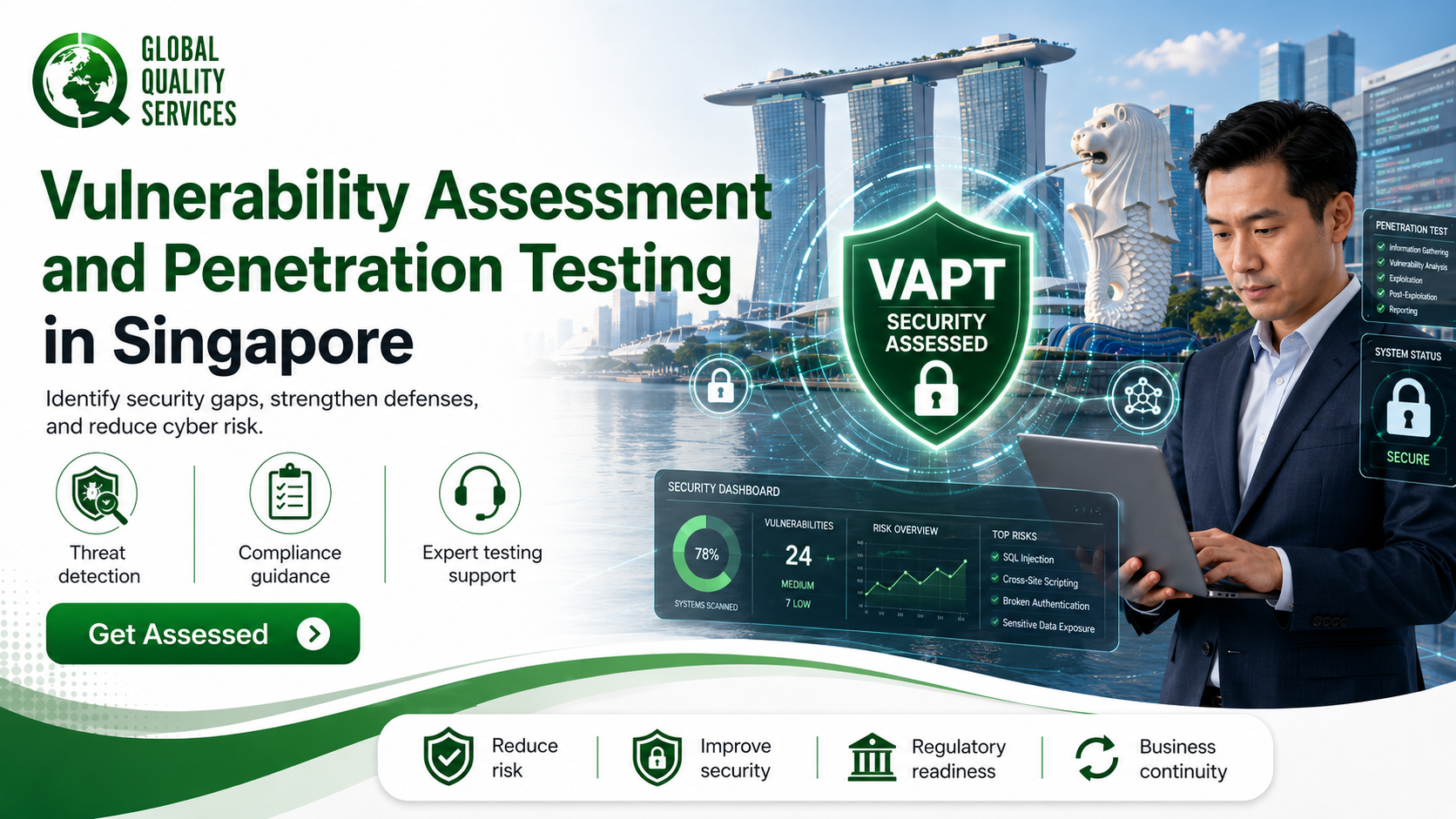
Is your business truly secure — or does it just feel secure? Most cyberattacks succeed not because defences do not exist, but because nobody tested whether those defences actually work. GQS Singapore helps organisations across Singapore conduct VAPT — Vulnerability Assessment and Penetration Testing — to find and fix security weaknesses before attackers do.
With over 21 years of experience and 1,450+ satisfied clients across Asia-Pacific, GQS Singapore is your trusted partner for cybersecurity compliance and VAPT readiness in Singapore.
What Is VAPT — In Simple Terms?
VAPT stands for Vulnerability Assessment and Penetration Testing. It is a two-part cybersecurity testing process that identifies weaknesses in your IT systems and then tests whether those weaknesses can actually be exploited by an attacker.
Think of it as hiring someone to try to break into your building — legally and in a controlled way — so you can fix every gap before a real criminal finds it.
Vulnerability Assessment (VA) is the first part. It involves systematically scanning your systems, networks, applications, and infrastructure to identify known security gaps — outdated software, misconfigured servers, weak passwords, missing patches, and open ports that should not be open.
Penetration Testing (PT) is the second part. This goes further. Skilled security professionals manually attempt to exploit the vulnerabilities found in the assessment — simulating the techniques a real attacker would use — to determine how far they can get and what data or systems they can access.
Together, VAPT gives you a clear, honest picture of your actual security posture — not just your theoretical one.
Why VAPT Is Critical for Singapore Businesses
Singapore businesses face a rapidly growing cyber threat landscape. Organisations in Singapore face one of the highest third-party breach rates in the world. Regulatory bodies are tightening cybersecurity requirements across every sector. A single breach can result in regulatory fines, contract losses, reputational damage, and significant recovery costs.
Here is why VAPT is no longer optional for Singapore organisations:
It is required by Singapore’s regulators. The Monetary Authority of Singapore (MAS) Technology Risk Management (TRM) Guidelines require financial institutions to conduct regular VAPT. The Personal Data Protection Commission (PDPC) expects organisations handling personal data to implement and test reasonable security arrangements under the Personal Data Protection Act (PDPA).
Penetration testing is a licensed activity in Singapore. Under Singapore’s Cybersecurity Act, penetration testing is a regulated service. All providers offering penetration testing to the Singapore market must hold a valid licence issued by the Cybersecurity Services Regulation Office (CSRO) — the government body set up by the Cyber Security Agency of Singapore (CSA) to administer the licensing framework. Engaging an unlicensed provider exposes your organisation to regulatory risk.
It is required for CSA Cyber Trust Mark. The CSA’s Cyber Trust Mark and Cyber Essentials Mark — Singapore’s national cybersecurity certification schemes — require organisations to demonstrate regular security testing as part of their certification. VAPT is a core requirement for achieving Cyber Trust Mark status.
It supports ISO 27001 compliance. ISO 27001 Information Security Management certification requires organisations to conduct regular security assessments. VAPT is the most direct way to satisfy this requirement and demonstrate that your controls are actually working.
It protects your customers and your contracts. Enterprise clients, government agencies, and international partners increasingly require their vendors to provide evidence of regular VAPT as a condition of doing business. A VAPT report is proof of due diligence.
Who Needs VAPT in Singapore?
Financial institutions and fintech companies regulated by MAS must conduct VAPT as part of their Technology Risk Management obligations. MAS TRM guidelines specifically require penetration testing of internet-facing systems and critical internal infrastructure.
Healthcare organisations handling patient data under the Personal Data Protection Commission (PDPC) Healthcare Advisory Guidelines and the new Health Information Act must demonstrate that their digital systems are secured and tested. Our HIPAA compliance consultancy and VAPT services work together for healthcare organisations serving international markets.
Government vendors and contractors supplying IT services to Singapore government agencies are required to meet GovTech cybersecurity standards, which include regular VAPT of systems handling government data.
E-commerce and SaaS businesses that store customer payment data, personal data, or sensitive business information face both PDPA obligations and PCI DSS requirements. Our PCI DSS compliance consultancy pairs directly with VAPT for these organisations.
IT service providers and managed service providers who hold sensitive client data or access to client systems are increasingly required by enterprise clients to provide annual VAPT reports as a vendor due diligence requirement.
Organisations pursuing ISO 27001, SOC 2, or DPTM certification need VAPT evidence as part of their audit preparation. GQS Singapore coordinates VAPT with your ISO 27001, SOC 2, and DPTM SS 714:2025 certification programmes.
Types of VAPT GQS Singapore Supports
Network VAPT — Testing of your internal and external network infrastructure including routers, switches, firewalls, servers, and endpoints. Identifies unpatched systems, open ports, misconfigured network devices, and weak access controls that could allow an attacker to move laterally through your environment.
Web Application VAPT — Testing of your internet-facing web applications for vulnerabilities including SQL injection, cross-site scripting (XSS), broken authentication, insecure direct object references, and business logic flaws that automated scanners routinely miss.
API VAPT — Testing of your application programming interfaces (APIs) for authentication weaknesses, excessive data exposure, injection vulnerabilities, and broken access control — critical for SaaS platforms, mobile applications, and microservices architectures.
Mobile Application VAPT — Testing of Android and iOS applications for insecure data storage, weak cryptography, improper session management, and client-side vulnerabilities.
Cloud Infrastructure VAPT — Testing of your cloud environment — AWS, Azure, or Google Cloud — for misconfigured storage buckets, overly permissive IAM roles, exposed management interfaces, and insecure cloud-native services. This pairs naturally with our ISO/IEC 27017 cloud security certification programme.
Wi-Fi VAPT — Testing of your wireless network infrastructure for rogue access points, weak encryption, and unauthorised access vulnerabilities — particularly important for offices, retail locations, and healthcare facilities with guest Wi-Fi.
Social Engineering Testing — Simulated phishing campaigns and social engineering exercises to test your staff’s ability to recognise and report manipulation attempts — the most common entry point for real-world attackers.
What the VAPT Process Looks Like — Step by Step
Step 1 — Scoping We work with your team to define exactly what systems, applications, and environments will be tested, the testing methodology (black box, grey box, or white box), and the rules of engagement. Clear scoping protects your operations and ensures the testing produces useful, actionable results.
Step 2 — Vulnerability Assessment We conduct systematic scanning and enumeration of your defined scope — identifying known vulnerabilities, misconfigurations, outdated components, and security gaps across your environment. Every finding is documented with its severity rating.
Step 3 — Penetration Testing Our security team manually attempts to exploit identified vulnerabilities — chaining weaknesses together the way a real attacker would — to determine the true impact and reach of each security gap. This phase goes well beyond what any automated scanner can achieve.
Step 4 — Reporting You receive a comprehensive VAPT report containing an executive summary for management, a detailed technical findings section for your IT team, risk ratings for every vulnerability found (Critical, High, Medium, Low), and specific, prioritised remediation recommendations for each finding.
Step 5 — Remediation Support GQS Singapore does not just hand you a report and disappear. We work with your IT team to understand each finding, prioritise fixes based on business risk, and implement the recommended remediation steps. This is where real security improvement happens.
Step 6 — Retest After remediation, we conduct a targeted retest of all identified vulnerabilities to confirm they have been properly fixed and no new issues have been introduced. Your final VAPT report reflects the retested, remediated state of your environment.
Understanding the VAPT Report
The VAPT report is the formal deliverable your organisation receives at the end of the engagement. It is what auditors, regulators, clients, and certification bodies ask to see. A quality VAPT report contains:
- Executive Summary — A non-technical overview of the testing scope, methodology, overall risk posture, and key findings. Written for management and board-level stakeholders who need to understand the business risk without reading technical details.
- Scope and Methodology — A clear record of what was tested, how it was tested, the timeframe of testing, and the tools and techniques used. This section establishes the credibility and completeness of the engagement.
- Findings Register — A complete list of every vulnerability identified, with its risk rating, a description of the issue, evidence of exploitation, business impact, and specific remediation guidance. Findings are rated using internationally recognised frameworks such as CVSS (Common Vulnerability Scoring System).
- Risk Summary — A visual breakdown of findings by severity level — Critical, High, Medium, Low, and Informational — giving management an at-a-glance view of your security posture.
- Remediation Roadmap — A prioritised action plan telling your team exactly what to fix first, what can wait, and what the acceptable risk level is for lower-priority findings.
- Retest Results — Confirmation of which vulnerabilities were successfully remediated, providing a clean closing record for audit and compliance purposes.
This report satisfies evidence requirements for MAS TRM audits, PDPC compliance reviews, ISO 27001 certification, SOC 2 attestation, CSA Cyber Trust Mark, and enterprise vendor due diligence requests.
VAPT and Related Certifications — How They Work Together
VAPT does not exist in isolation. GQS Singapore integrates VAPT preparation and evidence into your broader compliance programme:
ISO 27001 Information Security Management — ISO 27001 requires regular security testing as part of Annex A controls. VAPT directly satisfies this requirement and the findings feed into your risk register and treatment plan.
TVRA — Threat, Vulnerability and Risk Assessment — TVRA is a structured risk assessment methodology required by MAS for financial institutions. VAPT findings provide the technical evidence that TVRA assessments are built on.
DPTM SS 714:2025 Data Protection Trust Mark — Singapore’s Data Protection Trust Mark certification requires demonstrated security controls and testing. VAPT evidence is a key component of DPTM assessment preparation.
SOC 2 Certification — SOC 2 Type 2 audits require evidence of ongoing security testing. Regular VAPT, properly documented, directly supports your SOC 2 audit evidence package.
ISO 27701 Privacy Information Management — Privacy by design requires that systems handling personal data are regularly tested for security vulnerabilities. VAPT is the practical demonstration of this principle.
PCI DSS Compliance — PCI DSS Requirement 11 explicitly mandates regular internal and external penetration testing for organisations handling payment card data. GQS Singapore aligns VAPT scope directly with PCI DSS requirements.
ISO 22301 Business Continuity Management — VAPT findings inform your business impact analysis and help identify which system compromises would cause the greatest operational disruption — critical input for business continuity planning.
Frequently Asked Questions
1. Is VAPT mandatory in Singapore?
VAPT is mandatory for MAS-regulated financial institutions under TRM Guidelines, and strongly expected for organisations handling personal data under PDPA. CSA Cyber Trust Mark certification also requires regular security testing.
2. How often should VAPT be conducted?
Annual VAPT is the accepted standard in Singapore. Additional testing should be triggered by major system changes, new application launches, significant infrastructure changes, or following a security incident.
3. What is the difference between Vulnerability Assessment and Penetration Testing?
Vulnerability Assessment identifies and catalogues security weaknesses. Penetration Testing goes further — it actively attempts to exploit those weaknesses to determine whether they can be used to breach your systems. Both are needed for a complete picture.
4. How long does a VAPT engagement take with GQS Singapore?
A focused web application VAPT typically takes 1 to 2 weeks. A full enterprise VAPT covering network, applications, cloud, and social engineering typically takes 3 to 6 weeks depending on scope and complexity.
5. Can GQS Singapore combine VAPT with ISO 27001 or SOC 2 certification?
Yes. GQS Singapore regularly integrates VAPT into ISO 27001, SOC 2, DPTM, and PCI DSS programmes — ensuring VAPT findings feed directly into your compliance evidence and remediation planning.