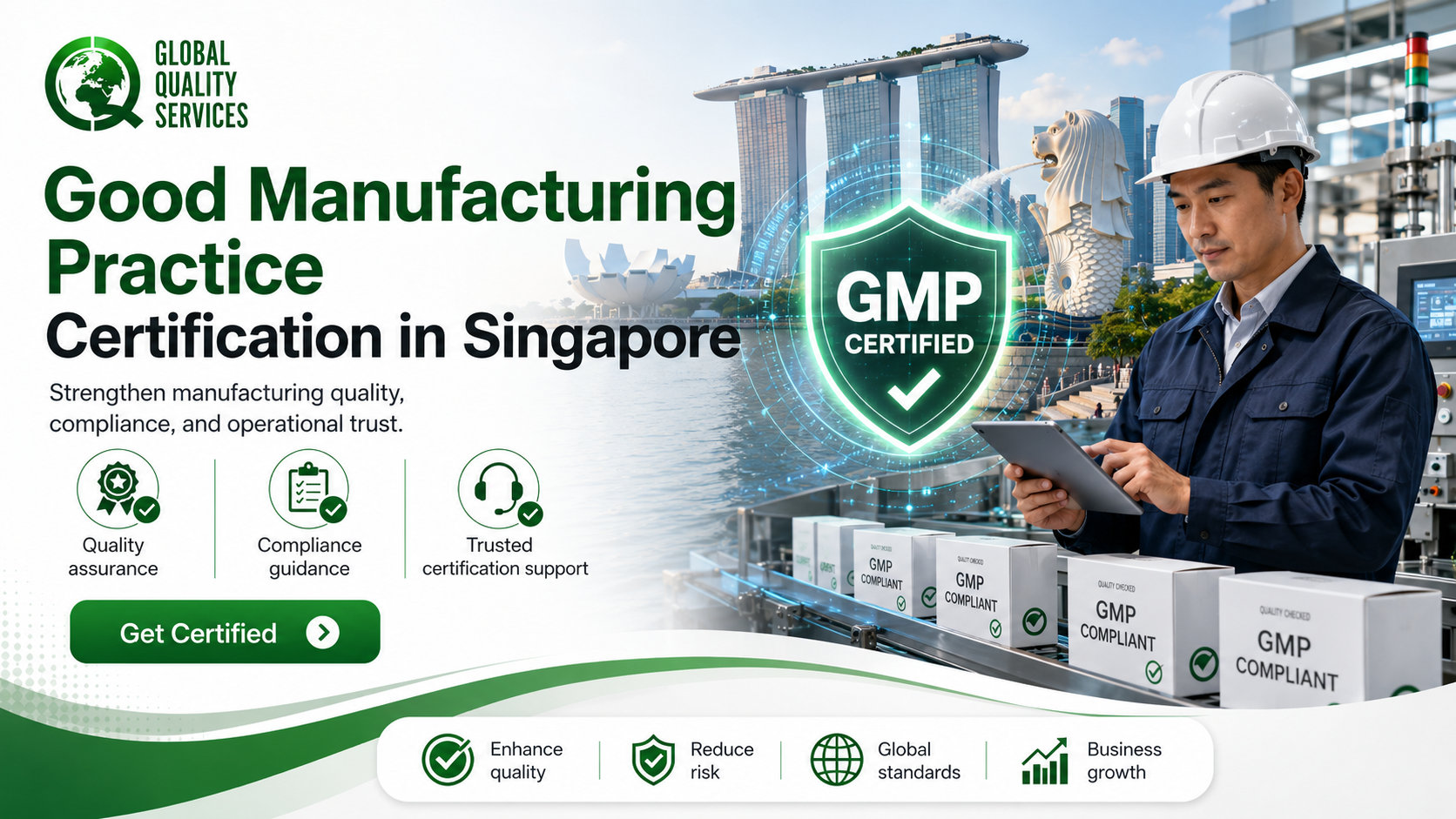
If your business manufactures pharmaceutical products, food, medical devices, or cosmetics in Singapore, GMP compliance is not optional — it is a legal requirement. GQS Singapore helps manufacturers understand GMP requirements, prepare for inspections, fix gaps, and stay compliant with Singapore’s Health Sciences Authority (HSA) standards — without the confusion.
With over decades of experience across Singapore and Asia-Pacific, GQS Singapore is your trusted partner for GMP certification consultancy in Singapore.
What Is GMP — In Simple Terms?
GMP stands for Good Manufacturing Practice. It is a system that ensures products are consistently produced and controlled according to quality standards. Simply put, GMP makes sure that whatever your facility manufactures — whether it is a medicine, a food product, or a medical device — is safe, effective, and of the quality it is supposed to be every single time.
GMP covers everything in your manufacturing process — the people, the equipment, the raw materials, the production environment, the documentation, and the testing. It is not a one-time check. It is an ongoing system that your entire organisation must follow daily.
In Singapore, GMP is enforced and inspected by the Health Sciences Authority (HSA) — the government body responsible for ensuring the safety, quality, and efficacy of therapeutic products, food, and health-related goods in Singapore.
Why Does GMP Matter in Singapore?
Singapore is one of Asia’s most important pharmaceutical and life sciences manufacturing hubs. The Singapore government takes product quality and patient safety very seriously — and GMP is the foundation of that commitment.
Here is why GMP compliance is critical for your business in Singapore:
It is a legal requirement. All manufacturers of therapeutic products, pharmaceutical drugs, medical devices, and certain food categories must comply with GMP standards to obtain and maintain a manufacturer’s licence from HSA.
It is now mandatory for drug substance manufacturers. From 1 October 2024, the HSA made GMP compliance evidence mandatory for all chemical drug substance manufacturers supporting new or generic drug applications in Singapore. Applications submitted without GMP compliance evidence are not accepted. Full details are available at the HSA GMP Evidence for Drug Substance Manufacturers page.
It protects your business. A failed GMP inspection can result in your manufacturer’s licence being suspended, products being recalled, and your business reputation suffering serious damage that takes years to recover from.
It opens global markets. Singapore is a member of the Pharmaceutical Inspection Co-operation Scheme (PIC/S) — one of the most respected international pharmaceutical inspection bodies. GMP compliance in Singapore is recognised by regulators in the US, Europe, Australia, and across Asia, making it a passport for global market access.
It builds customer trust. For B2B manufacturers supplying to hospitals, distributors, or international buyers, GMP certification demonstrates that your products meet internationally recognised quality standards — a key requirement for many supply contracts.
Who Needs GMP Certification in Singapore?
GMP requirements apply to a wide range of manufacturers and industries in Singapore:
Pharmaceutical manufacturers producing prescription drugs, over-the-counter medicines, or active pharmaceutical ingredients (APIs) for the Singapore or export market must be GMP-compliant and licenced by HSA.
Medical device manufacturers whose products have software, biological, or sterile components must meet GMP requirements aligned with ISO 13485 Quality Management for Medical Devices — a certification GQS Singapore specialises in.
Food and nutraceutical manufacturers producing health supplements, functional foods, and similar products are increasingly required to demonstrate GMP compliance alongside FSSC 22000 food safety certification and BRC certification.
Cosmetic and personal care product manufacturers must follow GMP guidelines for cosmetics as part of ASEAN Cosmetic Directive requirements applicable in Singapore.
Contract manufacturers and third-party manufacturers supplying finished products or raw materials to licenced pharmaceutical or food companies are subject to GMP requirements through their clients’ obligations.
Overseas manufacturers wishing to register therapeutic products in Singapore must provide GMP compliance evidence to HSA — typically a valid GMP certificate issued by a PIC/S member authority. Details are at the HSA GMP Conformity Assessment page.
The 10 Core Areas GMP Covers
GMP is not just about your production floor. It covers every part of your operation that can affect product quality. The ten core areas your GMP system must address are:
1. Quality Management System — A documented system defining responsibilities, procedures, and quality standards across your entire organisation.
2. Personnel — Every person involved in manufacturing must be adequately trained, qualified, and aware of their GMP responsibilities. This includes hygiene requirements and health monitoring.
3. Premises and Equipment — Your facility must be designed, built, and maintained to prevent contamination, mix-ups, and errors. Equipment must be qualified, calibrated, and maintained on a documented schedule.
4. Documentation — GMP is heavily document-driven. Every procedure, every batch, every deviation, every test result, and every corrective action must be recorded accurately and retained for the required period.
5. Production — Manufacturing processes must be clearly defined, validated, and followed consistently. Deviations from standard procedures must be recorded and investigated.
6. Quality Control — Independent testing of raw materials, in-process samples, and finished products must be conducted before any batch is released. All results must be within specification.
7. Outsourced Activities — If you outsource any part of your manufacturing or testing, your suppliers and contract labs must also meet GMP standards. You remain responsible for their compliance.
8. Complaints and Recalls — You must have a documented system for handling customer complaints and executing product recalls quickly and effectively when needed.
9. Self-Inspection — Regular internal GMP audits must be conducted to identify weaknesses before the HSA inspector does. GQS Singapore conducts these internal audits for you.
10. Change Control — Any change to your processes, equipment, materials, or facilities must go through a formal change control process to ensure GMP compliance is maintained.
What GQS Singapore Does for Your GMP Compliance
GQS Singapore provides end-to-end GMP consultancy — from your first assessment all the way through to inspection readiness and ongoing compliance. Here is what our engagement covers:
1. GMP Gap Assessment We review your current facilities, processes, documentation, and quality systems against HSA GMP requirements and the PIC/S GMP Guide. You receive a clear, prioritised report of exactly what needs to change before your next inspection.
2. Quality Management System Development We build or improve your entire Quality Management System — Standard Operating Procedures (SOPs), batch records, validation protocols, change control systems, deviation management, CAPA (Corrective and Preventive Action) processes, and all supporting documentation.
3. Facility and Equipment Qualification Support We guide your team through Installation Qualification (IQ), Operational Qualification (OQ), and Performance Qualification (PQ) for critical equipment and utilities — a mandatory requirement under GMP.
4. Process Validation We support the validation of your manufacturing processes to demonstrate that they consistently produce products meeting their specifications. This is non-negotiable for pharmaceutical manufacturers.
5. Staff GMP Training We deliver customised GMP training for all staff levels — production operators, quality control teams, warehouse staff, and management. Training covers GMP principles, documentation practices, hygiene requirements, and deviation reporting.
6. Internal GMP Audit Before your HSA inspection, we conduct a thorough internal audit to identify weaknesses and correct them. Our internal audit process mirrors the approach used in our ISO 9001:2026 quality management certification consultancy — giving you a genuine inspection-ready review, not just a paper exercise.
7. HSA Inspection Preparation We prepare your team for what to expect during an HSA GMP inspection — how inspectors work, what common deficiency areas are (HSA publishes these publicly), how to present your documentation, and how to respond professionally to inspector queries.
8. Post-Inspection CAPA Support If your HSA inspection results in observations or deficiencies, GQS Singapore helps you draft and implement a Corrective and Preventive Action (CAPA) plan that satisfies HSA’s requirements and closes the findings within the required timeframe.
9. Ongoing GMP Compliance Maintenance GMP compliance must be maintained continuously — not just at inspection time. We provide periodic reviews, SOP updates, retraining, change control support, and annual internal audits to keep your system genuinely effective year-round.
GMP and Related Certifications — How They Work Together
GMP does not exist in isolation. Singapore manufacturers frequently need GMP alongside other quality and regulatory certifications. GQS Singapore delivers all of the following and can run them together with GMP in integrated programmes:
- ISO 9001:2026 Quality Management System — The foundation quality management standard. GMP builds on ISO 9001 principles and the two are highly complementary. Many manufacturers pursue both simultaneously.
- ISO 13485 Medical Device Quality Management — The medical device sector equivalent of pharmaceutical GMP. Mandatory for medical device manufacturers in Singapore and required for global market access.
- FSSC 22000 Food Safety Certification — For food and nutraceutical manufacturers, FSSC 22000 and food GMP requirements work hand in hand. GQS Singapore delivers both.
- BRC Global Standard Certification — The British Retail Consortium standard is widely required by international retail buyers and incorporates GMP-aligned manufacturing hygiene and quality requirements.
- Good Laboratory Practice (GLP) Certification — GLP governs the quality of laboratory testing and is the natural companion to GMP for pharmaceutical and chemical manufacturers conducting product testing.
- PCQI Certification — Preventive Controls Qualified Individual certification, required for manufacturers supplying to the US market under the FDA Food Safety Modernisation Act (FSMA).
- ISO 45001 Occupational Health and Safety — GMP facilities must maintain safe working environments. ISO 45001 and GMP share overlapping requirements for workplace safety, cleanliness, and staff health monitoring.
- ISO 14001 Environmental Management — Pharmaceutical and food manufacturers in Singapore increasingly need to demonstrate environmental responsibility alongside GMP compliance.
Running these programmes in parallel — rather than one after another — reduces total cost, minimises disruption to your operations, and produces a stronger, more integrated quality system. Ready to get GMP certified in Singapore? GQS Singapore’s expert team is just a call away — contact us today for a free consultation.
Frequently Asked Questions
1. Is GMP certification mandatory for all manufacturers in Singapore?
Yes, for pharmaceutical, therapeutic product, and medical device manufacturers. HSA requires a valid manufacturer’s licence, and GMP compliance is the foundation of that licence. Food manufacturers may also be required to follow GMP under specific product categories.
2. Who conducts GMP inspections in Singapore?
The Health Sciences Authority (HSA) conducts GMP inspections for therapeutic product and active ingredient manufacturers in Singapore. HSA is a member of PIC/S, meaning its inspections meet international pharmaceutical GMP standards.
3. How is GMP different from ISO 9001?
ISO 9001 is a general quality management standard applicable to any industry. GMP is sector-specific — designed for pharmaceutical, food, and medical device manufacturing — and is much more prescriptive about facility design, documentation, validation, and contamination control.
4. How long does it take to become GMP compliant with GQS Singapore?
Timelines depend on your current state of readiness. A facility with some quality systems already in place typically takes 3 to 6 months. A facility starting from scratch may require 6 to 12 months for full implementation and inspection readiness.
5. Can GQS Singapore help with GMP and ISO 13485 or FSSC 22000 at the same time?
Absolutely. GQS Singapore specialises in integrated programmes combining GMP with ISO 13485, FSSC 22000, BRC, GLP, and ISO 9001 — saving significant time and cost compared to pursuing each separately.