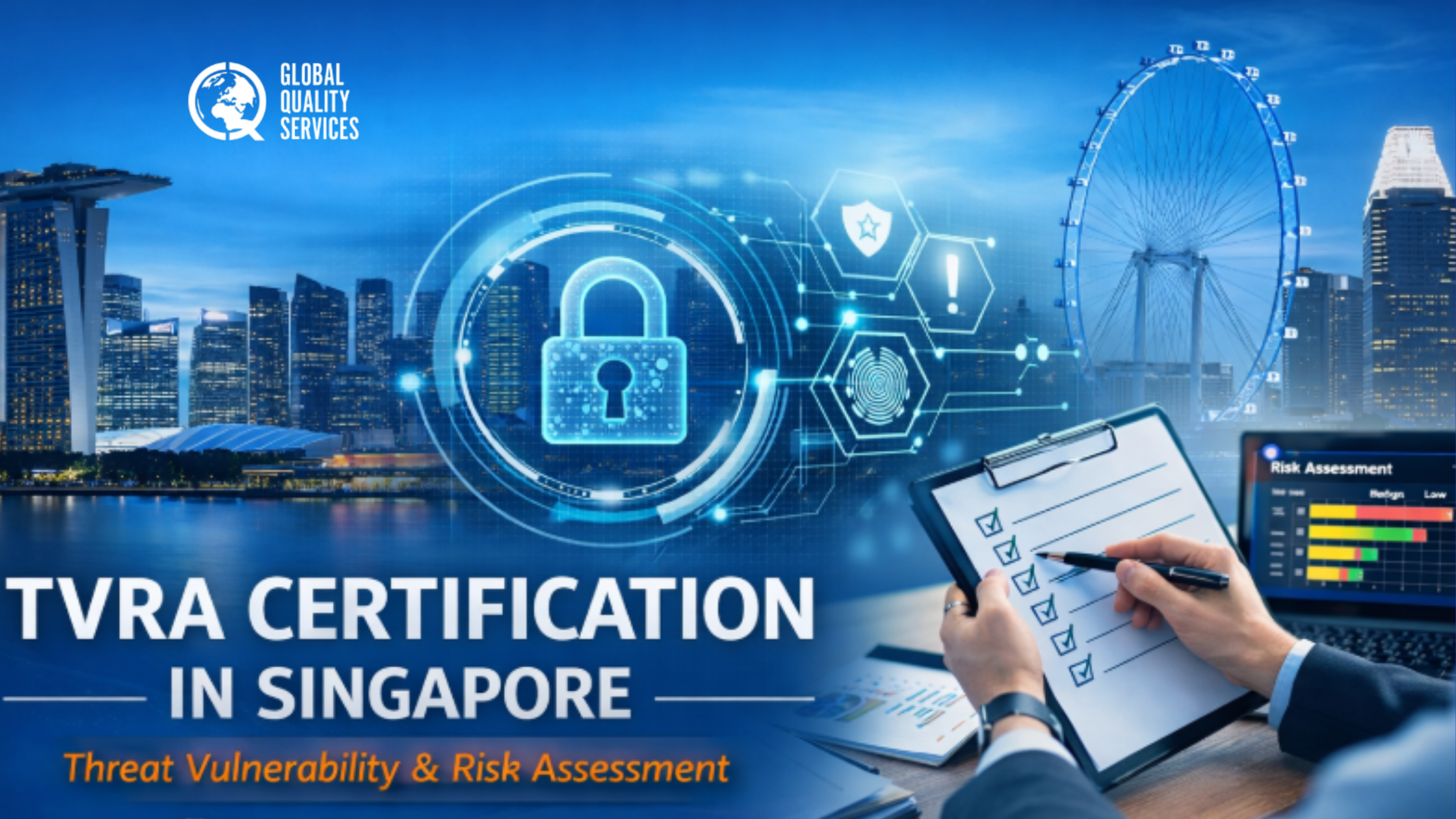
Threat, Vulnerability, and Risk Assessment (TVRA) plays a critical role in securing facilities that handle sensitive operations, infrastructure, or data. In Singapore, regulatory bodies expect organizations to adopt a structured approach to risk identification and mitigation, particularly in sectors such as finance, data centers, and critical infrastructure. Global Quality Services supports organizations in Singapore with end-to-end TVRA certification, ensuring assessments are not just compliant but practically aligned with real operational risks.
What is TVRA Certification?
TVRA certification refers to a structured assessment methodology used to identify potential threats, evaluate vulnerabilities, and determine a facility’s overall risk exposure. It is widely used in Singapore for environments where operational disruption or security breaches can have significant consequences. The process is not limited to documentation. It involves analyzing real-world scenarios, understanding asset criticality, and applying risk-scoring models to help organizations prioritize mitigation efforts effectively.
For regulatory reference, organizations can review the
- Monetary Authority of Singapore Technology Risk Management Guidelines
- Singapore Police Force advisory framework for risk assessments
TVRA certification provides organizations with a structured and defensible approach to understanding risk exposure across critical assets and operations. It ensures that risk management decisions are based on real-world scenarios rather than assumptions.
Benefits of TVRA Certification
TVRA certification provides clarity on where risks exist and how they impact business continuity. It enables organizations to move from reactive security practices to a structured and measurable risk management approach.
Regulatory Compliance
Ensures alignment with Singapore regulatory frameworks such as MAS Technology Risk Management guidelines, reducing compliance gaps and improving audit readiness across regulated sectors.
Improved Risk Visibility
Provides a comprehensive view of vulnerabilities across infrastructure, systems, and operational processes, allowing organizations to address risks proactively rather than reactively.
Business Continuity Protection
Helps identify critical failure points and potential disruptions early, enabling the implementation of safeguards that support uninterrupted operations.
Better Decision-Making
Supports leadership with data-driven insights, enabling the prioritization of investments based on actual risk exposure rather than assumptions.
TVRA Certification Process
A structured TVRA process ensures that risks are not only identified but also properly understood and prioritized. Each stage builds depth into the assessment, allowing organizations to move from basic visibility to actionable risk control.
Scope Definition and Asset Identification
The process begins with defining the assessment scope based on business operations, facility type, and regulatory requirements. Critical assets are identified, including physical infrastructure, IT systems, utilities, and operational dependencies. This step ensures the assessment is aligned with what actually matters to the organization, rather than applying a generic checklist.
Threat Scenario Identification
Threat scenarios are developed based on location-specific risks, industry exposure, and historical data. This includes both intentional threats, such as unauthorized access or sabotage, and non-intentional risks, such as system failures or environmental disruptions. The goal is to create realistic scenarios that reflect how incidents could occur in practice.
Vulnerability Assessment
At this stage, existing controls are evaluated across physical security, access management, environmental safeguards, and operational procedures. Site inspections and system reviews are conducted to identify gaps that could be exploited under defined threat scenarios. This step moves beyond theory and focuses on actual weaknesses within the facility.
Risk Analysis and Evaluation
Each identified risk is assessed using a structured model that considers likelihood, impact, and exposure. This allows risks to be ranked by severity rather than treated equally. The outcome is a prioritized risk register that clearly highlights critical vulnerabilities requiring immediate attention.
Reporting and Mitigation Planning
A detailed TVRA report is prepared, documenting methodology, findings, and risk ratings. More importantly, it includes practical mitigation strategies tailored to the organization’s operations. Recommendations are structured to support implementation, compliance audits, and future reassessments.
Why Choose Global Quality Services
Global Quality Services delivers TVRA certification in Singapore with a strong focus on practical risk assessment and regulatory alignment rather than generic reporting. Our team understands local compliance requirements, including MAS expectations, and applies a structured methodology that reflects real-world threat scenarios. We provide clear, audit-ready documentation, supported by actionable mitigation strategies, to ensure organizations can implement recommendations effectively. With experience across sectors such as finance, data centers, and infrastructure, we tailor each assessment to operational realities, helping businesses strengthen their security posture while maintaining compliance and continuity.
FAQ
What is TVRA certification, and why is it important in Singapore?
TVRA certification is a structured risk assessment process used to identify threats, vulnerabilities, and risks across critical facilities. In Singapore, it is important to meet regulatory expectations, especially in sectors like finance and infrastructure, while ensuring operational resilience.
Is TVRA certification mandatory for all businesses in Singapore?
TVRA certification is not mandatory for all businesses. Still, it is required or strongly recommended for regulated sectors such as financial institutions and critical infrastructure, where risk assessment is essential for compliance and security management.
How long does it take to complete a TVRA certification?
The duration of a TVRA assessment depends on the size and complexity of the facility. In Singapore, most projects typically take between two and six weeks, including evaluation, reporting, and review of mitigation strategies.
What are the key components of a TVRA assessment?
A TVRA assessment includes asset identification, threat scenario development, vulnerability analysis, risk evaluation, and mitigation planning. These components work together to provide a structured understanding of risks and recommended actions for improvement.
Who should conduct a TVRA assessment in Singapore?
A TVRA assessment should be conducted by experienced professionals who understand risk assessment methodologies and Singapore regulatory frameworks. This ensures the assessment is accurate, compliant, and aligned with industry-specific operational requirements.