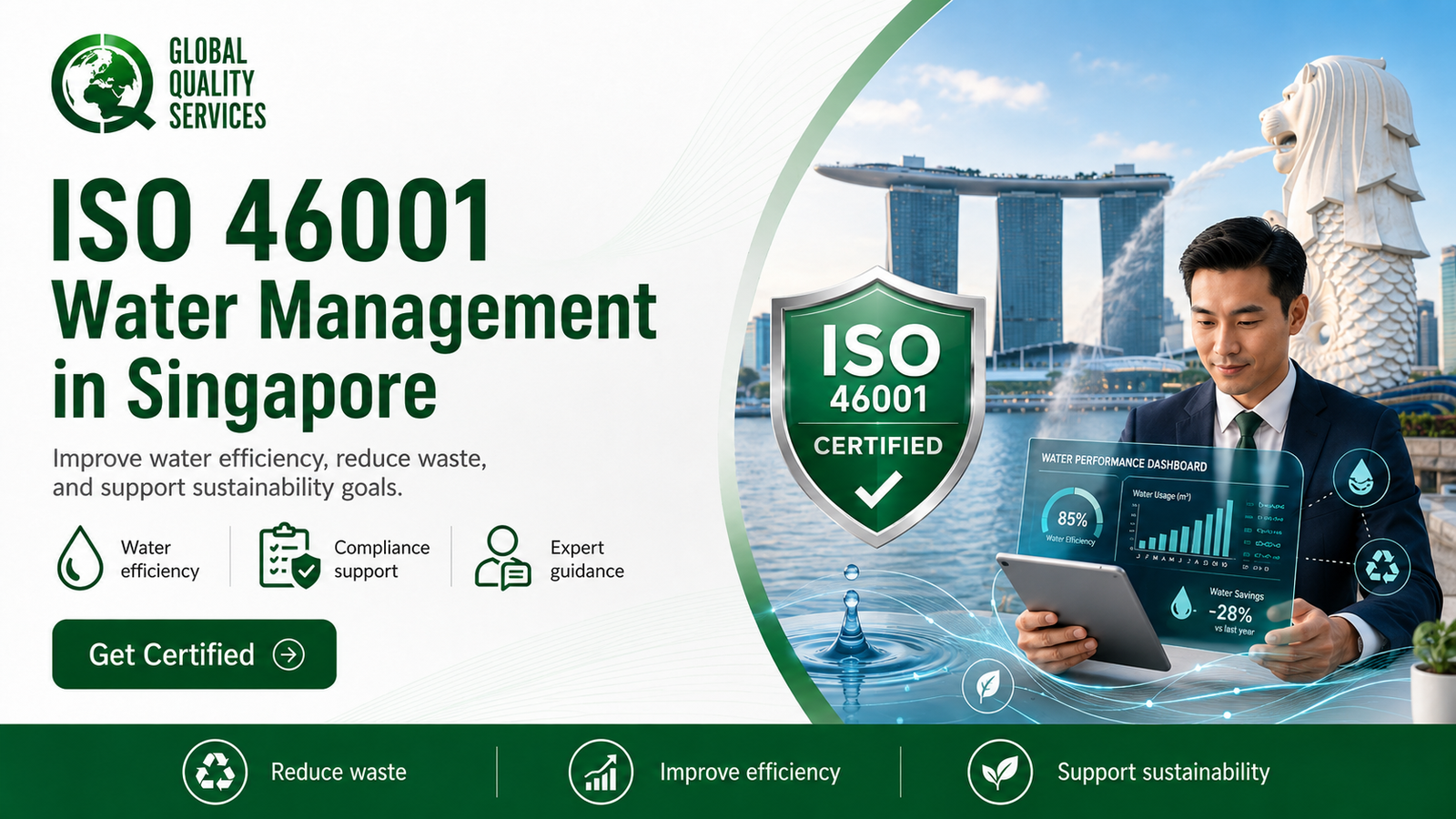
Is your business using more water than it needs to? Are you unsure whether Singapore’s mandatory water efficiency requirements apply to your facility? GQS Singapore helps organisations across all industries get ISO 46001 certified — reducing water costs, meeting PUB requirements, and building a credible sustainability programme.
What Is ISO 46001?
ISO 46001 is the international standard for Water Efficiency Management Systems (WEMS). It gives your organisation a structured, proven framework to monitor, measure, and continuously reduce water consumption across your entire operation.
In simple terms — instead of guessing where water is being wasted, ISO 46001 helps you find it, measure it, and systematically reduce it using the Reduce, Replace, and Reuse approach — year after year.
The standard is published by the International Organization for Standardization (ISO) and adopted in Singapore as SS ISO 46001:2019+C1:2021+A1:2024 — available through the Singapore Standards eShop. A revised Edition 2 of the standard is currently under development by ISO/TC 224 and is expected to replace ISO 46001:2019 in the coming years. GQS Singapore monitors all updates and ensures your system is ready for the transition.
Singapore played a direct role in shaping this standard. In 2012, PUB — Singapore’s National Water Agency developed a national standard SS 577:2012 on water efficiency management systems together with Enterprise Singapore and industry stakeholders. ISO 46001 builds directly on that foundation — making Singapore one of the most experienced markets globally for water efficiency management certification.
ISO 46001 follows the same Plan-Do-Check-Act structure as ISO 9001, ISO 14001, and ISO 50001, making it straightforward to integrate with management systems your organisation may already have.
Why Does ISO 46001 Matter in Singapore?
Water is Singapore’s most critical resource — and managing it is both a legal obligation and a business necessity.
Singapore’s daily water usage stands at around 430 million gallons, and demand is expected to nearly double by 2060. The non-domestic sector accounts for the majority of this projected increase. This means businesses — not households — carry the greatest responsibility for Singapore’s water future.
Mandatory water efficiency requirements are already in force. From 1 January 2024, PUB’s Mandatory Water Efficiency Requirements apply to new projects — including expansions of existing plants — that will consume at least 60,000 m³ of water annually. Requirements include a minimum 50% recycling rate for wafer fabrication plants in front-end semiconductor manufacturing, and mandatory recycling of specified waste streams for electronics, biomedical, and pharmaceutical plants. ISO 46001 provides the systematic framework your organisation needs to meet and maintain these obligations.
PUB actively promotes ISO 46001 adoption. PUB’s Best Practice Guide on Water Efficiency for Buildings specifically recommends that organisations adopt SS ISO 46001 as part of their water conservation strategy — recognising it as the most structured and internationally recognised approach to water efficiency management available.
It reduces your water bills directly. A properly implemented ISO 46001 system identifies leaks, inefficiencies, and wasteful practices that most organisations do not even know exist. The cost savings from reduced water consumption typically offset the cost of certification within the first year.
It strengthens your ESG reporting. Water consumption is a core ESG metric. ISO 46001 gives you the verified, documented water performance data that makes your sustainability reporting credible to investors, clients, and regulators. This pairs directly with our ESG Reporting consultancy at GQS Singapore.
It aligns with Singapore’s sustainability goals. Singapore’s long-term water security strategy — including desalination, NEWater, and water recycling — depends on the non-domestic sector significantly reducing demand. ISO 46001 certification is your organisation’s formal contribution to that national effort.
Who Needs ISO 46001 Certification in Singapore?
Any organisation with significant water consumption or PUB mandatory compliance obligations should pursue ISO 46001. Specifically:
Semiconductor and electronics manufacturers consuming 60,000 m³ or more annually are subject to PUB’s mandatory water recycling requirements from January 2024. ISO 46001 provides the system framework to manage and document compliance with these obligations.
Biomedical and pharmaceutical manufacturers — both directly subject to PUB’s mandatory requirements and expected by international clients and regulators to demonstrate water efficiency as part of broader environmental commitments.
Food and beverage manufacturers — water-intensive production processes make ISO 46001 directly relevant. This pairs naturally with our FSSC 22000 food safety certification and ISO 14001 Environmental Management programmes.
Hotels, hospitals, and commercial buildings — large facility operators with significant water footprints benefit from ISO 46001 alongside our ISO 41001 Facility Management certification.
Data centres — cooling systems in Singapore’s data centres are among the highest water consumers in the commercial sector. ISO 46001 provides the monitoring and reduction framework these facilities need.
Industrial facilities and process manufacturers in chemicals, textiles, printing, and other water-intensive sectors where water efficiency improvements directly reduce operating costs and environmental impact.
Organisations building an ESG or sustainability programme — ISO 46001 pairs directly with ISO 14001 Environmental Management, ISO 50001 Energy Management, ISO 14064 Carbon Footprint certification, and ISO 59000 Circular Economy certification — all delivered by GQS Singapore in integrated programmes.
What ISO 46001 Requires — The Key Elements
ISO 46001 covers every part of your organisation that influences how water is used, monitored, and managed. Here are the core requirements in plain language:
- Water Efficiency Policy — Senior management must formally commit to improving water efficiency, provide the resources to do so, and communicate this commitment across the organisation.
- Water Review and Planning — You identify where water is used, what drives consumption, and where the biggest opportunities for reduction exist. From this, you establish Water Performance Indicators (WPIs) — measurable metrics that tell you whether your water efficiency is genuinely improving over time.
- Water Baseline — A documented starting point against which future water performance is measured and compared. Without a baseline, you cannot demonstrate improvement.
- Objectives and Targets — Specific, measurable water efficiency targets must be set — for the whole organisation and for individual significant water uses — supported by action plans with timelines and clear responsibilities.
- Reduce, Replace, Reuse — The standard’s core approach to water efficiency improvement. Reduce consumption through efficient fittings, equipment, and processes. Replace potable water with alternative sources such as NEWater or rainwater where possible. Reuse treated water on-site for non-potable applications.
- Operational Controls — Procedures and controls must be in place for all activities that significantly affect water use — including equipment maintenance, procurement of water-efficient products, and design of new facilities or processes.
- Monitoring and Measurement — Regular measurement of your WPIs and overall water consumption, with accurate, reliable data that is systematically analysed and acted on.
- Internal Audit — Regular internal audits to verify that controls are working in practice and targets are being met — not just documented on paper.
- Management Review — Senior management reviews the performance of the water efficiency management system at planned intervals and makes strategic decisions about resources, targets, and improvement priorities.
- Continual Improvement — ISO 46001 requires ongoing, documented improvement in water efficiency year after year — not just at certification time.
How GQS Singapore Gets You ISO 46001 Certified — Step by Step
Step 1 — Water Review and Gap Assessment We conduct a thorough review of your current water consumption, monitoring practices, and documentation against ISO 46001 requirements. You get a clear, prioritised action plan — not a generic checklist, but a document specific to your facility and operations.
Step 2 — Water Efficiency Management System Design We build your complete WEMS — water efficiency policy, water review methodology, WPI framework, water baseline, objectives and targets, and operational controls — tailored to your specific processes and water profile.
Step 3 — Documentation Development We develop all required documentation — water efficiency policy, procedures, monitoring plans, records formats, and management review templates — ensuring your system is complete, practical, and audit-ready.
Step 4 — Water Performance Indicator Setup We work with your team to identify the right WPIs for your operations, set up your water monitoring system, and establish your documented water baseline — the foundation of your continual improvement programme.
Step 5 — Staff Training We train your water management team, operational staff, and internal auditors on ISO 46001 requirements, monitoring procedures, and their individual roles in maintaining the WEMS.
Step 6 — Internal Audit We conduct a full internal audit before your certification audit — identifying and closing any remaining gaps so you walk into Stage 1 and Stage 2 audits with complete confidence.
Step 7 — Certification Audit Support We prepare your team and documentation for the certification audit — briefing management, organising records, and supporting your team in responding professionally to auditor queries.
Step 8 — Post-Certification Maintenance ISO 46001 certification requires annual surveillance audits and a three-year recertification cycle. GQS Singapore provides ongoing support — WPI monitoring, management reviews, internal audits, and continual improvement planning — keeping your certification active and your water efficiency genuinely improving.
ISO 46001 Works Well With These Certifications
Organisations that combine ISO 46001 with related certifications get a stronger, more integrated sustainability system at lower total cost. GQS Singapore runs all of the following in integrated programmes:
- ISO 14001 Environmental Management — Shares the same management system structure. Water efficiency is a direct component of environmental performance. Running both together eliminates duplication
- ISO 50001 Energy Management — Energy and water efficiency management follow identical frameworks. Many organisations run ISO 50001 and ISO 46001 together as a single resource efficiency programme
- ISO 14064 Carbon Footprint Verification — Water treatment and distribution are carbon-intensive processes. Reducing water consumption directly reduces your carbon footprint
- ISO 9001:2026 Quality Management — Same High-Level Structure makes integration straightforward as part of an Integrated Management System
- ISO 41001 Facility Management — Water efficiency is a core component of effective facility management. Both certifications work hand in hand for facility operators
- ISO 59000 Circular Economy — Water reuse and recycling are central to circular economy principles. ISO 46001 and ISO 59000 form a natural sustainability combination
- FSSC 22000 Food Safety — Food and beverage manufacturers require both food safety and water efficiency management. GQS Singapore delivers both in a single coordinated engagement
- ESG Reporting — ISO 46001 provides the verified water performance data that makes your ESG disclosures credible and defensible to investors and clients
Ready to reduce water costs and get ISO 46001 certified in Singapore? Global Quality Services (GQS) Singapore specialises in making water efficiency certification straightforward for businesses of all sizes. Whether you are managing a PUB compliance obligation or building a sustainability programme from scratch, our team guides you every step of the way.
Frequently Asked Questions
1. Is ISO 46001 mandatory in Singapore?
ISO 46001 certification itself is not universally mandatory — but PUB’s mandatory water efficiency requirements from January 2024 apply to facilities consuming 60,000 m³ or more annually. ISO 46001 is the most structured and recognised way to meet and demonstrate compliance with these obligations.
2. Who does PUB’s mandatory water requirement apply to?
It applies to new projects and expansions of existing plants consuming at least 60,000 m³ of water annually — specifically semiconductor manufacturers, electronics plants, and biomedical and pharmaceutical facilities. GQS Singapore can help you assess whether your facility meets this threshold.
3. How long does ISO 46001 certification take with GQS Singapore?
Most organisations complete the full process — from gap assessment to certification audit — in 3 to 5 months. Facilities with existing water monitoring systems already in place can move faster. GQS Singapore gives you a realistic timeline after the initial gap assessment.
4. Can ISO 46001 be combined with ISO 14001 or ISO 50001?
Yes — and this is one of our most common requests. ISO 46001, ISO 14001, and ISO 50001 share the same management system structure. Running them together in an integrated programme saves significant time, reduces duplication, and produces a stronger overall sustainability management system.
5. How does ISO 46001 help reduce our water bills?
A properly implemented ISO 46001 system identifies leaks, inefficient equipment, and wasteful practices your organisation may not even be aware of. Setting measurable Water Performance Indicators and monitoring them regularly drives continuous reduction in consumption — with direct, measurable impact on your water costs.