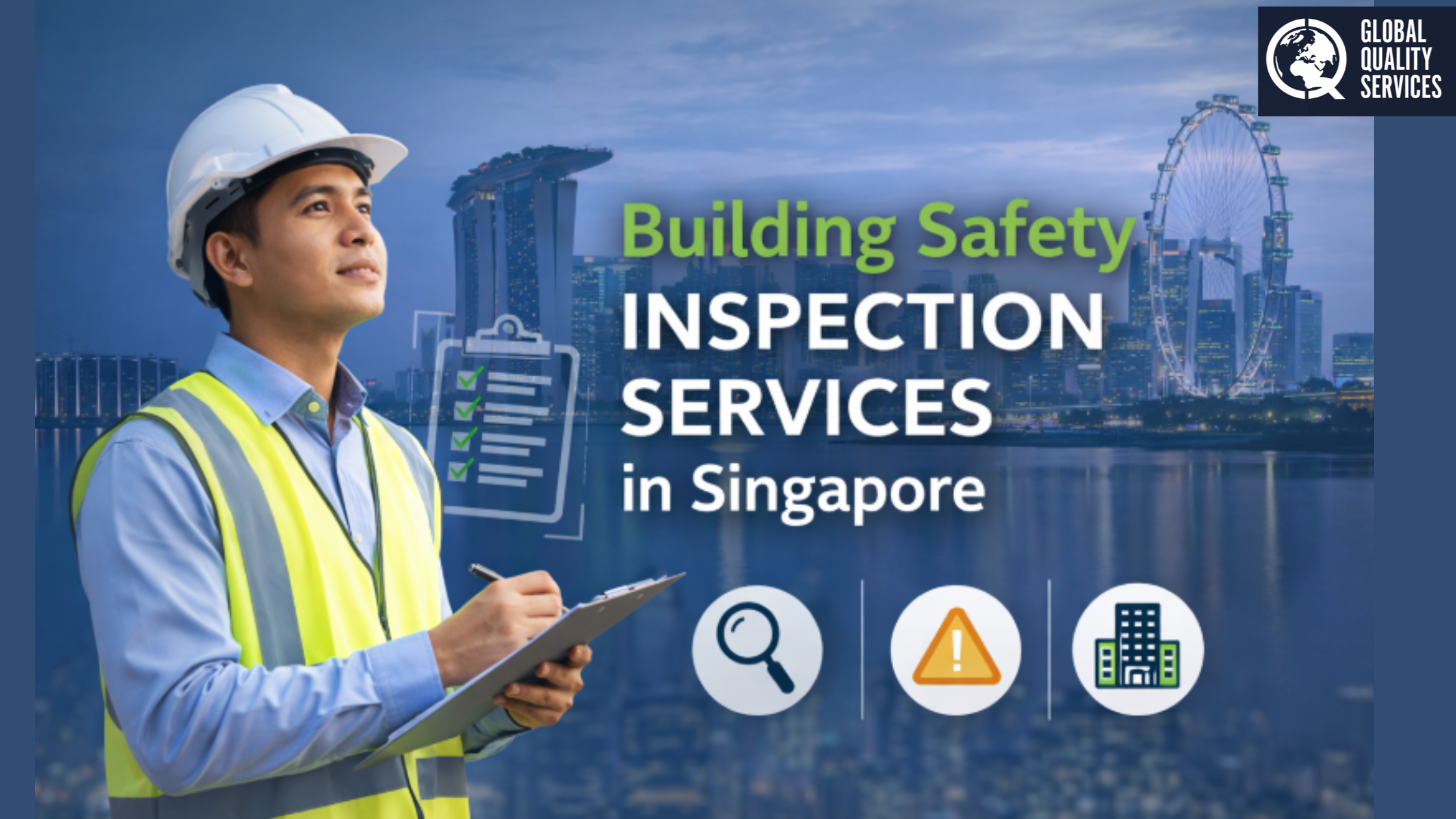
Singapore is home to one of Asia’s most densely built-up urban environments, with over 1.4 million residential and commercial buildings spread across a land area smaller than that of many global cities. As this built environment ages, the risk of structural deterioration, facade failure, and safety hazards grows significantly. The Building Control Act (Chapter 29) is the primary legislation governing building safety in Singapore. It sets out requirements for building design, construction, and maintenance — including mandatory periodic inspections.
At Global Quality Services, we make this process straightforward. Whether you own a commercial property, an industrial building, or a residential development, our certified inspection team handles the technical, regulatory, and reporting requirements — so you don’t have to.
Why Building Safety Inspections Matter in Singapore
Singapore’s high-rise built environment and tropical climate create unique challenges for building owners. High humidity, heavy rainfall, and heat accelerate the deterioration of concrete, facades, and structural components. Without regular inspection, these issues go undetected — until they become dangerous or expensive to fix.
Consider these facts:
- Over 20% of Singapore’s building stock is more than 20 years old and subject to mandatory Periodic Structural Inspection (PSI) requirements.
- Under the BCA’s PSI regime, commercial and industrial buildings must be inspected every 5 years; residential buildings (excluding landed housing) every 10 years.
- Buildings that miss their inspection deadlines face enforcement action, stop-work orders, and financial penalties.
- Facade-related incidents — such as falling external tiles and cladding — have occurred across Singapore, prompting the government to introduce the mandatory Periodic Facade Inspection (PFI) regime.
Early detection is always cheaper than emergency repairs. A crack in a beam or spalling concrete, caught early, may cost a few thousand dollars to fix. Left unaddressed, the same defect can lead to structural failure — and costs that run into hundreds of thousands.
Key Benefits of Professional Building Safety Inspections
Singapore’s Building Control Act and its associated regulations make periodic inspections a legal obligation for most building types. Non-compliance can result in BCA enforcement notices, fines, and in serious cases, prohibition from using the building. Staying ahead of your inspection schedule protects your legal standing and avoids costly disruptions.
Early Detection Saves Money
Structural defects and facade deterioration are progressive. A small crack or surface spall identified today can be repaired at a fraction of the cost compared to emergency structural remediation a year later. Professional inspectors are trained to identify defects that untrained eyes miss — providing you with an accurate picture of your building’s health before problems escalate.
Protecting Occupant Safety and Public Liability
Building owners have a duty of care to occupants, employees, and members of the public who interact with their buildings. An inspection report documents your active efforts to maintain safety, which is critical in the event of an incident. Insurance claims and legal liability can be significantly reduced when documented inspection records exist.
Preserving and Enhancing Property Value
A well-maintained, inspection-compliant building commands higher market value and rental yields. Prospective buyers, tenants, and investors increasingly request inspection records as part of due diligence. Having up-to-date reports signals responsible ownership.
Supporting Sustainable Building Lifecycle Management
Regular inspections feed into a broader maintenance strategy, helping owners plan budgets, prioritise repairs, and extend the functional lifespan of their buildings. This aligns with Singapore’s broader sustainability agenda under the BCA Green Mark Scheme and national goals for a resilient built environment.
Our Process — How Global Quality Services Conducts Building Safety Inspections
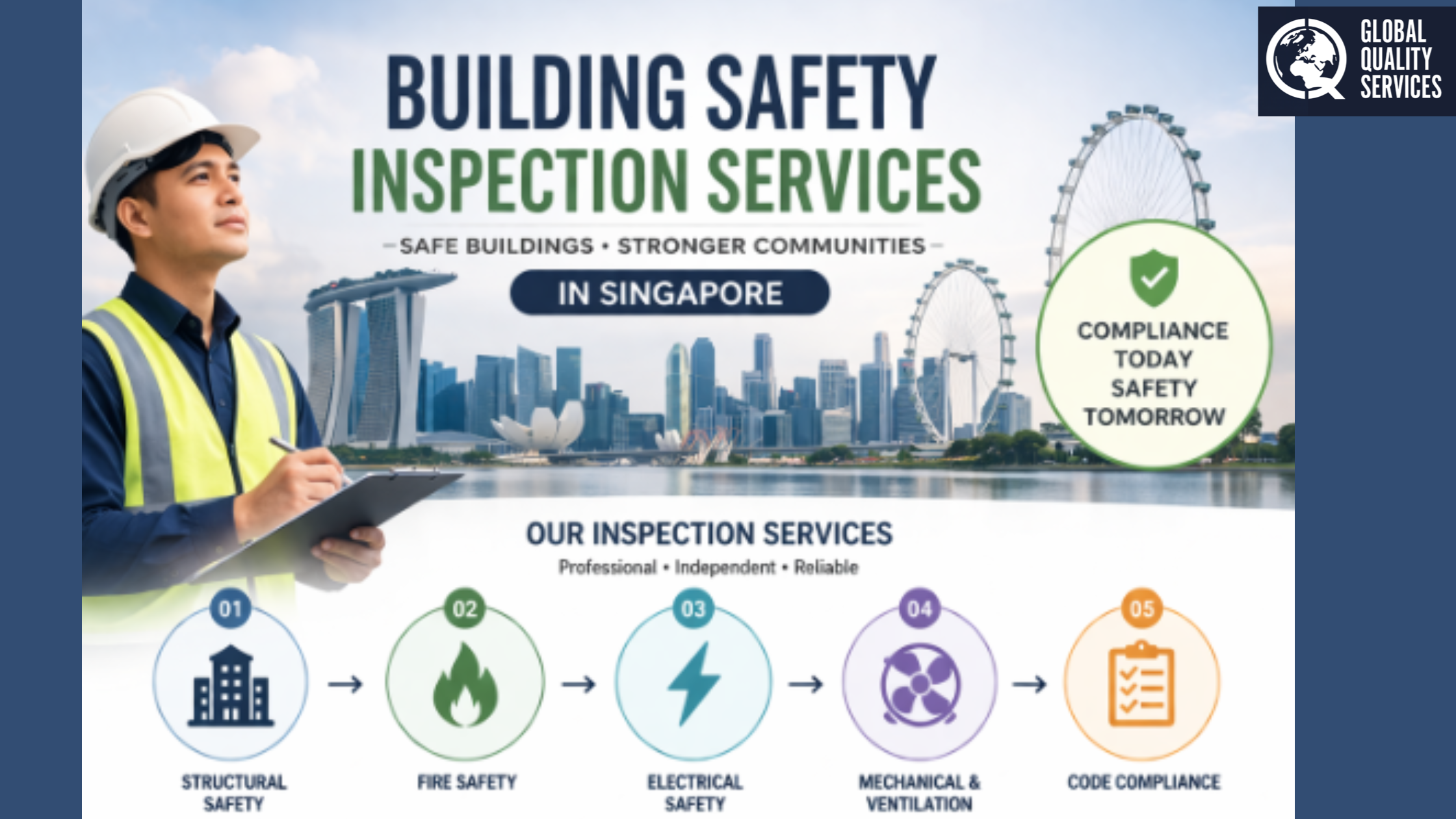
We follow a structured, transparent 6-step process designed to meet BCA requirements, minimize disruption to your operations, and deliver clear, actionable reports. We are compliant with the Periodic Facade Inspection (PFI) Regime under Part 2 of the Building Control Act and the Building Control (Inspection of Buildings and Building Facades) Regulations 2021; all qualifying buildings must undergo PSI at specified intervals by a PE registered with the Professional Engineers Board (PEB).
Step 1 — Initial Consultation and Scope Assessment
We begin with a detailed discussion to understand your building type, age, usage, and inspection history. We identify which regulatory regimes apply (PSI, PFI, PWI) and define the full scope of work. You receive a clear fee proposal with no hidden charges.
Step 2 — Document Review and Pre-Inspection Preparation
Our team reviews all existing building plans, previous inspection reports, maintenance records, and structural drawings. This pre-inspection analysis identifies known risk areas and helps us allocate inspection resources efficiently.
Step 3 — On-Site Inspection
Our registered Structural Engineers and qualified inspectors conduct a thorough visual and technical assessment of all relevant structural and non-structural elements. We use industry-standard diagnostic tools, including hammer sounding, crack mapping, and where required, non-destructive testing (NDT) techniques to assess concrete and material integrity.
Step 4 — Defect Classification and Risk Assessment
Every identified defect is systematically documented, photographed, and classified by severity — from cosmetic surface issues to defects of structural significance requiring urgent remediation. Our risk assessment prioritises findings so you know exactly what needs immediate attention and what can be addressed during planned maintenance cycles.
Step 5 — Inspection Report Preparation and BCA Submission
We prepare a comprehensive inspection report in the formats prescribed by BCA, including all required certification forms (Form D4, D5, D6, D7 as applicable). Our PE submits the report directly to BCA within the stipulated timeframe, ensuring full regulatory compliance on your behalf.
Step 6 — Post-Inspection Advisory and Remediation Support
Our service does not end with the report. We provide a clear remediation action plan — prioritizing repairs by urgency and cost impact. If remedial works are required, we can coordinate with approved contractors and provide supervision to ensure repairs meet the required standards before final BCA sign-off. If you are unsure of your obligations, contact the BCA directly at 1800 342 5222, or visit the BCA PSI page.
Why Choose Global Quality Services?
Every inspection is led by Professional Engineers registered with Singapore’s Professional Engineers Board (PEB) and holding recognized qualifications in civil and structural engineering. Our team brings deep practical experience across residential, commercial, industrial, and institutional building types.
From scoping the BCA submission to managing the entire inspection process, we handle it all. You do not need to navigate regulatory forms, submission systems, or BCA correspondence alone — we handle it all. Our inspection and compliance teams are familiar with the regulatory frameworks across all four major Southeast and South Asian markets. Whether your portfolio spans Singapore, Manila, Jakarta, or Mumbai, we deliver consistent inspection quality aligned with local laws.
Frequently Asked Questions (FAQs)
1 — Who is legally required to conduct a Periodic Structural Inspection (PSI) in Singapore?
Under Singapore’s Building Control Act, the building owner is the responsible party for arranging and funding periodic structural inspections. For strata-titled developments such as condominiums, the Management Corporation (MCST) serves as the building owner and is responsible for compliance.
2 — What happens if my building fails the inspection or defects are found?
Finding defects during an inspection is not a cause for panic — it is exactly what the inspection is designed to do. When defects are identified, the Structural Engineer classifies them by severity. Minor defects of no structural significance are documented and can be addressed during planned maintenance. For defects of structural significance, the SE will prescribe remedial works that must be completed within a specified timeframe and certified upon completion.
3 — Can I request an extension if I cannot complete the inspection by the BCA deadline?
Yes. Building owners can write to BCA to request an extension of time, stating the specific reasons — for example, difficulty gaining access to certain parts of the building, or delays in engaging a qualified PE. BCA considers extension requests on a case-by-case basis. However, extensions are not guaranteed, and BCA expects building owners to demonstrate active efforts to comply. It is always better to start the process early than to wait until the deadline approaches.
4 — Does building safety inspection apply to landed residential properties such as terrace houses and bungalows?
Under the current PSI regime, detached houses, semi-detached houses, terraced houses, and linked houses used exclusively for residential purposes are exempted from the mandatory Periodic Structural Inspection requirements. Similarly, temporary buildings are excluded. However, this exemption applies only to the mandatory PSI regime. B
5 — How long does a building safety inspection take, and will it disrupt my operations?
The duration of an inspection depends on the building type, size, age, and complexity. For a typical mid-sized commercial building, the on-site visual inspection phase generally takes one to three days. Larger or more complex buildings, or those requiring Stage 2 full structural investigation, will take longer. We plan all inspection activities with your operational needs in mind — scheduling access to sensitive areas outside business hours where possible and coordinating with your facilities team to minimise disruption.