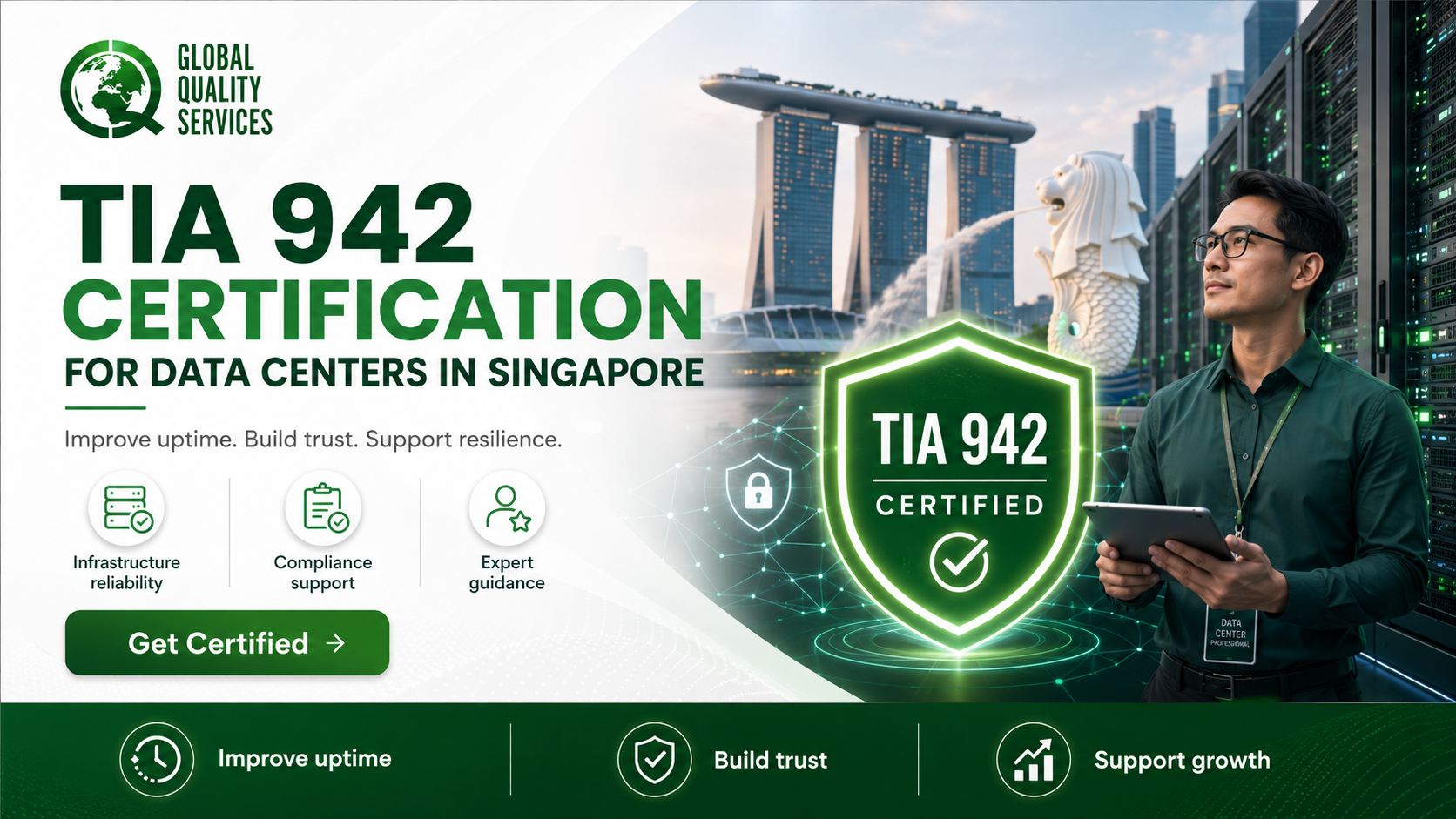
Singapore has established itself as an important digital infrastructure hub in Asia, making reliable data centre facilities increasingly important for cloud services, financial technology, telecommunications, enterprise applications and other digital services.
As dependence on digital infrastructure grows, data centre operators need more than high-performance IT equipment. They need a facility designed to maintain availability, manage infrastructure risks and support reliable operations.
TIA 942 Certification for Data Centers in Singapore provides a recognised framework for evaluating important elements of data centre infrastructure, including telecommunications, electrical systems, mechanical systems, fire protection, physical security and other facility requirements.
Global Quality Services (GQS) Singapore helps data centre owners and operators understand applicable requirements, identify infrastructure gaps and prepare for assessment.
What Is TIA 942?
TIA-942 is a telecommunications infrastructure standard specifically developed for data centres. It addresses the physical and supporting infrastructure required to create a reliable data centre environment.
The standard covers areas such as:
- Data centre site and architectural considerations
- Telecommunications infrastructure
- Cabling and pathways
- Electrical power systems
- Mechanical and cooling systems
- Fire detection and protection
- Physical security
- Monitoring and operational considerations
- Redundancy and availability
TIA 942 also provides a rating framework for different levels of infrastructure resilience. The appropriate rating should be determined by the organisation’s business requirements, availability expectations, risk profile and operational needs.
Why Is TIA 942 Important in Singapore?
Singapore’s digital economy depends heavily on reliable cloud services and data centres. IMDA states that digital services such as online banking, e-commerce, ride-hailing and digital identity rely on continued availability of cloud and data centre infrastructure.
Its Advisory Guidelines for Cloud Services and Data Centres recommend measures to improve resilience and security and address risks ranging from technical failures to fire, water leaks, cooling failures and cyberattacks.
This makes infrastructure resilience an important consideration for Singapore data centre operators. A failure involving power, cooling, connectivity or physical protection can affect services far beyond the facility itself.
TIA 942 can provide a structured infrastructure benchmark, while other standards can address related areas. For example, ISO 27001 Certification in Singapore focuses on information security management, while ISO 22301 Certification focuses on business continuity.
What Does TIA 942 Certification Cover?
TIA 942 looks at the data centre as an integrated facility rather than focusing only on IT equipment. This is important because reliability depends on how multiple infrastructure systems work together.
1. Site and Facility Design
Site selection and facility design influence long-term resilience. Organisations need to consider environmental risks, accessibility, building characteristics, space planning and the physical arrangement of critical infrastructure. For new data centres, considering these requirements during the design stage can help avoid expensive modifications later. Existing facilities can instead undergo a structured gap assessment to identify areas that may require improvement.
2. Electrical Systems
A dependable power infrastructure is fundamental to data centre availability. Assessment can consider utility supplies, generators, UPS systems, distribution systems, backup arrangements and redundancy. The objective is not simply to install additional equipment. Power architecture should be planned so that maintenance or failure of an individual component does not unnecessarily interrupt critical IT services.
3. Mechanical and Cooling Systems
Data centre equipment generates substantial heat, making cooling a major part of infrastructure planning. Cooling capacity, redundancy, distribution, monitoring and maintenance arrangements all influence facility resilience. Singapore’s tropical climate also makes cooling efficiency particularly important. BCA and IMDA’s Green Mark for Data Centres scheme addresses areas including energy performance and carbon efficiency, sustainable operations and digital innovation. The current GMDC:2024 scheme applies to new and existing data centres.
4. Telecommunications Infrastructure
Network availability is another critical component. TIA 942 considers telecommunications spaces, pathways, cabling infrastructure and related arrangements that support reliable connectivity. Good telecommunications design should reduce unnecessary points of failure and allow infrastructure to be maintained or expanded without compromising existing services.
5. Fire Protection
Data centres need appropriate measures for detecting and responding to fire risks. Fire protection should be considered alongside equipment layout, electrical infrastructure, cooling systems, building construction and emergency arrangements.
6. Physical Security
Critical infrastructure needs controlled physical access. Depending on the facility, this may include access control, surveillance, secure zones, visitor management and protection of restricted areas. Physical security should be proportionate to the importance of the systems and assets being protected.
TIA 942 and Singapore’s Data Centre Resilience Framework
TIA 942 should not be viewed as a substitute for Singapore’s regulatory requirements. Instead, it can complement national guidance and other management standards.
IMDA’s data centre guidelines encourage operators to address resilience and security across areas such as governance, technical architecture, physical infrastructure, cybersecurity, incident management and business continuity.
This creates a useful distinction:
- TIA 942: Data centre infrastructure and facility resilience
- ISO 27001: Information security management
- ISO 22301: Business continuity management
- ISO 50001: Energy management
Using complementary standards can help organisations create a more complete resilience programme rather than relying on one certification alone.
TIA 942 and Data Centre Sustainability
Availability and sustainability increasingly need to be considered together. Cooling, power distribution and other facility systems have a direct effect on energy consumption.
Singapore’s BCA-IMDA Green Mark for Data Centres framework specifically addresses data centre sustainability. BCA states that its current data centre scheme covers both new and existing facilities and considers energy performance and carbon efficiency, sustainable operations, digital innovation and smart systems.
The relationship is therefore practical:
- TIA 942 → Infrastructure resilience
- Green Mark → Environmental and energy performance
- ISO 50001 → Energy management system
For organisations looking at both reliability and energy performance, ISO 50001 Energy Management System Certification can complement infrastructure-focused work.
TIA 942 Certification Process in Singapore
The certification journey should begin with understanding the existing facility rather than immediately attempting to close every possible gap.
Step 1: Define the Data Centre Scope
GQS first establishes what facility, systems and services are included in the assessment. The organisation’s business requirements, availability expectations and intended TIA 942 rating are considered at this stage.
Step 2: Conduct a Gap Assessment
The existing facility is reviewed against applicable requirements. Electrical, mechanical, telecommunications, architectural, fire protection, physical security and operational areas can be assessed according to the agreed scope.
Step 3: Identify Infrastructure Risks
The assessment identifies weaknesses such as single points of failure, insufficient redundancy, inadequate documentation or gaps in maintenance and operational arrangements.
This stage is important because not every finding has the same business impact. Critical weaknesses should normally receive priority over minor improvements.
Step 4: Prepare a Corrective Action Plan
Once gaps are understood, the organisation can develop a practical improvement plan. Depending on the findings, actions may involve infrastructure modifications, additional redundancy, improved monitoring, revised procedures or better documentation.
Step 5: Prepare Technical Evidence
Supporting evidence may include design information, drawings, equipment specifications, maintenance records, testing records, procedures and other documents relevant to the assessment.
Step 6: Conduct Readiness Review
Before formal assessment, GQS reviews the available evidence and outstanding gaps. This helps the organisation identify issues that could affect the assessment.
Step 7: Certification Assessment
The formal assessment is carried out by the appropriate independent certification or assessment organisation. GQS can support the organisation with preparation, coordination and response to findings throughout the process.
Benefits of TIA 942 Certification
Demonstrates Infrastructure Capability
Certification can provide customers, partners and other stakeholders with independent evidence that a data centre has been assessed against recognised infrastructure requirements.
Reduces Single Points of Failure
A structured review can expose dependencies that may not be obvious during routine operations. Identifying such weaknesses allows organisations to prioritise improvements before an actual incident occurs.
Supports Availability
Redundancy, maintenance planning and infrastructure design are closely connected to availability. TIA 942 helps organisations assess whether supporting infrastructure is capable of meeting their intended operational objectives.
Improves Customer Confidence
For colocation, cloud and managed hosting providers, infrastructure resilience can influence customer selection. A recognised assessment can provide additional assurance when customers are evaluating data centre facilities.
Supports Business Continuity Planning
Data centre infrastructure is an important part of continuity for organisations dependent on digital systems. Combining TIA 942 with ISO 22301 Certification can provide a broader approach to continuity and recovery.
Helps Structure Data Centre Upgrades
For an existing facility, TIA 942 can provide a useful reference when planning upgrades. Instead of making isolated improvements, organisations can evaluate power, cooling, connectivity, security and other infrastructure as connected systems.
Who Needs TIA 942 Certification in Singapore?
TIA 942 can be relevant to a wide range of organisations operating or developing critical data centre infrastructure, including:
- Colocation providers
- Cloud service providers
- Enterprise data centres
- Managed hosting providers
- Telecommunications organisations
- Financial technology companies
- Banking and financial services organisations
- Technology companies
- Government and public-sector facilities
- Healthcare organisations
- Organisations developing new data centre facilities
The requirements and appropriate rating will differ depending on the facility’s purpose and business risk.
Why Choose GQS Singapore?
GQS Singapore helps organisations prepare for international certification and assessment requirements through a structured, evidence-based approach.
A resilient data centre requires more than redundant servers. Power, cooling, connectivity, fire protection, physical security and operational practices must work together to support availability. TIA 942 Certification for Data Centers in Singapore provides a structured way to evaluate this infrastructure and identify opportunities for improvement. If you are developing a new facility, upgrading an existing data centre or preparing for a TIA 942 assessment, contact GQS Singapore to discuss your data centre scope and certification requirements.
Frequently Asked Questions
1. Is TIA 942 certification mandatory for Singapore data centres?
TIA 942 is not a blanket statutory certification requirement for all Singapore data centres. However, organisations may pursue certification or assessment to demonstrate infrastructure resilience and meet customer or contractual expectations. Singapore’s IMDA separately provides advisory guidelines encouraging cloud and data centre operators to strengthen resilience and security.
2. What are the TIA 942 ratings?
TIA 942 uses a rating framework to describe different levels of data centre infrastructure resilience. The appropriate rating should be selected according to business requirements, availability objectives and risk rather than automatically choosing the highest level.
3. Can an existing Singapore data centre be assessed against TIA 942?
Yes. Existing facilities can undergo a gap assessment to understand how their current infrastructure compares with applicable requirements. Identified gaps can then be prioritised for corrective action.
4. Is TIA 942 the same as ISO 27001?
No. TIA 942 and ISO 27001 address different areas. TIA 942 is primarily concerned with data centre infrastructure, whereas ISO 27001 provides a management-system framework for information security.
5. Can TIA 942 be combined with other certifications?
Yes. Organisations often consider complementary standards depending on their objectives. TIA 942 can be considered alongside ISO 27001 for information security, ISO 22301 for business continuity and ISO 50001 for energy management.