Many sustainability claims are based on information prepared by the businesses themselves. Independent certification provides an additional level of accountability by assessing specified requirements against a defined standard. B Corp Certification is one such certification, administered by the nonprofit B Lab. Global Quality Services supports Singapore businesses preparing for this process through readiness assessment, gap analysis, implementation guidance, and documentation support ahead of the independent audit, assurance, and certification process administered by B Lab.
What Is B Corp Certification?
B Corp Certification is a business certification administered by B Lab that assesses how a company manages its social, environmental and governance impact. The current B Lab Standards establish requirements across seven Impact Topics and include Foundation Requirements covering eligibility, the B Corp legal requirement and risk assessment.
Unlike a sustainability claim made solely by a company, B Corp Certification involves an independent verification and assurance process. B Lab states that certified B Corps are independently audited against its standards, helping provide greater transparency and accountability around the company’s practices. The certification also involves a legal commitment to stakeholder governance. The requirement is designed to ensure that companies consider the effects of their decisions on stakeholders rather than focusing solely on shareholder interests. For Singapore businesses, this can involve amendments to the company’s governing corporate documents using the applicable B Lab legal language. The exact requirement depends on the company’s legal entity and structure.
What Has Changed Under the New B Lab Standards?
Under the current standards, companies must meet applicable requirements through:
- Foundation Requirements
- Seven Impact Topics
- Requirements tailored to factors such as company size, sector and operating country
- Independent verification and assurance
- Continuing requirements throughout the certification journey
This means businesses preparing for certification should not approach the process simply as an exercise in maximising an assessment score. The focus is now on meeting defined requirements and demonstrating that appropriate practices are embedded within the organisation.
The Impact of B Corp Certification on Sustainable Businesses in Singapore
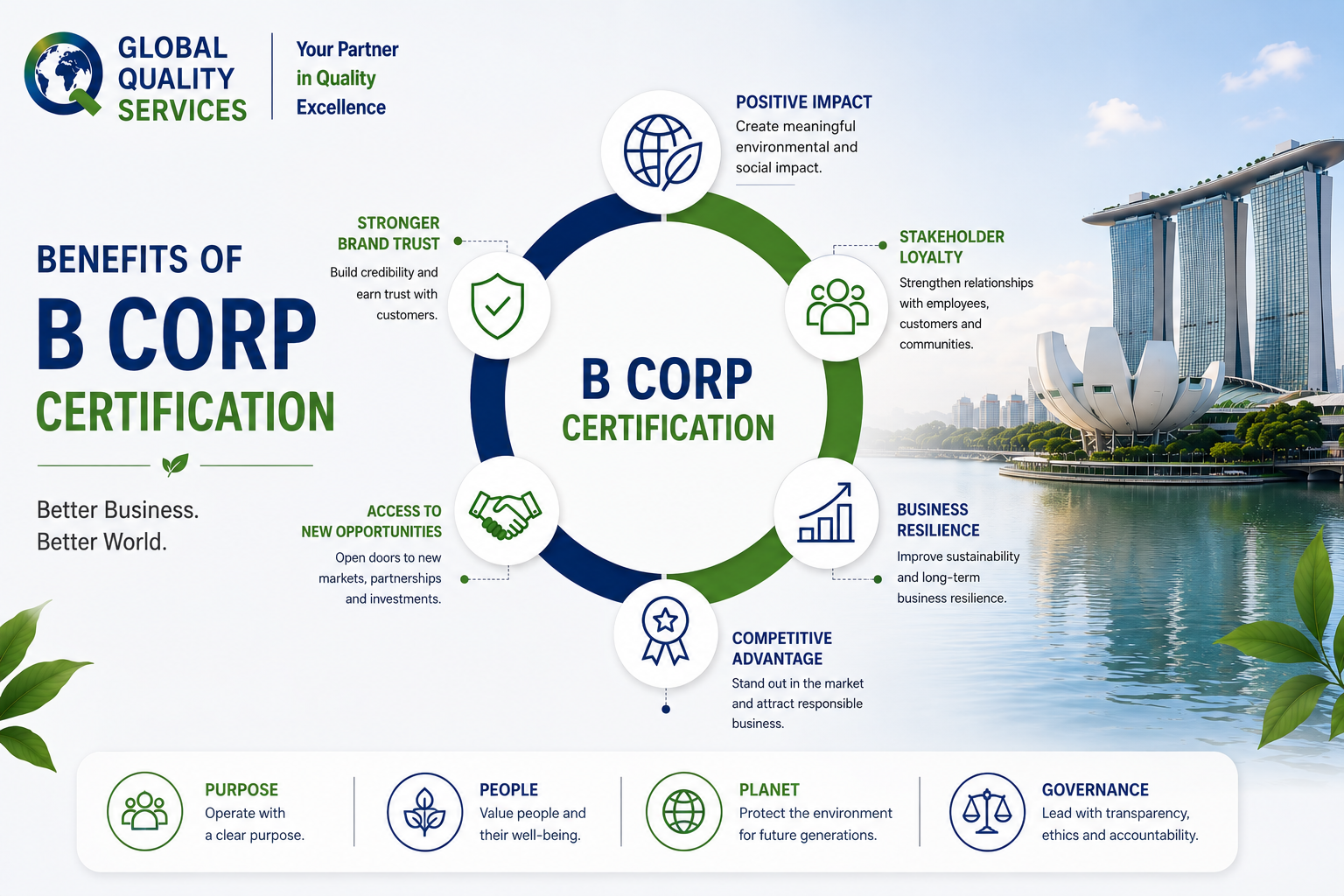
B Corp Certification is a private, voluntary standard. It is not a Singapore government scheme or approval. It sits alongside, not inside, national sustainability policy, such as the Singapore Green Plan 2030, which sets national targets for emissions reduction, waste reduction, and green business capability-building through programmes like Enterprise Singapore’s Enterprise Sustainability Programme.
Some of the practical work involved in preparing for B Corp Certification overlaps with what the Green Plan more broadly pushes businesses toward. Building emissions measurement, governance documentation, and impact monitoring for the B Lab assessment can also support a company’s wider sustainability reporting readiness, including resources such as the SME Sustainability Hub.
This does not mean B Corp Certification automatically qualifies a business for government grants, funding, or regulatory benefits. Eligibility for any government programme must be assessed separately, on its own criteria. For businesses weighing whether to pursue certification, the more accurate framing is this: B Corp Certification and Singapore’s national sustainability initiatives cover overlapping ground from different directions. One works through independent, audited verification. The other works through public policy and funding. Preparing for one can make the other more manageable, but neither substitutes for the other.
B Corp Certification Process
Preparing for B Corp Certification involves more than completing an assessment. Organisations need to understand the applicable requirements, establish appropriate practices and maintain evidence that supports their responses. GQS can support your internal preparation through the following stages.
Step 1: Eligibility & Readiness Assessment
We begin by reviewing your organisation’s structure, operations and existing sustainability, governance and people-related practices. The objective is to identify:
- Eligibility considerations
- Existing policies and controls
- Governance arrangements
- Sustainability practices
- Available documentation
- Potential implementation gaps
This provides a clearer starting point before your organisation progresses through the B Lab certification process.
Step 2: Foundation Requirements Review
We help your team understand the Foundation Requirements applicable to the organisation. This can include reviewing:
- Eligibility considerations
- B Corp legal requirement
- Stakeholder governance arrangements
- Risk-assessment considerations
- Relevant corporate documentation
B Lab identifies these Foundation Requirements as the first stage of its current certification framework.
Step 3: Impact Topic Gap Assessment
We assess your existing practices against the applicable requirements across the seven Impact Topics. Depending on the organisation, this may involve reviewing areas such as:
- Climate and emissions management
- Environmental practices
- Worker policies
- Human-rights processes
- Diversity and inclusion
- Governance
- Supplier and value-chain practices
- Stakeholder engagement
- Government and public-policy practices
The objective is not simply to identify missing documents. We look at whether the relevant practices are actually implemented and whether the organisation can substantiate them.
Step 4: Gap Closure & Implementation Support
Once gaps are identified, GQS can support your team in prioritising corrective actions. Depending on your needs, this may include assistance with:
- Policy development
- Governance documentation
- HR and worker-related processes
- Supplier requirements
- Environmental procedures
- Sustainability data collection
- Impact measurement
- Evidence organisation
- Internal responsibilities and implementation planning
The level of support can be scaled according to your organisation’s existing systems and resources.
Step 5: Documentation & Evidence Preparation
Certification requires organisations to demonstrate that applicable requirements are being met.
GQS helps your internal teams organise relevant documentation, evidence and supporting records so that information is easier to review and substantiate during the independent certification process. We focus on making documentation:
- Relevant
- Traceable
- Consistent
- Current
- Supported by appropriate evidence
Step 6: Preparation for Independent Assurance
GQS can help your team prepare for the independent assurance stage by reviewing documentation, identifying potential evidence gaps and helping staff understand the information they may need to substantiate. The independent audit, verification and certification decisions remain outside GQS’s role. B Lab states that independent third-party assurance providers are responsible for auditing and certifying businesses under its certification process.
Does B Corp Certification Provide Singapore Government Grants?
B Corp Certification should not be presented as an automatic route to Singapore government grants, incentives or regulatory benefits. However, some practices developed during B Corp preparation—such as sustainability measurement, governance documentation, emissions management and impact monitoring—may support an organisation’s broader sustainability initiatives. Eligibility for government grants or programmes must be assessed separately according to the requirements of the relevant Singapore programme.
The 7 B Lab Impact Topics
Under B Lab Standards V2.1, companies are assessed against two layers of requirements rather than a single aggregate score. Understanding what each layer evaluates is what separates a realistic certification timeline from a guess.
1. Government affairs and collective action.
Engaging in collective efforts to drive systemic change and advocate for positive policy outcomes. The largest companies must also publicly share country-by-country tax reports.
2. Purpose and stakeholder governance
Acting in accordance with a defined purpose and embedding stakeholder governance into decision-making, including governance structures that monitor purpose, social, and environmental performance
3. Climate action
Developing an action plan aligned with limiting global warming to 1.5°C. Larger companies must also report GHG emissions and validated science-based targets.
4. Human rights
Understanding how the company’s operations and value chain may involve negative human rights impacts, and taking action to prevent and mitigate them.
5. Fair work
Providing good quality jobs and positive workplace cultures, fair wage practices, and worker feedback in decision-making.
6. Environmental stewardship and circularity
Assessing environmental impacts across operations and the value chain, and taking meaningful action to minimise them.
7. Justice, equity, diversity, and inclusion.
Fostering inclusive and diverse workplaces and value chains, and contributing meaningfully to just, equitable communities.
Helpful ISO Standards That Complement B Corp Certification
Integrating internationally recognized ISO standards can help organizations strengthen the systems, policies, and practices that support B Corp certification and its focus on environmental, social, and governance performance.
ISO 14001:2026 Certification, Environmental Management – Provides a structured framework for managing environmental impacts, including energy consumption, waste, resource efficiency, and environmental objectives.
ISO 45001:2018 Certification, Occupational Health & Safety – Helps establish effective workplace health and safety systems, supporting employee well-being and responsible workplace practices aligned with B Corp’s worker impact focus.
ISO 27001 Certification: Information Security Management: Strengthens information security, data protection, risk management, and governance practices, helping organizations demonstrate responsible management of sensitive information.
ISO 9001:2026 Certification: Quality Management: Establishes consistent and effective operational processes, customer-focused practices, and continual improvement, supporting a culture of accountability and responsible business management.
Together, these ISO standards can provide a strong management-system foundation for organizations pursuing B Corp certification, helping translate sustainability and social responsibility commitments into structured, measurable, and continually improving business practices.
How Long Does B Corp Certification Take?
There is no single timeline that applies to every organisation.
Preparation time can vary depending on:
- Company size
- Industry and activities
- Corporate structure
- Existing governance systems
- Sustainability maturity
- Availability of evidence
- Number of entities or locations
- Complexity of applicable requirements
- Amount of implementation required before certification
A company with established management systems and documented sustainability practices may have a different preparation journey from an organisation building these systems for the first time.
Common Reasons Applications Get Delayed
Several recurring gaps can delay B Corp Certification preparation, and identifying them early can help organisations avoid unnecessary delays.
Undocumented HR policies
Many companies follow fair employment practices informally but have not documented them clearly. This can make it difficult to demonstrate that applicable requirements are being met during the certification process.
Missing supplier code of conduct
Companies may have supplier expectations in place but lack formal documentation or processes for communicating and monitoring relevant labour, environmental or human-rights requirements across their value chain.
No formal stakeholder governance clause
Companies that have not addressed the applicable B Corp legal requirement may need to make changes to their governing documents before they can complete certification. The precise requirement depends on the company’s entity type and circumstances.
Incomplete environmental data
Companies that estimate rather than track energy use, waste, or emissions often need to implement basic tracking before they can substantiate their responses in the Environment section.
Disclosure questionnaire surprises
Unresolved legal, regulatory, or reputational issues surfaced late in B Lab’s background disclosure process can stall verification that was otherwise on track.
Why Global Quality Services
Global Quality Services has worked across ISO management system certifications, compliance frameworks, and sustainability standards for businesses in Singapore. B Corp Certification is not simply a sustainability label. It requires organisations to examine how they govern the business, manage their impact and demonstrate responsible practices against defined requirements.
GQS helps Singapore businesses prepare for that process through readiness assessment, gap analysis, implementation support and documentation preparation. If you are considering B Corp Certification and want to understand what your organisation needs to address before entering the independent certification process, speak with our team.
Frequently Asked Questions
What is B Corp Certification?
B Corp Certification is a certification administered by the nonprofit B Lab that assesses businesses against defined social, environmental and governance requirements. The current B Lab Standards include Foundation Requirements and seven Impact Topics.
Is there still an 80-point minimum for B Corp Certification?
The former 80-point B Impact Assessment model is not the basis of the current standards framework. Under the current approach, companies must meet applicable requirements across the Foundation Requirements and relevant Impact Topics rather than qualifying solely through an aggregate 80-point threshold.
Does B Corp Certification last three years?
The current certification model follows a five-year phased approach, with additional requirements introduced at Years 3 and 5. B Lab also describes more regular monitoring during the certification period.
Is B Corp Certification mandatory in Singapore?
No. B Corp Certification is a voluntary certification administered by B Lab.
Do Singapore companies need to change their constitution?
The applicable legal requirement depends on the company’s entity type and structure. B Lab provides Singapore-specific legal language for eligible structures, and the requirement may involve amendments to governing corporate documents.
Does B Corp Certification guarantee access to government grants?
No. B Corp Certification does not automatically qualify a company for Singapore government grants, incentives or regulatory benefits. Each programme has its own eligibility criteria.
How long does B Corp Certification take?
The preparation timeline varies by organisation. Company size, sector, corporate structure, existing policies, sustainability maturity and evidence availability can all affect the time required. A readiness assessment can provide a more practical basis for planning