SS 590 is Singapore’s HACCP-based food safety management system standard for food manufacturers. It sits between SS 444 and ISO 22000 in terms of scope and complexity, and it is recognised by the Singapore Food Agency as an approved Food Safety Management System standard that qualifies food establishments for Grade A attainment under the Safety Assurance for Food Establishments (SAFE) framework.
For Singapore food manufacturers that find ISO 22000 or FSSC 22000 too complex a starting point, SS 590 provides a structured, auditable food safety management system built specifically for the Singapore food industry that can be implemented incrementally and used as a direct stepping stone to ISO 22000 certification when the business is ready to move there.
Global Quality Services provides end-to-end SS 590 certification consultancy for food manufacturers and food chain operators in Singapore, from initial gap assessment through HACCP system implementation, internal audit, and third-party certification.
What Is SS 590 Certification?
SS 590 is a modified variant of ISO 22000:2005 and has slightly more requirements to fulfil than SS 444. The standard has been redrafted to ensure its viability for implementation by small and medium food organisations. SS 590 is an intermediate standard to attain the ISO 22000 standard.
It is published by Enterprise Singapore under the Singapore Standards Council and is accredited for certification under the Singapore Accreditation Council (SAC). Certification demonstrates that your food safety management system meets the requirements of a HACCP-based standard that goes beyond basic HACCP principles to include a broader management system framework covering policy, objectives, internal audit, and management review.
How SS 590 Differs From SS 444 and ISO 22000
Understanding where SS 590 sits in Singapore’s food safety certification landscape is the most important step before scoping any engagement.
SS 444 is a basic preventative risk-based approach for identifying, assessing and controlling food safety hazards, applicable to any organisation in the food chain including services and manufacturing. SS 590 is a HACCP-based food safety management system aligned with ISO 22000, a next step for those looking to achieve ISO 22000 certification, applicable to any organisation in the food chain, particularly food manufacturers.
In practice, the three standards sit on a progression.
- SS 444 is the entry-level Singapore HACCP standard. It establishes the seven HACCP principles and twelve HACCP steps and is best suited to food service establishments, caterers, and smaller retail food businesses.
- SS 590 adds a full management system layer to those same HACCP requirements, covering food safety policy and objectives, documented prerequisite programmes, management review, internal audit, and corrective action, making it specifically suited to food manufacturers who need a more structured system than SS 444 provides.
- ISO 22000 and FSSC 22000 are international standards that extend further to add operational prerequisite programmes, emergency preparedness, and traceability requirements, and carry global market recognition that SS 590 does not.
For a Singapore SME food manufacturer supplying primarily into the local market, SS 590 is usually the most practical starting point. For a manufacturer with export ambitions or international buyer qualification requirements, ISO 22000 or FSSC 22000 is the more appropriate destination, with SS 590 as a structured intermediate step.
Who SS 590 Is For in Singapore
- SME food manufacturers producing ambient, chilled, or frozen food products for the Singapore retail and food service market who want a certified HACCP-based management system without the full complexity of ISO 22000
- Food manufacturers transitioning from SS 444 who have outgrown the basic HACCP framework and need a more structured management system to support business growth, additional product lines, or new retail customer requirements
- Manufacturers preparing for ISO 22000 or FSSC 22000 who want to build their food safety management system in stages rather than attempting full ISO 22000 implementation from scratch
- Contract food manufacturers and co-packers whose retail and food service clients require a certified FSMS beyond basic HACCP but whose export volumes do not yet justify the cost of full ISO 22000 certification
- Category 1 food establishments under SFA’s SAFE framework that need a certified FSMS to qualify for Grade A attainment under Phase 2 of the framework
What SS 590 Covers
SS 590 requires your food safety management system to address the following areas.
- HACCP system. The twelve essential HACCP steps and seven HACCP principles from Codex Alimentarius, including hazard identification, hazard analysis, critical control point determination, critical limit setting, monitoring procedures, corrective actions, verification, and documentation.
- Prerequisite programmes. Documented PRPs covering facility and equipment maintenance, cleaning and disinfection, pest control, personnel hygiene, supplier control, and waste management.
- Food safety policy and objectives. A documented food safety policy communicated across the organisation, with measurable food safety objectives set at the management level.
- Management system documentation. A document control system covering procedures, records, and the overall food safety management system documentation.
- Internal audit programme. A scheduled internal audit cycle conducted against the full SS 590 requirements.
- Management review. A formal management review covering system performance, non-conformances, corrective actions, and resource adequacy.
- Corrective action and continual improvement. Documented processes for investigating non-conformances, identifying root causes, and implementing and verifying corrective actions.
SS 590 and the SFA SAFE Framework
Under the SAFE framework implemented from 19 January 2026, Category 1 food establishments will need to appoint an Advanced Food Hygiene Officer and implement a Food Safety Management System to maintain or attain Grade A.
SS 590 is one of the SFA-approved FSMS standards that qualifies food establishments for this Grade A pathway. For a Singapore food manufacturer whose grade is visible to retail buyers, institutional clients, and enterprise food service chains through SFA’s public licensing portal, the commercial value of Grade A status is direct and measurable.
Consumers can access the Safety Assurance for Food Establishments (SAFE) grades of food establishments via SFA’s Track Records for Licensed Food Establishments webpage or by scanning the QR code on the SFA licence displayed at the food establishment. A Grade A status supported by a certified SS 590 FSMS is a visible, verifiable food safety signal to every customer who checks.
More information on the SAFE framework is available at SFA’s SAFE framework page.
Our SS 590 Certification Process for Singapore Food Manufacturers
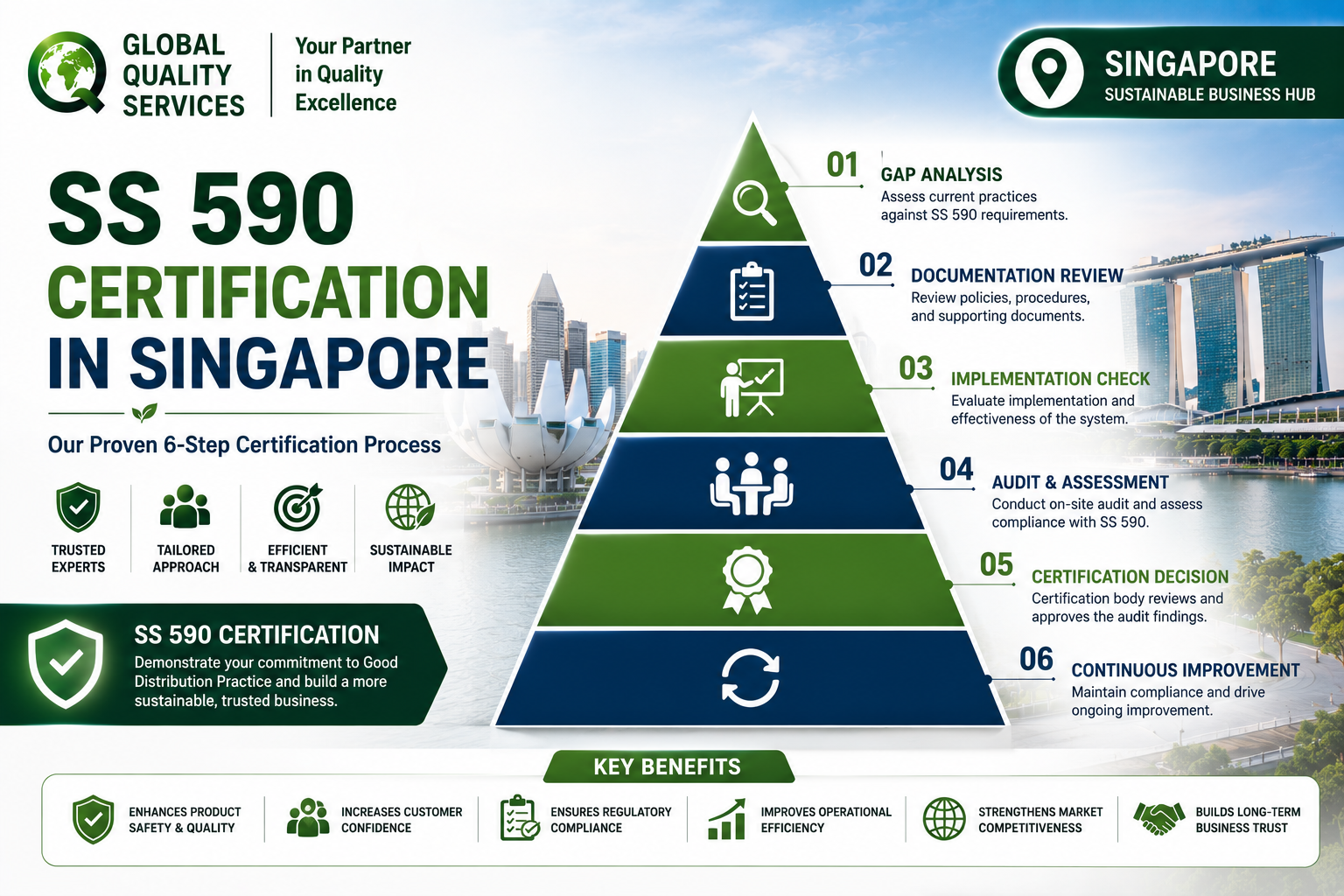
Step 1: Gap assessment. Your current food safety practices, HACCP documentation, and operational controls are reviewed against SS 590 requirements. A written gap report identifies what already meets the standard and what needs to be developed or updated, with findings prioritised by audit risk.
Step 2: Scope confirmation. We confirm the products, processes, and facilities to be included within the SS 590 certification scope and establish the certification boundary with your management team.
Step 3: HACCP system and FSMS build. We develop or update your HACCP plan, hazard analysis, critical control point documentation, prerequisite programmes, food safety policy, food safety objectives, and management system documentation to meet SS 590 requirements.
Step 4: Staff training. Your food safety team, production staff, and management are trained on HACCP principles, SS 590 requirements, and their individual roles within the food safety management system.
Step 5: Internal audit and management review. A full internal audit is conducted against SS 590 requirements, and a management review is facilitated, before the external certification audit begins. All non-conformances are identified and closed.
Step 6: Certification audit support. We coordinate your Stage 1 and Stage 2 certification audits with your chosen SAC-accredited certification body and provide support through to certificate issuance.
Benefits of SS 590 Certification for Singapore Food Manufacturers
Let us explore the benefits of SS 590 Certification for Singapore Food Manufacturers in detail
SFA SAFE Framework Grade A Qualification
SS 590 is an SFA-approved FSMS standard that qualifies Category 1 food establishments for Grade A attainment under the SAFE framework. A certified SS 590 FSMS is the documented evidence SFA requires that your food safety management system meets the standard for Grade A.
A Structured System Designed for Singapore SMEs
Unlike ISO 22000 or FSSC 22000, SS 590 was specifically redrafted for viability in small and medium food organisations. The management system requirements are proportionate to the scale of an SME food manufacturer without sacrificing the rigour of a certified HACCP-based system.
A Direct Path to ISO 22000
SS 590 is an intermediate standard to attain the ISO 22000 standard. The documentation, internal audit cycle, management review process, and HACCP system built during SS 590 certification are directly reusable when upgrading to ISO 22000. Manufacturers who certify to SS 590 first typically complete their ISO 22000 transition faster and at lower cost than those who attempt ISO 22000 implementation from scratch.
Retail and Institutional Buyer Confidence
Singapore retail chains, institutional food service operators, and contract catering buyers increasingly require a certified FSMS from their food manufacturing suppliers. SS 590 satisfies those requirements for the domestic market and provides the system foundation to meet international buyers’ requirements as the business scales.
Enterprise Development Grant Eligibility
Singapore SMEs may recover up to 50% of qualifying consultancy and certification costs for SS 590 certification through Enterprise Singapore’s Enterprise Development Grant under the Standards Adoption project category.
SS 590 as a Stepping Stone to ISO 22000 and FSSC 22000
Many Singapore food manufacturers use SS 590 as a planned intermediate step rather than a final destination.
The logic is straightforward. Implementing a full management system, HACCP plan, PRP documentation, internal audit programme, and management review cycle under SS 590 builds the institutional capability that ISO 22000 and FSSC 22000 certification require. A manufacturer that has operated under a certified SS 590 system for twelve to eighteen months has already trained its team, established its documentation discipline, and run multiple internal audit cycles. The upgrade to ISO 22000 adds operational prerequisite programmes and a few additional system requirements to a foundation that already works, rather than building from the ground up.
For manufacturers with confirmed export ambitions or international buyer requirements that reference GFSI-benchmarked certification, we scope the SS 590 implementation with ISO 22000 or FSSC 22000 as the planned next step from the outset, ensuring the documentation and system architecture built under SS 590 are directly compatible with the subsequent transition.
Why Choose Global Quality Services
Global Quality Services has supported food safety management system certification projects across Singapore for over two decades. Our SS 590 engagements are built for Singapore SME food manufacturers: proportionate in scope, practical in implementation, and structured to deliver a certified system that your team can actually maintain rather than one that exists only on paper until the next audit.
We understand how SS 590 sits alongside SFA’s SAFE framework, the FSSA 2025 obligations, and the broader landscape of food safety management certifications available to Singapore food businesses. For manufacturers planning to move from SS 590 to ISO 22000 or FSSC 22000, we scope every SS 590 engagement with that transition in mind so the upgrade is a progression rather than a restart.
Contact Global Quality Services to begin your SS 590 certification in Singapore.
Frequently Asked Questions
What is SS 590 certification and who needs it in Singapore?
SS 590 is Singapore’s HACCP-based food safety management system standard for food manufacturers, recognised by SFA as an approved FSMS. It is best suited to SME food manufacturers who need a certified food safety management system for the Singapore market that goes beyond SS 444 but does not yet require the international recognition of ISO 22000 or FSSC 22000.
What is the difference between SS 444 and SS 590?
SS 444 covers the seven HACCP principles and twelve HACCP steps and is best suited to food service, catering, and retail food businesses. SS 590 adds a full management system layer including food safety policy, objectives, internal audit, and management review, and is specifically designed for food manufacturers. SS 590 has more requirements than SS 444 and is aligned with ISO 22000.
Does SS 590 satisfy SFA’s SAFE framework requirement for a certified FSMS?
Yes. SS 590 is an SFA-approved FSMS standard. Food establishments that implement and certify to SS 590 meet the certified FSMS requirement for Grade A attainment under the SAFE framework.
Can Singapore SMEs get government funding for SS 590 certification?
Yes. Singapore SMEs may claim up to 50% of qualifying consultancy and certification costs for SS 590 certification through Enterprise Singapore’s Enterprise Development Grant under the Standards Adoption project category.
How long does SS 590 certification take for a Singapore food manufacturer?
Most Singapore food manufacturers complete SS 590 certification in three to five months, depending on the current state of existing HACCP documentation and management system practices. Companies with an existing SS 444 HACCP system typically move faster since the HACCP foundation is already in place.