SS 444:2018 is Singapore’s nationally recognised standard for Hazard Analysis and Critical Control Point (HACCP) food safety management systems. Published by Enterprise Singapore through the Singapore Standards Council, it establishes a systematic, preventive, risk-based approach to identifying, assessing, and controlling food safety hazards — biological, chemical, and physical — across every stage of the food supply chain.
The standard applies to any organisation involved in the food chain, from raw material production through manufacturing, processing, packaging, storage, distribution, retail, and catering. It is recognised by the Singapore Food Agency (SFA) as an approved Food Safety Management System (FSMS) under the Safety Assurance for Food Establishments (SAFE) framework.
Certificates issued under SS 444:2018 are valid only when awarded by bodies accredited by the Singapore Accreditation Council (SAC) or accreditation bodies that are signatories to the International Accreditation Forum (IAF) multilateral recognition agreement. The official SS 444:2018 standard is available from the Singapore Standards eShop.
If you are evaluating which food safety certification best suits your operation, see our guides on FSSC 22000 Certification, ISO 22000 Food Safety Management, and BRCGS Certification.
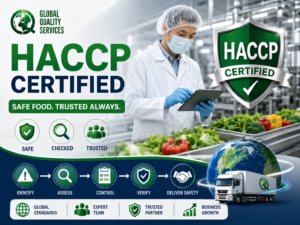
The 7 HACCP Principles Under SS 444
SS 444:2018 is structured around the seven internationally recognised Codex HACCP principles, applied across a 12-step implementation sequence. Every business seeking SS 444 certification must demonstrate full compliance with all seven principles — they form the backbone of your entire HACCP plan and are what auditors assess during the certification process. Understanding what each principle requires helps your team prepare a system that holds up both in documentation and in practice.
Principle 1 — Conduct a Hazard Analysis
Identify all potential biological, chemical, and physical hazards at each step of your food process. Assess the likelihood of occurrence and the severity of harm if the hazard is not controlled, so that meaningful control measures can be prioritised.
Principle 2 — Identify Critical Control Points (CCPs)
Determine the specific process steps where control measures can be applied to prevent, eliminate, or reduce a food safety hazard to an acceptable level. The Codex decision tree is the standard tool used for this determination.
Principle 3 — Establish Critical Limits
Set measurable boundaries — such as temperature, pH, time, or water activity — for each CCP. These limits define the line between what is safe and what is potentially unsafe, and every limit must be scientifically justified and documented.
Principle 4 — Establish Monitoring Procedures
Define how, when, and by whom each CCP will be monitored. Monitoring must be systematic and frequent enough to detect a loss of control before unsafe product leaves the operation.
Principle 5 — Establish Corrective Actions
Document the specific actions to be taken when a CCP deviates from its critical limit — covering both the disposition of any affected product and the correction of the process failure to prevent recurrence.
Principle 6 — Establish Verification Procedures
Confirm that the overall HACCP plan is working as intended through independent activities such as internal audits, review of monitoring records, microbiological testing, and periodic plan reviews.
Principle 7 — Record-Keeping and Documentation
Maintain complete, auditable records that demonstrate your HACCP system is operating as designed at all times — including monitoring logs, corrective action reports, calibration records, and verification results.
Who Needs SS 444 Certification in Singapore?
SS 444:2018 is applicable to any organisation that operates within the food chain, regardless of size or segment. The Singapore Food Agency (SFA) specifically requires catering businesses — and food establishments providing catering as an ancillary service — to implement a certified FSMS as a licensing condition. Beyond this regulatory requirement, many retailers, airlines, healthcare institutions, and government agencies in Singapore impose SS 444 or equivalent certification as a mandatory supplier pre-qualification criterion. If your business supplies, handles, or distributes food in any capacity, this certification is relevant to you.
Food Manufacturers and Processors
Companies involved in producing, processing, or transforming food products must demonstrate systematic hazard control across their production lines. SS 444 provides the structured framework to achieve and evidence this.
Catering and Central Kitchen Operators
Catering businesses and those providing meals as an ancillary service — including hospitals, schools, corporations, and events — are specifically required by the SFA’s SAFE framework to implement a certified FSMS. SS 444 is one of the recognised pathways to fulfil this requirement.
Restaurants, Cafes, and F&B Establishments
While not always mandatorily required for standalone dining operations, SS 444 certification strengthens your SAFE framework grading, signals food safety commitment to diners, and is often required by landlords, corporate clients, and institutional buyers.
Food Storage and Cold Chain Distribution Companies
Businesses responsible for warehousing, cold storage, or transporting food products carry significant hazard control responsibilities. SS 444 formalises temperature management, traceability, and hygiene controls across logistics operations.
Food Retailers, Importers, and Packaging Businesses
Retailers and importers handling ready-to-eat or minimally processed foods, as well as businesses involved in food contact packaging, benefit from SS 444 certification when tendering to institutional buyers or applying for import licences from the SFA.
Key Benefits of SS 444 Certification
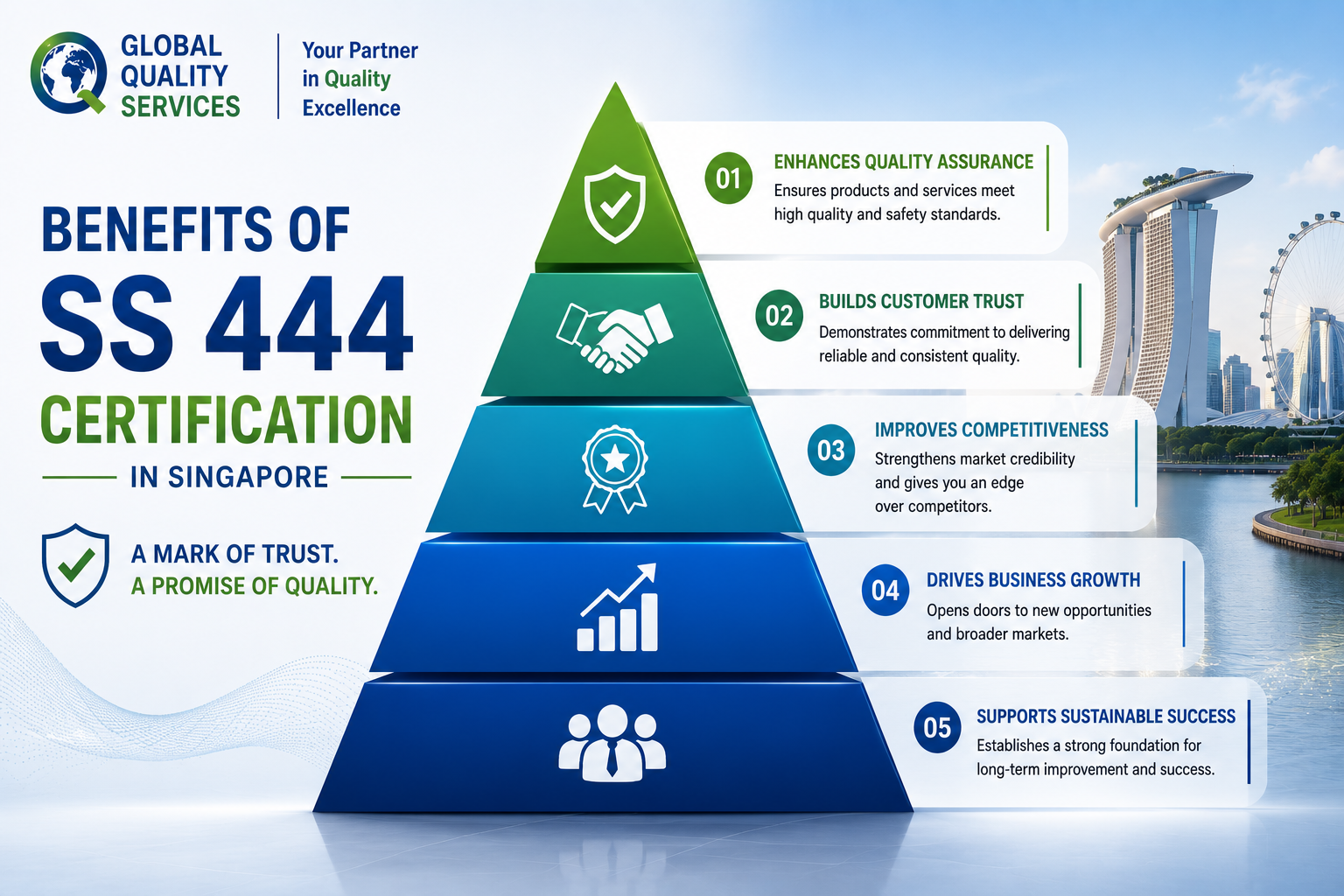
Achieving SS 444 certification is not simply a box-ticking exercise — it delivers tangible, measurable advantages that strengthen your business from the inside out. Organisations that implement a properly functioning HACCP system consistently report fewer food safety incidents, greater buyer confidence, faster entry into new sales channels, and a stronger foundation for scaling operations. Here is what you stand to gain.
Proactive Food Safety Risk Control
Replace reactive end-product testing with a preventive system that identifies and eliminates hazards before they reach the consumer. This reduces the risk of costly product recalls, consumer complaints, regulatory penalties, and reputational damage.
SFA Regulatory Compliance
Fulfil Singapore Food Agency licensing conditions and SAFE framework requirements. SS 444 is a directly recognised pathway to satisfy mandatory FSMS conditions for catering and food manufacturing licences under Singapore’s Sale of Food Act and Food Safety and Security Act.
Stronger Market Position and Procurement Access
Win contracts with supermarkets, airlines, hospitals, government institutions, and corporate food service clients that require a recognised food safety certification as a minimum qualification. Holding SS 444 expands the range of tenders you are eligible to submit.
Foundation for International Certification
SS 444 is the entry-level building block of Singapore’s food safety standards hierarchy. Once your HACCP system is established, upgrading to ISO 22000, FSSC 22000, or BRCGS becomes significantly more achievable, opening export markets across Asia-Pacific, Europe, and North America.
Enhanced Consumer and Buyer Confidence
Display a SAC-recognised certification mark that signals to consumers, procurement managers, and business partners that your food safety practices meet Singapore’s national standards — independently verified by a third-party auditor.
Operational Efficiency and Reduced Waste
Structured monitoring, documented procedures, and defined corrective action protocols reduce production errors, food waste, and incident response time. Businesses that implement SS 444 properly typically see measurable improvements in consistency, yield, and staff accountability.
SS 444 and Singapore’s Regulatory Landscape
Food safety in Singapore is governed by the Singapore Food Agency under the Sale of Food Act and the Food Safety and Security Act. Understanding how SS 444 sits within this regulatory environment — and which government bodies recognise it — is important before you begin the certification process. The good news is that SS 444:2018 is fully embedded in Singapore’s official food safety framework, making it one of the most direct routes to regulatory compliance for food businesses operating here.
The SFA’s SAFE framework incentivises FSMS adoption by tying inspection grades to certification status. Establishments holding a valid SS 444, SS 590, ISO 22000, FSSC 22000, or BRCGS certificate — issued by a body accredited by the Singapore Accreditation Council (SAC) — can attain better grades under the SAFE inspection scheme, provided all other prescribed conditions are met.
Enterprise Singapore administers the Singapore Standards programme under which SS 444:2018 is published. Certification bodies operating in Singapore must hold SAC accreditation under the HACCP-based Food Management System scheme, or accreditation from an IAF multilateral recognition agreement signatory, for their SS 444 certificates to be accepted by SFA. GQS Singapore coordinates your full certification process with the appropriate accredited bodies — you do not need to navigate this independently.
Our SS 444 Certification Process
Getting certified to SS 444:2018 requires more than simply writing a HACCP plan — it demands that your system is genuinely implemented, consistently monitored, and verifiable by an independent auditor. GQS Singapore follows a structured seven-stage process that takes your organisation from initial gap assessment through to successful third-party certification and beyond. Our approach is hands-on at every stage, so your team is confident and audit-ready — not just document-ready.
Stage 1 — Initial Gap Analysis and Scoping
Our food safety consultants review your existing processes, products, supply chain, and documentation against SS 444:2018 requirements. We identify gaps, define your HACCP scope, and produce a prioritised action plan tailored to your operation’s size, product range, and risk profile.
Stage 2 — HACCP Team Formation and Training
We help you assemble a competent, multidisciplinary HACCP team from within your organisation and deliver targeted training on the seven HACCP principles, prerequisite programmes (PRPs), Good Manufacturing and Hygiene Practices (GMP/GHP), and SS 444:2018 documentation requirements. Visit our food safety training page for available programmes.
Stage 3 — HACCP Plan Development
We support your team in building a complete, auditable HACCP plan — including product descriptions, ingredient specifications, process flow diagrams, hazard analysis tables, CCP determination records using the Codex decision tree, critical limits, monitoring schedules, corrective action procedures, and verification plans.
Stage 4 — Implementation and Prerequisite Programmes
We guide the live implementation of your HACCP plan alongside supporting PRPs — covering cleaning and disinfection, pest control, allergen management, personal hygiene, supplier approval, equipment calibration, and traceability systems — to ensure your operation meets SS 444 requirements in practice, not just on paper.
Stage 5 — Internal Audit
GQS conducts a rigorous internal audit against SS 444:2018 to verify that your HACCP system is functioning effectively, records are accurate and complete, and all non-conformities are identified, root-caused, and corrected well before the certification audit takes place.
Stage 6 — Third-Party Certification Audit
We refer your organisation to a SAC-accredited certification body and support you through both the Stage 1 document review and Stage 2 on-site audit — attending as observers, addressing auditor queries, and ensuring any observations are resolved correctly and promptly.
Stage 7 — Certification and Ongoing Surveillance Support
Once your SS 444 certificate is issued, GQS provides continued support through annual surveillance audits and the three-yearly recertification cycle. We also advise on upgrading to FSSC 22000 or ISO 22000 as your business grows and your market access requirements evolve.
SS 444 vs Other Food Safety Standards in Singapore
Choosing the right food safety certification depends on your industry sector, customer requirements, export ambitions, and operational complexity. SS 444 is not the only option — and for some businesses, a higher-level standard may be the smarter long-term investment. The table below compares SS 444:2018 against the other FSMS standards recognised by the Singapore Food Agency, so you can make an informed decision. If you are unsure which standard fits your business best, our consultants offer a complimentary standards-matching session — contact GQS Singapore to arrange one.
| Feature | SS 444:2018 | SS 590:2013 | ISO 22000:2018 | FSSC 22000 | BRCGS |
|---|---|---|---|---|---|
| Singapore-specific standard | Yes | Yes | International | International | International |
| SFA FSMS recognised | Yes | Yes | Yes | Yes | Yes |
| HACCP-based | Core focus | Yes | Incorporated | Yes | Yes |
| International market recognition | Regional | Regional | Global | Global | Global (retail) |
| Complexity / entry level | Entry level | Intermediate | Intermediate | Advanced | Advanced |
| Best suited for | Local F&B, SMEs, caterers | Larger food manufacturers | Exporters, multi-site ops | GFSI retail supply chains | UK/EU retail suppliers |
Get SS 444 Certified with GQS Singapore
GQS Singapore has supported over 1,450 organisations across 17 global locations in achieving recognised management system certifications over 21 years of practice. Our food safety consultants combine deep technical knowledge of SS 444:2018 with practical, on-the-ground implementation experience across food manufacturing, catering, distribution, and retail sectors in Singapore.
We offer a complimentary gap analysis to show you exactly where your current practices stand against SS 444:2018 requirements — and what it will take to achieve certification. There is no obligation, and no generalised advice: every assessment is specific to your products, processes, and business goals.
Ready to begin? Contact GQS Singapore today or explore our full range of food safety certification services.
Frequently Asked Questions About SS 444 Certification
Food businesses in Singapore often have similar questions before starting the SS 444 certification journey — about mandatory requirements, timelines, costs, and how this standard compares to others. We have answered the five most common ones below. If your question is not covered here, speak directly with one of our food safety consultants through our contact page.
Is SS 444 certification mandatory in Singapore?
SS 444 certification is not universally mandatory for all food businesses, but it is required for specific categories. The Singapore Food Agency requires catering businesses — and food establishments providing catering as an ancillary service, such as hospitals, schools, and corporate cafeterias — to implement a certified FSMS as a condition of their operating licence. SS 444:2018 is one of the standards recognised to satisfy this requirement, alongside SS 590, ISO 22000, FSSC 22000, and BRCGS. Beyond regulatory mandates, many Singapore retailers, airlines, healthcare institutions, and government procurement frameworks impose SS 444 or equivalent certification as a supplier pre-qualification requirement. Even where it is not legally compelled, the commercial and operational advantages of certification make it a sound investment for any food business.
How long does it take to get SS 444 certified?
The timeline depends on the size and complexity of your operation and the maturity of your existing food safety practices. For a small to medium-sized food business starting with limited documentation, the full implementation and certification process typically takes three to six months. Larger food manufacturers or those with multiple product lines and complex supply chains may require six to twelve months. GQS Singapore’s initial gap analysis provides a precise, realistic project timeline for your specific situation. Engaging an experienced consultancy significantly reduces the risk of audit failures and repeated corrective action cycles, compressing the overall time to certification and lowering your total investment.
What is the difference between SS 444 and SS 590?
Both are Singapore Standards that incorporate HACCP principles and are recognised by the SFA as valid FSMS frameworks. The key differences lie in scope and system complexity. SS 444:2018 focuses specifically on implementing the HACCP system and its prerequisite programmes — it is entry-level and well-suited to SMEs, caterers, restaurants, and businesses new to systematic food safety management. SS 590:2013 builds on SS 444 by adding a broader management system structure — including clauses on management responsibility, resource management, and continual improvement — making it comparable to ISO 22000 in its overall approach. For businesses with international export ambitions or GFSI-mandated supply chains, progressing directly to ISO 22000 or FSSC 22000 is often the more efficient path, as these carry global market recognition that SS 590 does not.
Which certification bodies can issue SS 444 certificates in Singapore?
SS 444 certificates must be issued by a Management System Certification Body (MSCB) accredited by the Singapore Accreditation Council (SAC) under its HACCP-based Food Management System scheme, or by a certification body accredited by an IAF multilateral recognition agreement signatory. Well-known accredited bodies operating in Singapore include TÜV SÜD PSB, SOCOTEC Certification International, Bureau Veritas, and SGS, among others. GQS Singapore maintains working relationships with multiple SAC-accredited certification bodies and recommends the most suitable one based on your industry sector, timeline, and budget — removing the complexity of sourcing and managing a certification body yourself.
Can SS 444 certification help us qualify for government tenders in Singapore?
Yes. Many Singapore government agencies and statutory boards — including the Ministry of Education (MOE), Ministry of Health (MOH), and various Healthcare Clusters — require food suppliers and caterers to hold a recognised food safety certification as part of their tender pre-qualification criteria. An SS 444 certificate issued by a SAC-accredited body is accepted as documentary evidence of food safety management compliance in government procurement processes. For larger or more complex government food contracts — particularly those involving multi-site catering or export components — upgrading to ISO 22000 or FSSC 22000 may provide a stronger competitive advantage. Our GQS consultants can assess which certification best positions your business for the specific tenders you are targeting.