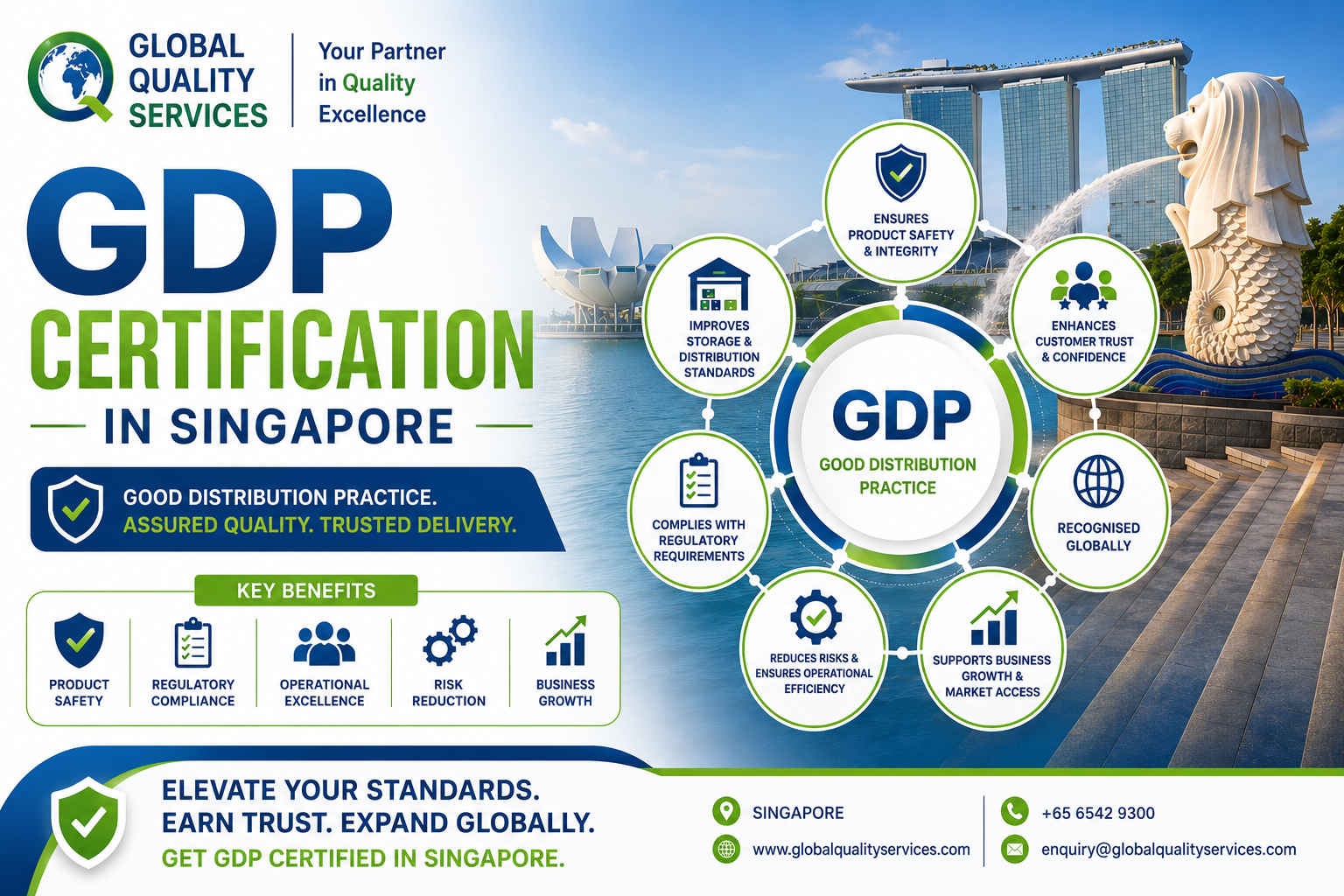
Good Distribution Practice certification is not optional for every company it applies to in Singapore. For importers and wholesalers of therapeutic products, Chinese proprietary medicines, cell and gene therapy products, and active pharmaceutical ingredients, GDP compliance is a mandatory condition of holding a local dealer’s license under the Health Sciences Authority (HSA). For medical device importers and wholesalers, GDPMDS certification is mandatory before a Medical Device Dealer’s License can be issued.
Understanding which GDP framework applies to your Singapore operation, and whether you are subject to mandatory compliance, a voluntary certificate, or both, is where every engagement with Global Quality Services begins.
We provide end-to-end GDP certification consultancy for pharmaceutical importers, wholesalers, third-party logistics companies, and medical device dealers in Singapore. We prepare your quality system documentation, guide your team through the HSA audit process, and keep your GDP compliance current through every product scope change and operational update.
What Is GDP Certification?
Good Distribution Practice is a vital component of quality assurance. It requires the company to establish a quality system which ensures that products are consistently stored and handled under appropriate conditions as required by the marketing authorization or product specification.
In Singapore, GDP certification has two distinct regulatory tracks administered by HSA.
- Pharmaceutical GDP — governed by HSA’s Guidance Notes on Good Distribution Practice, revised in December 2023, and applicable to importers and wholesalers of therapeutic products, Chinese proprietary medicines, cell, tissue and gene therapy products (CTGTP), and active pharmaceutical ingredients intended for the Singapore market.
- Medical Device GDP (GDPMDS) — governed by Singapore Standard SS 620:2016, mandatory for all companies importing or distributing medical devices and in-vitro diagnostic devices in Singapore, and a prerequisite for obtaining a Medical Device Dealer’s License from HSA.
Both tracks require a documented quality management system covering personnel qualifications, premises and facilities, storage controls, documentation, self-inspection, complaints and product recalls, and contract activities.
Mandatory Compliance vs Voluntary GDP Certificate
Getting this distinction right matters before any consultancy work begins.
Mandatory GDP compliance applies to all local importers and wholesalers of therapeutic products, Chinese proprietary medicines, CTGTPs, and active pharmaceutical ingredients. Compliance to HSA’s Guidance Notes on Good Distribution Practice is mandatory for all local importers and wholesalers of Therapeutic Products, Chinese Proprietary Medicines, Cell, Tissue and Gene Therapy Products and Active Ingredients intended for the Singapore market. HSA GDP auditors conduct audits on these companies prior to the issuance of their local dealer’s licenses.
Voluntary GDP Certificate is a separate scheme. Good Distribution Practice certification is a voluntary scheme offered to local dealers of therapeutic products interested to be certified for conformity with relevant GDP standards. Third-party logistics companies, contract warehouses, and distribution operators not directly holding a dealer’s license may pursue this voluntary certificate to demonstrate GDP compliance to partners, principals, and supply chain customers.
GDPMDS is mandatory for medical device dealers and is a non-negotiable prerequisite for a Medical Device Dealer’s License in Singapore.
Global Quality Services advises you on which track applies to your operation before any documentation work begins, since preparing for the wrong framework wastes time and delays your HSA audit.
Who Needs GDP Certification in Singapore
- Pharmaceutical importers and wholesalers of therapeutic products requiring a Therapeutic Products Import License (TPIL) or Therapeutic Products Wholesale License (TPWL) from HSA
- Chinese proprietary medicine dealers importing or wholesaling CPMs for the Singapore market
- Active pharmaceutical ingredient importers and wholesalers under the Health Products (Active Ingredients) Regulations 2023, the scope clarified in the December 2023 revision of HSA’s GDP Guidance Notes
- CTGTP handlers including companies involved in storage and distribution of cell, tissue and gene therapy products and starting materials used for CTGTP manufacture
- Medical device importers and distributors requiring GDPMDS certification under SS 620:2016 before applying for a Medical Device Dealer’s License
- Third-party logistics and cold-chain operators handling pharmaceutical products for principals who require documented GDP compliance in their supply chain audits
- Companies at Tuas Biomedical Park importing APIs, distributing finished pharmaceutical products, or handling cold-chain biologics as part of the park’s pharmaceutical manufacturing ecosystem
What GDP Certification Covers
HSA’s GDP framework requires your quality system to address nine areas documented in your Site Master File.
- General information covering your distribution site, activities, and scope of operations
- Personnel including qualification requirements for key staff, job descriptions, and training records
- Premises and facilities covering warehouse design, temperature-controlled storage, segregation of products, and security
- Stock handling and stock control covering receipt, storage, picking, packing, and dispatch procedures
- Documentation covering procedures, records, and the document control system underpinning your quality management
- Product complaints and recalls covering your process for receiving, investigating, and escalating quality complaints and executing product recalls
- Self-inspections covering your internal audit program for ongoing GDP compliance monitoring
- Contract activities covering GDP obligations placed on or accepted from contract warehouses, logistics providers, and other third parties in your distribution chain
A Site Master File should contain approximately 25 to 30 pages of information in total and may be submitted to HSA in hard copy or electronic format. Global Quality Services prepares your Site Master File to HSA’s current standards and formats.
A Key 2026 Update: Electronic GDP Certificates
With effect from 30 June 2026, HSA will be issuing Good Manufacturing Practice Certificates and Good Distribution Practice Certificates as verifiable electronic documents using GovTech’s FileSG digital platform. There are no changes to the application process, regulatory requirements, or application fees as a result of this change. However, companies that previously stored physical GDP certificates for supply chain verification purposes need to update their document management procedures to reference the new electronic certificate format.
Global Quality Services advises clients on updating their GDP documentation procedures to reflect this change as part of every active engagement from 2026 onwards.
HSA GDP Audit and Certificate Details
The GDP certificate is valid for 3 years from the date of audit. Companies are advised to apply for a new certificate at least 3 months prior to the anticipated date for the GDP inspection to allow sufficient time to schedule for a GDP inspection. The certificate cannot be renewed or re-issued. Upon expiry, a new application must be submitted.
When HSA receives your GDP certificate application, it reviews your submission to assess audit readiness before arranging the GDP audit. Companies that are not audit-ready at the time of HSA’s assessment face delays in scheduling, which can affect dealer’s license issuance timelines. Global Quality Services prepares your documentation and quality system to the standard HSA expects before your application is submitted, not after.
Our GDP Certification Consultancy Process for Singapore Companies
Step 1: Scope and track confirmation. We confirm whether your Singapore operation falls under mandatory pharmaceutical GDP, voluntary GDP certificate, GDPMDS, or a combination of these, and identify all products and activities within your distribution scope.
Step 2: Gap assessment. Your current quality system, premises, storage controls, and documentation are reviewed against HSA’s Guidance Notes on Good Distribution Practice or SS 620:2016 for medical devices. A written gap report prioritizes findings by audit risk.
Step 3: Quality system and Site Master File build. We develop or update your Site Master File, standard operating procedures, personnel training records, temperature mapping documentation, complaint and recall procedures, and self-inspection program to meet HSA’s current requirements.
Step 4: Staff training. Your distribution, warehouse, and quality assurance staff are trained on GDP requirements specific to your product scope, with particular focus on storage condition monitoring, documentation discipline, and deviation reporting.
Step 5: Internal audit and pre-inspection review. We conduct an internal audit simulating the HSA GDP inspection, identify and close any remaining gaps, and prepare your team for the audit interaction.
Step 6: HSA audit support. We support your team during the HSA GDP audit, coordinate responses to inspector queries, and manage any corrective action requests raised during or after the audit through to certificate issuance.
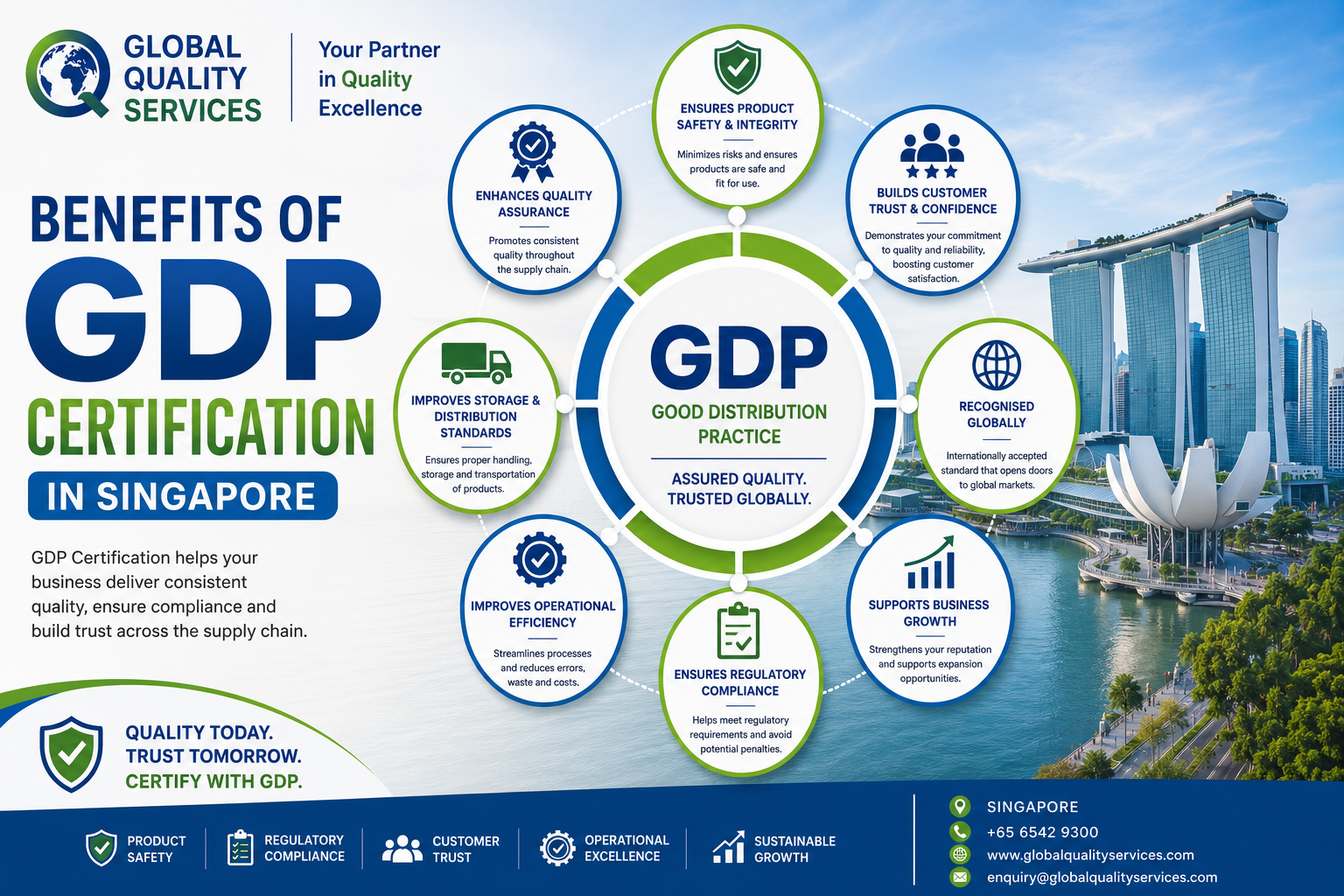
Benefits of GDP Certification for Singapore Companies
Dealer’s License Without Delays
For pharmaceutical importers and wholesalers, GDP compliance is a mandatory audit step before HSA issues a dealer’s license. A quality system that is audit-ready when HSA inspects it means a license issued on schedule rather than delayed by corrective action requests.
Supply Chain Confidence for Multinational Principals
Many pharmaceutical and medical device companies in Singapore act as local distributors for multinational principals whose global GDP policies require proof of certified distribution practices. A current HSA GDP certificate or GDPMDS certification satisfies those principal qualification requirements with a Singapore government-issued document rather than a self-declaration.
Credibility With Cold-Chain and Logistics Partners
Third-party logistics companies and cold-chain operators without a GDP certificate are increasingly excluded from supply agreements with pharmaceutical importers who include distribution partner GDP compliance in their own HSA submissions. A voluntary GDP certificate opens those distribution partnerships.
Alignment With International GDP Standards
Singapore’s GDP framework is aligned with PIC/S (Pharmaceutical Inspection Co-operation Scheme) GDP guidelines, which means a company certified to HSA’s GDP standard is working to an internationally recognized baseline that supports business with pharmaceutical partners in Europe, Australia, and other PIC/S member markets.
Integration With ISO 9001 and ISO 13485
A GDP quality system shares significant structural overlap with ISO 9001:2026 quality management and ISO 13485 medical device quality management. Companies holding or pursuing these certifications alongside GDP can use aligned documentation, shared internal audit cycles, and combined management review processes rather than maintaining completely separate systems.
Why Choose Global Quality Services
Global Quality Services has supported regulatory compliance and management system certification projects across Singapore and the Asia-Pacific region for over two decades. Our GDP consultants understand HSA’s audit approach, the current Guidance Notes on Good Distribution Practice revised in December 2023, and the specific documentation expectations HSA inspectors bring to pharmaceutical and medical device distribution operations in Singapore.
We prepare your Site Master File, operating procedures, and quality system to audit-ready standard before your application is submitted to HSA, not after an initial inspection flags gaps. Our experience across pharmaceutical therapeutic products, Chinese proprietary medicines, active pharmaceutical ingredients, CTGTPs, and medical devices under GDPMDS means we scope every engagement to the correct regulatory track rather than applying a single generic GDP template across different product categories.
For companies also pursuing ISO 13485 medical device quality management, ISO 9001:2026 quality management, or ISO 45001:2018 occupational health and safety, we scope GDP consultancy to sit alongside your existing management system framework rather than operate as a separate track.
Contact Global Quality Services to begin your GDP certification in Singapore.
Frequently Asked Questions
Is GDP certification mandatory or voluntary in Singapore?
It depends on your product category. GDP compliance is mandatory for all importers and wholesalers of therapeutic products, Chinese proprietary medicines, CTGTPs, and active pharmaceutical ingredients, with HSA auditing companies before issuing dealer’s licenses. GDPMDS is mandatory for medical device dealers. A separate voluntary GDP certificate is also available from HSA for companies wishing to obtain formal certification beyond mandatory compliance.
What is the difference between pharmaceutical GDP and GDPMDS in Singapore?
Pharmaceutical GDP applies to importers and wholesalers of therapeutic products, CPMs, CTGTPs, and active ingredients, governed by HSA’s Guidance Notes on Good Distribution Practice. GDPMDS applies to medical device and in-vitro diagnostic device importers and distributors, governed by Singapore Standard SS 620:2016. Both are administered by HSA but have different documentation requirements and audit processes.
How long is a Singapore HSA GDP certificate valid?
An HSA GDP certificate is valid for 3 years from the date of audit. It cannot be renewed or re-issued. Upon expiry, companies must submit a new application and undergo a new GDP audit.
What changed in HSA’s GDP Guidance Notes in December 2023?
The December 2023 revision primarily clarified GDP requirements for the handling of active pharmaceutical ingredients under the new Health Products (Active Ingredients) Regulations 2023. Companies importing or wholesaling active ingredients in Singapore must ensure their GDP quality systems reflect these clarified requirements.
What is the 2026 update to how HSA issues GDP certificates?
From 30 June 2026, HSA is issuing GDP certificates as verifiable electronic documents through GovTech’s FileSG digital platform rather than physical documents. The application process, regulatory requirements, and fees remain unchanged. Companies should update their document management procedures to reference the electronic certificate format.