Water is now a board-level risk for any company that manufactures, processes, or cools at scale. Investors ask about it. Large customers now audit water use across their supply chains, and in water-stressed markets, regulators track it closely. If your business operates in Singapore, one of the most water-stressed countries in the world, a vague “we care about water” statement no longer holds up.
ISO 14046 certification gives you a defensible answer. It puts a verified number on your water footprint, measured against the international standard, ISO 14046:2014. GQS Singapore takes you there, from the first gap assessment to the independent verification that stands up to scrutiny.
Here is what this page covers: what ISO 14046 certification is, why it matters for Singapore businesses, what the assessment measures, the step-by-step process, and who needs it.
What Is ISO 14046 Certification?
ISO 14046 certification is independent, third-party confirmation that your water footprint assessment meets the requirements of ISO 14046:2014, the international standard for water footprint assessment.
The standard, published by the International Organization for Standardization, sets out how to measure the potential water-related environmental impacts of a product, a process, or a whole organisation. It does this through life cycle assessment (LCA), following the same four-phase method defined in ISO 14040 and ISO 14044.
One point is worth making clear. ISO 14046 is a methodology standard, not a management-system standard like ISO 14001. You do not “implement ISO 14046” the way you implement an environmental management system. Instead, you conduct a water footprint assessment to its rules, then have that assessment independently verified. The output is a verified water footprint, backed by a verification statement you can share with stakeholders.
The scope is deliberately focused. ISO 14046 measures water use and changes in water quality only. Air and soil emissions count solely when they affect water quality, and not otherwise. The result is either a single figure or a profile of impact indicators covering areas such as water scarcity and water quality degradation.
Why ISO 14046 Certification Matters for Singapore Businesses
For Singapore, water is a strategic resource, and the pressure on it is rising fast.
Singapore is among the most water-stressed countries in the world, with almost no natural water resources of its own. PUB, the national water agency, projects that total water demand will almost double by 2065, with the non-domestic sector, meaning business and industry, expected to account for two-thirds of it. Much of the supply still depends on the Four National Taps, including imported water from Johor under an agreement that runs out in 2061.
That backdrop carries real regulatory weight. Large non-domestic water users are already required to submit annual water efficiency management plans to PUB, and new projects in water-intensive industries face mandatory water recycling requirements. Measuring your water footprint properly is fast becoming table stakes, not a nice-to-have.
Here is what ISO 14046 certification does for you in that context:
- It turns water from a reputational risk into a managed, measured number you can act on.
- It gives ESG reports, tender submissions, and investor disclosures a credible, standardised basis instead of self-declared estimates.
- It shows where in your operations or supply chain water impact actually sits, so efficiency spend goes to the right place.
What ISO 14046 Measures: Inside a Water Footprint Assessment
A water footprint assessment under ISO 14046 follows the four phases of life cycle assessment. Each phase feeds the next.
| Phase | What happens |
|---|---|
| 1. Goal and scope definition | Set why the assessment is being done, the functional or reporting unit, system boundaries, and the geographic and time coverage. |
| 2. Water use inventory analysis | Collect data on water inputs, outputs, and quality changes across the defined boundary, including relevant supply-chain stages. |
| 3. Water footprint impact assessment | Convert the inventory into impact indicators, such as water scarcity and water quality degradation. |
| 4. Interpretation | Analyse the results, test their reliability, and draw conclusions that inform decisions. |
Because it uses life cycle thinking, an ISO 14046 assessment can look narrowly at a single site or reach across an entire product value chain, from raw material to end of life. You choose the boundary that fits the decision you are trying to make.
The ISO 14046 Certification Process With GQS
We run ISO 14046 certification as a structured programme, so you always know the next step.
- Gap assessment. We review your current water data, systems, and reporting against ISO 14046 requirements and map what is missing.
- Scope and boundary setting. Together we define the assessment goal, functional unit, and system boundaries, deciding which sites, products, and supply-chain stages are in.
- Water use inventory. We help you collect and organise water input, output, and quality data into a defensible inventory.
- Impact assessment. The inventory is translated into water footprint impact indicators using recognised assessment methods.
- Reporting. Results are documented in a water footprint report that meets ISO 14046 reporting requirements.
- Independent verification. A third-party verifier reviews the assessment. Any gaps raise corrective actions, which are closed before sign-off.
- Verified water footprint. On successful verification, you receive your verified water footprint and verification statement, ready for ESG, tender, or disclosure use.
Benefits of ISO 14046 Certification
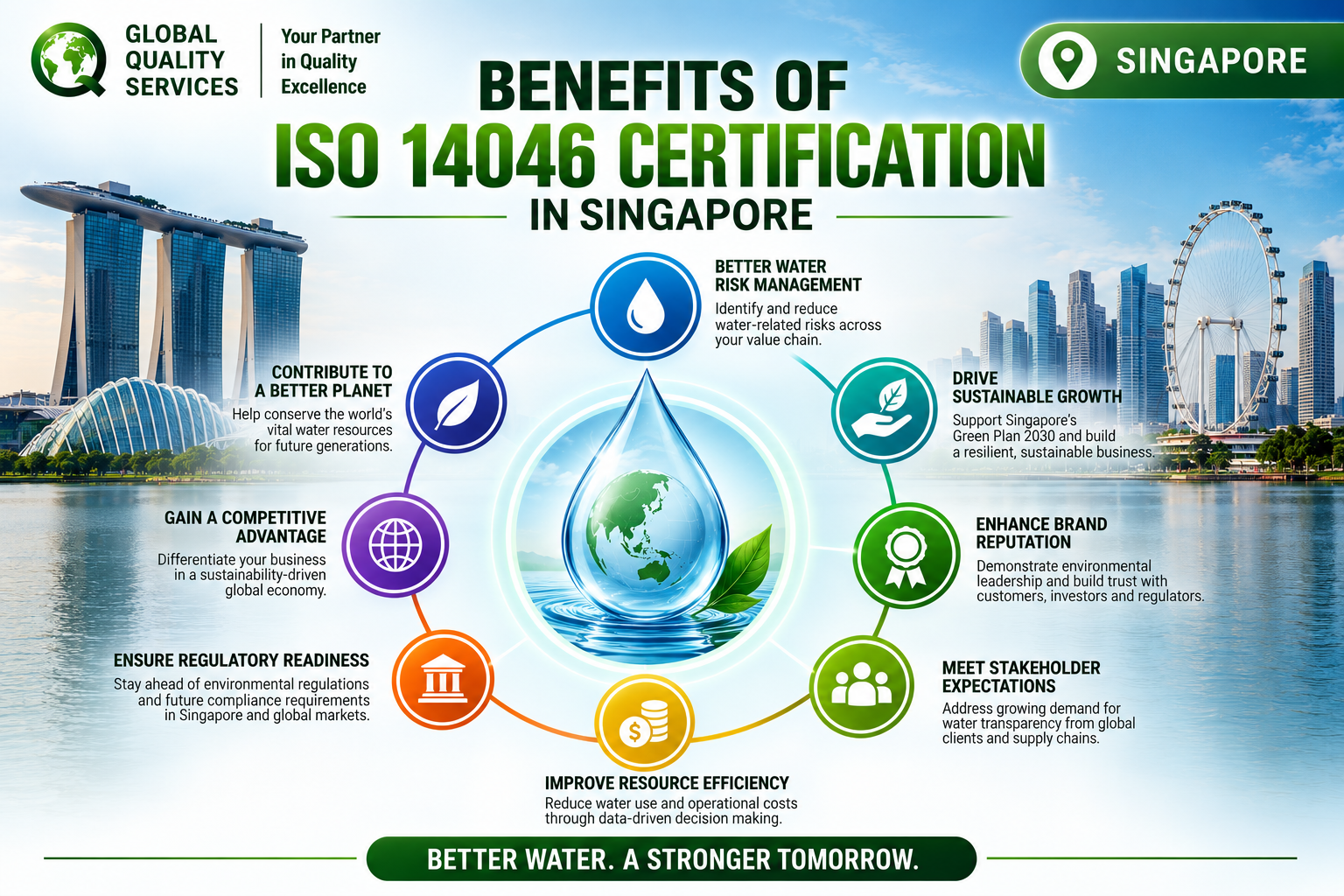
ISO 14046 certification helps Singapore organisations manage water risk, report credibly, and compete for water-conscious contracts.
Here is where it pays off:
- Water risk management. You see your exposure to water scarcity and quality issues clearly, which supports business continuity planning in a water-stressed market.
- Credible sustainability reporting. A verified water footprint strengthens ESG disclosures and lowers the risk of greenwashing claims. It pairs naturally with ISO 14064 for carbon and ISO 50001 for energy.
- Market and tender access. Global buyers and large customers increasingly ask suppliers for water data. Verification gives you a recognised answer.
- Operational efficiency. Knowing where water impact concentrates helps target recycling, reuse, and process changes that cut both consumption and cost.
Who Needs ISO 14046 Certification in Singapore?
ISO 14046 certification matters most to water-intensive operations, though any organisation reporting on sustainability can benefit.
The sectors that feel water pressure hardest in Singapore include semiconductor and electronics manufacturing, food and beverage, pharmaceuticals, data centres, textiles, and chemicals. The numbers explain why. PUB notes that a single semiconductor fabrication plant can use the equivalent of 500 swimming pools of ultra-pure water a day, roughly enough to serve 33,000 households. For operations at that scale, an unmeasured water footprint is a genuine blind spot.
Why Choose GQS for ISO 14046 Certification in Singapore
GQS Singapore has supported organisations across Asia-Pacific with ISO certification and environmental compliance for over two decades.
What that means for your ISO 14046 project:
- Environmental depth. Our consultants work across the full environmental family, so ISO 14046 slots into a wider picture that can include ISO 14001, ISO 14064, and water efficiency management under ISO 46001.
- Local regulatory knowledge. We understand Singapore’s water rules and PUB expectations, so your assessment supports the reporting you actually need to do.
- Integrated programmes. Running ISO 14046 alongside other standards cuts duplication, audit fatigue, and total cost. Many clients combine it with their ESG reporting work.
- End-to-end support. From gap assessment to verification, one team stays with you the whole way.
Ready to measure and verify your water footprint? Talk to our ISO 14046 consultants for a scoped quote.
Frequently Asked Questions
1. Is ISO 14046 certification mandatory in Singapore? No. ISO 14046 certification is not legally mandatory in Singapore. However, large non-domestic water users are already required to submit annual water efficiency management plans to PUB, and customers, investors, and tenders increasingly expect a verified water footprint. Many organisations adopt ISO 14046 to meet those expectations and stay ahead of tightening water regulation.
2. What is the difference between ISO 14046 and ISO 14001? ISO 14046 and ISO 14001 solve different problems. ISO 14046 is a water footprint assessment methodology that quantifies water-related impacts using life cycle assessment. ISO 14001 is an environmental management system standard covering how you manage environmental responsibilities across the board. Many organisations run both, using ISO 14001 for the management system and ISO 14046 for the water-specific numbers.
3. How long does ISO 14046 certification take in Singapore?
It depends on your size, the assessment boundary, and how much water data you already hold. Organisations with clean, accessible data and a single-site scope move faster, while broad supply-chain assessments take longer. After the initial gap assessment, GQS gives you a realistic timeline before work begins.
4. Can ISO 14046 be combined with ISO 14064 or ISO 14001?
Yes, and it is a common request. ISO 14046 for water, ISO 14064 for greenhouse gas emissions, and ISO 14001 for environmental management work well as one integrated environmental programme. Running them together reduces duplicated documentation, audit effort, and overall cost, which is why many GQS clients bundle them.
5. Which industries in Singapore need ISO 14046 certification most?
Water-intensive sectors benefit most: semiconductor and electronics, food and beverage, pharmaceuticals, data centres, textiles, and chemicals. These operations use large volumes of water and face the closest scrutiny from regulators, customers, and investors. Even so, any organisation building credible sustainability reporting can use ISO 14046 to strengthen its water disclosures.