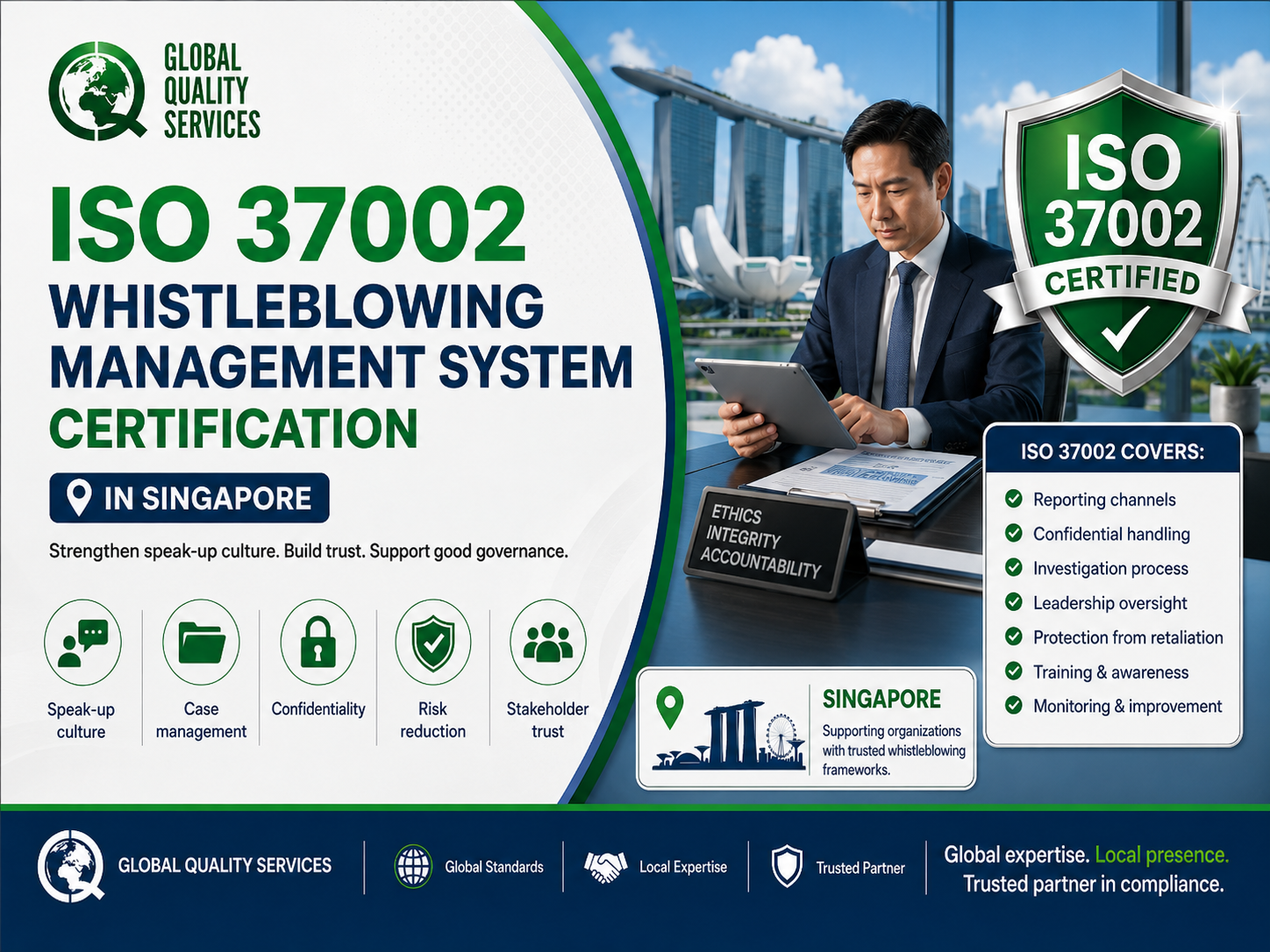
Corporate misconduct thrives in silence. Across Singapore’s financial institutions, multinational corporations, government-linked companies, and professional services firms, the ability to surface wrongdoing early — before it escalates into regulatory censure, reputational damage, or criminal liability — depends entirely on whether employees, suppliers, and stakeholders trust that speaking up is safe, taken seriously, and acted upon with integrity. ISO 37002 provides organizations with a globally recognized framework for building that trust through a certified, independently assessed Whistleblowing Management System, and Global Quality Services (GQS) helps Singapore organizations implement and certify it with the rigor the standard demands.
What ISO 37002 Establishes
ISO 37002 is the international standard published by the International Organization for Standardization that specifies requirements and provides guidance for establishing, implementing, maintaining, and continuously improving a Whistleblowing Management System. It covers the complete lifecycle of a whistleblowing report — from the moment a concern is raised through intake, assessment, referral, investigation, conclusion, and follow-up — within a framework built on four core principles: confidentiality, impartiality, protection of whistleblowers, and accountability.
Unlike internal whistleblowing policies that exist primarily on paper, ISO 37002 certification requires organizations to demonstrate through independent third-party audit that their system is genuinely operational, consistently applied, and capable of handling disclosures with the procedural rigor and human sensitivity the process demands.
Singapore’s Corrupt Practices Investigation Bureau (CPIB) actively encourages organizations to establish robust internal reporting mechanisms as a frontline defense against corruption, while the Monetary Authority of Singapore (MAS) has progressively strengthened whistleblowing expectations across the financial sector through its guidelines on risk governance and misconduct reporting. ISO 37002 certification provides a structured, auditable framework that directly supports alignment with both agencies’ expectations.
Why Singapore Organizations Need ISO 37002 Now
Singapore’s corporate governance landscape is undergoing significant evolution. Regulatory scrutiny of misconduct reporting frameworks has intensified across banking, capital markets, insurance, and listed companies. Globally, institutional investors and ESG rating agencies are increasingly evaluating the robustness of whistleblowing infrastructure as a governance quality indicator — with weak or unverified speak-up cultures drawing direct scrutiny in sustainability disclosures and board assessments.
Beyond regulatory and investor pressure, the business case for ISO 37002 is fundamentally practical. Organizations with credible, well-functioning whistleblowing systems detect misconduct earlier, contain damage more effectively, and demonstrate to employees, regulators, and business partners that ethical conduct is a genuine organizational value rather than a compliance formality.
Who Should Pursue ISO 37002 Certification in Singapore?
- Banks, insurers, and capital market institutions operating under MAS governance and misconduct reporting guidelines
- Listed companies on the Singapore Exchange (SGX) subject to corporate governance disclosure requirements
- Multinational corporations managing cross-border compliance and ethics obligations from Singapore regional headquarters
- Government-linked companies and statutory boards accountable to public stakeholders and parliamentary oversight
- Professional services firms — legal, audit, consulting — where client confidentiality and internal integrity are fundamental to business credibility
- Healthcare organizations managing clinical, procurement, and operational misconduct risks
- Technology and data companies subject to Singapore’s evolving digital regulatory and data governance frameworks
How GQS Delivers ISO 37002 Certification in Singapore
GQS brings structured implementation expertise and deep regulatory familiarity to every ISO 37002 engagement:
- Conduct a comprehensive gap analysis of your existing whistleblowing policies, intake channels, investigation procedures, and protection mechanisms against ISO 37002 requirements
- Design a Whistleblowing Management System framework tailored to your organization’s size, sector, regulatory environment, and cultural context
- Develop intake channel infrastructure — including anonymous reporting mechanisms — that meets ISO 37002’s accessibility and confidentiality requirements
- Build documented procedures for concern triage, assessment, referral, investigation, and outcome communication that satisfy the standard’s process integrity requirements
- Deliver leadership and staff training to foster genuine speak-up culture and ensure consistent application of whistleblowing procedures across your organization
- Establish whistleblower protection mechanisms that meet ISO 37002’s requirements for safeguarding reporters against retaliation, disadvantage, and identity exposure
- Prepare your organization for third-party certification audits through structured mock assessments and corrective action support
- Coordinate with accredited certification bodies through to successful ISO 37002 certification issuance
Business and Governance Benefits of ISO 37002 Certification
- Demonstrate to MAS, CPIB, SGX, and other Singapore regulatory authorities that your misconduct reporting infrastructure meets internationally verified standards
- Strengthen ESG governance disclosures and satisfy institutional investor expectations around speak-up culture and ethics management
- Detect misconduct, fraud, and regulatory breaches earlier through a trusted, accessible, and consistently applied reporting system
- Protect your organization from the compounding reputational and legal consequences of misconduct that goes unreported or mishandled
- Build employee confidence that raising concerns is genuinely safe, taken seriously, and resolved with fairness and transparency
- Complement ISO 37001 anti-bribery and ISO 37301 compliance management certifications within an integrated ethics and governance framework
In Singapore’s zero-tolerance governance environment, a certified whistleblowing system is not just good practice — it is a statement of organizational integrity. Contact GQS today and build an ISO 37002 certified Whistleblowing Management System that your employees, regulators, and stakeholders can genuinely trust.
Frequently Asked Questions
1. Is ISO 37002 a certifiable standard or a guidance document?
ISO 37002 is a fully certifiable standard with auditable requirements, enabling organizations to obtain independent third-party certification of their Whistleblowing Management System — unlike earlier guidance-only documents in this space.
2. How does ISO 37002 interact with MAS whistleblowing guidelines for Singapore financial institutions?
ISO 37002 provides a structured, independently verified framework that directly supports compliance with MAS’s misconduct reporting and risk governance expectations, giving financial institutions a credible, auditable evidence base for regulatory engagement.
3. Does ISO 37002 require anonymous reporting channels to be established?
Yes, ISO 37002 requires organizations to provide accessible reporting mechanisms that protect whistleblower confidentiality, which in practice includes anonymous intake channels appropriate to the organization’s size and operational context.
4. Can ISO 37002 be integrated with ISO 37001 and ISO 37301 certifications?
Absolutely. ISO 37002 follows the Harmonized Structure shared by ISO 37001 and ISO 37301, making integrated implementation of all three standards within a unified ethics and compliance management framework highly practical and audit-efficient.
5. How long does ISO 37002 certification take for a Singapore organization?
Most Singapore organizations complete the process within three to seven months, depending on the maturity of existing whistleblowing policies, the complexity of the organizational structure, and the scope of the certification.