ISO 55001 is an international standard for Asset Management Systems (AMS). It provides a structured framework for organisations to manage physical and other types of assets throughout their lifecycle while balancing performance, risk, cost, and business objectives. Global Quality Services (GQS) provides ISO 55001 certification consultancy and audit preparation support for organisations in Malaysia. Our consultants help businesses understand the standard, assess their existing asset management practices, identify gaps, develop the required management system, and prepare for an independent certification audit.
What Is ISO 55001 Certification?
ISO 55001 sets out requirements for establishing, implementing, maintaining, and continually improving an Asset Management System. The standard helps organisations make informed decisions about their assets throughout their lifecycle—from acquisition and operation to maintenance, renewal, and disposal. It encourages organisations to align asset management decisions with their strategic objectives while considering cost, risk, performance, and opportunities. ISO 55001 can be particularly relevant to organisations that depend heavily on assets, including manufacturing companies, utilities, transportation businesses, infrastructure operators, construction organisations, energy companies, healthcare facilities, and other asset-intensive industries.
Benefits of ISO 55001 Certification
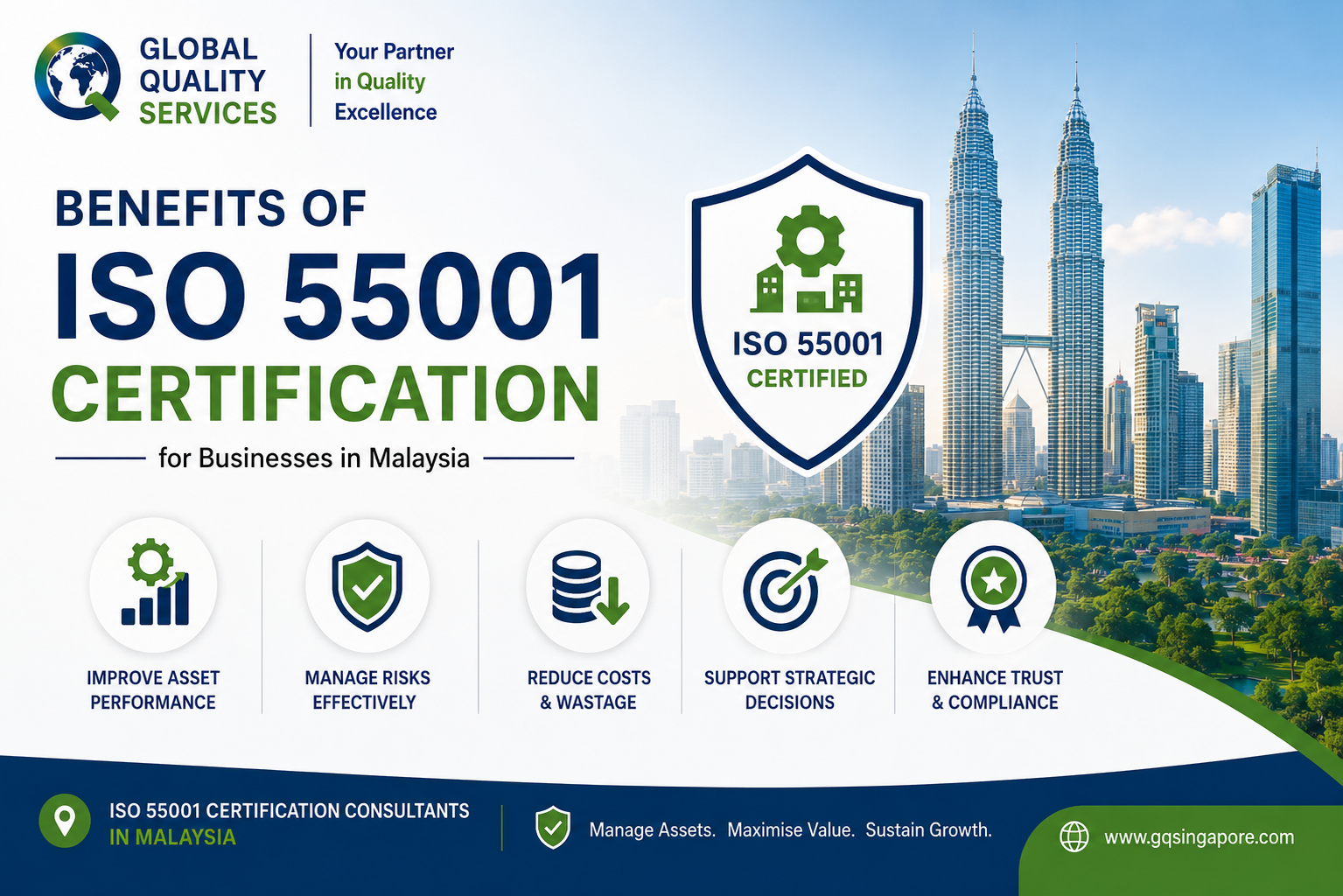
Let us have a look at the benefits of ISO 55001 certification consultants in Malaysia can provide you with:
Improved Asset Performance
ISO 55001 helps organisations establish a systematic approach to managing assets. Better planning, monitoring, maintenance, and performance evaluation can help organisations get greater value from their assets.
Better Risk Management
Asset-related failures can affect safety, production, service delivery, and finances. ISO 55001 encourages organisations to identify and manage asset-related risks and make decisions based on their potential impact.
Reduced Lifecycle Costs
Rather than focusing only on the initial purchase price of an asset, ISO 55001 considers costs throughout its lifecycle. This can support better decisions regarding maintenance, replacement, upgrades, and disposal.
Improved Maintenance Planning
A structured Asset Management System can help organisations move towards planned, risk-based maintenance, reducing reliance on reactive responses to asset failures.
Stronger Business Decision-Making
ISO 55001 connects asset management with organisational objectives. This helps management make more informed decisions about investment, maintenance, replacement, and resource allocation.
Greater Operational Reliability
Effective asset management can support improved availability, reliability, and continuity of critical assets, particularly in asset-intensive operations.
ISO 55001 Certification Process in Malaysia
ISO 55001 certification requires an organisation to establish an Asset Management System that is aligned with its business objectives and capable of managing assets throughout their lifecycle. The process involves assessing existing practices, developing the system, implementing asset management controls, evaluating performance, and undergoing an independent certification audit.
1. Initial Consultation and Gap Assessment
The process begins with an understanding of the organisation’s asset portfolio, business objectives, existing asset management practices, and operational challenges. A gap assessment is then carried out against ISO 55001 requirements. This review may cover asset management policies, roles and responsibilities, asset information, maintenance practices, risk management, lifecycle planning, performance monitoring, and existing documentation. The assessment identifies gaps and provides a practical roadmap for developing the required Asset Management System.
2. Establish the Asset Management Policy and Objectives
Once the gaps are understood, the organisation establishes an asset management policy that reflects its business direction and commitment to effective asset management. Clear asset management objectives are then established. These objectives should support organisational goals and provide a basis for measuring asset performance. Responsibilities and authorities are also defined so that relevant employees understand who is responsible for planning, operating, maintaining, monitoring, and improving assets.
3. Develop the Strategic Asset Management Framework
The organisation then establishes how asset management will support its overall business strategy. This involves considering the organisation’s asset portfolio, stakeholder requirements, asset-related risks, available resources, performance expectations, and lifecycle requirements. A Strategic Asset Management Plan (SAMP) is developed to connect organisational objectives with asset management objectives and provide direction for managing assets over the long term.
4. Identify and Evaluate Assets
The organisation establishes appropriate information about the assets within the scope of the Asset Management System. This may include identifying critical assets, asset condition, location, ownership, performance requirements, maintenance requirements, failure risks, and lifecycle considerations. Asset information is important because management decisions need to be based on reliable and relevant information rather than assumptions.
5. Assess Asset Risks and Lifecycle Requirements
The organisation identifies risks that could affect asset performance or business objectives. These may include equipment failure, operational disruption, safety risks, maintenance issues, financial impacts, or asset deterioration. Risk-based thinking is then applied to asset-related decisions. The organisation considers the entire asset lifecycle, including planning, acquisition, operation, maintenance, renewal, modification, and disposal. This helps management determine where resources should be prioritised and which assets require greater attention.
6. Implement Asset Management Processes
The Asset Management System is then implemented across relevant departments and operations. Depending on the organisation, this may include processes for asset planning, maintenance, operational control, procurement, asset information management, change management, risk management, and performance monitoring. Employees involved in asset management are made aware of their responsibilities and the processes they need to follow.
7. Establish Performance Monitoring and Improvement Measures
The organisation establishes appropriate methods for monitoring asset and Asset Management System performance. Performance indicators can be used to evaluate areas such as asset availability, reliability, maintenance effectiveness, downtime, lifecycle costs, risk performance, or achievement of asset management objectives. The results are reviewed to determine whether the organisation is achieving its planned outcomes and where improvement is required.
8. Conduct Internal Audit
Before the external certification audit, the organisation conducts an internal audit of its Asset Management System. The internal audit evaluates whether the system conforms to ISO 55001 requirements and whether the organisation is actually following its established processes. Any nonconformities or weaknesses identified during the audit are documented and addressed through corrective actions. This helps ensure that significant issues are resolved before the certification audit.
9. Management Review
Top management then reviews the performance and effectiveness of the Asset Management System. The review considers factors such as audit results, asset performance, achievement of objectives, risks and opportunities, corrective actions, resource requirements, and opportunities for continual improvement. Management review also confirms that the Asset Management System continues to support the organisation’s strategic direction.
10. Stage 1 Certification Audit
Once the organisation is ready, an independent certification body conducts the first stage of the certification audit. Stage 1 primarily evaluates the organisation’s documented Asset Management System and readiness for the main certification audit. The certification auditors may review the system’s scope, policies, objectives, key processes, documentation, and preparedness for Stage 2. Any areas requiring attention can be addressed before proceeding to the next stage.
11. Stage 2 Certification Audit
Stage 2 is the main certification audit. The certification auditors assess whether the Asset Management System has been effectively implemented and conforms to applicable ISO 55001 requirements. Auditors may review records, examine asset management processes, interview personnel, assess operational controls, and evaluate evidence showing that the system is being implemented and maintained. If nonconformities are identified, the organisation must take appropriate corrective action within the requirements and timelines established by the certification body.
12. Certification and Continual Improvement
After successful completion of the certification process and the certification body’s certification decision, the organisation receives its ISO 55001 certificate. However, certification is not a one-time exercise. The organisation must continue to monitor asset performance, conduct internal audits, perform management reviews, manage risks, address nonconformities, and improve its Asset Management System. Periodic surveillance audits are conducted by the certification body to verify continued conformity. This ensures that ISO 55001 remains an active management system rather than simply a certificate held by the organisation.
Why Choose GQS for ISO 55001 Certification Support?
Global Quality Services helps Malaysian organisations pursue ISO 55001 certification through a structured, practical process. Our consultants can support gap assessment, system development, documentation, implementation guidance, internal audit preparation, and readiness for the independent certification audit. Whether you manage industrial equipment, infrastructure, facilities, transportation assets, utilities, or other critical assets, our approach can be tailored to your organisation’s asset management needs.
GQS Singapore is a member of the Institute of Asset Management UK (Membership ID – 6149246), SCMC Singapore certified management consultant by TUV SUD, Lead auditor in ISO 55001 and has extensive experience in implementing ISO 55001 Asset management system towards successful certification of the standards across different industries such as Airports, Public transport companies, Manufacturing companies, Asset management holding companies, Facility management companies in Singapore, Indonesia, Malaysia, Philippines, Indonesia, Thailand, South Korea, Vietnam.
Frequently Asked Questions
1. Is ISO 55001 mandatory in Malaysia?
ISO 55001 certification is generally voluntary. However, customers, contracts, industry requirements, or organisational objectives may make certification beneficial.
2. Who should obtain ISO 55001 certification?
ISO 55001 is particularly useful for asset-intensive organisations such as manufacturers, utilities, transportation companies, infrastructure operators, energy businesses, and facilities management organisations.
3. What does ISO 55001 cover?
ISO 55001 covers the management of assets through a structured system that considers asset performance, risk, cost, lifecycle requirements, and alignment with organisational objectives.
4. Can ISO 55001 be integrated with other ISO standards?
Yes. ISO 55001 can be integrated with other management systems where appropriate, helping organisations create more consistent and efficient management processes.
5. Does GQS issue the ISO 55001 certificate?
GQS provides consultancy and certification preparation support. The formal certification audit and certification decision should be carried out by an appropriately independent certification body.