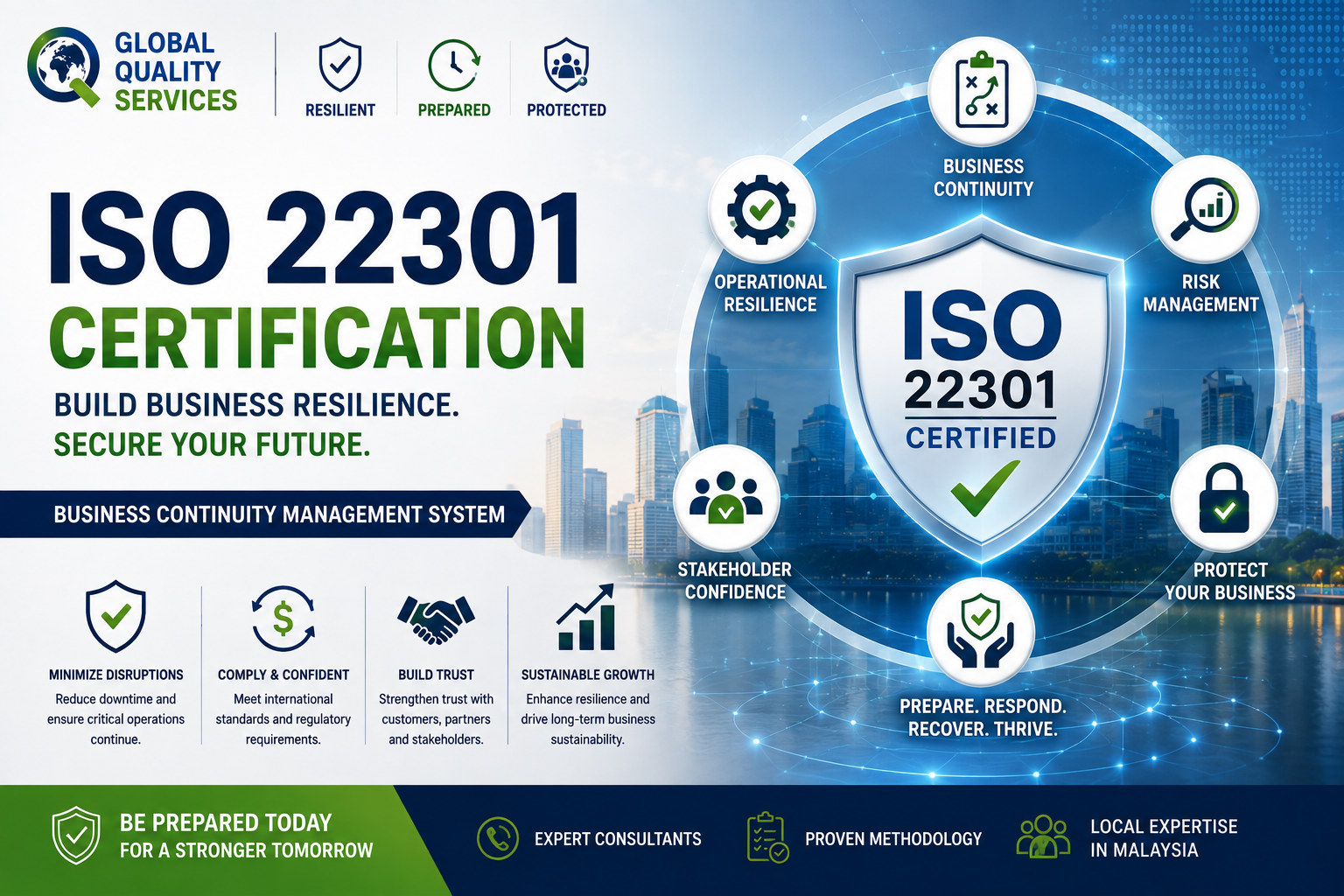
Business disruptions can arise from cyber incidents, technology failures, supply chain problems, natural disasters or other unexpected events. ISO 22301 helps organisations prepare for such disruptions and establish a structured Business Continuity Management System (BCMS) to maintain critical operations and recover effectively. Global Quality Services (GQS) provides ISO 22301 certification consultancy in Malaysia, helping organisations prepare their BCMS and get ready for certification against ISO 22301:2019.
What Is ISO 22301 Certification?
ISO 22301 is an internationally recognised standard for a Business Continuity Management System (BCMS). It helps organisations prepare for, respond to and recover from disruptive events that could affect critical business operations, such as cyber incidents, technology failures, natural disasters, supply chain interruptions or other emergencies. The standard provides a structured framework for identifying continuity risks, understanding critical activities and establishing plans and processes to maintain important products and services during disruption. ISO 22301 certification demonstrates that an organisation has established and implemented a systematic approach to business continuity and is committed to continually improving its resilience.
Benefits of ISO 22301 Certification in Malaysia
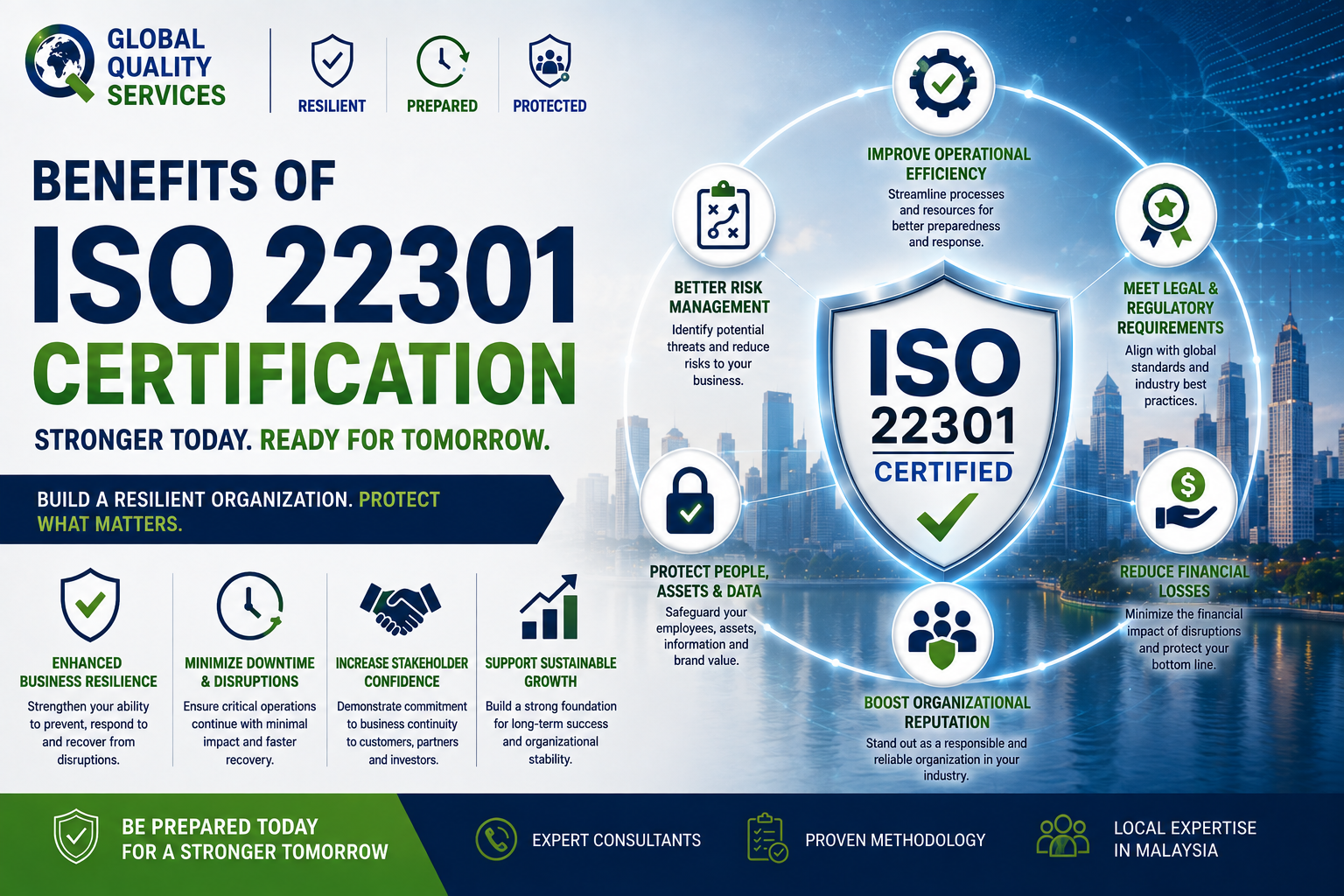
ISO 22301 is designed to help organisations prepare for disruption rather than simply react when an incident occurs. The standard provides a structured framework for planning, responding to and recovering from disruptive events, helping organisations improve resilience and maintain important products and services.
Improves Business Resilience
ISO 22301 helps organisations understand which activities are critical to their operations and establish arrangements to keep them running during disruption. This can improve the organisation’s ability to respond to unexpected events and recover in a controlled manner.
Reduces the Impact of Business Disruptions
Disruptions caused by technology failures, cyber incidents, natural disasters, supplier problems or other unexpected events can affect operations and revenue. A structured BCMS helps organisations prepare response and recovery arrangements in advance, potentially reducing downtime and the impact on business performance.
Strengthens Risk and Impact Management
ISO 22301 encourages organisations to understand their vulnerabilities, critical activities, dependencies and potential disruption scenarios. This gives management better information to prioritise resources and decide how continuity risks should be addressed.
Protects Critical Products and Services
Business continuity is not only about having a disaster recovery plan. ISO 22301 helps organisations establish arrangements to maintain critical products and services at an acceptable, predefined capacity during disruptions.
Builds Customer and Stakeholder Confidence
Customers, suppliers, regulators and business partners want confidence that an organisation can continue operating when unexpected problems occur. ISO 22301 certification provides evidence that the organisation has established a recognised framework for managing business continuity.
Supports Better Business Planning
The process of analysing critical activities, vulnerabilities and dependencies can give management a clearer understanding of how the organisation operates. These insights can also support strategic planning, resource management, supply chain planning and risk management.
Encourages Continual Improvement
Business risks change as organisations introduce new technology, suppliers, locations and services. ISO 22301 requires the BCMS to be monitored, reviewed and continually improved, helping continuity arrangements remain relevant as the business changes.
ISO 22301 Certification Process in Malaysia
Achieving ISO 22301 certification is a progressive process. The organisation first needs to understand its continuity requirements, then develop and implement a suitable BCMS before demonstrating its effectiveness to an independent certification body.
1. Initial Consultation and Scope Definition
The process starts with an initial consultation to understand your organisation, key products and services, locations, processes and business continuity objectives. The certification scope is defined so that everyone understands exactly which activities and parts of the organisation will be covered. Once the scope is established, the next step is to assess the organisation’s current preparedness.
2. Gap Assessment
GQS reviews existing business continuity arrangements against the requirements of ISO 22301. This can include policies, continuity plans, risk management practices, roles and responsibilities, recovery arrangements and documented processes. The assessment identifies what is already in place and where improvements are needed. With these gaps clearly identified, the organisation can begin building a BCMS that addresses its actual continuity risks.
3. BCMS Development and Business Impact Assessment
The organisation develops its Business Continuity Management System around its operational requirements. This involves understanding critical activities, dependencies and potential disruption scenarios, and determining appropriate continuity and recovery arrangements. Policies, procedures, responsibilities and supporting documentation are established as part of the BCMS. However, having documented arrangements is only the beginning. The next stage is to put them into practice and verify that they work.
4. Implementation, Testing and Internal Audit
The BCMS is implemented across the relevant parts of the organisation. Employees and responsible teams understand their roles, while continuity arrangements can be exercised or tested to identify weaknesses. An internal audit is then conducted to determine whether the BCMS conforms to ISO 22301 requirements and is operating effectively. Any identified nonconformities or weaknesses can be addressed before the external certification audit. Once the organisation has demonstrated sufficient readiness, it can proceed to independent certification.
5. Certification Audit
An independent certification body conducts the certification audit to assess the organisation’s BCMS against the applicable ISO 22301 requirements. The audit evaluates both the documented management system and its implementation. Where nonconformities are identified, the organisation must address them through the certification body’s process before certification can be granted.
6. Certification and Ongoing Improvement
Following successful completion of the certification process, the organisation receives its ISO 22301 certification from the independent certification body. Certification is not the end of the business continuity journey. The organisation continues to monitor its BCMS, conduct internal audits, review its arrangements and address changing risks. Periodic surveillance audits help verify continued conformity and support continual improvement. This ongoing approach helps ensure that business continuity arrangements remain practical and aligned with the organisation as its operations and risks evolve.
Why Choose GQS for ISO 22301 Certification in Malaysia?
Global Quality Services provides structured ISO certification consultancy and support for organisations across Malaysia. Our approach focuses on understanding the organisation’s operations, risks and continuity requirements rather than applying a generic business continuity model. GQS can support organisations across sectors including IT, manufacturing, financial services, healthcare, logistics, professional services and other businesses where maintaining critical operations is essential. Looking for ISO 22301 Certification Consultants in Malaysia? Contact Global Quality Services to discuss your business continuity certification requirements.
Frequently Asked Questions
1. Is ISO 22301 certification mandatory in Malaysia?
ISO 22301 certification is generally voluntary. However, customers, contracts, industry requirements or business partners may require organisations to demonstrate effective business continuity arrangements.
2. Who needs ISO 22301 certification?
ISO 22301 can benefit organisations of any size or in any industry that need to maintain critical products, services, or operations during disruptions.
3. What does ISO 22301 cover?
ISO 22301 covers the Business Continuity Management System, including business continuity risks, planning, response, recovery, monitoring, internal audits and continual improvement.
4. How long does ISO 22301 certification take?
The timeline depends on the organisation’s size, scope, existing business continuity arrangements and readiness. Organisations with established processes may require less preparation than those developing a BCMS from the beginning.
5. Is ISO 22301:2019 still valid?
Yes. ISO 22301:2019 remains the published international standard, with Amendment 1:2024 adding climate-action considerations. ISO is currently developing a new edition, so organisations should monitor future transition requirements.