
Global Quality Services provides end-to-end FSSC 22000 consultancy for food manufacturers and processors based in Mandai Estate. We cover gap analysis, food safety management system (FSMS) implementation, HACCP documentation, internal audit, and certification readiness.
Our approach is aligned with Singapore Food Agency (SFA) requirements and Global Food Safety Initiative (GFSI) benchmarks. Mandai is one of Singapore’s most established food manufacturing clusters.
It hosts licensed food processing and manufacturing facilities across multiple estates including Foodfab @ Mandai, CT FoodNex, Mandai Foodlink, Smart Food @ Mandai, and EcoFood @ Mandai.
These facilities are SFA-approved for food-related activities. For businesses operating here, FSSC 22000 certification is increasingly a buyer requirement, a retail qualification standard, and a direct pathway to recognition under SFA’s SAFE framework.
What Is FSSC 22000 Certification?
FSSC 22000 is the Food Safety System Certification scheme developed by the Foundation FSSC. It is benchmarked by the Global Food Safety Initiative (GFSI) and recognized globally by major retailers, food brands, and buyers in export markets. The scheme is built on three layers:
- ISO 22000: The international standard for Food Safety Management Systems. Covers hazard analysis, HACCP principles, operational prerequisite programs, and continual improvement.
- Sector-specific Prerequisite Programs (PRPs): Technical specifications that address sector-specific hygiene and operational requirements. For food manufacturers, the relevant standard is ISO/TS 22002-1.
- Additional FSSC Requirements: Covering food fraud prevention, food defense, allergen management, environmental monitoring, quality culture, and supplier control.
FSSC 22000 Version 6 is the current active version. It became effective for audits on 1 April 2024. Key changes under Version 6 include:
- Quality control is now a mandatory part of the scheme, not a voluntary add-on
- Food safety and quality culture is a standalone requirement with a documented plan and measurable objectives
- Allergen management, equipment management, and food loss and waste received strengthened requirements
- Organizations must notify their certification body within three working days of serious incidents affecting food safety or certification integrity
Why FSSC 22000 Matters for Mandai Food Manufacturers
Mandai is not just an industrial estate. It is becoming Singapore’s primary food manufacturing hub in the northern corridor. SFA-licensed facilities at Mandai Estate, Mandai Link, and Mandai Foodlink support Singapore’s broader 30 by 30 food production goal, which aims to produce 30% of the nation’s nutritional needs locally by 2030. Three things are driving FSSC 22000 demand for Mandai operators right now.
Retail and export buyers require it.
Major supermarket chains, foodservice distributors, and export buyers in the region require GFSI-recognized certification as a minimum entry condition. FSSC 22000 is one of the most widely accepted GFSI-benchmarked schemes globally. Without it, Mandai food manufacturers are excluded from significant buyer programs.
SFA’s SAFE framework recognizes it.
The SFA Safety Assurance for Food Establishments (SAFE) framework recognizes FSSC 22000 as an accredited Food Safety Management System. Category 1 food establishments with a certified FSMS can fast-track to an ‘A’ grade. This is a direct operational and reputational benefit for Mandai manufacturers supplying Singapore’s retail and foodservice market.
Singapore’s food safety standards are tightening.
The Singapore Food Agency Act 2019 consolidated food safety regulation under SFA. SFA’s licensing requirements for food manufacturers include HACCP-based systems as a baseline. FSSC 22000 goes beyond that baseline. It positions Mandai manufacturers to meet not just current SFA requirements but also international food safety expectations from buyers across Asia, Australia, Europe, and the Middle East.
Who in Mandai Needs FSSC 22000
FSSC 22000 applies across the food supply chain. In Mandai, that covers:
- Food processors and manufacturers producing packaged, chilled, or ambient products for retail or foodservice distribution
- Food ingredient and flavoring producers supplying to other food manufacturers
- Bakery and confectionery production facilities
- Ready-to-eat and meal kit manufacturers
- Cold chain and frozen food processors
- Food repacking and co-manufacturing operations
- Food storage and distribution operators where food safety management is part of the scope
If your facility is SFA-licensed and supplying to retail, foodservice, or export channels, FSSC 22000 is either already required or will be required in your next contract cycle.
Key Requirements of FSSC 22000
These requirements apply to all food manufacturers pursuing FSSC 22000 certification:
- Management System Foundation: Establish a documented Food Safety Management System aligned to ISO 22000. This includes food safety policy, objectives, roles, and management review.
- Hazard Analysis and HACCP: Conduct a full hazard analysis covering biological, chemical, physical, and allergen hazards. Establish Critical Control Points (CCPs) with defined limits, monitoring, and corrective action procedures.
- Prerequisite Programs (PRPs): Implement and document operational PRPs covering infrastructure, cleaning and sanitation, pest control, personnel hygiene, allergen management, and cross-contamination prevention, aligned to ISO/TS 22002-1.
- Food Safety Culture: Document a food safety culture plan with defined objectives and measurable evidence of implementation across the organization. This is a standalone Version 6 requirement.
- Food Fraud Prevention: Conduct a documented food fraud vulnerability assessment. Establish a mitigation plan covering adulteration, substitution, mislabeling, and counterfeiting risks relevant to your supply chain.
- Food Defense: Assess threats to the intentional contamination of food products. Establish a food defense plan with access control, personnel, and monitoring measures.
- Allergen Management: Implement a documented allergen management program covering raw material control, segregation, labeling, and verification.
- Supplier Control: Establish a supplier approval and monitoring program covering all direct and indirect food material suppliers.
- Traceability: Maintain a traceability system that can trace raw materials forward to finished product and backward to supplier within a defined timeframe.
- Internal Audit: Conduct planned internal audits against FSSC 22000 requirements to verify system effectiveness and close non-conformances before the certification audit.
Steps to Get FSSC 22000 Certified in Mandai
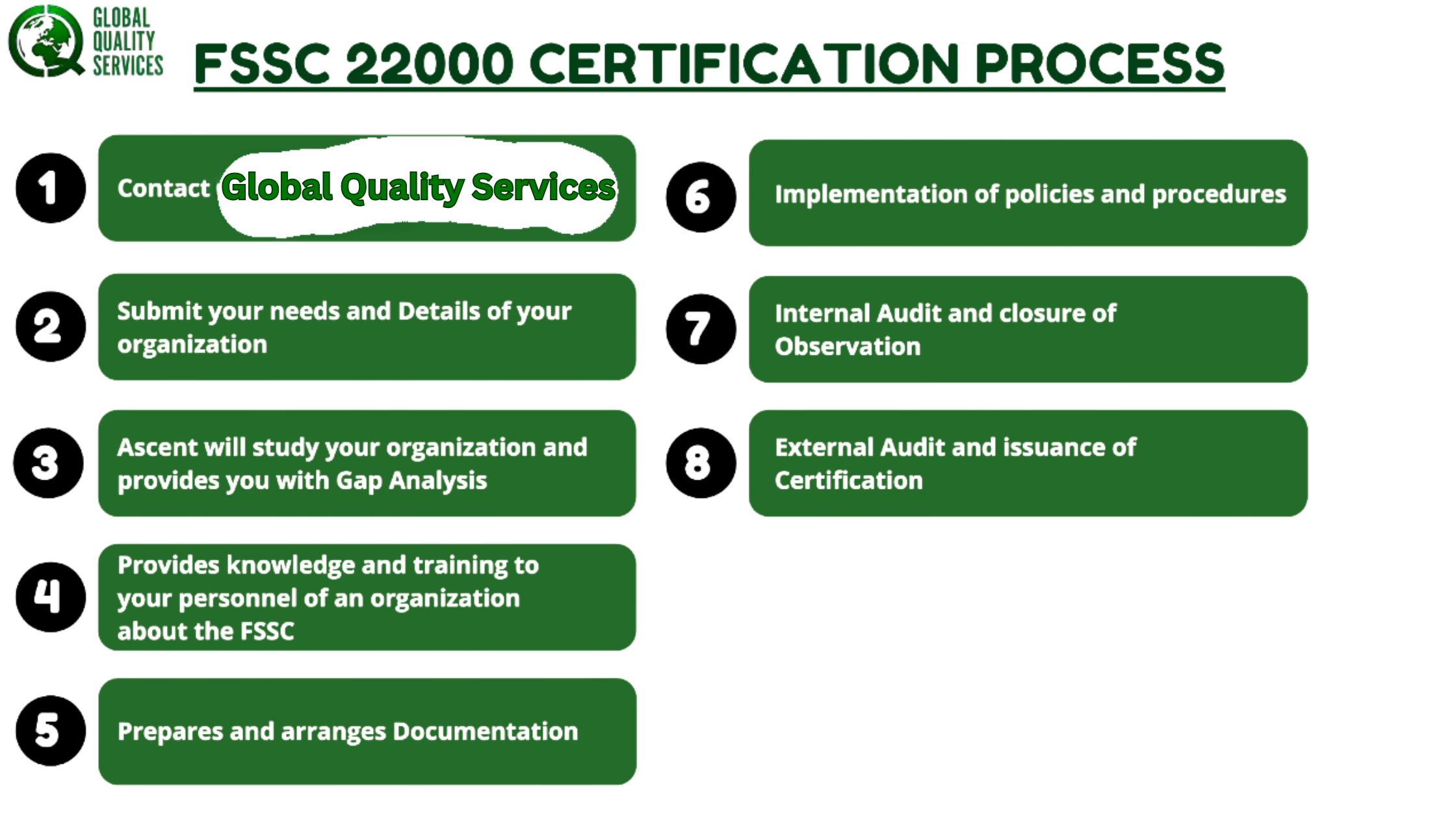
Step 1: Gap Analysis
Compare your current food safety practices against the full FSSC 22000 Version 6 requirements. Identify what is in place, what needs updating, and what needs to be built from scratch. Produce a prioritized action plan.
Step 2: FSMS Documentation
Develop or update your Food Safety Manual, HACCP plan, PRP documentation, food fraud vulnerability assessment, food defense plan, allergen management program, and supplier control procedures. All documents must reflect your actual Mandai facility operations.
Step 3: Prerequisite Program Implementation
Put PRPs into practice across your facility. This includes cleaning schedules, pest control contracts, personnel hygiene training, allergen segregation, and facility maintenance programs aligned to ISO/TS 22002-1.
Step 4: HACCP Implementation
Implement your HACCP plan on the production floor. Train relevant staff on CCP monitoring, corrective action procedures, and documentation requirements.
Step 5: Food Safety Culture Rollout
Develop and implement your food safety culture plan. Collect measurable evidence of implementation. This is not a documentation exercise. It requires visible leadership commitment and employee engagement at all levels.
Step 6: Internal Audit
Conduct a full internal audit against FSSC 22000 Version 6 requirements. Identify non-conformances. Close all gaps before approaching your certification body.
Step 7: Management Review
Conduct a management review that covers food safety performance data, customer feedback, audit results, and continual improvement actions. This must be documented and completed before the certification audit.
Step 8: Certification Audit
Engage an accredited FSSC 22000 certification body. The audit runs in two stages: a documentation review followed by an on-site audit of your Mandai facility.
Step 9: Post-Certification Maintenance
Sustain certification through annual surveillance audits, ongoing HACCP monitoring, management reviews, and continual improvement. Recertification audits occur every three years.
Singapore Regulatory Context for Mandai Food Manufacturers
Mandai food manufacturers operate within a well-defined Singapore regulatory framework:
- Singapore Food Agency Act 2019: Established SFA as the lead agency for food safety regulation in Singapore. Governs licensing, inspection, and enforcement for all food manufacturers and processors.
- SFA SAFE Framework: SFA’s grading and assurance framework for food establishments. Recognizes FSSC 22000 as an accredited FSMS. Category 1 establishments with FSSC 22000 certification can fast-track to grade ‘A’.
- SFA List of Licensed Food Manufacturing and Storage Areas: Mandai Estate, Mandai Link, and Mandai Foodlink are all listed. Operating in these areas requires SFA licensing. FSSC 22000 supports and strengthens that licensed status.
- Personal Data Protection Act (PDPA): Enforced by the Personal Data Protection Commission (PDPC). Applies to Mandai food manufacturers processing employee and customer data as part of traceability and supplier management systems.
- Environmental Public Health Act: Enforced by the National Environment Agency (NEA). Covers cleaning, sanitation, and pest control obligations for licensed food premises. FSSC 22000 PRP requirements directly support NEA compliance.
- Wholesome Meat and Fish Act: Applies to Mandai processors handling meat and fish products. FSSC 22000 hazard analysis and CCP documentation support compliance with SFA’s species-specific requirements under this Act.
Industries at Mandai That Benefit from FSSC 22000
Food Processing and Manufacturing
Mandai’s core business. Facilities at Foodfab @ Mandai, CT FoodNex, and Mandai Foodlink process a wide range of ambient, chilled, and frozen products. Retail buyers supplying Cold Storage, FairPrice, Giant, and international chains require GFSI-recognized certification from their manufacturing partners. FSSC 22000 is the most common scheme they reference.
Bakery and Confectionery Production
Bakeries and confectionery producers at Mandai supply foodservice distributors, hotel chains, and retail outlets. Allergen management is a major operational challenge in this segment. FSSC 22000 Version 6 addresses allergen control as a dedicated requirement, not just a PRP footnote.
Ready-to-Eat and Meal Kit Manufacturing
The growth of meal delivery services and ready-to-eat formats is driving demand from Mandai manufacturers. These products carry higher food safety risk. Buyers and delivery platforms apply stricter supplier qualification criteria. FSSC 22000 provides the assurance framework they require.
Food Ingredient and Flavoring Production
Ingredient suppliers inside Mandai feed into other manufacturers’ supply chains. Buyers in downstream food manufacturing increasingly require their ingredient suppliers to hold FSSC 22000 or an equivalent GFSI-recognized certification. This makes certification a supply chain access question, not just a compliance exercise.
Cold Chain and Frozen Food Processing
Cold storage and frozen food operators at Mandai handle high-risk product categories under strict temperature control requirements. SFA’s licensing conditions for cold store operations align closely with FSSC 22000 PRP and traceability requirements.
Food Repacking and Co-Manufacturing
Co-manufacturers and repacking operations at Mandai often supply to brand owners who require FSSC 22000 certification as a contract condition. The brand owner’s own FSSC 22000 scope may require it from all co-manufacturers in their production network.
Migration For FSSC 22000 from Version 6 to Version 7
FSSC 22000 Version 7 was officially released in May 2026, replacing Version 6 as the current certification standard. All organizations seeking new FSSC 22000 certification proceed directly under Version 7. Organizations currently certified to Version 6 have an 18-month transition window to migrate at their next regular audit.
What Is New in Version 7
Version 7 does not restructure the standard. It tightens and formalizes requirements in specific areas where Version 6 left room for inconsistent implementation.
| Area | Version 6 | Version 7 |
|---|---|---|
| Allergen management | Referenced within HACCP and PRPs | Standalone mandatory allergen management plan with validated controls and annual review |
| Food loss and waste | Not required | Mandatory policy with measurable reduction targets aligned to SDG 12.3 |
| Food fraud mitigation | Required | Updated vulnerability assessment scope and guidance |
| Food defense | Required | Updated threat scenario requirements |
| Food safety culture | Expected at management level | Explicit auditable requirement with measurable top management objectives |
| Standard reference | ISO 22002 series | Updated to ISO 22002-100:2025 umbrella standard |
What the 18-Month Transition Window Means in Practice
The transition window runs from the May 2026 release date. For most Singapore food businesses, this means Version 7 compliance must be demonstrated at your next scheduled surveillance or recertification audit falling within that window, not at a separate standalone transition audit.
The practical steps are gap assessment against the five changed areas, documentation update, a management briefing on the new food safety culture requirements, and an internal audit conducted against Version 7 before the external audit.
For Singapore SMEs, the Enterprise Singapore Enterprise Development Grant continues to support up to 50% of qualifying consultancy costs for FSSC 22000 transitions under the Standards Adoption category.
Global Quality Services manages the full Version 6 to Version 7 transition process for Singapore food manufacturers, processors, cold-chain operators, and food packaging companies, scoping the migration to your specific products, facility, and audit calendar.
Contact Global Quality Services to begin your FSSC 22000 Version 7 transition in Singapore.
Why Global Quality Services
GQS has delivered FSSC 22000 certification projects across Singapore’s food manufacturing sector. Our consultants work directly inside your Mandai facility. We do not apply generic templates to your operations.
Every food facility is different. Your HACCP plan, PRP documentation, and food fraud assessment must reflect your specific products, processes, and supply chain, not a copied document from another site.
With GQS, Mandai food manufacturers receive:
- Gap analysis against FSSC 22000 Version 6, mapped to your specific products and processes
- Full FSMS documentation development covering ISO 22000, sector PRPs, and all FSSC additional requirements
- HACCP plan development and CCP verification specific to your Mandai facility
- Food fraud vulnerability assessment and mitigation plan
- Food defense plan development aligned to your site and supply chain
- Allergen management program implementation
- Food safety culture plan development with measurable objectives and evidence collection
- Internal audit facilitation against FSSC 22000 Version 6
- Certification audit coordination with your chosen accredited certification body
- Post-certification surveillance support and continual improvement planning
- Scope extension to ISO 9001, ISO 14001, or HACCP certification for Mandai operators consolidating quality, environmental, and food safety compliance under one engagement
Contact Global Quality Services to start your FSSC 22000 certification journey in Mandai. In addition to FSSC 22000 Certification, we also provide consultancy / guidance for PCQI (Preventive Controls Qualified Individual) in Training and Certification to help food manufacturers comply with the U.S. FDA FSMA requirements.
Frequently Asked Questions
What is FSSC 22000 and is it required for Mandai food manufacturers?
FSSC 22000 is a GFSI-recognized food safety certification scheme built on ISO 22000 and sector-specific prerequisite programs. No Singapore law currently mandates it for all food manufacturers. However, SFA’s SAFE framework recognizes it as an accredited FSMS, and retail buyers, foodservice distributors, and export partners increasingly require it as a condition of supply. For Mandai manufacturers targeting retail or export channels, it is effectively a market access requirement.
How does FSSC 22000 differ from HACCP or ISO 22000?
HACCP is the foundational food safety methodology. ISO 22000 builds a full management system around HACCP principles. FSSC 22000 adds a third layer: sector-specific PRPs, food fraud prevention, food defense, allergen management, and quality culture requirements. FSSC 22000 is GFSI-benchmarked, which makes it globally recognized by major buyers. ISO 22000 and HACCP alone are not GFSI-recognized.
Which version of FSSC 22000 is current?
FSSC 22000 Version 6 is the current active version. It became the audit basis on 1 April 2024. Version 6 made quality control mandatory, added food safety culture as a standalone requirement, and strengthened allergen management and food loss and waste requirements. All GQS engagements are aligned to Version 6.
How long does FSSC 22000 certification take for a Mandai facility?
Most Mandai food manufacturers completing the process from gap analysis through to certification audit take between four and nine months. The timeline depends on the complexity of your product range, the number of processes in scope, and the maturity of your existing food safety practices. Facilities with documented HACCP systems and SFA-compliant PRPs in place typically move faster. GQS provides a timeline assessment during the initial gap analysis.
Can FSSC 22000 be integrated with SFA licensing requirements?
Yes. FSSC 22000 does not replace SFA licensing. It operates alongside it. The FSSC 22000 PRP requirements for cleaning, sanitation, pest control, and hygiene directly support SFA’s licensing conditions. The SAFE framework recognizes FSSC 22000 as an accredited FSMS, which benefits Category 1 establishments in their grading assessment. GQS aligns all FSSC 22000 engagements with SFA expectations from the outset.