Jurong Industrial Estate is Singapore’s oldest and largest industrial zone, built from reclaimed mangrove swampland beginning in 1961 under the original Jurong Town Corporation. Over six decades, it has grown into a dense mix of electronics manufacturers, precision engineers, food and consumer goods producers, chemical handlers, and heavy fabricators, all of whom are now navigating the same challenge: connecting legacy operational technology to modern digital systems without creating the cybersecurity vulnerabilities that connection introduces.
That challenge is exactly what ISA/IEC 62443 was built to address. It is the only internationally recognized series of standards for securing industrial automation and control systems (IACS), covering the people, processes, and technology that protect programmable logic controllers, distributed control systems, SCADA networks, and manufacturing execution systems across the full lifecycle of an industrial operation.
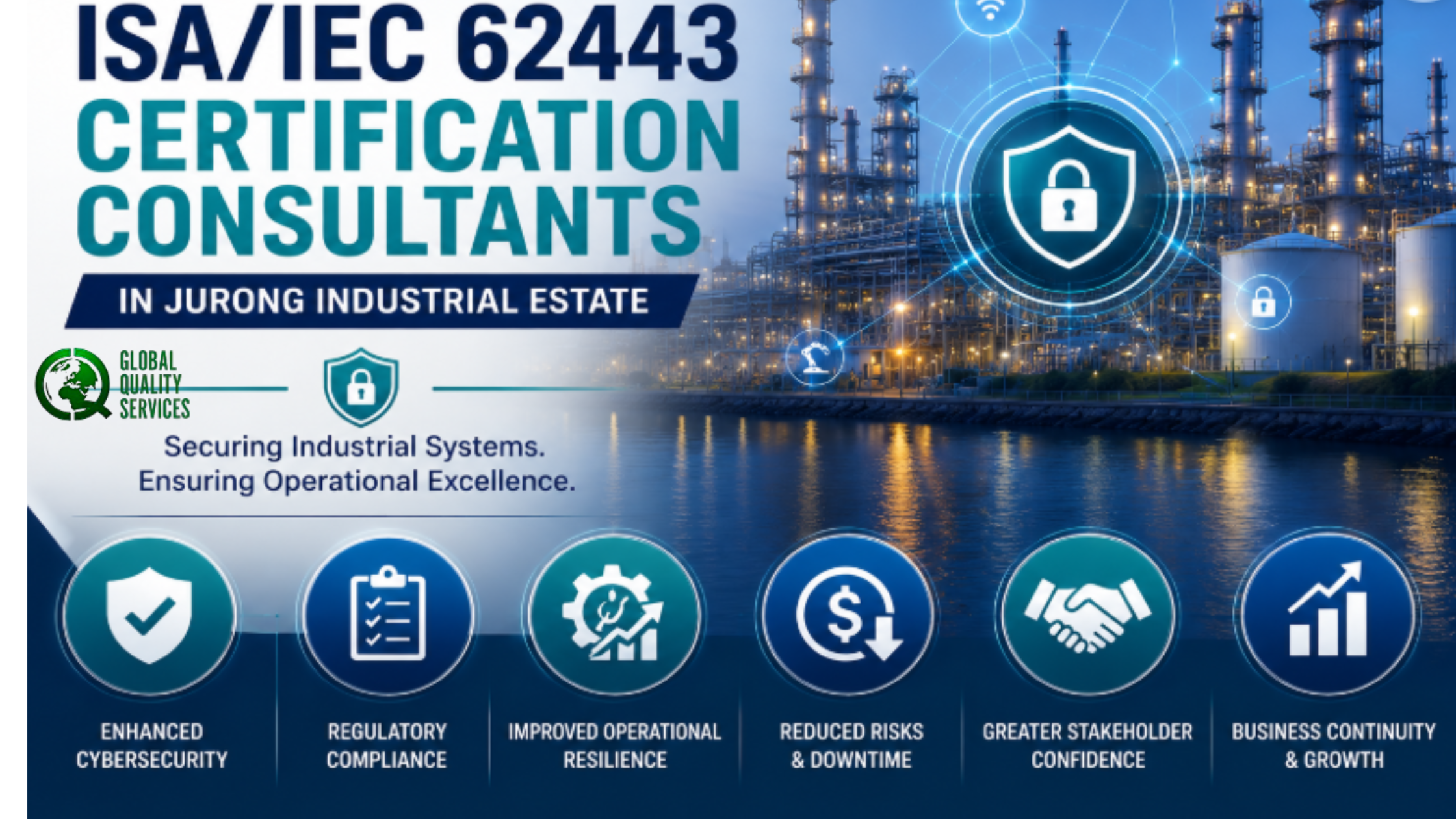
Global Quality Services provides ISA/IEC 62443 consultancy services for manufacturers and industrial operators in Jurong Industrial Estate. We assess your current OT security posture, identify gaps against the applicable standard parts, and work directly with your engineering and operations teams to build and certify a cybersecurity framework that protects your production environment without disrupting it.
Why Jurong Industrial Estate’s Needs ISA/IEC 62443
Jurong Industrial Estate was built for manufacturing. Its factories were not designed with networked cybersecurity in mind, because when most of them were commissioned, the threat did not exist in its current form.
What has changed is connectivity. The Jurong Innovation District, the 620-hectare Industry 4.0 campus adjacent to Jurong Industrial Estate, is pulling manufacturers in the corridor toward smart factory upgrades, digital twins, industrial IoT sensors, remote monitoring, and cloud-connected production management systems. Each of those connections between an older OT environment and a new IT layer is a potential attack surface that ISA/IEC 62443 exists to assess and control.
Three factors make certification a practical decision for Jurong Industrial Estate companies rather than a theoretical one.
- IT/OT convergence is the primary risk driver. A factory that has operated its PLC network in isolation for twenty years faces a fundamentally different risk profile the moment that network is connected to an enterprise resource planning system, a remote monitoring dashboard, or a supplier’s cloud portal. ISA/IEC 62443’s zones-and-conduits model is specifically designed for this transition.
- Singapore’s OT Cybersecurity Masterplan 2024. The Cyber Security Agency of Singapore updated its OT Cybersecurity Masterplan in 2024 to extend cybersecurity expectations beyond Critical Information Infrastructure to non-CII OT sectors, and to promote Secure-by-Deployment principles across the full OT system lifecycle. Manufacturers in Jurong Industrial Estate sit within the scope of that direction.
- Buyer and supply chain requirements. Electronics manufacturers, precision engineers, and industrial suppliers in Jurong Industrial Estate increasingly receive cybersecurity questionnaires from multinational customers, particularly those in automotive, aerospace, and medical device supply chains, that reference IEC 62443 explicitly.
What ISA/IEC 62443 Covers
The standard is a series of 14 documents organized into four parts. Each part addresses a different layer of IACS cybersecurity.
- Part 1: General. Establishes the foundational vocabulary, concepts, and the zones-and-conduits security model that runs through the entire series, along with the Security Level framework used to define protection requirements.
- Part 2: Policies and Procedures. Defines how asset owners must build and operate an IACS cybersecurity management program, covering patch management, supplier security requirements, and security monitoring obligations.
- Part 3: System. Covers security risk assessment methodology for IACS design and the system-level security requirements that a deployed control system must meet against its target Security Level.
- Part 4: Component. Defines technical security requirements for individual IACS components including embedded devices, host devices, network devices, and software applications, along with secure product development lifecycle requirements for suppliers.
For a Jurong Industrial Estate manufacturer, the most directly relevant parts are typically 2-1 for building a cybersecurity management program, 3-2 for conducting a structured security risk assessment, and 3-3 for defining and verifying system security requirements. Part 4 requirements apply to equipment suppliers and system integrators within your facility’s supply chain.
Who ISA/IEC 62443 Applies To
The standard addresses three distinct stakeholder groups in a Jurong Industrial Estate context.
Asset Owners
Asset owners are the manufacturers and industrial operators that own and run production facilities in the estate. They are responsible for establishing an IACS cybersecurity management program, conducting security risk assessments across their control system zones and conduits, and defining target Security Levels for each zone based on operational risk.
System Integrators
System integrators are the automation and engineering contractors that design, install, and commission control system solutions for asset owners. In Jurong Industrial Estate, this includes the firms handling PLC programming, SCADA configuration, MES integration, and smart factory upgrades for established manufacturers. ISA/IEC 62443 Part 2-4 sets out the cybersecurity requirements that asset owners are entitled to place on their integrators.
Product Suppliers
Product suppliers develop and sell the IACS components that run production in Jurong Industrial Estate, including controllers, sensors, drives, switches, and industrial software. Part 4-1 and Part 4-2 set out secure development lifecycle and technical security requirements for these products, and ISASecure third-party certification provides independent verification that a product meets the applicable requirements.
Security Levels in a Mixed-Industry Context
Jurong Industrial Estate’s diversity means Security Level requirements vary significantly from one facility to the next, and sometimes from one zone to the next within a single plant.
- Security Level 1. Protection against casual or unintentional violations. Appropriate for low-criticality zones such as general facility management networks or non-production support systems.
- Security Level 2. Protection against intentional violation using simple means with low resources and generic skills. This is the level most commonly targeted for general production networks in electronics assembly and food manufacturing facilities.
- Security Level 3. Protection against intentional violation using sophisticated means with moderate resources and IACS-specific skills. Appropriate for higher-criticality zones in precision engineering, chemical handling, or pharmaceutical production within the estate.
- Security Level 4. Protection against sophisticated, well-resourced attacks. Reserved for control systems where a breach could cause significant harm to people, the environment, or critical infrastructure.
Defining the right target Security Level for each zone in your facility is one of the first deliverables of a structured IEC 62443 assessment, and it forms the basis for every subsequent gap analysis and remediation decision.
Our ISA/IEC 62443 Consultancy Process for Jurong Industrial Estate
We approach OT cybersecurity consultancy in Jurong Industrial Estate with the specific constraint most of its manufacturers share: production cannot stop. Every stage of our process is scoped around your operational schedule, not around ours.
Step 1: OT Asset Inventory and Network Mapping. We document your IACS architecture, identify all control system components, and map the zones and conduits that define your production environment’s security boundaries.
Step 2: Security Risk Assessment (Part 3-2). We conduct a structured risk assessment against your defined zones and conduits, identifying threats, vulnerabilities, and consequences specific to your sector and production process, and determining appropriate target Security Levels for each zone.
Step 3: Gap Assessment Against Target Security Levels. Your current technical controls, access management practices, patch management processes, and incident response capabilities are reviewed against the Part 2-1 and Part 3-3 requirements for your target Security Levels. A written gap report documents findings in order of remediation priority.
Step 4: Remediation and Hardening. We work with your engineering and operations teams to close identified gaps, including network segmentation between IT and OT environments, access control improvements, patch management procedures adapted to OT constraints, and incident response protocols that do not require production shutdown to execute.
Step 5: IACS Cybersecurity Management Program Build. Your program documentation is built or updated to meet Part 2-1 requirements, covering policies, procedures, roles, responsibilities, and ongoing monitoring activities.
Step 6: Certification Audit Support. We coordinate your third-party certification audit with your chosen accredited body and provide technical support through to certificate issuance.
Benefits of ISA/IEC 62443 Certification
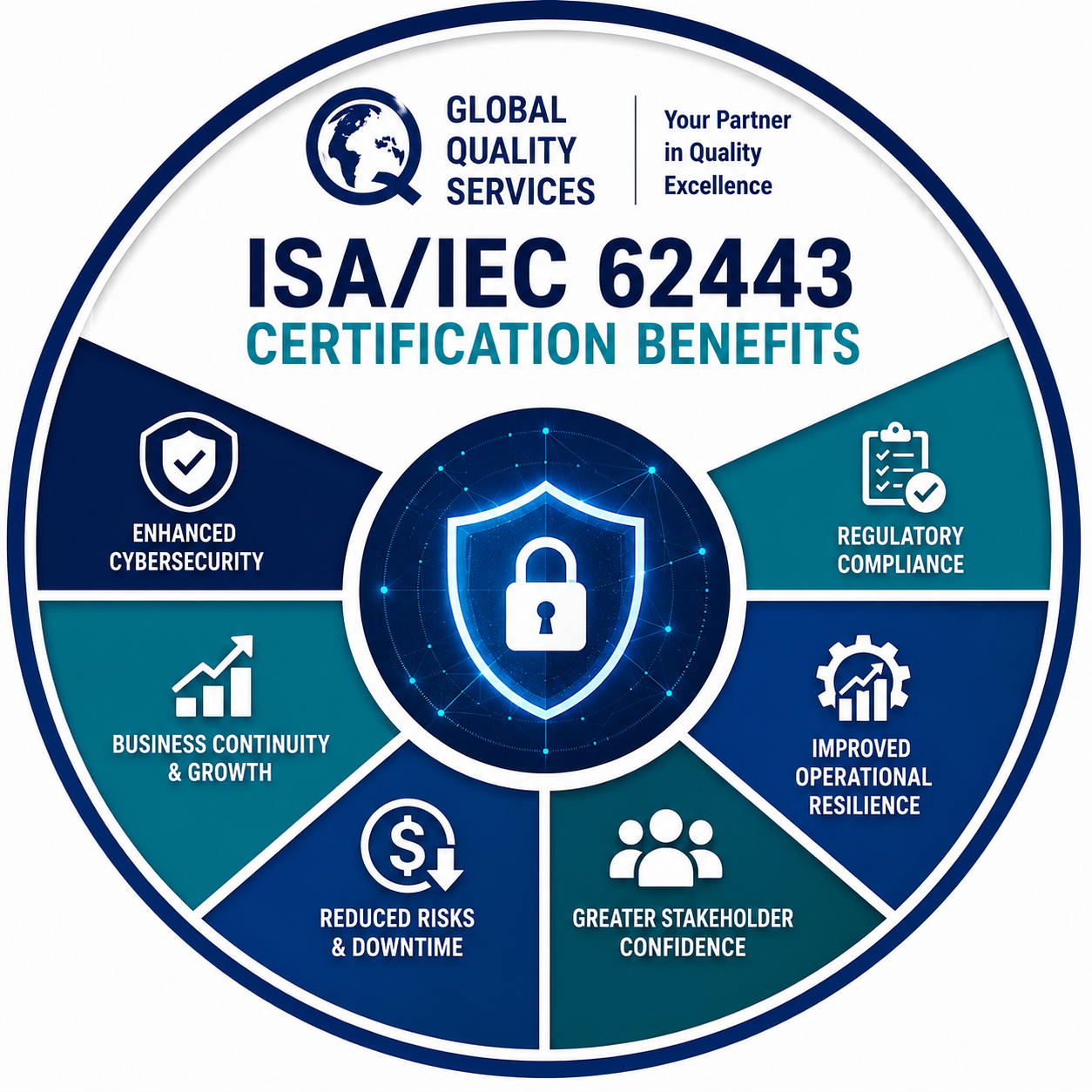
Protection Designed for Manufacturing, Not IT
Standard enterprise cybersecurity controls prioritize confidentiality. Industrial cybersecurity must prioritize availability and process integrity, because the consequence of an unplanned production stop in Jurong Industrial Estate is measured in output, not data. ISA/IEC 62443 is built on that priority, not adapted from it.
A Structured Framework for Managing IT/OT Convergence
ISA/IEC 62443’s zones-and-conduits model gives manufacturers a principled way to connect old and new systems without exposing their entire production network to the risks that connection introduces. That framework is more useful than a checklist precisely because it scales to the size and complexity of your specific OT environment.
Alignment With Singapore’s OT Regulatory Direction
CSA’s OT Masterplan 2024 and the Cyber Trust mark framework are moving the regulatory baseline toward IEC 62443 for industrial cybersecurity. Certifying ahead of that baseline is significantly easier than catching up to it after it becomes a formal obligation.
Stronger Supply Chain Security Documentation
A certified IACS cybersecurity management program gives your procurement team a documented, standardized framework for placing and verifying cybersecurity requirements on equipment suppliers and system integrators, which is increasingly what your own customers are asking you to demonstrate.
Integration With ISO 27001 and ISO 45001:2018
ISA/IEC 62443 addresses OT cybersecurity. ISO 27001 addresses IT and information security. ISO 45001:2018 addresses occupational health and safety, which in a Jurong Industrial Estate manufacturing context includes the physical safety consequences of a control system failure. Running all three gives a Jurong manufacturer an integrated risk picture that no single standard provides on its own.
Industries We Work With Most Often in Jurong Industrial Estate
- Electronics and semiconductor assembly
- Precision engineering and CNC manufacturing
- Food, beverage, and consumer goods production
- Chemical handling, blending, and distribution
- Heavy fabrication and industrial machinery
- Logistics, warehousing, and automated material handling
Why Choose Global Quality Services
Global Quality Services has delivered OT cybersecurity and management system certification projects across Singapore and the wider Asia-Pacific region for over two decades. Our consultants understand the specific environment of Jurong Industrial Estate: mixed-industry facilities, legacy OT systems undergoing digitization, production-first operational constraints, and the regulatory backdrop of Singapore’s evolving OT cybersecurity requirements.
We do not apply IT security frameworks to OT problems. Our assessments are built around your actual control system architecture, sector-specific threat profile, and operational schedule. Every gap assessment and remediation plan we deliver is reviewed with your engineering team, not handed to your IT department to interpret and implement alone.
For manufacturers in Jurong Industrial Estate that also hold or are pursuing ISO 9001:2026 quality management or ISO 14001:2026 environmental management, we scope our ISA/IEC 62443 engagement to sit alongside your existing management system framework rather than operate as a separate track. Contact Global Quality Services to begin your ISA/IEC 62443 gap assessment in Jurong Industrial Estate.
Frequently Asked Questions
What is ISA/IEC 62443 certification?
ISA/IEC 62443 is the international series of standards for securing industrial automation and control systems. Certification demonstrates that an asset owner’s cybersecurity management program, a system integrator’s processes, or a product supplier’s components meet the security requirements for their defined target Security Level.
How is Jurong Industrial Estate different from Jurong Island for IEC 62443 purposes?
Jurong Island is a single-sector petrochemical and energy hub with a homogeneous threat profile. Jurong Industrial Estate is a multi-sector manufacturing zone where IT/OT convergence risks vary significantly by industry, facility age, and digitization stage. The IEC 62443 assessment scope, target Security Levels, and remediation priorities are different for each environment.
Does IEC 62443 apply to older factories that are not yet connected to IT systems?
Yes. Part 2-1 applies to any facility with industrial automation or control systems regardless of connectivity. However, the urgency and complexity of the assessment increases substantially when legacy OT environments are being connected to IT systems, which is exactly the transition underway for many Jurong Industrial Estate manufacturers.
How long does ISA/IEC 62443 certification take for a Jurong Industrial Estate facility?
Most facilities complete certification in six to twelve months, depending on the complexity of the IACS architecture, the number of defined zones and conduits, and the current maturity of OT security controls. Facilities with established ISO 27001 or ISO 45001:2018 management systems typically move faster due to existing documentation and process discipline.
Can a system integrator working in Jurong Industrial Estate get IEC 62443 certified independently?
Yes. System integrators can pursue IEC 62443 Part 2-4 certification scoped to their integration capabilities and processes, independent of any specific asset owner’s certification. This is increasingly expected by asset owner customers as a vendor qualification requirement before awarding automation contracts