
ISO 9001:2026 is the upcoming revision of the world’s most recognised quality management standard. For companies based in One-North, Singapore’s 200-hectare research and innovation district in Queenstown, the migration from ISO 9001:2015 to ISO 9001:2026 lands differently than it does anywhere else in Singapore.
One-North is not a generic business park. It is a cluster of three distinct innovation precincts: Biopolis for biomedical sciences, Fusionopolis for infocomm technology, physical sciences and engineering, and Mediapolis for media and creative industries, alongside LaunchPad at one-north, home to over 1,300 tech startups, incubators and venture capitalists.
The work done here, clinical research, drug discovery, engineering R&D, AI development, content production, is exactly the kind of knowledge-intensive work where quality system documentation is not an administrative exercise. It is how you prove your processes are reliable enough to trust.
ISO 9001:2026 has not been published yet. Publication is expected around September 2026, with a three-year transition window following publication, through to approximately September 2029. Global Quality Services helps One-North companies begin this migration now, before the window narrows and accredited auditors become harder to book.
Why ISO 9001:2026 Migration Matters for One-North Companies
One-North companies operate in an environment anchored by A*STAR, Singapore’s national research and development agency, and supported by JTC Corporation’s qualifying criteria that keep the district’s character as a high-technology and knowledge-intensive hub. ISO 9001:2026 migration matters here for reasons that are specific to each cluster.
- For Biopolis companies. Pharmaceutical R&D, antibody discovery, clinical trial support, and biomedical device development all involve clients, collaborators, and regulatory bodies, including the Health Sciences Authority, that expect documented and auditable quality management systems. A current ISO 9001:2026 certificate demonstrates that your research processes are controlled and reproducible, not just your outputs.
- For Fusionopolis companies. ICT firms, engineering R&D centers, AI developers, and software enterprises in Fusionopolis regularly go through enterprise vendor qualification processes that treat ISO 9001 as a baseline requirement, particularly for multinational clients in regulated industries.
- For Mediapolis companies. Production studios, media technology providers, and content distribution companies in Mediapolis increasingly work with clients and broadcasters whose procurement frameworks include quality management certification as a standard supplier requirement.
- For LaunchPad startups scaling to enterprise. Startups at Block 71 and LaunchPad that are pursuing enterprise contracts for the first time regularly encounter ISO 9001 as a buyer-qualification gate. Migrating to ISO 9001:2026 from the outset, rather than implementing the 2015 edition as a step, positions a scaling startup ahead of the next transition rather than behind it.
- Alignment with Singapore’s Kampong AI direction. Budget 2026 announced the development of Kampong AI at LaunchPad @ one-north, a dedicated AI park for startups, practitioners, researchers and innovators. As the AI ecosystem at one-north grows, the quality and governance of AI-linked processes will draw increased scrutiny from clients and regulators alike.
Key Requirements for ISO 9001:2026 Migration
For R&D, technology, and innovation-sector companies in One-North, the following requirements must be addressed in the migration:
- Updated context analysis including the new climate change relevance assessment already mandatory under Amendment 1:2024, in force since February 2024, independent of the 2026 publication date
- Leadership accountability for quality culture and ethical behavior, a new explicit requirement under Clause 5.1, with particular relevance for biomedical research companies operating under ethical frameworks, clinical trial protocols, and A*STAR research integrity guidelines
- Separated risk and opportunity management, requiring clearer documentation of how the organization identifies, assesses, and acts on each
- Strengthened knowledge management provisions, with greater emphasis on capturing, retaining, and protecting institutional knowledge, is critically important at One-North, where research methodology, proprietary processes, and technical IP are the core organizational assets
- Scope review across precincts, for companies with operations or collaborators across more than one One-North cluster, to confirm the QMS scope accurately reflects where quality-affecting activities occur
- Internal audit cycle conducted against ISO 9001:2026, not the 2015 version, before the formal migration audit is initiated
ISO 9001:2015 vs ISO 9001:2026: What Changes for a One-North Company
ISO 9001:2026 builds on the 2015 structure rather than replacing it. For One-North companies, the differences that require action are:
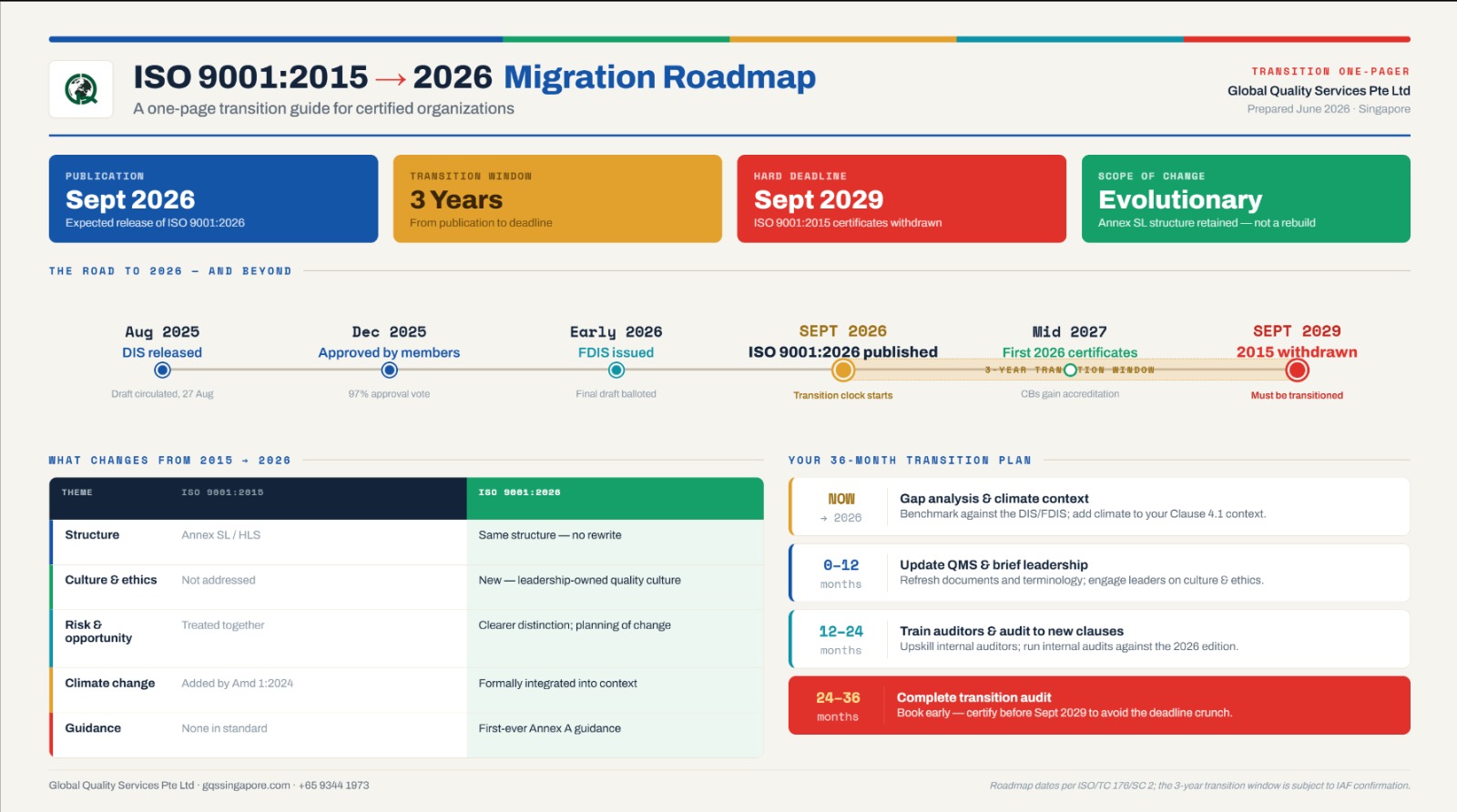
- Climate Change Context, already in force. Amendment 1:2024 added a requirement to assess whether climate change is relevant to your quality management system, effective February 2024. For biomedical and research companies where environmental conditions affect research validity or laboratory operations, this is a substantive requirement, not a checkbox.
- Quality Culture, now explicit. Clause 5.1 requires top management to actively foster and demonstrate commitment to a quality culture. At One-North, where research integrity and scientific rigor are organizational values, this requirement creates a formal space within the QMS for what should already be the organization’s lived reality.
- Ethical Behavior, a new standalone requirement. Entirely absent from ISO 9001:2015. For Biopolis companies conducting clinical research, pharmaceutical development, or biomedical trials, aligning this clause with existing research ethics frameworks and institutional review board requirements is essential and achievable.
- Risk and opportunity are more clearly separated. The 2026 edition tightens documentation expectations around both. For a startup at LaunchPad pursuing its first enterprise contract, this is often the clause that most clearly distinguishes a real quality management system from one hastily assembled for qualification purposes.
- Knowledge Management, significantly strengthened. The 2026 edition places greater emphasis on capturing, protecting, and transferring institutional knowledge. At One-North, where researchers move between institutes, startups pivot, and R&D teams restructure in response to new funding, undocumented technical knowledge is a recurring risk that ISO 9001:2026 directly addresses.
- Updated Harmonized Structure. The new edition aligns with the latest Harmonized Structure, making integration with ISO 13485 for medical device quality, ISO 27001 for information security, and ISO 45001:2018 for occupational health and safety more straightforward for One-North companies running multiple management systems.
Steps for ISO 9001:2026 Migration in One-North
- Gap Analysis. We review your current ISO 9001:2015 quality management system against the confirmed 2026 draft requirements, including the climate amendment already in force, and deliver a written gap report tailored to your cluster, Biopolis, Fusionopolis, Mediapolis, or LaunchPad.
- Scope and Context Review. Your QMS scope, quality objectives, and context analysis are updated to reflect the 2026 requirements, including the climate change context and any multi-site or multi-precinct considerations.
- Documentation Update. The quality policy, risk and opportunity register, knowledge management provisions, leadership accountability statements, and ethical behavior requirements have been revised to meet the new standard.
- Implementation and Training. Updated requirements are embedded into active operations. Staff awareness and internal auditor training is delivered against ISO 9001:2026, not the 2015 version.
- Internal Audit. An internal audit is conducted against the 2026 requirements to identify and close any non-conformances before the formal migration audit begins.
- Migration Audit. Stage 1 and Stage 2 migration audits are coordinated with your chosen accredited certification body, sequenced with your existing surveillance cycle wherever possible to avoid a standalone audit fee.
Migration audit steps will be initiated following publication of the standard and accreditation of certification bodies for the new edition, expected from late 2026 into 2027.
Migration Timeline: ISO 9001:2015 to ISO 9001:2026
Months 0 to 12: Assessment and Foundation
This phase focuses on building a clear picture of what the migration requires for your specific One-North operation. Companies should complete a gap analysis against the 2026 draft requirements, update the context analysis to include the climate change assessment, and begin leadership discussions on the quality culture and ethical behavior clauses. For Biopolis companies, this is also the stage to map alignment between the new ethical behavior requirement and existing research ethics frameworks.
Months 12 to 24: Implementation and Internal Auditing
Updated systems, documentation, and processes are embedded into active research, development, and production operations. Internal audits run against ISO 9001:2026, not 2015, so gaps are identified and resolved before the formal migration audit. For companies with A*STAR collaboration agreements, joint research protocols, or third-party clinical partnerships, this is the stage to confirm that quality-affecting activities within those relationships are appropriately documented within the QMS scope.
Months 24 to 36: Migration Audit and Completion
The formal Stage 1 and Stage 2 migration audits, conducted by an accredited certification body, are completed before the September 2029 deadline. One-North is a dense, high-certification environment. Organizations that delay until this final phase face overloaded auditor schedules, rushed internal audit cycles, and a potential lapse in certification at precisely the point where new Kampong AI contracts, enterprise client renewals, or clinical collaboration agreements may depend on an active certificate.
Start Your Migration Early: Global Quality Services Can Help
The migration from ISO 9001:2015 to ISO 9001:2026 requires real work: updated documentation, a trained internal audit team, a leadership briefing on new clause requirements, and an external audit with an accredited body. That work does not get easier the closer you are to the September 2029 deadline.
One-North companies that begin now will complete the migration with time to embed changes, run a full internal audit cycle, and sequence the migration audit into their normal surveillance schedule.
Companies that wait risk the same outcome seen during the 2015 transition: overloaded certification bodies, last-minute document gaps, and avoidable lapses in a certificate that client contracts and research collaboration frameworks may treat as a standing requirement.
With Global Quality Services, you get:
- Gap analysis scoped to your One-North cluster and the specific ISO 9001:2026 changes most relevant to your sector
- Full documentation review and update, including knowledge management and ethical behaviour provisions
- Leadership and staff training delivered to a research and technology environment, not a manufacturing template
- Internal audit facilitation conducted against ISO 9001:2026
- Migration audit support coordinated with your chosen accredited certification body
- Integration mapping across ISO 13485, ISO 27001, or ISO 45001:2018 if you hold multiple certifications
Contact Global Quality Services to begin your ISO 9001:2026 migration in One-North.
Why Choose Global Quality Services
Global Quality Services has supported certification and migration projects across Singapore and the Asia-Pacific region for over two decades. Our ISO 9001 programs are designed for knowledge-intensive, research-driven, and technology organizations, not adapted from manufacturing frameworks, which means the documentation, training, and audit preparation we deliver are relevant to how One-North companies actually work.
For Biopolis companies, we pair ISO 9001:2026 with ISO 13485 medical device quality management where applicable. For Fusionopolis and LaunchPad technology companies, our scope regularly extends into ISO 27001 information security and ISO 45001:2018 occupational health and safety.
For companies with sustainability reporting obligations, ESG Reporting and ISO 14001:2026 environmental management are also within scope.
Disclaimer: ISO 9001:2026 is still in draft and has not been published by the International Organization for Standardization at the time of writing. The publication date, transition timeline, and clause content described on this page are based on the current Final Draft International Standard, Amendment 1:2024, and industry projections, and remain subject to change until ISO issues the official release. Global Quality Services will update this page once the standard is formally published.
Frequently Asked Questions
What is ISO 9001:2026 and when will it be published?
ISO 9001:2026 is the upcoming revision of the international quality management standard. Publication is expected around September 2026, with a transition window of approximately three years following publication, through to around September 2029.
Is ISO 9001:2026 relevant to biomedical research companies in Biopolis?
Yes. Pharmaceutical R&D, clinical trial support, antibody discovery, and biomedical device development all involve clients and collaborators who expect auditable quality management systems. ISO 9001:2026 provides that framework, and its new ethical behavior clause aligns directly with existing research ethics obligations in a Biopolis environment.
Can a LaunchPad startup pursue ISO 9001:2026 instead of ISO 9001:2015?
Once the standard is published and certification bodies are accredited for the new edition, yes. First-time applicants can go directly to ISO 9001:2026, bypassing the 2015 version entirely. This is the recommended approach for startups beginning their certification journey in 2027 onwards.
How does the new knowledge management requirement affect R&D companies at One-North?
The 2026 edition strengthens requirements around how organizations capture, retain, protect, and transfer knowledge. For R&D companies where research methodology, proprietary processes, and technical IP are the core assets, this clause requires formal documentation of knowledge management practices rather than relying on individual expertise or informal handover.
Can we combine ISO 9001:2026 migration with ISO 13485 or ISO 27001?
Yes. All three standards follow the Harmonized Structure, which makes integrated audits and shared documentation possible. Global Quality Services regularly delivers combined programmes across ISO 9001, ISO 13485, and ISO 27001 for One-North companies running multiple certifications.