
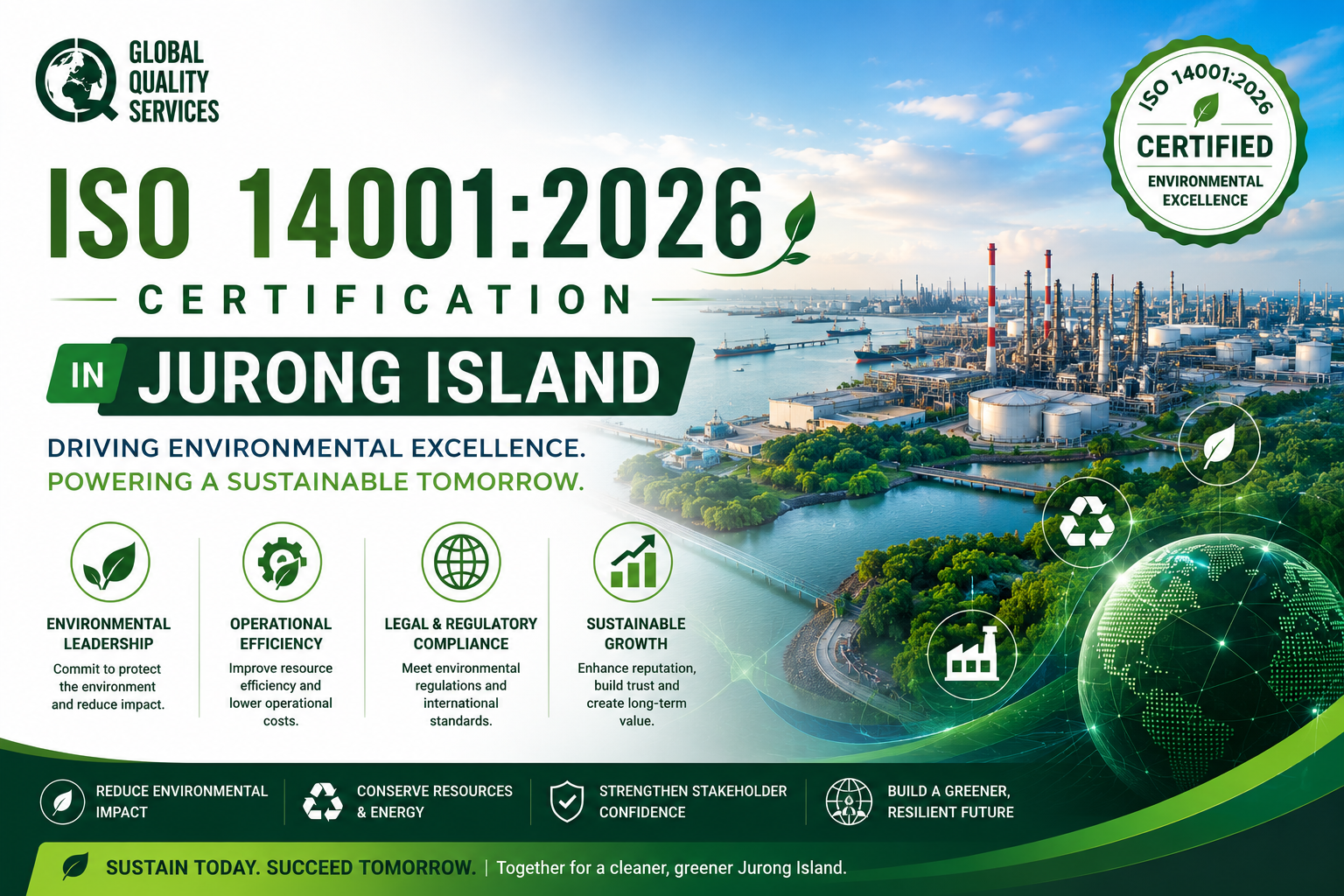
Global Quality Services helps energy and chemical companies on Jurong Island achieve ISO 14001:2026 certification, the current edition of the international environmental management system standard, published in April 2026 to replace ISO 14001:2015.
Jurong Island is Singapore’s flagship energy and chemicals hub, built from seven reclaimed islets into more than 3,000 hectares of refineries, crackers, and specialty chemical plants, managed by JTC Corporation and regulated closely by Singapore’s National Environment Agency.
A facility operating here rarely starts from zero on environmental compliance, and our work usually begins by mapping what you already have against the full 2026 clause structure rather than building from a blank template.
Jurong Island at a Glance
Jurong Island opened officially in October 2000 and is now home to more than 100 global energy and chemicals companies, a sector that contributes roughly three percent of Singapore’s GDP, around a quarter of its manufacturing output, and employment for about 27,000 people.
The island’s refineries process an estimated 1.5 million barrels of crude oil daily, feeding a tightly interlinked production network where the output of one plant routinely becomes the feedstock for the next.
The island also carries a designation most industrial estates do not: it has been gazetted a Protected Place since October 2001, with access controlled through security clearance and patrols rather than open entry.
This matters operationally for certification work. Site visits, audits, and document reviews on Jurong Island are scheduled around access protocols that an ordinary industrial park consultant would not need to account for, and we build that into your project timeline from the outset rather than treating it as a delay once it arises.
Why ISO 14001:2026 Certification Matters Here Specifically
Jurong Island companies already operate under Singapore’s Environmental Protection and Management Act, which gives the National Environment Agency authority over air emissions, trade effluent discharges, and the handling of hazardous substances across the island. ISO 14001:2026 certification does not replace any part of that regulatory authority.
What it adds is a structured environmental management system that makes your ongoing NEA permitting, monitoring, and reporting considerably easier to sustain, and it satisfies the certification requirements that parent companies, joint venture partners, and buyers increasingly expect from energy and chemicals operations regardless of how compliant you already are on the regulatory side.
What Changed in ISO 14001:2026
The 2026 edition keeps the same core structure as the 2015 version but introduces three changes worth understanding before scoping a project.
A Wider Environmental Context Requirement
Clause 4.1 now asks organizations to assess climate change, biodiversity, and resource availability, not only the legal and regulatory risks already covered under the 2015 edition. For a Jurong Island facility, this typically means documenting exposure to resource constraints and to the shared-infrastructure risk of operating within a dense, highly interconnected industrial estate.
A New Clause on Planning Changes
Clause 6.3 is new in this edition. It requires a defined process for managing planned changes to equipment, processes, or capacity, applicable to any Jurong Island company expanding a unit, adding a line, or retooling for specialty chemicals production, without disrupting existing environmental controls.
A Three-Year Transition Window
Companies already certified to ISO 14001:2015 have until roughly April 2029 to transition, through their normal recertification or surveillance audit cycle rather than as a separate project. First-time applicants can go directly to the 2026 edition now.
The Role of ISO 14001:2026 in Jurong Island’s Next Chapter
Jurong Island is shifting. As global petrochemical demand softens and plastics face tighter regulation, Singapore is steering the island toward specialty chemicals, sustainable materials, and low-carbon energy infrastructure. JTC and the Economic Development Board report that sustainable product output on the island has already grown 1.4 times since 2019, with a target of 1.5 times by 2030, alongside new hydrogen, ammonia, and carbon capture infrastructure and a planned low-carbon data centre park.
Benefits of ISO 14001:2026 Certification for Jurong Island Facilities
A documented environmental management system is the practical mechanism behind that kind of claim. It is how a company shows, with actual records rather than a general statement, that its energy use, emissions, and resource consumption are measured and improving over time.
As Jurong Island’s own infrastructure and reporting expectations move in this direction, a certified locator is positioned to participate in that shift rather than reconstruct years of scattered data once it becomes a requirement rather than an advantage.
Smoother NEA Permitting and Reporting
A structured environmental management system means your monitoring data, discharge records, and hazardous substance logs are already organized the way NEA submissions expect, which shortens the time spent assembling documentation for permit renewals and inspections.
Stronger Standing With Parent Companies and Joint Venture Partners
Many Jurong Island operations are subsidiaries or joint ventures of multinational energy and chemicals groups headquartered elsewhere. A current ISO 14001:2026 certificate gives group sustainability reporting a verified data source rather than a site-level estimate.
Faster Buyer and Supply Chain Qualification
Certification increasingly substitutes for lengthy environmental questionnaires during vendor and offtake agreement negotiations, particularly with buyers in markets that have their own tightening emissions disclosure rules.
Reduced Risk of Incidents and Penalties
A structured legal compliance register flags upcoming obligations before they lapse into violations, which carries real weight inside a Protected Place where a serious environmental incident draws scrutiny from multiple government agencies at once.
Easier Integration With ISO 9001, ISO 45001, ISO 50001, and RC 14001
ISO 14001:2026 follows the same Harmonized Structure as several other standards common on Jurong Island, so companies running multiple certifications can combine audits and share documentation rather than maintaining separate systems for each one.
Our Certification Process for Jurong Island Facilities
- Scoping and access planning. We confirm your existing NEA permits, prior ISO 14001:2015 documentation if any, and the site access protocols your facility’s Protected Place status requires for our visits.
- Gap assessment. Your current environmental controls are reviewed against the full ISO 14001:2026 clause structure, including the new change management requirement.
- System build. We draft your environmental policy, aspect and impact register, and operational controls around your actual plant processes rather than a generic template.
- Internal audit and management review. Your team is trained to run both, with templates suited to a refinery, cracker, or chemical manufacturing environment.
- Certification or transition audit. We coordinate the external audit with your chosen accredited certification body, sequencing a 2015-to-2026 transition inside your existing surveillance cycle wherever possible.
Industries and Operations We See on Jurong Island
- Crude oil refining and petrochemical cracking
- Specialty chemicals and sustainable materials manufacturing
- Industrial gases and chemical storage or terminalling
- Polymers, resins, and synthetic rubber production
- New energy infrastructure, including hydrogen and ammonia handling
Why Choose Global Quality Services
Global Quality Services has supported certification projects across Singapore and the wider region for over two decades. Many Jurong Island companies pair ISO 14001:2026 with ISO 9001:2026 quality management, ISO 45001:2018 occupational health and safety, or ISO 50001 energy management, and chemical manufacturers in particular often add RC 14001 certification, the chemical industry’s own Responsible Care framework, alongside their environmental management system.
Certification day is not where the relationship ends. We stay on for your surveillance audits, your eventual recertification, and any expansion or retooling project that needs to be folded into your system under the new Clause 6.3 requirement.
For a facility on a Protected Place where access must be planned in advance, having a consultant who already understands your site, your existing NEA paperwork, and your access protocols means certification stays current without adding friction to an already tightly controlled operation.
If your facility operates on Jurong Island, contact Global Quality Services for a gap assessment scoped to your current NEA compliance status, existing environmental documentation, and site access requirements.
Frequently Asked Questions
What is ISO 14001:2026 certification?
ISO 14001:2026 is the current edition of the international environmental management system standard, published in April 2026. It helps companies manage waste, energy use, and pollution through a structured, auditable framework.
Does ISO 14001:2026 replace NEA requirements on Jurong Island?
No. NEA’s permits and licenses under the Environmental Protection and Management Act remain mandatory. ISO 14001:2026 is a voluntary certification that sits alongside these requirements, not instead of them.
Does Jurong Island’s Protected Place status affect certification audits?
It affects scheduling, not the certification requirements themselves. Site visits and audits need to be planned around access clearance, which we build into your project timeline from the start.
How long does certification take for a Jurong Island facility?
Most facilities complete certification in three to six months, faster if an environmental management system already exists from prior ISO 14001:2015 certification or established NEA compliance records.
What happens if my company is already ISO 14001:2015 certified?
You have until roughly April 2029 to transition to ISO 14001:2026, and most companies fold this into their next scheduled surveillance or recertification audit rather than running it as a separate project.