
Few industrial sites in Southeast Asia carry the historical weight that Jurong does. Spanning 9,600 acres of reclaimed swampland, Jurong stands as one of the largest industrial complexes in the region, built from a vision that transformed crocodile-infested waterways into Singapore’s industrial backbone.
By the late 1960s, the estate already hosted 153 fully operational factories with 46 more under construction, and within a decade had grown to allocate land across more than 1,200 companies employing 93,000 workers.
Today, that legacy lives on through key industries including manufacturing, electronics, shipbuilding, petrochemicals, and biomedical sciences — sectors where quality management has never been optional, and will only become more codified once ISO 9001:2026 is published.
This page will walk Jurong Industrial Estate companies through what the upcoming ISO 9001:2026 transition entails, why it will matter specifically for an estate with this industrial heritage, and how GQS will support a smooth migration once the standard is formally released.
Why This Transition Will Matter for Jurong’s Industrial Base
Jurong’s industrial identity has evolved through what historians describe as five distinct phases — labor-intensive in the 1960s, skill-intensive in the 1970s, capital-intensive in the 1980s, technology-intensive in the 1990s, and knowledge and innovation-intensive from the 2000s onward.
Companies still operating within the original estate today, alongside newer entrants in precision engineering and advanced manufacturing, will be navigating the ISO 9001:2026 transition from very different starting points — but all will face the same hard deadline once the standard takes effect.
Heavy industry players inherited from Jurong’s earliest decades, including shipbuilding and repair yards, steel-pipe manufacturing, and oil refining operations, will need a transition approach calibrated to long production cycles and heavy capital infrastructure.
Meanwhile, companies in the surrounding Jurong Innovation District — home to advanced manufacturing leaders in precision engineering, autonomous mobility, and clean technology, including multinational names such as Shimano and Hyundai Motor Group — will be approaching the same transition from a more digitally mature, Industry 4.0-aligned starting point.
What Will Change, and Why It Will Matter for Jurong’s Industry Mix
ISO 9001:2026 will introduce targeted updates rather than a wholesale rewrite, but several will land with particular weight across Jurong’s diverse industrial base:
- Climate change context will become a required part of QMS planning. For petrochemical, refining, and heavy manufacturing operations historically anchored in Jurong, this will mean formally assessing how climate-related disruption — regulatory shifts, resource availability, supply chain exposure — could affect product and service quality.
- Quality culture will move from an implied expectation to a direct requirement, meaning leadership across both legacy heavy-industry players and newer Jurong Innovation District tenants will need to visibly champion quality rather than delegating it solely to the QA function.
- Ethical behaviour will be introduced as a distinct, newly formalized requirement that companies across the estate will need to define and demonstrate through their people, processes, and decisions.
- Sharper risk and opportunity management will tighten documentation expectations — a natural extension for precision engineering and advanced manufacturing tenants already operating to tight tolerances within JID’s Industry 4.0 framework.
- The updated Harmonised Structure will make integration with ISO 14001 and ISO 45001 considerably smoother, which will particularly benefit JID tenants already embedded in a district built around environmental stewardship, from centralised cooling systems to green mobility networks.
The Transition Process — Step by Step
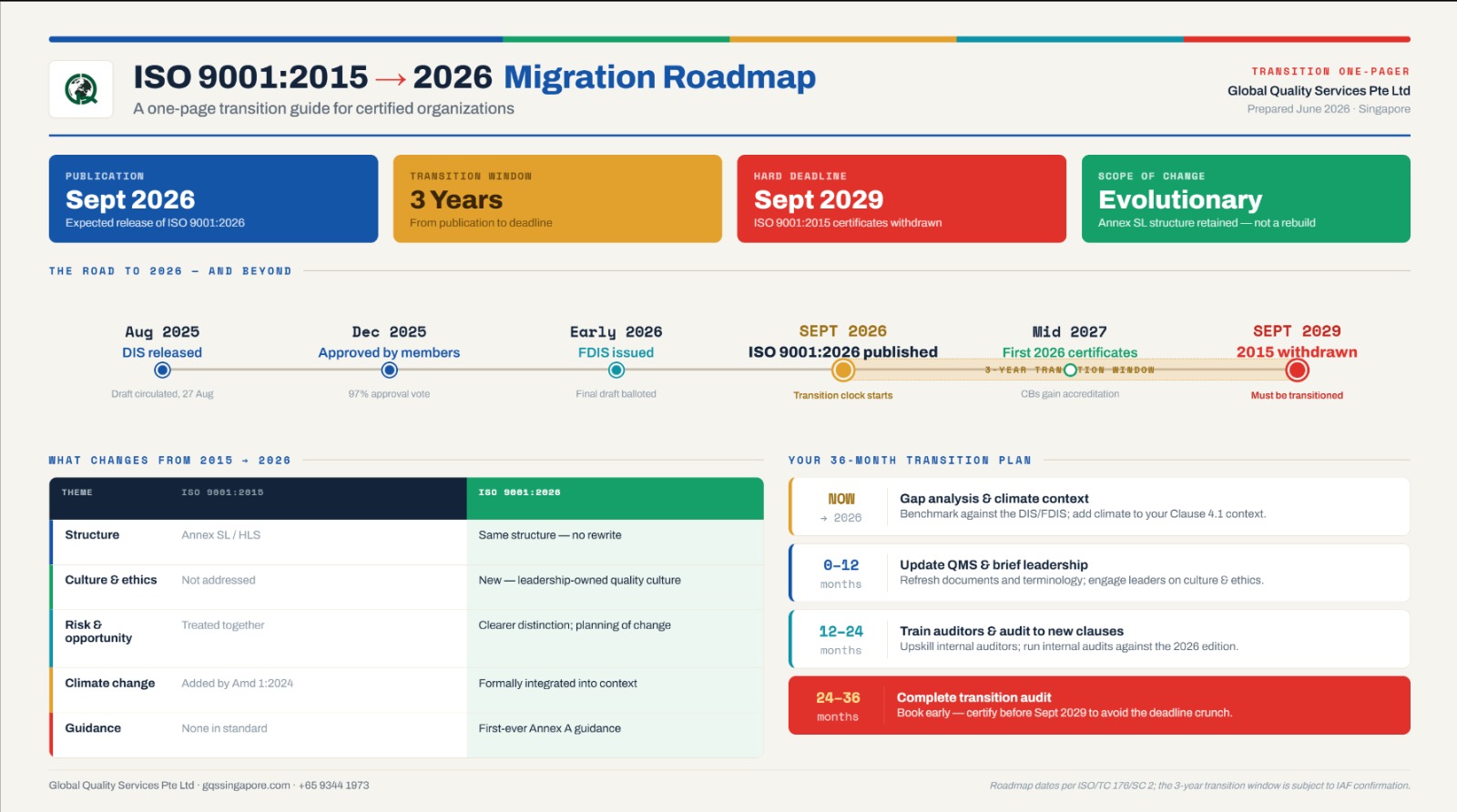
Once ISO 9001:2026 is officially published, companies across Jurong Industrial Estate and the broader Jurong Innovation District will be expected to follow a structured path:
- Gap analysis — A dedicated team will compare your facility’s existing ISO 9001:2015 processes against the confirmed ISO 9001:2026 requirements, with particular attention to the new climate change context clause.
- Documentation update — Procedures, policies, and quality objectives will be revised to reflect the 2026 framework while staying grounded in your facility’s actual day-to-day operations.
- QMS implementation — Staff will be trained on the updated system, with documented processes rolled out and monitored for early-stage compliance gaps.
- Internal audit — A detailed internal audit will be conducted against the 2026 requirements, specifically to surface any remaining non-conformances before the formal certification stage.
- Certification audit — Your accredited certification body will conduct a two-stage audit: a documentation review followed by an on-site implementation review.
- Certification issuance — Once successfully reviewed, your ISO 9001:2026 certificate will be issued, with ongoing compliance maintained through annual surveillance audits.
Benefits Jurong Companies Will Gain from Transitioning Early
- Uninterrupted operational continuity — Companies running long production cycles, particularly in shipbuilding, refining, and heavy manufacturing, will avoid certification lapses that could disrupt long-standing client and supplier relationships.
- Stronger positioning within JID’s innovation ecosystem — Advanced manufacturing tenants will be able to demonstrate quality maturity that aligns with the district’s broader Industry 4.0 ambitions, strengthening their standing alongside multinational anchor tenants.
- Smoother integration with existing certifications — The updated Harmonized Structure will make it considerably easier for facilities already holding ISO 14001 or ISO 45001 to fold ISO 9001:2026 into a single, coordinated management system.
- Reduced audit-day disruption — Companies that prepare early will be able to schedule certification body audits around production peaks rather than scrambling near contractual deadlines.
- A genuine quality culture upgrade — Beyond the certificate itself, companies will build sturdier internal habits around risk management, ethical conduct, and leadership accountability that will outlast any single audit cycle.
How GQS Will Support Companies Across Jurong
Once the standard is published, GQS will work directly with companies across Jurong Industrial Estate and Jurong Innovation District to make the transition practical rather than disruptive:
- Conduct a facility-specific gap analysis comparing existing ISO 9001:2015 systems against confirmed ISO 9001:2026 requirements
- Update QMS documentation, risk registers, and process maps without halting live production or R&D activity
- Deliver leadership and staff training calibrated to your facility’s operational maturity, whether a legacy heavy-industry operation or an advanced manufacturing tenant
- Coordinate transition audits with accredited certification bodies in a way that minimizes disruption to production schedules and client commitments
- Support facilities that also hold ISO 14001, ISO 45001, or other certifications in folding all transition work into a single coordinated roadmap
- Liaise directly with regional or global quality teams where transition timelines will need to be synchronized across multiple facilities or subsidiaries
Jurong transformed from reclaimed swampland into one of Southeast Asia’s most significant industrial estates through decades of deliberate, forward-looking planning. The ISO 9001:2026 transition will be the next chapter in that same tradition. Contact Global Quality Services today to start planning your facility’s transition with a team that will understand what operating in Jurong actually demands.
Disclaimer
ISO 9001:2026 is currently under development and has not yet been officially published by the International Organization for Standardization (ISO). The steps, requirements, and guidance provided above are based on draft information, anticipated changes, and professional interpretation of the evolving standard, intended for informational and preparatory purposes only. Certification bodies will not audit against ISO 9001:2026 until it is formally released, and organizations should continue maintaining compliance with the currently published ISO 9001:2015 standard until official transition timelines are confirmed. GQS will update this content to reflect the final published standard as soon as it becomes available.
Frequently Asked Questions
1. Has ISO 9001:2026 been published yet, and does this transition process apply now?
No, ISO 9001:2026 has not yet been officially published. The transition process described here will only become applicable once ISO formally releases the standard, and certification bodies will not audit against it until then.
2. Will both legacy Jurong Industrial Estate companies and newer Jurong Innovation District tenants need to transition?
Yes, once published, any company currently certified under ISO 9001:2015 will need to transition to ISO 9001:2026 within the confirmed window, regardless of whether it operates in the original estate or the newer innovation district.
3. How will the transition affect companies with long, capital-intensive production cycles like shipbuilding or refining?
GQS will schedule gap assessments, documentation updates, and audits around long production cycles to avoid disrupting ongoing contracts or capital-intensive operations.
4. Will GQS coordinate with multinational parent companies operating within Jurong Innovation District?
Yes, GQS will liaise directly with regional or global quality teams to ensure your facility’s transition aligns with broader corporate certification strategies.
5. How early should companies in Jurong start preparing for the transition?
Beginning internal awareness and preliminary planning well ahead of the official publication date will be strongly advisable, given the scale of documentation and training many Jurong-based companies will need to complete within the eventual transition window.