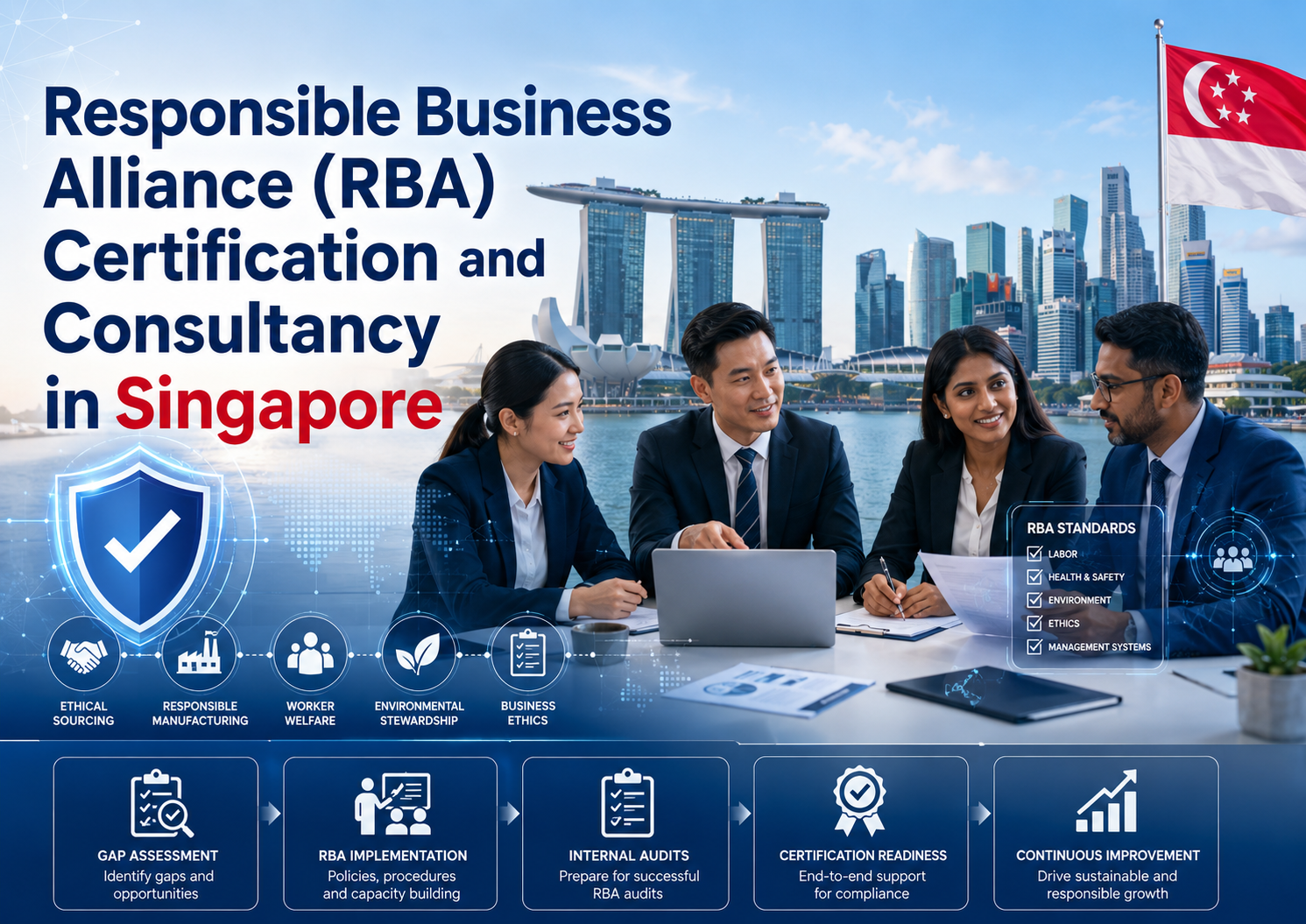
Responsible sourcing, ethical employment and sustainable supply chains are becoming increasingly important for businesses operating in Singapore. Customers, investors and multinational companies now expect suppliers to demonstrate responsible business practices across labour, health and safety, environmental protection and business ethics.
Responsible Business Alliance Certification in Singapore is a commonly used search term for services that help organisations prepare for alignment with the Responsible Business Alliance (RBA) Code of Conduct, RBA assessments and customer-driven social compliance requirements.
However, RBA itself is not an ISO-style certification standard. It is an industry-led organisation that establishes responsible business expectations and uses tools such as self-assessment questionnaires, risk assessments, independent audits and corrective actions to drive improvement across supply chains.
Global Quality Services (GQS) provides consulting and readiness support to Singapore businesses that need to strengthen their responsible sourcing, social compliance, environmental and ethical management systems in line with RBA expectations.
What Is RBA Certification?
The Responsible Business Alliance (RBA) is an industry coalition focused on responsible business conduct in global supply chains. It was originally established around the electronics industry but its Code of Conduct is now used across several industries and supply-chain environments.
The RBA Code of Conduct establishes expectations covering labour, health and safety, environment, ethics and management systems. The current Code of Conduct is Version 8.0, which took effect on 1 January 2024. RBA states that its Code references international norms and standards, including ILO labour standards, OECD guidelines and other recognised frameworks.
This makes RBA particularly relevant to manufacturers and suppliers working with multinational organisations that require evidence of responsible business practices throughout their supply chains.
Is RBA a Certification?
This is an important distinction for businesses considering RBA compliance.
RBA does not operate like ISO 9001 or ISO 14001, where an organisation obtains a conventional management-system certificate.
Instead, RBA members commit to its Code of Conduct and use different assessment and accountability mechanisms depending on their membership category and supply-chain requirements.
RBA’s framework includes:
- Self-Assessment Questionnaires (SAQs)
- Risk assessments
- RBA Code of Conduct implementation
- Validated Assessment Program (VAP) audits
- Corrective action plans
- Follow-up assessments
- Supply-chain due diligence
- Responsible sourcing programmes
RBA states that independent third-party firms approved by RBA conduct relevant audits, while corrective actions may be required where standards are not met.
Therefore, when a company searches for RBA Certification Services in Singapore, it is usually looking for consultancy and preparation support for RBA requirements, customer assessments or RBA-related audits rather than a conventional certification certificate.
What Does the RBA Code of Conduct Cover?
The RBA framework addresses five major areas.
1. Labour
RBA places strong emphasis on protecting workers’ rights and preventing abusive employment practices.
Organisations need to consider issues such as:
- Freely chosen employment
- Prohibition of forced labour
- Child labour prevention
- Working hours
- Wages and benefits
- Humane treatment
- Non-discrimination
- Freedom of association
- Worker grievance mechanisms
For Singapore employers, RBA requirements should be considered alongside applicable local employment legislation.
The Singapore Ministry of Manpower (MOM) provides official information on employment rights, workplace responsibilities and employment practices. Businesses can review MOM’s employment practices resources when establishing their local compliance framework.
RBA alignment should therefore complement—not replace—Singapore’s legal obligations.
2. Health and Safety
A responsible supply chain requires workplaces to protect employees and other people who may be affected by operations.
RBA expectations can cover areas such as:
- Occupational safety
- Emergency preparedness
- Workplace injuries and illnesses
- Industrial hygiene
- Physically demanding work
- Machine safety
- Worker accommodation where provided
- Safety communication
- Risk assessment
Singapore organisations must also comply with applicable requirements under the Workplace Safety and Health Act.
MOM states that employers must protect the safety and health of employees and workers under their direction and must conduct risk assessments and implement effective risk controls. Businesses can refer to the official Workplace Safety and Health responsibilities of stakeholders.
For companies preparing for RBA assessments, this creates an important connection between international customer expectations and Singapore’s statutory workplace safety requirements.
3. Environmental Responsibility
Environmental management is another major part of responsible supply-chain performance.
Businesses may need to address:
- Environmental permits
- Pollution prevention
- Waste management
- Resource consumption
- Hazardous substances
- Air emissions
- Water management
- Energy use
- Climate-related risks
- Environmental monitoring
An organisation should be able to demonstrate that environmental risks are identified and managed rather than simply maintaining an environmental policy.
For companies wanting a formal environmental management framework alongside RBA requirements, ISO 14001 Certification in Singapore can provide a structured system for managing environmental responsibilities.
4. Ethics
Responsible business also requires organisations to operate ethically.
RBA’s ethics expectations address areas such as:
- Business integrity
- Anti-corruption
- Responsible disclosure of information
- Intellectual property
- Fair business practices
- Protection of identity
- Responsible sourcing of minerals
- Privacy
Organisations should establish appropriate policies, reporting channels and controls to prevent unethical behaviour.
For Singapore businesses, these controls should be considered alongside applicable local legislation and corporate governance requirements.
5. Management Systems
This section is particularly important because RBA compliance is not achieved by writing policies alone.
Organisations need management processes that help them identify risks, implement controls, monitor performance and correct problems.
A mature management system can include:
Policy → Risk Assessment → Responsibility → Procedures → Implementation → Monitoring → Audit → Corrective Action → Management Review → Continual Improvement
This structure also explains why companies with established ISO management systems may find it easier to organise evidence for RBA-related assessments.
Who Needs RBA Certification Compliance Support in Singapore?
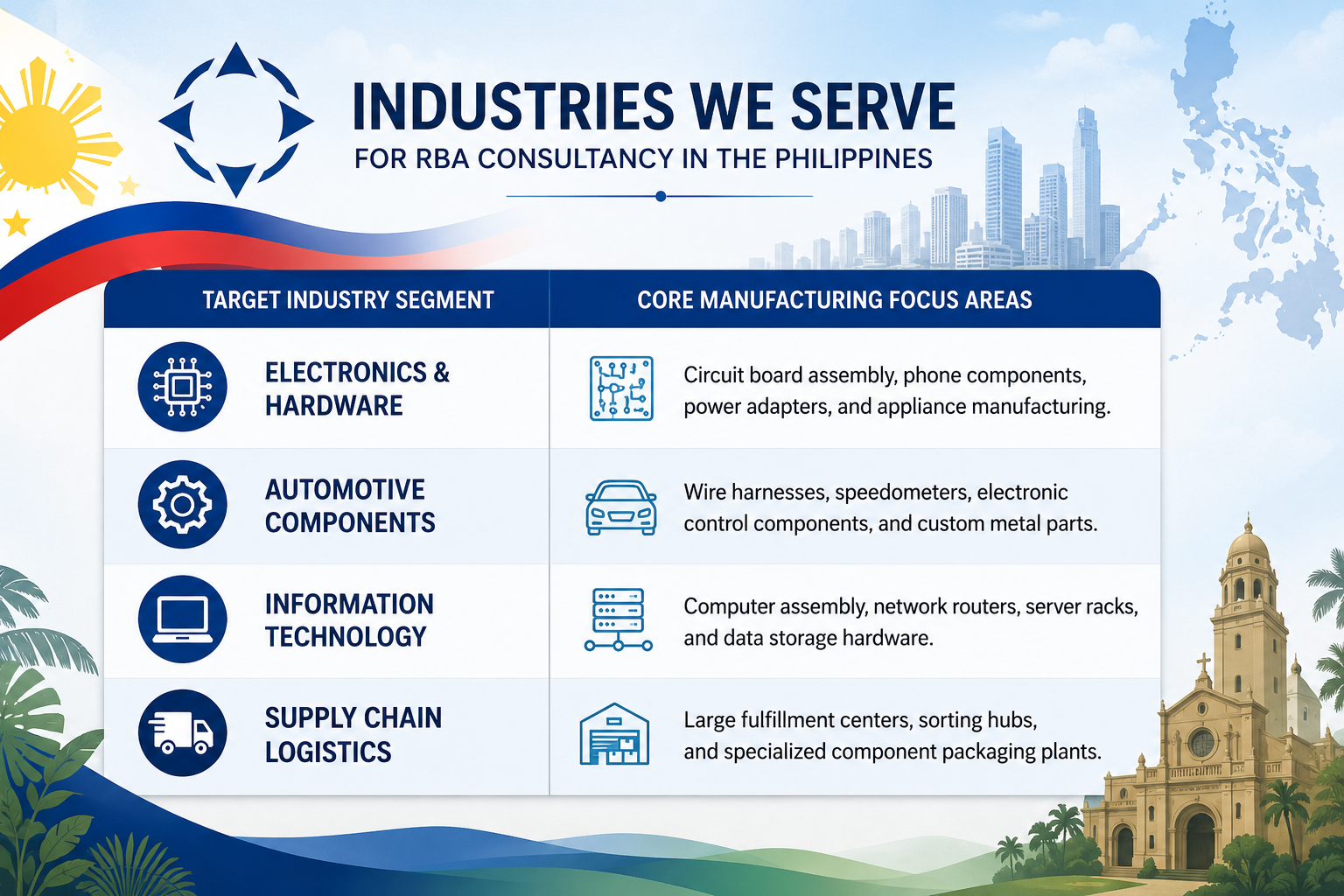
RBA requirements can be particularly relevant to businesses involved in global manufacturing and supply chains.
Potentially affected organisations include:
- Electronics manufacturers
- Semiconductor suppliers
- Contract manufacturers
- Component manufacturers
- Automotive suppliers
- Battery and energy technology suppliers
- Consumer electronics suppliers
- Hardware manufacturers
- Precision engineering companies
- Packaging suppliers
- Chemical suppliers
- Logistics and supply-chain organisations
- Suppliers working with multinational corporations
RBA membership itself has specific eligibility and membership-category requirements. RBA states that membership is open to companies that manufacture or contract the manufacture of products and share the organisation’s mission and vision.
However, a company does not necessarily need to become an RBA member simply because a customer requires an RBA-related assessment. Customer contracts and supply-chain requirements should be reviewed separately.
RBA Assessment and Certification Process
A strong preparation programme should begin well before an assessment.
Step 1: Understand Customer and RBA Requirements
The first step is to determine exactly what the customer or supply-chain partner expects.
A buyer may request:
- RBA Code alignment
- RBA SAQ completion
- VAP assessment
- Social compliance audit
- Corrective action closure
- Environmental evidence
- Labour documentation
- Supplier due diligence
Understanding the expected assessment route prevents organisations from preparing for the wrong requirements.
Step 2: Conduct an RBA Gap Assessment
GQS reviews existing policies, procedures, records and operational practices against relevant RBA requirements.
The assessment may examine:
Labour + Health & Safety + Environment + Ethics + Management Systems
The purpose is to identify gaps between documented policies and actual workplace practices.
For example, a company may have a working-hours policy but discover that overtime records do not consistently demonstrate compliance. Another organisation may have an environmental policy but lack sufficient records showing waste or emissions controls.
Step 3: Assess Supply-Chain Risks
RBA places significant emphasis on supply-chain responsibility.
Organisations should understand where significant social, environmental and ethical risks exist among suppliers and contractors.
RBA’s assessment tools are designed to help members identify social, environmental and ethical risks and determine where corrective action may be needed.
GQS can help organisations establish supplier evaluation criteria, risk classifications and monitoring mechanisms.
Step 4: Review Documentation
Documents may include:
- Labour policies
- Employment contracts
- Wage records
- Working-hour records
- Safety procedures
- Risk assessments
- Emergency procedures
- Environmental permits
- Waste records
- Ethics policies
- Anti-corruption procedures
- Grievance procedures
- Supplier codes of conduct
- Training records
- Audit reports
- Corrective action records
The goal is to ensure that documentation reflects actual business practices.
Step 5: Strengthen Operational Controls
Policies must be implemented at the workplace.
For example, if the organisation has a workplace safety procedure, employees should understand it, appropriate risk controls should exist and evidence should demonstrate that those controls are being maintained.
Singapore’s MOM provides extensive Workplace Safety and Health guidance covering legal requirements, monitoring, reporting and workplace safety resources.
Step 6: Conduct Internal Assessment
Before an external assessment, the organisation can conduct an internal review.
This can identify:
- Missing evidence
- Incomplete records
- Policy gaps
- Inconsistent implementation
- Supplier weaknesses
- Safety issues
- Environmental control gaps
- Worker concerns
Step 7: Correct Non-Conformities
Each identified issue should be investigated.
A good corrective-action process should establish:
Problem → Root Cause → Corrective Action → Responsible Person → Deadline → Evidence → Effectiveness Review
Simply correcting the immediate problem may not be enough if the underlying cause remains.
Step 8: Prepare for Independent Assessment
Depending on the programme involved, an approved third-party assessment may be conducted.
RBA’s accountability framework includes independent third-party assessments and corrective-action mechanisms.
GQS can help the organisation prepare its people, documentation and evidence before the assessment.
Benefits of RBA Compliance for Singapore Businesses
Improve Customer Confidence
Multinational customers increasingly want evidence that suppliers manage labour, safety, environmental and ethical risks responsibly.
RBA alignment can help suppliers demonstrate that these issues are being addressed systematically.
Strengthen Supply-Chain Transparency
Supply-chain risks can exist beyond a company’s own facility. Supplier screening and due diligence help organisations understand where potential risks exist.
Reduce Social Compliance Risks
A structured approach can identify issues involving working hours, wages, worker treatment, safety and other employment-related concerns before they become major customer findings.
Improve Workplace Safety
RBA requirements can complement Singapore’s existing WSH framework by encouraging organisations to identify hazards, implement controls and maintain appropriate safety systems.
Strengthen Environmental Performance
RBA environmental expectations encourage businesses to pay closer attention to pollution prevention, waste, resource use and environmental compliance.
Companies can also integrate RBA-related environmental controls with ISO 14001 environmental management systems.
Support Global Supply-Chain Access
Suppliers working with international brands may encounter customer requirements based on RBA or similar responsible-sourcing frameworks.
Preparing in advance can make supplier onboarding and customer assessments more manageable.
Encourage Continual Improvement
RBA is not simply about passing one assessment. Its approach emphasises ongoing improvement, risk assessment and corrective action. RBA states that supply-chain sustainability is a continuous challenge and encourages members to use assessments, training and other tools to improve performance over time.
RBA vs ISO 14001 vs ISO 45001
RBA should not be confused with conventional ISO management-system certification.
| Framework | Primary focus | Typical application |
|---|---|---|
| RBA | Responsible labour, safety, environment, ethics and supply-chain conduct | Global supply-chain responsibility |
| ISO 14001 | Environmental management | Organisations managing environmental impacts |
| ISO 45001 | Occupational health and safety | Organisations managing workplace safety risks |
| ISO 9001 | Quality management | Organisations managing quality and customer requirements |
A business can use several of these frameworks together.
For example, an electronics manufacturer may use ISO 9001 for quality, ISO 14001 for environmental management, ISO 45001 for occupational health and safety and RBA requirements for broader responsible-supply-chain expectations.
RBA and Singapore Workplace Requirements
RBA alignment does not replace Singapore law.
A Singapore organisation must continue to comply with applicable legislation and regulatory requirements, regardless of whether a customer requests RBA compliance.
For workplace safety, MOM states that employers have responsibilities to conduct risk assessments, implement effective risk controls and provide sufficient instruction, training and supervision.
For workplaces defined as factories under Singapore’s WSH Act, MOM also specifies notification or registration requirements depending on the nature and risk level of activities.
Businesses should therefore build their RBA programme around their existing legal compliance structure rather than creating a completely separate system.
Singapore Government Resources for Responsible Business Compliance
Businesses preparing for RBA-related assessments can refer to official Singapore Government resources alongside the RBA Code.
1. Ministry of Manpower – Workplace Safety and Health
The official MOM Workplace Safety and Health portal provides information on workplace safety requirements, monitoring, accident reporting and WSH resources.
2. MOM – WSH Act Responsibilities
The WSH Act responsibilities page explains employer, principal and occupier responsibilities, including risk assessments and workplace safety controls.
3. MOM – Factory Notification and Registration
Businesses operating qualifying factories can review factory notification and registration requirements to understand applicable obligations before commencing operations.
4. MOM – Workplace Safety and Health Legislation
The Singapore workplace safety legislation resource provides access to WSH legislation and approved codes of practice.
5. MOM – Tripartite Standards
The Tripartite Standards provide guidance on verifiable and actionable employment practices adopted by progressive employers in Singapore.
These government resources should be used alongside the official RBA Code of Conduct and RBA assessment requirements, because Singapore Government requirements and RBA customer requirements are separate obligations.
Why Choose GQS for RBA Consulting in Singapore?
RBA assessments can involve multiple departments at once. Human resources may hold employment records, EHS teams may manage safety and environmental evidence, procurement may control suppliers, while management handles policies and governance.
GQS can help bring these areas together into a structured compliance programme.
Our support can include:
- RBA requirements review
- Initial gap assessment
- RBA Code of Conduct alignment
- Labour compliance review
- Workplace safety review
- Environmental compliance review
- Ethical business-practice review
- Supplier due-diligence assessment
- Documentation review
- Internal assessment
- Corrective-action planning
- Audit-readiness support
- Evidence and records review
- Continual-improvement planning
Where a company already maintains ISO 9001, ISO 14001 or ISO 45001 systems, GQS can help identify where existing processes can support RBA requirements rather than unnecessarily duplicating controls.
Frequently Asked Questions
1. Is Responsible Business Alliance Certification mandatory in Singapore?
No. RBA is an industry-led responsible-business framework rather than a Singapore statutory certification. However, a multinational customer or supply-chain partner may require a supplier to demonstrate RBA Code of Conduct alignment or complete a particular RBA assessment.
2. Does RBA issue an ISO-style certificate?
No. RBA uses membership requirements, self-assessments, risk assessments, audits and corrective-action mechanisms rather than operating as a conventional ISO certification scheme. RBA itself identifies independent third-party audits and other assessment activities as part of its accountability approach.
3. What industries use RBA requirements?
RBA originated in the electronics industry, but its Code of Conduct is applicable beyond electronics and is used across broader supply chains. RBA membership eligibility and individual customer requirements should be checked for the specific organisation.
4. What are the main areas covered by RBA?
The RBA Code of Conduct covers Labour, Health and Safety, Environment, Ethics and Management Systems. These areas collectively address responsible employment, workplace conditions, environmental responsibility, ethical conduct and management controls.
5. What is an RBA VAP assessment?
The Validated Assessment Program (VAP) is one of RBA’s assessment mechanisms used to evaluate facility-level conformance with the RBA Code of Conduct. Organisations preparing for a VAP assessment generally need to demonstrate both documented systems and actual implementation.
6. Can ISO certification help with RBA compliance?
Yes, existing ISO management systems can provide useful evidence and processes for RBA-related requirements. However, ISO certification does not automatically mean that an organisation complies with every RBA requirement. Each RBA assessment and customer requirement should be evaluated separately.
7. How long does RBA preparation take?
There is no fixed timeframe. It depends on facility size, workforce, supply-chain complexity, existing management systems, customer requirements and the number of gaps identified during the initial assessment. Organisations with mature quality, environmental and safety systems may have a stronger starting point.