
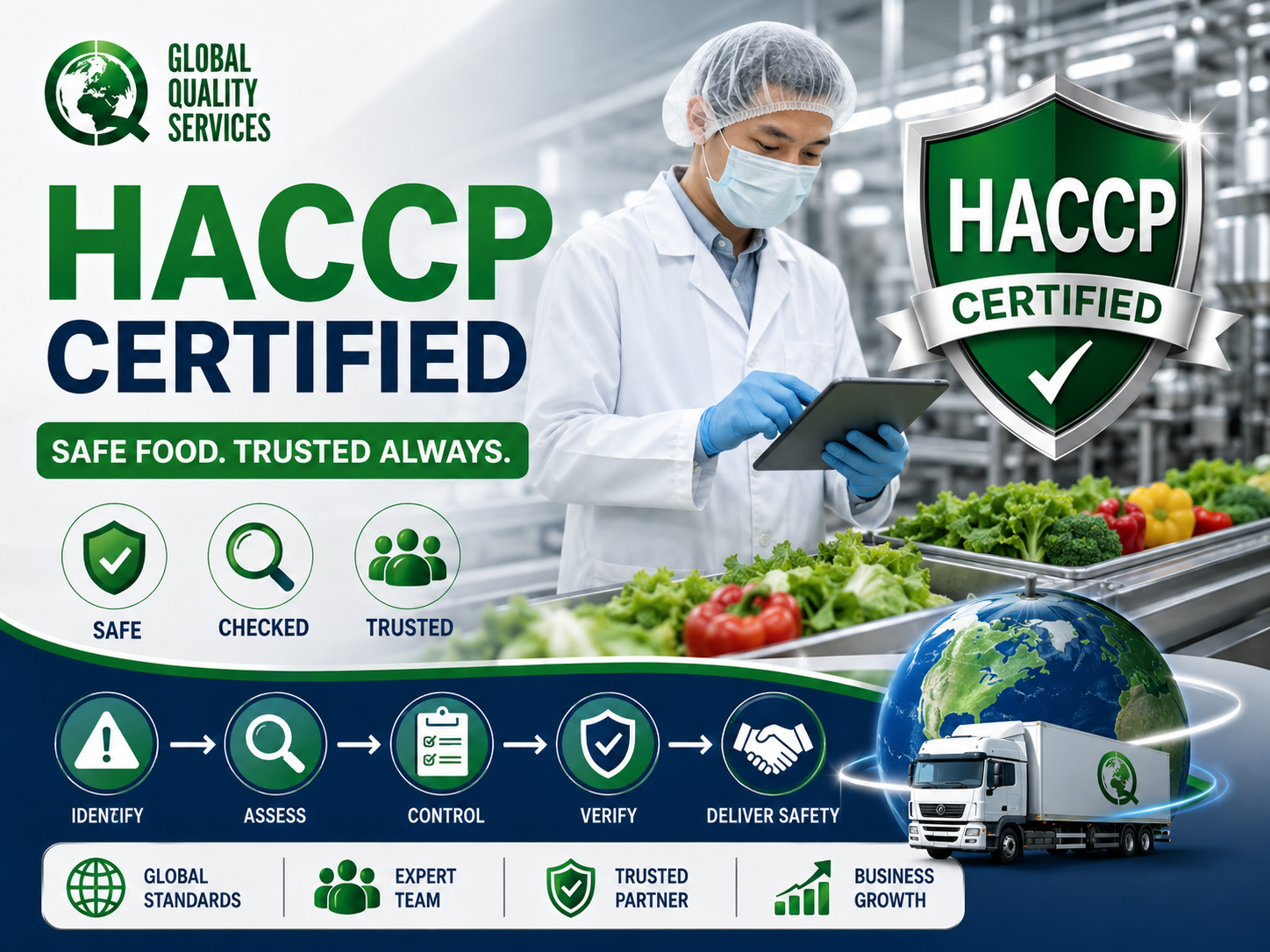
Food safety is non-negotiable in Singapore. Whether you run a food manufacturing facility, a catering operation, or a central kitchen supplying hotels and hospitals, the way you identify and control food safety hazards defines your credibility with clients, regulators, and consumers alike. HACCP — Hazard Analysis and Critical Control Points — is the internationally recognized food safety system that gives food businesses a structured, science-based approach to preventing contamination before it occurs. Global Quality Services (GQS) helps Singapore food businesses implement and certify HACCP efficiently and practically, without unnecessary complexity.
What HACCP Certification Means for Your Business
HACCP is a preventive food safety system that identifies biological, chemical, and physical hazards at every stage of food production and establishes critical control points where those hazards can be effectively managed or eliminated. Unlike reactive quality checks that catch problems after they occur, HACCP builds safety into the process itself — from raw material intake through processing, packaging, storage, and distribution.
In Singapore, the Singapore Food Agency (SFA) oversees food safety regulation and strongly encourages food businesses to adopt structured hazard management systems. HACCP certification is recognized by SFA as a credible demonstration of food safety commitment and supports stronger outcomes under the Safety Assurance for Food Establishments (SAFE) Framework introduced in January 2026.
Who Needs HACCP Certification in Singapore?
HACCP applies to any organization involved in producing, handling, or distributing food:
- Food manufacturers and processors operating under SFA licensing
- Catering companies supplying airlines, hospitals, schools, and corporate clients
- Central kitchens managing large-scale food preparation
- Cold chain and food logistics operators
- Food importers and distributors managing product integrity across the supply chain
- Retail food businesses with in-house production or processing operations
How GQS Supports Your HACCP Certification Journey
GQS takes a straightforward, hands-on approach to HACCP implementation — focusing on building a system that actually works in your daily operations rather than one that exists only on paper:
- Review your existing food handling practices and identify gaps against HACCP principles and SFA requirements
- Conduct a thorough hazard analysis covering biological, chemical, and physical risks across your entire food production process
- Establish and document Critical Control Points, critical limits, monitoring procedures, and corrective action plans
- Develop Prerequisite Programs covering hygiene, sanitation, pest control, and supplier management
- Train your team on HACCP principles, monitoring responsibilities, and record-keeping requirements
- Prepare your facility for third-party certification audits through practical mock assessments and documentation reviews
Why Singapore Food Businesses Choose GQS for HACCP Certification
- Deep familiarity with SFA’s food safety regulatory framework and SAFE Framework grading criteria
- Practical, operations-first implementation approach suited to Singapore’s diverse food industry sectors
- End-to-end support from initial gap assessment through to successful certification
- Clear, jargon-free guidance that your operations team can understand and apply every day
- Post-certification support to sustain compliance through surveillance audits and regulatory changes
Safe food starts with the right system. Contact GQS today and build a HACCP certified food safety framework your clients, regulators, and customers can rely on.
Frequently Asked Questions
1. Is HACCP certification mandatory for food businesses in Singapore?
HACCP is not legally mandatory for all businesses, but SFA strongly encourages it and many institutional buyers, airlines, and hotel groups require certified suppliers.
2. How is HACCP different from ISO 22000 certification?
HACCP focuses specifically on hazard control within food production, while ISO 22000 builds a complete management system around HACCP principles including leadership, supplier management, and continual improvement.
3. How long does HACCP certification take in Singapore?
Most Singapore food businesses complete HACCP certification within two to four months depending on operational complexity and existing food safety practices.
4. Does HACCP certification support better grading under SFA’s SAFE Framework?
Yes, a certified HACCP system demonstrates structured hazard management that directly supports stronger compliance outcomes and grading performance under the SAFE Framework.
5. Can GQS help food businesses maintain HACCP certification after the initial audit?
Yes, GQS provides ongoing post-certification support including surveillance audit preparation, internal review assistance, and system updates as SFA requirements evolve.