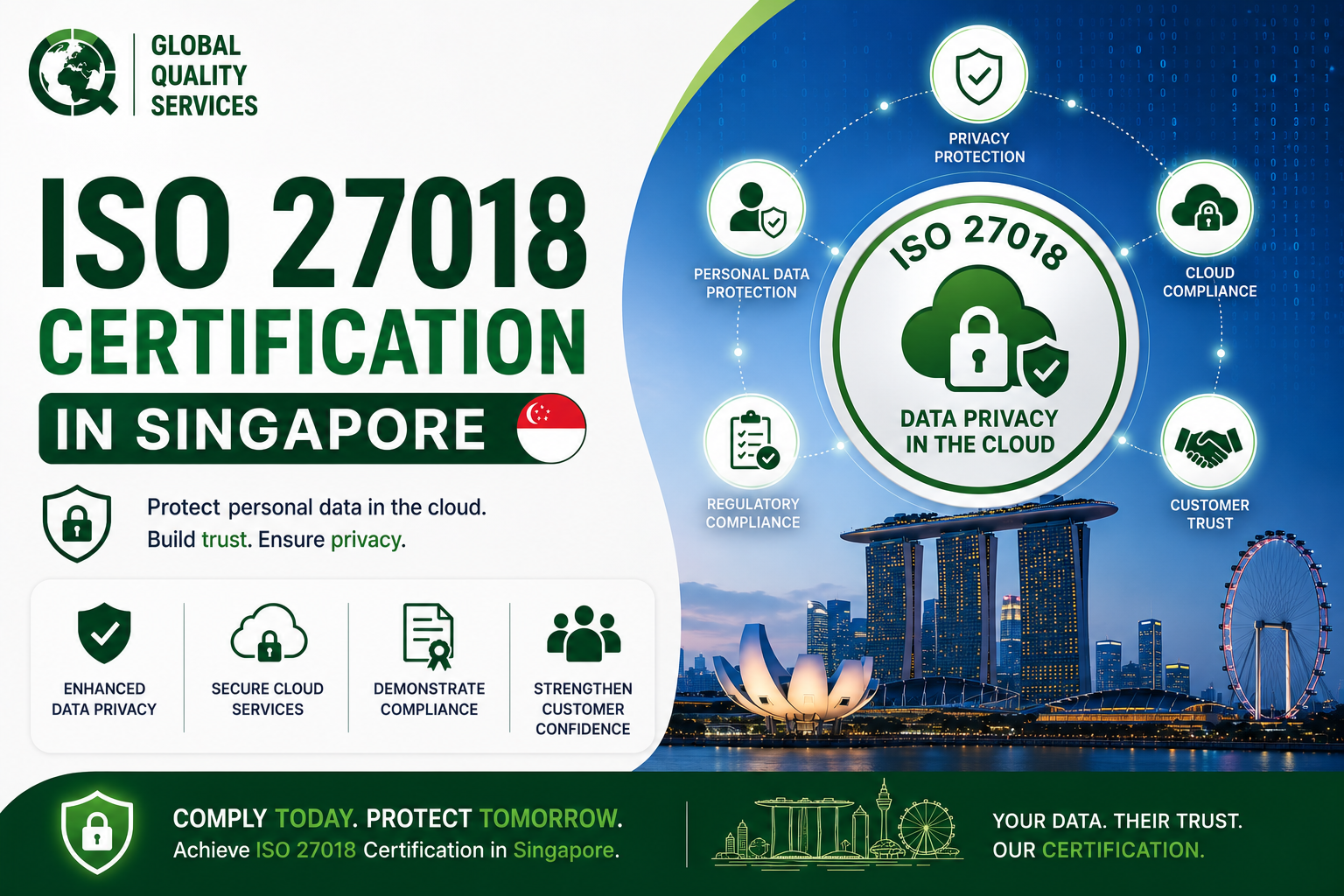
ISO 27018 is the international standard for protecting personally identifiable information (PII) in public cloud environments. For businesses operating in Singapore — where data protection obligations are governed by the Personal Data Protection Act (PDPA) and enforced by the Personal Data Protection Commission (PDPC).
ISO 27018 certification provides a globally recognised framework that demonstrates your organisation’s commitment to responsible cloud data handling.
As Singapore positions itself as a regional data hub, cloud service providers, SaaS companies, and enterprises processing customer data face increasing scrutiny over how PII is collected, stored, and shared.
ISO 27018 addresses this directly, giving businesses a structured, auditable approach to cloud privacy that aligns with both international expectations and Singapore’s regulatory environment.
What ISO 27018 Covers
ISO 27018 builds on the information security controls in ISO 27001 and extends them specifically to PII processed in public cloud infrastructure. It establishes controls across several key areas:
- Consent and purpose limitation — PII must only be processed for the purposes agreed upon with the customer, and explicit consent is required before data is used for secondary purposes such as marketing or analytics
- Transparency obligations — Cloud service providers must disclose where data is stored, who has access, and whether any subprocessors are involved in handling PII
- Data subject rights — The standard supports an individual’s right to access, correct, and delete their personal data — aligning directly with obligations under Singapore’s PDPA
- Security controls for PII — Encryption, access controls, and audit logging are mandated to protect personal data at rest and in transit
- Breach notification — Providers must have documented procedures for detecting and reporting PII breaches promptly, consistent with Singapore’s mandatory data breach notification requirements under the PDPA
- Subprocessor management — Any third-party subprocessors handling PII on behalf of the cloud provider must meet equivalent data protection standards
Why ISO 27018 Certification Matters for Singapore Businesses
Singapore’s Infocomm Media Development Authority (IMDA) and PDPC have both signalled expectations for stronger data governance across cloud-dependent industries. ISO 27018 certification supports compliance in several ways:
Regulatory alignment. The standard’s requirements for consent, data subject rights, and breach notification map closely to Singapore’s PDPA obligations, reducing compliance gaps for organisations already working toward PDPA conformance.
Customer and enterprise trust. For B2B cloud providers, ISO 27018 certification is increasingly a procurement prerequisite. Enterprise buyers — particularly in financial services, healthcare, and government-adjacent sectors — require evidence of privacy controls before onboarding cloud vendors.
Cross-border data transfers. Singapore businesses frequently transfer data to cloud infrastructure in other jurisdictions. ISO 27018 provides a recognised baseline that helps demonstrate adequate protection standards, supporting compliance with PDPA’s transfer limitation obligations.
Competitive differentiation. Certification signals to customers, partners, and regulators that your organisation has gone beyond minimum compliance — embedding privacy controls into cloud operations rather than treating them as a checkbox exercise.
The ISO 27018 Certification Process: What to Expect
Getting certified to ISO 27018 is a structured process that moves through distinct phases. Understanding what each stage involves helps organisations plan resources, timelines, and internal responsibilities before the process begins.
Gap Assessment
The certification journey begins with a thorough gap assessment against ISO 27018’s control requirements. This involves reviewing your current cloud data processing practices, PII handling procedures, subprocessor agreements, consent mechanisms, and existing security controls.
The output is a prioritised remediation roadmap that identifies what needs to be built, revised, or documented before a formal audit can proceed. Organisations with existing ISO 27001 certification typically find this phase faster, as foundational controls are already in place.
Control Implementation and Documentation
Based on the gap assessment findings, your team — supported by your certification partner — implements the required controls and builds the documentation framework that auditors will review.
This includes updating privacy notices, establishing data subject rights procedures, documenting subprocessor oversight mechanisms, formalising breach notification workflows, and implementing technical controls such as encryption standards and access logging.
Documentation quality matters as much as control implementation at this stage — auditors need evidence that controls operate consistently, not just that they exist.
Internal Audit and Management Review
Before engaging an external certification body, an internal audit validates that implemented controls are operating effectively and that documentation is complete.
A formal management review follows, demonstrating that senior leadership has reviewed the cloud privacy programme, understands residual risks, and is committed to ongoing compliance. This step is both an ISO requirement and a meaningful governance checkpoint for your organisation.
Certification Audit
The certification audit is conducted in two stages. Stage 1 is a documentation review where the auditor assesses whether your management system and control documentation meet ISO 27018 requirements.
Stage 2 is an on-site or remote operational audit that evaluates whether controls are functioning as documented in practice. Successful completion of both stages results in certification, which is valid for three years subject to annual surveillance audits.
Surveillance and Recertification
ISO 27018 certification is not a one-time achievement. Annual surveillance audits verify that controls remain effective and that your organisation is keeping pace with changes in cloud infrastructure, processing activities, and regulatory requirements.
A full recertification audit takes place at the end of the three-year cycle. Maintaining certification requires an ongoing commitment to control monitoring, incident management, and periodic review — which is where a long-term compliance partner adds sustained value.
ISO 27018 and Singapore’s Broader Data Protection Landscape
ISO 27018 does not operate in isolation. For Singapore organisations, it sits within a broader regulatory and governance ecosystem that shapes how cloud privacy obligations are defined, enforced, and expected by customers and partners.
Alignment with the Personal Data Protection Act (PDPA)
Singapore’s PDPA, administered by the Personal Data Protection Commission, establishes obligations around the collection, use, disclosure, and protection of personal data. ISO 27018’s requirements around consent, data subject rights, breach notification, and subprocessor transparency directly reinforce PDPA obligations for cloud environments.
Importantly, Singapore’s 2021 PDPA amendments introduced mandatory data breach notification and expanded financial penalties — making documented, auditable privacy controls more operationally critical than before.
Alignment with MAS Technology Risk Management Guidelines
For financial institutions and fintech companies operating under the Monetary Authority of Singapore’s oversight, the MAS Technology Risk Management (TRM) Guidelines set expectations for cloud vendor due diligence, data protection, and third-party risk management.
ISO 27018 certification provides financial institutions with documented evidence of a cloud provider’s PII controls — directly supporting the vendor assessment requirements embedded in MAS TRM compliance programmes.
Singapore’s Model AI Governance Framework and Data Accountability
As AI adoption accelerates across Singapore’s enterprise sector, data governance and PII protection have become inseparable from responsible AI deployment. The Singapore Model AI Governance Framework, published by the PDPC, emphasises data accountability and transparency — principles that ISO 27018 operationalises at the cloud infrastructure level. Organisations building AI systems on cloud-processed PII increasingly look to ISO 27018 as evidence that the underlying data handling meets the accountability standards the framework requires.
Singapore’s Position as a Regional Cloud Hub
Singapore is home to major cloud infrastructure operated by AWS, Google Cloud, Microsoft Azure, and a growing ecosystem of regional providers. The IMDA’s Cloud Certification Mark and related digital trust initiatives signal the government’s intent to position Singapore as a high-trust cloud jurisdiction. ISO 27018 certification aligns with this direction — demonstrating that organisations processing PII in Singapore’s cloud ecosystem meet internationally recognised privacy standards, which matters for enterprise buyers across Southeast Asia evaluating Singapore-based cloud vendors.
Why Choose Global Quality Services
Global Quality Services (GQS) brings deep experience supporting Singapore organizations through internationally recognized certification programs, including ISO 27018. Here is what sets GQS apart:
- Singapore-specific regulatory expertise. GQS consultants understand how ISO 27018 requirements intersect with Singapore’s PDPA, IMDA guidelines, and sector-specific data protection expectations — ensuring your certification journey addresses local obligations, not just international ones.
- End-to-end implementation support. From gap assessment and control design through to internal audit preparation and certification body liaison, GQS manages the full certification process — reducing the burden on your internal teams.
- Cross-standard integration. Many organisations pursuing ISO 27018 are also working toward ISO 27001 or ISO 27701. GQS designs integrated implementation roadmaps that avoid duplicated effort and accelerate time to certification across multiple standards.
- Proven track record. GQS has supported businesses across cloud services, fintech, healthcare, and enterprise SaaS in achieving and maintaining ISO certifications — with a structured methodology that is built around real operational environments, not generic templates.
- Ongoing compliance support. Certification is a starting point, not a finish line. GQS provides surveillance audit support, control monitoring frameworks, and annual review programmes to keep your certification current and your controls effective.
Frequently Asked Questions
- Is ISO 27018 mandatory for businesses operating in Singapore?
ISO 27018 is not legally mandated, but it is strongly aligned with Singapore’s PDPA obligations for cloud service providers handling PII. For organisations in regulated sectors such as financial services or healthcare, certification is increasingly expected by enterprise customers and regulators as evidence of responsible data handling.
- What is the difference between ISO 27001 and ISO 27018?
ISO 27001 is a broad information security management standard covering organisational risk and controls. ISO 27018 is a code of practice that extends ISO 27001 specifically to the protection of PII in public cloud environments. Organisations typically implement ISO 27001 as a foundation before pursuing ISO 27018.
- How long does it take to achieve ISO 27018 certification in Singapore?
The timeline depends on your organisation’s existing information security maturity and cloud infrastructure complexity. Most organisations complete the gap assessment, control implementation, and certification audit within four to nine months. Organisations with existing ISO 27001 certification typically move faster.
- Does ISO 27018 certification cover all types of cloud services?
ISO 27018 is designed specifically for public cloud service providers acting as processors of PII on behalf of their customers. Private cloud environments and on-premise infrastructure fall outside its scope, though many of its principles are relevant across deployment models.
- How does ISO 27018 support PDPA compliance in Singapore?
ISO 27018 addresses several PDPA obligations directly — including consent management, data subject rights, breach notification procedures, and third-party processor oversight. Achieving ISO 27018 certification does not guarantee PDPA compliance, but it provides a documented, audited framework that significantly strengthens your organisation’s compliance posture. The PDPC’s Advisory Guidelines on the PDPA provide further context on how these obligations apply to cloud environments.