
FSSC 22000 is the world’s most widely adopted food safety management system certification scheme. It is recognized by the Global Food Safety Initiative, currently held by more than 35,000 organizations worldwide, and built on three existing frameworks: ISO 22000:2018 for food safety management, ISO 22002-1 for food manufacturing prerequisite programs, and the FSSC 22000 Additional Requirements that cover food defense, food fraud, allergen management, environmental monitoring, and food loss and waste.
For food manufacturers, processors, and ingredient companies in Singapore, FSSC 22000 certification is increasingly the entry requirement for supplying into export markets in Japan, the European Union, the United States, and Australia, and from January 2026, it is also the fastest route to achieving Grade A under Singapore’s own Safety Assurance for Food Establishment (SAFE) framework introduced by the Singapore Food Agency.
Global Quality Services provides FSSC 22000 certification consultancy for food manufacturers and processors in Singapore.
We build and implement your food safety management system, prepare your team for the certification audit, and support you through to a GFSI-benchmarked certificate that satisfies both Singapore regulatory requirements and the expectations of buyers in every major export market.
Why Singapore Food Companies Need FSSC 22000 Certification
Singapore’s food regulatory environment changed significantly in 2025 and 2026. Two developments make FSSC 22000 certification more relevant now than at any point in the past.
- The SAFE framework, effective January 2026. The Singapore Food Agency (SFA) replaced its existing A-B-C-D grading system with the Safety Assurance for Food Establishment framework from 19 January 2026. A fast-track option is available for Category 1 food establishments to attain Grade A in shorter time if they have at least one year of good food safety track records, appointed an Advanced Food Hygiene Officer, and implemented a certified Food Safety Management System. FSSC 22000 is a GFSI-benchmarked certified food safety management system. Implementing and certifying it under Global Quality Services provides your food establishment with the required FSMS certification to qualify for the fast-track Grade A pathway.
- The Food Safety and Security Act 2025. Singapore’s Parliament passed the Food Safety and Security Act (FSSA) in January 2025, with provisions to come into force in tranches starting in November 2025. The FSSA introduces stronger traceability and record-keeping obligations, a two-tier export and import licensing system, and expanded pre-market approval requirements for defined foods. FSSC 22000’s traceability, documentation, and hazard control requirements align directly with the food safety management expectations the FSSA is embedding into Singapore law.
- Export market access requirements. Singapore is a food manufacturing and repackaging hub for the Asia-Pacific, and its food manufacturers supply into markets where GFSI-benchmarked certification is a supplier qualification baseline. Japanese retailers, European supermarkets, and American food companies all use FSSC 22000 as a standard supplier prerequisite.
What FSSC 22000 Version 6 Covers
FSSC 22000 is a complete food safety management system certification scheme based upon three existing certifications: ISO 22000, ISO 22002-1, and the FSSC 22000 Additional Requirements. Version 6 is the current mandatory version as of 1 April 2024, and it covers the following elements.
- ISO 22000:2018. The core food safety management system standard, covering food safety policy, hazard analysis and critical control points (HACCP), prerequisite programs, food safety objectives, and management review.
- ISO 22002-1. Sector-specific prerequisite programs for food manufacturing, covering building and facility design, cleaning and disinfection, pest control, personnel hygiene, purchased material management, and waste and sewage disposal.
- FSSC 22000 Additional Requirements. The scheme-specific requirements covering food defense, food fraud mitigation, allergen management, environmental monitoring, quality control, food loss and waste management, and the purchase and installation of new equipment.
What Is New in FSSC 22000 Version 6
Version 6 includes more detailed clauses on integration of the requirements on food safety and quality culture, validation and verification of packaging claims, criteria for using recycled materials, more detailed allergen management, environmental monitoring, quality control, purchase and installation of new equipment, and handling of food loss and waste.
The additions most relevant for Singapore food manufacturers are:
- Food safety and quality culture. Version 6 requires organizations to establish, monitor, and document a food safety and quality culture, with measurable objectives set at the leadership level. This is not a soft requirement but an auditable one.
- Allergen management, significantly expanded. New protocols to prevent allergen cross-contamination include needing a list of all allergens handled on site, documented validation and verification of control measures, training in allergen awareness, and the implementation of an allergen management plan reviewed annually or following any significant changes.
- Food loss and waste. The FSSC 22000 Additional Requirement on Food Loss and Waste contributes to the UN Sustainable Development Goal 12.3 of halving global food loss and waste per capita by 2030. Singapore food manufacturers with ESG reporting obligations will find this clause directly relevant to their sustainability disclosures.
- Recycled materials handling. New criteria for using recycled materials in food production, relevant for Singapore manufacturers aligning with sustainability commitments.
- Food fraud mitigation, strengthened. Updated guidance on identifying and controlling food fraud vulnerabilities, including economically motivated adulteration and deliberate substitution.
Food Chain Categories Under FSSC 22000 Version 6
Version 6 introduces changes to food chain categories according to ISO 22003-1:2022. The updated scheme adds two new categories: BIII, the pre-process handling of plant products, and C0, which focuses on animal primary conversion.
The categories most common among Singapore food manufacturers include:
- Category B. Processing of perishable animal products, including meat, poultry, eggs, dairy, and seafood.
- Category C. Processing of perishable plant products, including fresh-cut fruit and vegetables.
- Category D. Processing of ambient stable products, including canned foods, dry goods, and shelf-stable beverages.
- Category E. Production of animal feed.
- Category F. Food packaging and packaging material manufacturing.
- Category G. Wholesale, brokerage, and distribution.
Confirming the correct category for your Singapore operation is the first step in scoping your FSSC 22000 certification, since the applicable prerequisite program standard and audit time are both determined by category.
Our FSSC 22000 Certification Process for Singapore Companies
Step 1: Scope and category confirmation. We confirm your food chain category, the products and processes in scope, and which ISO 22002 prerequisite program standard applies to your Singapore operation.
Step 2: Gap assessment. Your current food safety practices, documentation, and controls are reviewed against ISO 22000:2018, ISO 22002-1, and the FSSC 22000 Version 6 Additional Requirements. A written gap report prioritizes findings by audit risk.
Step 3: Food safety management system build. We develop or update your food safety policy, HACCP plan, prerequisite programs, hazard analysis, allergen management plan, food fraud vulnerability assessment, food defense plan, and food safety and quality culture documentation.
Step 4: Implementation and training. Updated systems and requirements are embedded into your production operations. Your food safety team is trained on the Version 6 requirements, including the new allergen management protocols and food loss and waste obligations.
Step 5: Internal audit and management review. An internal audit is conducted against the full FSSC 22000 Version 6 requirements, and a management review is completed, before the external certification audit begins.
Step 6: Certification audit support. We coordinate your Stage 1 and Stage 2 certification audits with your chosen accredited certification body and provide technical support through to certificate issuance.
Benefits of FSSC 22000 Certification for Singapore Food Companies
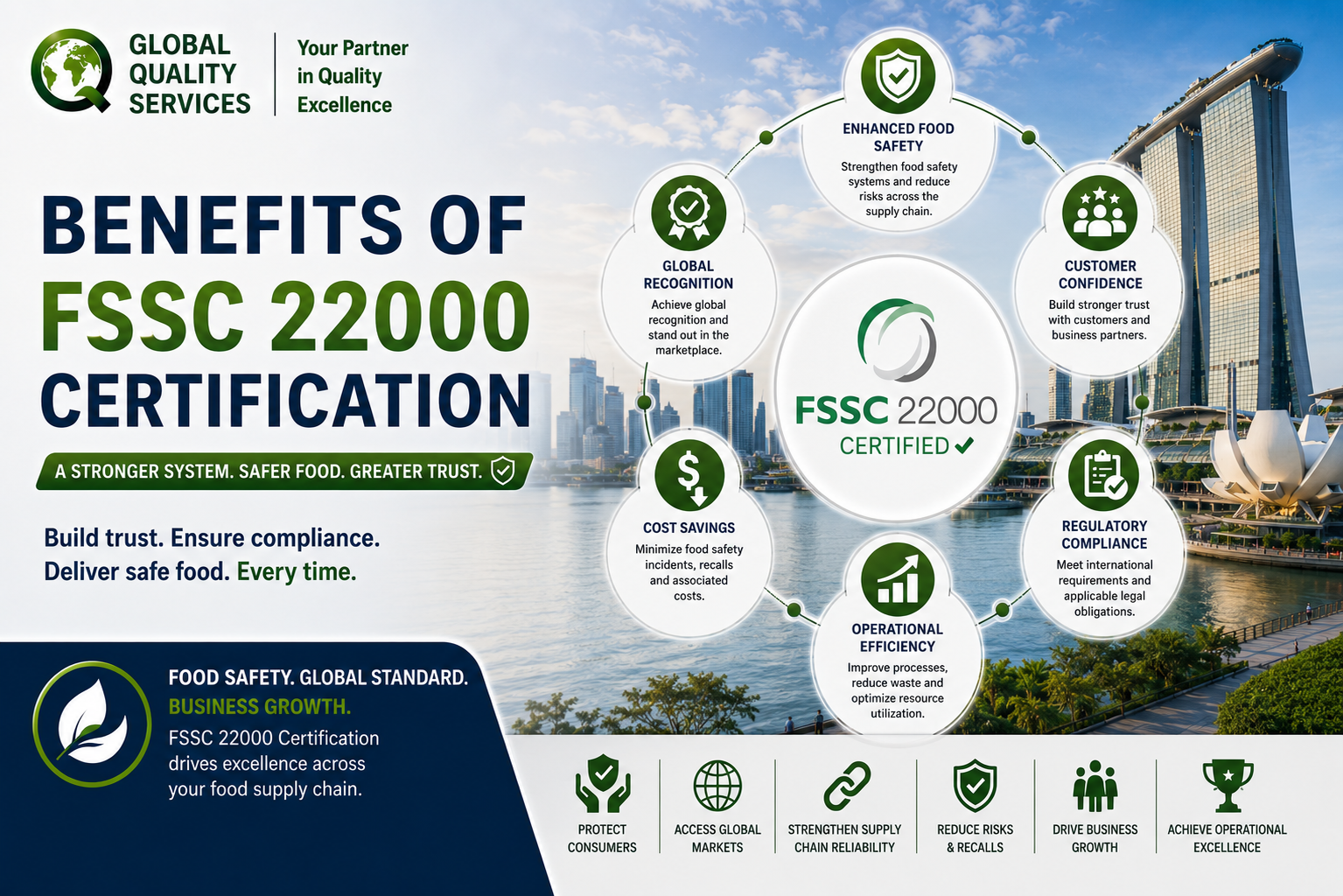
Let us know more about the benefits offered by FSSC 22000 Certification Consultants in Singapore:
Fast-Track to SFA SAFE Grade A
Under SFA’s SAFE framework, food establishments with a certified food safety management system qualify for the accelerated Grade A pathway. FSSC 22000 gives your business the certified FSMS that activates that option, which matters for any Singapore food manufacturer where consumer-facing grade visibility affects business performance.
Access to Export Markets That Require GFSI Certification
Japan, the European Union, the United States, and Australia all have major retail and food service buyers that list GFSI certification as a supplier qualification requirement. FSSC 22000 is GFSI benchmarked, which means one certificate satisfies multiple market access requirements simultaneously.
Stronger Traceability and Record-Keeping Under the FSSA
The Food Safety and Security Act 2025 introduces stronger traceability and documentation obligations for Singapore food businesses. FSSC 22000’s documentation and record-keeping requirements build the exact internal systems that satisfy FSSA compliance expectations rather than treating them as a separate exercise.
Demonstrable Food Fraud and Allergen Risk Control
FSSC 22000 Version 6’s strengthened food fraud mitigation and allergen management requirements give Singapore food manufacturers auditable evidence of risk control that protects both consumer safety and brand reputation in markets with strict product liability and recall frameworks.
ESG Alignment Through Food Loss and Waste Management
The Version 6 food loss and waste requirement connects FSSC 22000 directly to Singapore’s sustainability reporting expectations and the SDG 12.3 commitment. For Singapore food manufacturers with parent companies or investors requiring ESG disclosures, this clause provides verified food loss and waste data in a standardized format.
Integration With ISO 9001 and ISO 14001
FSSC 22000 is built on the ISO management system structure, making integration with ISO 9001:2026 quality management and ISO 14001:2026 environmental management more straightforward. Combined audits reduce total audit days and eliminate duplicated documentation across management systems.
Migrating From FSSC 22000 Version 6 to Version 7
FSSC 22000 Version 7 was released in May 2026. If your facility holds a current Version 6 certificate, you have an 18-month transition window to migrate at your next scheduled surveillance or recertification audit.
The transition is not a full rebuild. Most of your existing documentation remains valid. What changes falls into five specific areas.
- Allergen management, now mandatory and documented. Version 7 requires a formal allergen management plan covering every allergen handled on site, validated control measures, annual review, and documented allergen awareness training. A general allergen policy referenced in your HACCP plan is no longer sufficient.
- Food loss and waste, now a measurable commitment. A food loss and waste reduction policy with defined, measurable targets is a new Version 7 requirement aligned with the UN SDG 12.3 commitment to halve food loss and waste by 2030. Your existing sustainability commitments may partially cover this, but they need to be formalized within the FSMS with measurable objectives.
- Food fraud and food defense, updated scope. Both plans require updating to reflect the Version 7 guidance, including a reassessment of your fraud vulnerability analysis and a review of access controls and threat scenarios under the updated food defense requirements.
- Food safety and quality culture, now audited. Version 7 requires measurable objectives for food safety and quality culture set at the top management level. This was implicit in Version 6. It is explicit and auditable in Version 7.
- ISO 22002-100:2025 alignment. Version 7 references the new ISO 22002-100:2025 umbrella standard. Your prerequisite programs need to be reviewed for alignment, particularly if your scope category has been renumbered or renamed under the updated category structure.
Global Quality Services scopes every Version 6 to Version 7 transition against your specific facility, products, and audit schedule so the migration is completed within your existing audit cycle rather than requiring a separate standalone visit.
In addition to FSSC 22000 Certification, we also provide consultancy/guidance for PCQI (Preventive Controls Qualified Individual) in Training and Certification to help food manufacturers comply with the U.S. FDA FSMA requirements.
Contact Global Quality Services to begin your FSSC 22000 Version 7 transition.
Why Choose Global Quality Services
Global Quality Services has supported food safety and management system certification projects across Singapore and the Asia-Pacific region for over two decades. Our FSSC 22000 consultants work directly with your food safety team and production management, and every food safety management system we build reflects the specific products, processes, and regulatory environment of your Singapore operation rather than a generic template adapted from another market.
We understand how FSSC 22000 Version 6 aligns with Singapore’s Food Safety and Security Act 2025 and the SFA SAFE framework, and we scope our engagements to satisfy both the international certification requirement and local regulatory expectations simultaneously, rather than treating them as separate projects.
Contact Global Quality Services to begin your FSSC 22000 certification in Singapore.
Frequently Asked Questions
What is FSSC 22000 and how is it different from ISO 22000?
FSSC 22000 is a certification scheme built on ISO 22000:2018, adding sector-specific prerequisite programs under ISO 22002-1 and the FSSC 22000 Additional Requirements covering food defense, food fraud, allergen management, and food loss and waste. ISO 22000 is the underlying standard. FSSC 22000 is the complete, GFSI-benchmarked scheme that most major buyers and retailers require.
Does FSSC 22000 certification satisfy SFA’s SAFE framework requirement for a certified FSMS?
Yes. FSSC 22000 is a GFSI-benchmarked certified food safety management system. Under SFA’s SAFE framework, food establishments that implement a certified FSMS qualify for the fast-track pathway to Grade A, and FSSC 22000 meets that requirement.
What version of FSSC 22000 is currently mandatory?
Version 6 has been mandatory for all new certifications since 1 April 2024. All FSSC 22000 certification audits conducted from that date onwards are assessed against Version 6 requirements.
How long does FSSC 22000 certification take for a Singapore food manufacturer?
Most Singapore food manufacturers complete certification in three to six months, depending on the complexity of operations, the number of product categories in scope, and whether a food safety management system already exists. Companies with existing ISO 22000 or HACCP documentation typically move faster.
Can we combine FSSC 22000 with ISO 9001 or ISO 14001 in a single audit?
Yes. FSSC 22000 follows the ISO Harmonized Structure, which allows integration with ISO 9001:2026 and ISO 14001:2026 management systems. Combined audits reduce total audit days and eliminate duplicated documentation work across all three systems.