
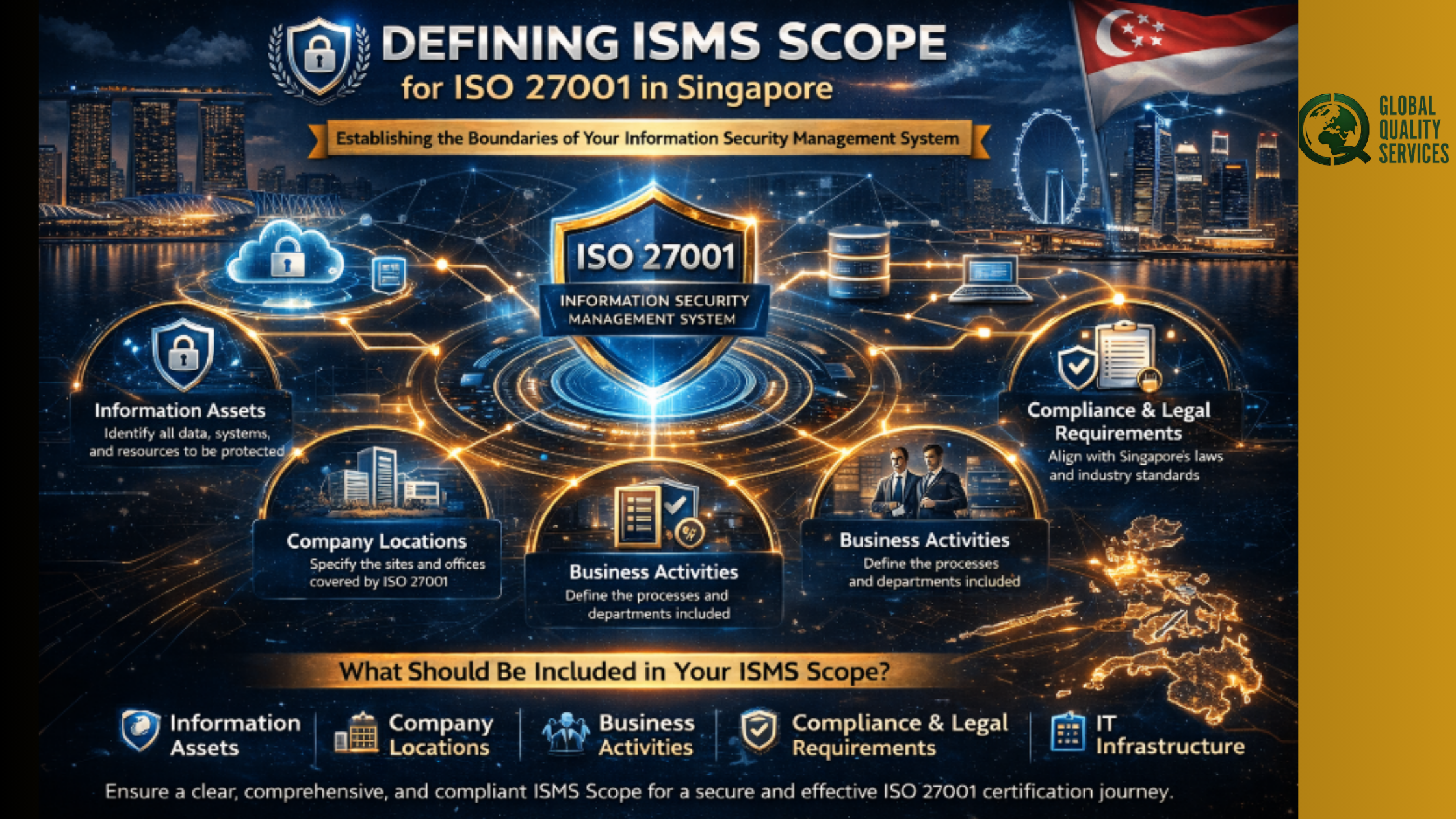
Starting your ISO 27001 journey can feel a bit like staring at a massive mountain. You know you need to climb it to keep your data safe, but where do you actually put your foot first?
The answer is the ISMS Scope.
In simple terms, defining your scope is like drawing a circle around the parts of your business that you want to protect. If you don’t draw this circle correctly, you might leave the “jewelry box” outside, or you might try to protect the entire “neighborhood,” which is exhausted and unnecessary.
In this guide, we’ll break down how to define your Information Security Management System (ISMS) scope in plain English, so you can get your certification right the first time.
What Exactly is an ISMS Scope?
Think of your company as a large house. You have a kitchen, a home office, a garage, and a backyard.
-
Do you need high-end security cameras in the garden shed where you keep old flower pots? Probably not.
-
Do you need a smart lock and an alarm on the home office where you keep your laptop and bank statements? Absolutely.
The Scope is the official document that says: “These are the specific rooms, people, and computers that we are guarding with ISO 27001 rules.” According to the ISO 27001 standard (specifically Clause 4.3), you must determine the boundaries and applicability of the ISMS. You can’t just say “we do security.” You have to be specific.
Why is the Scope So Important?
-
It Saves Money: If you try to include every single department (even the ones that don’t handle sensitive data), your audit will take longer and cost much more.
-
It Provides Focus: Your IT team has limited time. Defining a scope tells them exactly which servers and apps need the most “love.”
-
Auditor Clarity: When the external auditor shows up, the first thing they ask for is the Scope. If it’s blurry, they can’t start the audit.
The Checklist: Is Your Scope Ready?
Before you finalize it, ask yourself these 5 questions:

Step 1: Understand the “Context” (The Big Picture)
Before you draw that circle, you need to know what’s happening inside and outside your company. ISO calls this “Internal and External Issues.”
-
External Issues: Think about government laws (like GDPR or India’s DPDP Act), the neighborhood you operate in, and your competitors.
-
Internal Issues: Think about your company culture, the type of tech you use, and your business goals.
Example: If you are a software company in Bangalore making a health app for the US market, your “Context” includes US healthcare laws (HIPAA) and your internal goal of being the most trusted app on the Play Store.
Step 2: Identify the “Interested Parties”
Who cares if your data gets hacked?
-
Customers: They want their privacy.
-
Employees: They want their salary details kept secret.
-
Investors: They want the company’s reputation to stay clean.
-
Regulators: They want you to follow the law.
Write down what these people expect from you. If your biggest client says, “You must be ISO 27001 certified for the cloud service you provide us,” then that cloud service must be in your scope.
Step 3: Setting the Boundaries (The 3 Pillars)
This is the “meat” of the process. To define the boundary, look at these three areas:
A. Physical Boundaries
Where is the work happening?
-
Is it one floor in a shared office?
-
Is it a data center in a different city?
-
Is it “Work From Home”? Even if your team is remote, the “physical” scope includes the security of their home office setups or the cloud servers they access.
B. Organizational Boundaries
Which departments are included? You might decide that only the Engineering and Customer Support teams are in the scope because they handle the data, while the Cafeteria Staff or Janitorial Services are not.
C. Technological Boundaries
Which “assets” are we talking about?
-
Your main software product (e.g., “The XYZ Banking Portal”).
-
The laptops used by developers.
-
The cloud platform (AWS, Azure, or Google Cloud).
-
The database where user emails are stored.
Step 4: Writing the Scope Statement
Once you’ve done the thinking, you have to write it down. A good scope statement is usually 2–4 sentences long. It should be clear and leave no room for guessing.
Bad Scope Statement: “We protect our IT department and some customer data.” (Too vague!)
Good Scope Statement: “The ISMS covers the management of information security for the development, maintenance, and support of the ‘SmartPay’ application. This includes the infrastructure hosted on AWS Singapore and the activities of the Engineering and DevOps teams based at the Mumbai headquarters.”
Common Mistakes to Avoid
1. Making the Scope Too Big
A common “hero” mistake is trying to include the entire company at once. If you have 5,000 employees and 10 offices, start with the most critical part of the business first. You can always expand the scope next year.
2. Making the Scope Too Small
If you only include one laptop in a company of 50 people, the auditor will call it “cherry-picking.” The scope must make sense for the business. If you sell a software service, you can’t exclude the developers who write the code!
3. Forgetting Outsource Partners
Do you use a third-party payroll company? A cloud provider? A security firm? Even if you don’t “own” their office, you are responsible for the data you send them. They are part of your “extended” scope.
How to Handle “Exclusions”
Sometimes, you might want to exclude a specific part of the ISO 27001 standard. For example, if your company doesn’t write any code (you just buy and use software), you might exclude the “Secure Coding” controls.
In your scope document, you must clearly state what you are excluding and why.
Final Thoughts
Defining the ISMS Scope isn’t just a “checkbox” task; it’s the foundation of your entire security strategy. Think of it as the map for your journey. If the map is wrong, you’ll end up in the wrong place. Keep it simple, keep it honest, and focus on what truly matters to your customers and your business. Once your scope is defined, you have successfully cleared the biggest hurdle in the ISO 27001 process! Want to know more connect with Global Quality Services now.