
Cloud adoption, data-driven services, fintech innovation, and nationwide digitalisation have created massive opportunities — but also growing risks. Cyberattacks have become more frequent, compliance requirements are stricter, and clients are more cautious about who they trust with their data.
ISO 27001 has therefore become a benchmark for Singapore organisations. It offers a structured, globally recognised approach to building an Information Security Management System (ISMS) that protects information, strengthens resilience, and supports sustainable growth.
This guide breaks down the ISO 27001 certification journey in simple, practical terms, helping Singapore businesses understand what the standard requires, why it matters, and how to achieve it smoothly.
What is ISO 27001? Overview of ISO 27001 Standard
ISO 27001 is an international standard developed by the International Organization for Standardization (ISO) and the International Electrotechnical Commission (IEC). It defines how an organisation should create, implement, maintain, and improve an Information Security Management System.
Rather than focusing only on IT controls, ISO 27001 covers:
-
People
-
Processes
-
Technology
-
Risk management
-
Governance
-
Continuous improvement
The framework outlines 114 Annex A controls, grouped under areas like access management, cryptography, physical security, supplier relationships, incident management, and operational security.
This structured approach helps organisations build a security system that aligns with business goals instead of relying on scattered or reactive measures.
Why ISO 27001 Matters in Singapore
Singapore has one of the strongest regulatory environments for data protection and cybersecurity. Organisations must navigate guidelines like:
-
Personal Data Protection Act (PDPA)
-
Cybersecurity Act
-
Monetary Authority of Singapore (MAS) TRM Guidelines
-
Infocomm Media Development Authority (IMDA) codes
-
Sector-specific requirements for finance, healthcare, logistics, telecom, and government vendors
These regulations expect companies to maintain strict controls over data and digital operations.
ISO 27001 helps organisations meet these expectations by:
-
Demonstrating compliance in a structured way
-
Lowering legal and business risks
-
Providing a clear audit trail
-
Showing clients that their data is safe
-
Establishing credibility in local and international markets
ISO 27001 is no longer viewed as optional — it is increasingly seen as a baseline requirement for doing business.
Key Steps to Achieve ISO 27001 Certification
ISO 27001 certification is not a quick checklist exercise. It’s a structured transformation of how an organisation manages data, technology, and people. Here’s a clearer, more practical view of what the journey looks like for Singapore businesses.
1. Understanding Your Information Landscape
Before jumping into documentation or controls, businesses need a complete map of their information ecosystem. This includes:
-
What data is collected
-
Where it is stored
-
Who uses it
-
How it flows across teams, apps, and vendors
This discovery stage allows organisations to understand what’s truly at stake. Many companies in Singapore realise during this phase that data is spread across multiple cloud platforms, third-party tools, and personal devices. Without this clarity, a strong ISMS cannot be built.
2. Identifying Security Risks & Business Priorities
ISO 27001 focuses on risk-driven decision-making, not guesswork. Organisations analyse threats relevant to their business model — such as phishing attempts, system downtime, insider threats, vendor issues, ransomware, or regulatory non-compliance.
Each risk is evaluated based on:
-
Its likelihood
-
Its impact on operations
-
The level of control required
This step ensures that security decisions support business continuity instead of creating unnecessary complexity.
3. Designing an ISMS That Fits Your Organisation
Once risks are understood, the organisation begins shaping an Information Security Management System that matches its size, sector, and operational reality.
This stage includes:
-
Setting clear security objectives
-
Establishing roles and responsibilities
-
Writing practical, business-aligned security policies
-
Creating processes for access control, incident handling, backups, encryption, and supplier management
-
Selecting the ISO 27001 Annex A controls that address identified risks
Here, the goal is not to copy generic templates but to design a system that employees can realistically follow.
4. Embedding Security into Daily Operations
An ISMS works only if people use it. Implementation focuses on:
-
Training teams to adopt secure behaviour
-
Integrating processes with daily workflows
-
Updating tools, credentials, and access rights
-
Configuring technical controls (e.g., firewalls, logging, encryption)
-
Making sure vendors follow secure practices
-
Keeping records that demonstrate compliance
This is where organisations start seeing real change — cybersecurity becomes part of work culture, not a side project.
5. Reviewing & Testing the ISMS
Before facing external auditors, companies must ensure the ISMS works as intended.
This includes:
-
Internal audits
-
Reviewing logs, reports, and documented evidence
-
Checking if controls are effective
-
Conducting management reviews
-
Fixing any gaps or inconsistencies
This stage is like a rehearsal — it builds confidence and ensures the team is ready for certification.
6. Undergoing the Certification Audit
An accredited certification body conducts the official audit in two phases:
Stage 1:
Review of documentation, ISMS design, scope, and readiness.
Stage 2:
Verification of real-world implementation through interviews, evidence checks, and control evaluations.
If everything meets ISO 27001 requirements, the organisation receives certification, followed by annual surveillance audits to maintain compliance over the three-year cycle.
Rules and Regulations Singapore Businesses Must Consider When Implementing ISO 27001
ISO 27001 aligns closely with Singapore’s regulatory environment, where data security, consumer protection, and digital resilience are taken extremely seriously. While the standard itself is voluntary, many of its requirements support compliance with national laws, industry guidelines, and mandatory security practices. Businesses preparing for ISO 27001 should understand how the certification connects to key Singapore regulations.
1. Personal Data Protection Act (PDPA)
Singapore’s PDPA sets the baseline for how organisations must collect, use, store, and disclose personal data. ISO 27001 supports PDPA compliance by helping companies:
-
Establish clear data protection policies
-
Strengthen access control and data handling processes
-
Implement proper consent and retention mechanisms
-
Build incident reporting and breach management workflows
Since PDPA breach penalties are strict, ISO 27001 helps organisations minimise legal exposure through structured governance.
2. Cybersecurity Act
The Cybersecurity Act governs critical information infrastructure (CII) sectors such as:
-
Banking
-
Energy
-
Water
-
Transport
-
Telecommunications
-
Government systems
Companies operating in or supporting these sectors must meet mandatory security obligations. ISO 27001 complements these requirements by offering a comprehensive framework for:
-
Protecting critical digital systems
-
Ensuring operational continuity
-
Maintaining evidence of compliance
-
Strengthening security incident management
This makes ISO 27001 particularly valuable for contractors, vendors, and IT service providers working with CII operators.
3. MAS Technology Risk Management (TRM) Guidelines
Financial institutions and fintech companies in Singapore follow the Monetary Authority of Singapore’s TRM Guidelines. These guidelines emphasise:
-
Secure system development
-
Strong access control
-
Proper change management
-
Robust cybersecurity monitoring
-
Incident reporting and containment
ISO 27001 aligns closely with MAS TRM expectations, making it a strategic tool for:
-
Banks
-
Payment gateways
-
Fintech startups
-
Insurtech companies
-
Digital asset service providers
Certification strengthens credibility in a regulatory-heavy ecosystem.
4. IMDA Regulations & Telecom Security Requirements
The Infocomm Media Development Authority enforces frameworks for telecom operators, digital service providers, and cloud vendors. ISO 27001 supports organisations in meeting IMDA’s expectations for:
-
Secure handling of consumer information
-
Protection of network infrastructure
-
Vendor and supply-chain risk management
-
Data transmission and storage safeguards
This is particularly relevant to telecom companies, hosting providers, and digital service platforms.
5. Sector-Specific Compliance Expectations
Several industries in Singapore have their own standards and requirements, and ISO 27001 often acts as a foundational layer. Examples include:
-
Healthcare Sector: Alignment with healthcare information security guidelines
-
Logistics & Maritime: Protection of trade, shipping, and cargo data
-
Education: Protection of student information and digital learning platforms
-
E-commerce: Safeguarding customer payment and order data
ISO 27001 not only helps organisations meet these expectations but also reduces the resource burden during audits or regulatory reviews.
6. Vendor & Supply Chain Requirements in Singapore
Many Singapore companies, especially MNCs and government-linked organisations, include ISO 27001 compliance as a requirement or evaluation criterion for vendors.
This is increasingly seen in:
-
Tender documentation
-
Procurement agreements
-
Outsourcing contracts
-
Managed service provider evaluations
For businesses aiming to secure government projects or large enterprise contracts, ISO 27001 provides a major competitive advantage.
Benefits of ISO 27001 Certification for Singapore Companies
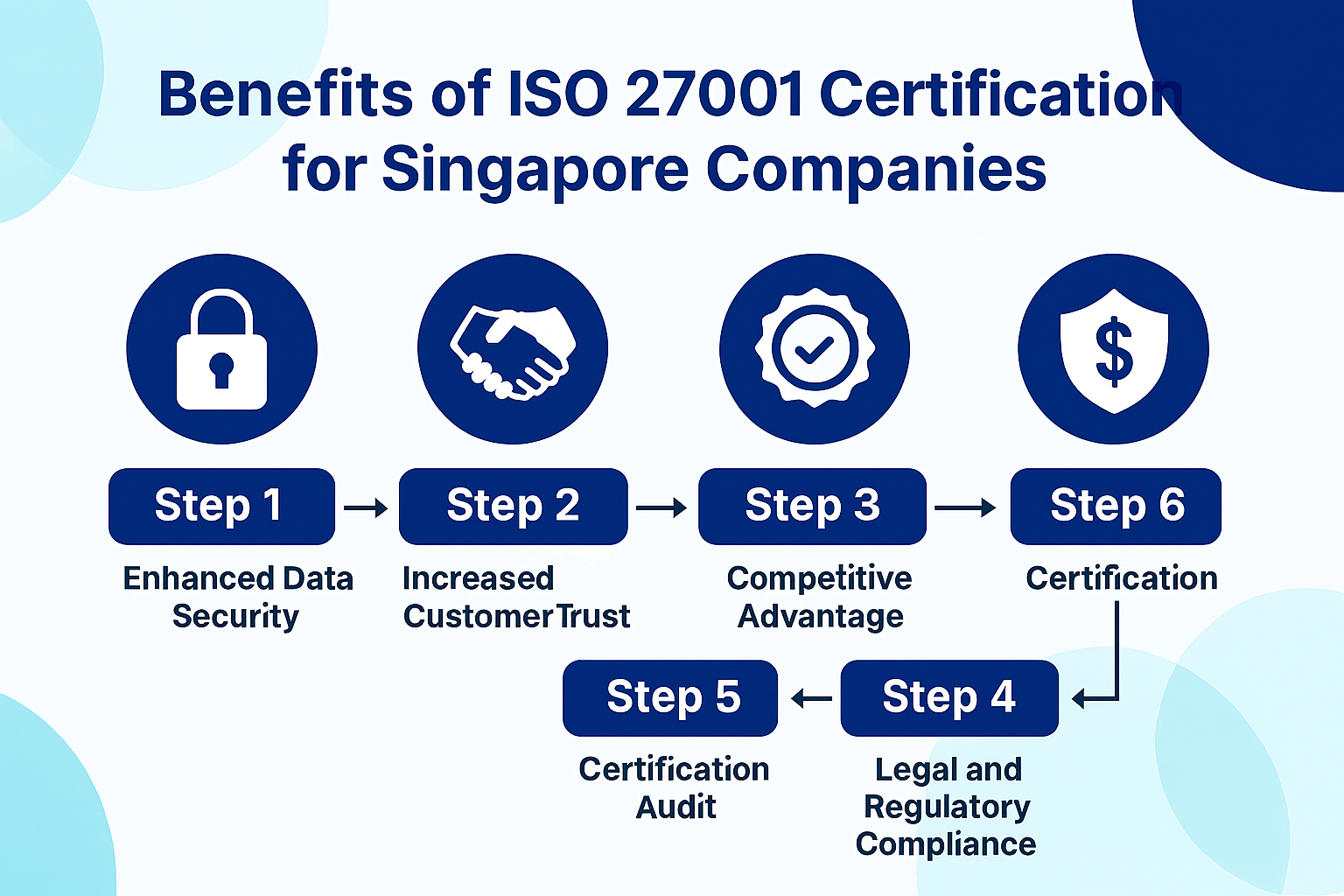
ISO 27001 is more than a security standard — it is a strategic investment that strengthens a company’s reputation, operations, and long-term growth. For businesses in Singapore, where digital adoption and regulatory expectations are high, the benefits are even more significant.
1. Stronger Protection Against Cyber Threats
Cyberattacks in Singapore have become more advanced, especially across finance, healthcare, and technology sectors. ISO 27001 helps organisations:
-
Identify vulnerabilities before attackers do
-
Build multi-layered security controls
-
Create clear incident-handling processes
-
Reduce the chances of data breaches
-
Strengthen resilience against ransomware, phishing, and insider threats
Instead of reacting to damage, companies adopt a preventive and structured security posture.
2. Better Regulatory Compliance
Singapore’s compliance landscape — PDPA, Cybersecurity Act, MAS TRM Guidelines, IMDA codes — requires organisations to demonstrate responsible data handling and strong cybersecurity governance.
ISO 27001 supports these obligations by providing:
-
Documented processes
-
Consistent control measures
-
Audit-ready evidence
-
Clear risk management practices
This lowers legal risks, avoids penalties, and keeps the organisation aligned with national requirements.
3. Increased Customer Trust and Market Credibility
Clients, especially in Singapore’s B2B and government sectors, want assurance that their data is safe. ISO 27001 certification is a recognised symbol of reliability. It signals that the organisation:
-
Values data security
-
Follows global best practices
-
Can be trusted with sensitive information
-
Is committed to long-term risk management
This builds confidence among customers, partners, and investors.
4. Easier Access to Government & Enterprise Projects
Many Singapore tenders and procurement documents explicitly request ISO 27001 certification, especially in:
-
IT services
-
Cloud solutions
-
Managed security
-
Software development
-
Contact centres
-
Financial technology
-
Healthcare technology
Being certified expands business opportunities and improves eligibility for high-value contracts.
5. More Efficient and Well-Structured Internal Processes
ISO 27001 pushes organisations to refine how information is handled. This leads to:
-
Streamlined workflows
-
Reduced operational errors
-
Better accountability and documentation
-
Clearer roles and responsibilities
-
Improved communication between departments
The ISMS encourages long-term discipline that benefits the entire organisation.
6. Reduced Business Risk and Downtime
Security incidents often result in downtime, revenue loss, and reputational damage — all costly in Singapore’s fast-moving economy. ISO 27001 helps minimise these risks through:
-
Strong business continuity measures
-
Data backup and recovery planning
-
Proactive monitoring and response
-
Controls that reduce the impact of disruptions
Companies become more resilient, even in unexpected scenarios.
7. A Scalable Framework for Future Growth
As businesses adopt AI, cloud platforms, automation, and regional expansion, security needs evolve quickly. ISO 27001 provides a flexible framework that grows with the organisation.
It supports:
-
New technologies
-
Cross-border operations
-
Multiple office locations
-
Expanding teams
-
Increasing data volumes
This makes ISO 27001 a long-term strategic asset rather than a one-time certification.
Conclusion
ISO 27001 is no longer a “good-to-have” for Singapore organisations — it has become a core requirement for sustainable, secure, and competitive business operations. It strengthens data protection, aligns companies with national regulations, builds customer confidence, and opens doors to government and enterprise opportunities.
While the certification process requires planning and structured implementation, the outcome is a stronger, more resilient organisation that can adapt to evolving cyber risks and digital challenges. With the right approach and expert guidance from Global Quality Services, Singapore companies can achieve ISO 27001 certification smoothly and turn it into a meaningful asset for long-term success.