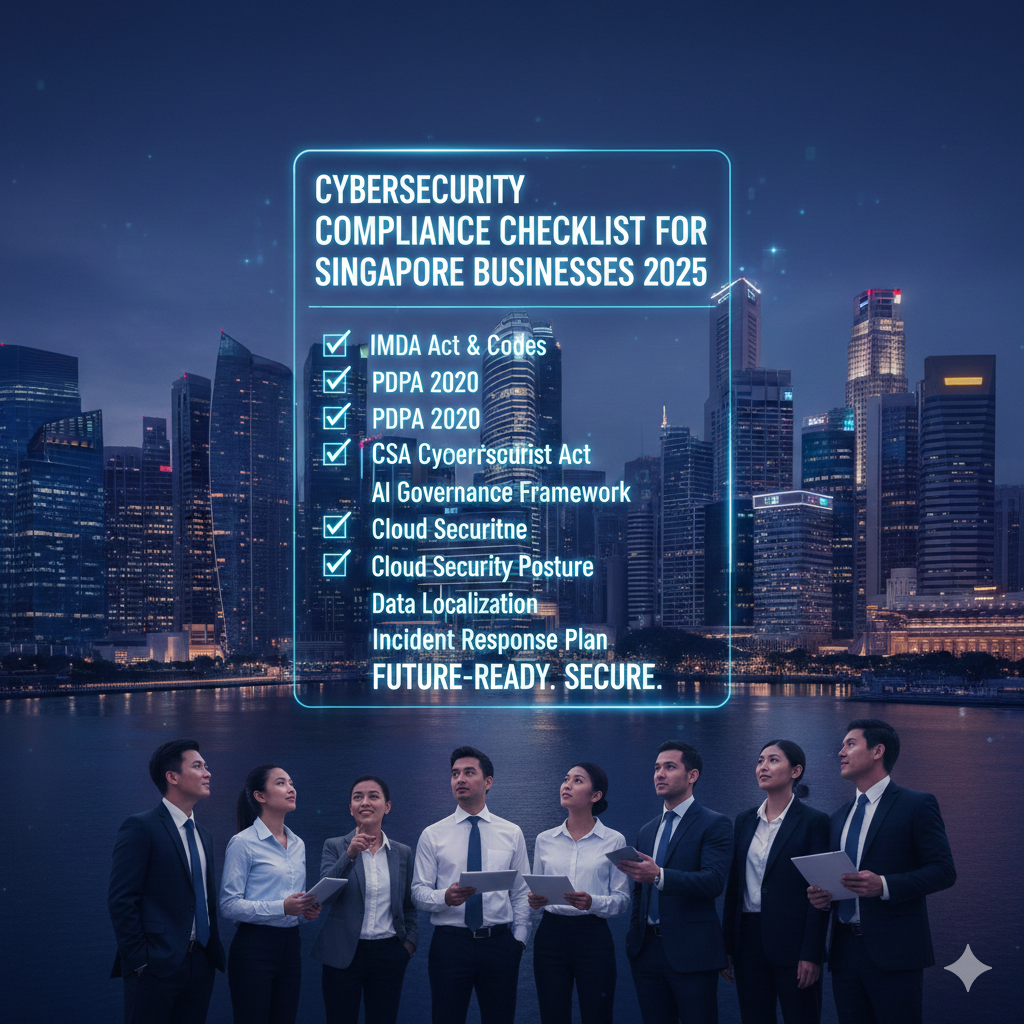
Cyber threats are more frequent and sophisticated in 2025. Singapore organisations must meet rising regulatory expectations (PDPA, MAS TRM for finance firms) and follow national cyber guidance (CSA/SingCERT). A practical compliance program combines continuous risk assessment, strong identity controls, encryption, tested incident response, third-party management, monitoring, and regular audits. This blog gives a step-by-step checklist, tools, and timelines to convert cybersecurity controls into verifiable compliance.
Why Cybersecurity Compliance Matters in Singapore
Before diving into controls and checklists, understand why compliance is now a board-level responsibility.
Singapore’s digital economy and public trust depend on robust cyber hygiene. Failure to meet legal or industry standards can lead to PDPA investigations, financial penalties, operational disruption, and reputational damage. Regulators (PDPC, MAS for regulated financial firms) and central agencies (CSA/SingCERT) publish concrete expectations: reasonable security arrangements, timely breach notification, and incident preparedness.
Current Cyber Threat Landscape in Singapore
Singapore sees ransomware, targeted phishing, business email compromise, supply-chain attacks, cloud misconfigurations, and insider risks. Attackers increasingly automate attacks against exposed cloud services and remote workforce endpoints. Expect adversaries to exploit unpatched systems, weak identity controls, and insufficient logging.
Regulatory Environment & PDPA Requirements
Under the PDPA, organisations must implement “reasonable security arrangements” to protect personal data and notify PDPC and affected individuals for notifiable data breaches. For certain sectors (finance), MAS’s Technology Risk Management (TRM) Guidelines require specific controls and governance. Organisations should treat PDPA obligations and MAS TRM as compliance drivers when designing cybersecurity programs.
Core Components of Cybersecurity Compliance
A compliance program is three parts: people + process, + technology. Below are the components you must operationalise.
Transition: Each component below translates policy into operational controls, measurable evidence, and scheduled activities.
Risk Assessment & Vulnerability Management
What it is: Systematic identification and prioritisation of threats, vulnerabilities, and business impact.
Actionable steps:
-
Business-context risk assessment: Map critical assets (customer data, payment systems, IP), associated threats, and potential impact. Perform annually or whenever business scope changes.
-
Vulnerability scanning & pen tests: Monthly automated scans for external assets; authenticated scans for internal networks at least quarterly. Conduct full penetration tests (external + internal) at least annually and after major changes.
-
Prioritisation & remediation SLAs: Classify findings (Critical/High/Medium/Low) and assign remediation windows (e.g., Critical — 7 days; High — 30 days).
-
Risk register & remediation evidence: Maintain a risk register showing owner, mitigation status, and evidence (patch tickets, configuration changes).
Why it matters: Risk assessments feed board reporting and justify investments. Evidence from scans and remediation tickets demonstrates “reasonable security arrangements” under PDPA.
Access Controls & Identity Management
What it is: Ensure only the right people (and services) can access systems and data.
Actionable steps:
-
Enforce multi-factor authentication (MFA) for all privileged and remote access (cloud consoles, VPN, admin portals).
-
Least privilege & role-based access (RBAC): Implement time-bound privileges and just-in-time (JIT) elevation for admins.
-
Privileged Access Management (PAM): Record sessions, rotate secrets, and force password vaulting for service accounts.
-
Identity lifecycle: Integrate HR on/off-boarding to automatically revoke access when staff leave or change roles. Audit orphaned accounts quarterly.
-
Password & authentication policies: Apply strong password rules, SSO where feasible, and phishing-resistant MFA (hardware tokens or platform authenticators).
Why it matters: Weak identity controls are the top vector for breaches. Documented access policies and logs form key audit evidence.
Incident Response Planning
What it is: A tested playbook to detect, contain, recover, and learn from cyber incidents.
Actionable steps:
-
Create a written Incident Response Plan (IRP) that defines roles (CISO, Incident Lead, Legal, Communications, HR, DPO), escalation paths, and key contacts (internal, vendors, law enforcement, CSA/SingCERT).
-
Notification triggers & timelines: Establish criteria for what constitutes a notifiable breach under PDPA and ensure procedures to notify PDPC “as soon as practicable” (and within statutory timelines if applicable). Practice drafting notification templates.
-
Tabletop exercises & playbook testing: Run tabletop exercises at least twice a year and a live simulated recovery annually (e.g., restore from backups after ransomware). Validate communication scripts and evidence collection.
-
Forensics readiness: Define data-preservation steps and chain-of-custody procedures so forensic artifacts remain admissible.
Why it matters: Regulators expect evidence of preparedness and timely response. CSA provides an incident response checklist that organisations can adapt.
Data Encryption & Protection
What it is: Technical controls to keep data unreadable to unauthorised users.
Actionable steps:
-
Encryption in transit and at rest: Use TLS 1.2+ for transport; encrypt sensitive data stores with strong algorithms (e.g., AES-256) and manage keys with an enterprise KMS/HSM.
-
Data classification policy: Tag data by sensitivity (public, internal, restricted, personal data). Apply controls by classification (access, encryption, retention).
-
Backups & immutable storage: Ensure offline or immutable backups to recover from ransomware. Test restores quarterly.
-
Data minimisation & retention: Keep only what’s needed; implement automated deletion or anonymisation when retention period ends (align with PDPA retention expectations).
Why it matters: Encryption and classification reduce breach impact and support PDPA obligations on data protection.
Cybersecurity Compliance Checklist for Singapore Businesses
Use this Cybersecurity Compliance Checklist for Singapore Businesses to create an implementation plan and link each item to evidence (logs, policies, screenshots, tickets).
Step-by-Step Compliance Tasks (with recommended frequency & owners)
-
Governance & Roles
-
Appoint CISO or security lead and Data Protection Officer (DPO). (Owner: Exec) — One-time / ongoing.
-
Maintain a cybersecurity steering committee with quarterly reviews. — Quarterly.
-
-
Risk Assessment & Asset Inventory
-
Create and update an asset inventory (hardware, cloud instances, SaaS apps). — Quarterly.
-
Conduct business impact and risk assessments. — Annually or on major change.
-
-
Identity & Access Controls
-
Enforce MFA, RBAC, PAM. Audit privileged accounts. — Ongoing; audit quarterly.
-
-
Vulnerability Management
-
Run automated scanning and remediate per SLA. — Monthly scanning; quarterly authenticated scans.
-
Annual penetration test. — Annually + after major changes.
-
-
Endpoint & Network Security
-
Deploy endpoint protection with EDR; manage firewall rules and segmentation. — Ongoing; review monthly.
-
-
Encryption & Data Protection
-
Encrypt sensitive data at rest and in transit; manage keys securely. — Ongoing; review annually.
-
-
Monitoring & Logging
-
Implement SIEM/Log aggregation, retain logs for forensics (90–365 days depending on risk). Review alerts daily. — Ongoing.
-
-
Incident Response & Recovery
-
Document IRP, run tabletop exercises twice yearly, test backups quarterly. — Semi-annual and quarterly.
-
-
Third-Party Risk Management
-
Maintain an approved vendor list, require attestations (SOC2/ISO27001) and run security assessments before onboarding. — Onboarding & annual re-assessment.
-
-
Security Awareness Training
-
Phishing simulations and training for all staff at least twice a year; targeted training for high-risk roles. — Biannual.
-
-
Policies & Compliance Evidence
-
Maintain written policies (acceptable use, remote access, data protection) and store proof of reviews and approvals. — Annual review.
-
-
Audits & Reporting
-
Internal audits every 6–12 months; external assessments as required. Generate board-level compliance reporting quarterly. — Semi-annual/annual.
-
Tools & Technologies to Support Compliance
-
SIEM / SOAR: Splunk, Azure Sentinel — continuous detection, playbook automation.
-
Endpoint Detection & Response (EDR): CrowdStrike, Microsoft Defender for Endpoint — endpoint visibility and response.
-
IAM / PAM: Okta, Azure AD, CyberArk — manage identities and privileged sessions.
-
DLP & CASB: For data loss prevention across SaaS and cloud services.
-
Vulnerability Scanners & Pentest Providers: Nessus, Qualys; accredited pen-test partners.
-
Backup & Immutable Storage: Air-gapped backups, object storage with immutability.
-
Breach Notification & Case Management Tools: Ticketing systems that preserve chain-of-custody logs.
When selecting tools, prioritise integration (SIEM ingest), automation, and evidence export for audits.
Common Cybersecurity Compliance Challenges in Singapore
Transition: Knowing common pitfalls helps you build mitigations into the plan.
-
Legacy systems & technical debt: Old systems may not support modern encryption or MFA. Mitigation: isolate legacy assets, apply compensating controls, plan phased upgrades.
-
Cloud misconfigurations: Misconfigured storage buckets or permissive IAM roles cause exposures. Mitigation: enforce IaC reviews, apply automated cloud posture management.
-
Third-party risk: Vendors with poor controls create supply-chain risk. Mitigation: contractual security requirements, continuous vendor monitoring, and breach notification clauses.
-
Talent shortage: Hiring skilled security staff is hard. Mitigation: outsource SOC capabilities, use managed detection and response (MDR) services, and invest in upskilling.
-
Regulatory flux: Rules and guidance evolve (PDPC, CSA, MAS). Mitigation: assign regulatory monitoring to legal/compliance and adapt policies promptly.
Benefits of Cybersecurity Compliance

- Transition: Compliance is an investment that reduces risk and creates business advantage.
-
Lower breach probability & impact: Controls reduce the chance and blast radius of incidents.
-
Regulatory alignment & reduced fines: Demonstrable evidence of “reasonable security arrangements” limits PDPC penalties and speeds incident handling.
-
Operational resilience: Tested IR plans and backups reduce downtime and financial loss.
-
Trust & commercial advantage: Customers, suppliers, and partners prefer vendors with mature security posture and third-party attestation (SOC2/ISO27001).
-
Insurance leverage: Strong controls may reduce cyber insurance premiums or improve coverage terms.
Practical Templates & Example Timelines (Quick reference)
30-day start plan (for an SME just starting):
-
Days 1–7: Asset inventory, appoint security lead and DPO, enable MFA on all admin accounts.
-
Days 8–15: Baseline vulnerability scan, deploy endpoint protection, enable centralized logging for critical systems.
-
Days 16–30: Draft IRP, run a basic tabletop, start phishing awareness campaign.
90-day maturity plan (next steps):
-
Implement SIEM ingest for 90 days of logs, schedule pen test, vendor assessments for top 5 suppliers, document policies, and run backup restore tests.
Evidence checklist for an audit:
-
Risk register, scan/pen test reports, access logs, MFA enforcement proof, IRP and exercise minutes, breach notification templates, vendor attestation documents, and training completion records.
Conclusion – Staying Ahead in Cybersecurity for Singapore Businesses
Cybersecurity compliance in 2025 requires continuous effort: governance, technical controls, testing, vendor management, and regulatory monitoring. Singapore regulators (PDPC, MAS) and national agencies (CSA/SingCERT) provide clear guidance and expect organisations to demonstrate “reasonable security arrangements” and to handle incidents promptly. Integrate the checklist above into an annual compliance calendar, map each item to evidence, and prioritise remediation by business impact. With consistent investment and a tested response capability, businesses can reduce risk, meet regulatory expectations, and preserve customer trust.