
Asset-intensive organizations in Singapore face increasing pressure to control costs, improve asset performance, and manage long-term risk. ISO 55001 Asset Management Certification provides a structured framework to manage physical, financial, and intangible assets throughout their lifecycle while aligning asset decisions with business objectives.
Global Quality Services offers comprehensive ISO 55001 Asset Management Certification services in Singapore, supporting organizations with gap analysis, system development, implementation, internal audits, and certification readiness. Our approach focuses on practical asset governance, risk-based decision-making, and measurable performance improvement.
What is ISO 55001 Asset Management
ISO 55001 Asset Management is an international standard that helps organizations manage assets efficiently, reduce risks, and optimise costs by implementing a structured system aligned with business goals and lifecycle performance.
The ISO 55001 family helps organizations:
-
Manage assets in a systematic and cost-effective manner
-
Balance performance, risk, and expenditure
-
Improve decision-making across the asset lifecycle
-
Align asset management objectives with corporate strategy
ISO 55001 applies to organizations of all sizes and sectors, particularly those with significant asset portfolios.
Why ISO 55001 Certification is Important in Singapore
Singapore is home to highly regulated and asset-intensive industries such as infrastructure, utilities, transport, manufacturing, real estate, and energy. Organizations are expected to demonstrate transparency, accountability, and long-term asset sustainability.
ISO 55001 Certification supports Singapore-based organizations by:
-
Improving governance and asset accountability
-
Enhancing lifecycle planning and cost control
-
Supporting regulatory and stakeholder expectations
-
Reducing operational and financial risk
-
Enabling data-driven asset decisions
For public sector entities and private enterprises alike, ISO 55001 strengthens asset performance and organizational resilience.
Who Should Get ISO 55001 Certification?
ISO 55001 is suitable for organizations that rely on assets to deliver services or value, including:
-
Infrastructure and utilities providers
-
Transportation and logistics companies
-
Manufacturing and industrial facilities
-
Energy and power generation companies
-
Real estate and facilities management firms
-
Public sector agencies and statutory boards like airports and state transport companies
-
Engineering and maintenance service providers
Any organization seeking structured asset governance and long-term value realization can benefit from ISO 55001.
Scope of ISO 55001 Asset Management Certification
The scope of ISO 55001 certification typically covers:
-
Asset management policy and objectives
-
Asset lifecycle planning and control
-
Risk-based decision-making
-
Asset performance evaluation
-
Maintenance and reliability strategies
-
Financial and non-financial asset considerations
-
Roles, responsibilities, and governance structures
-
Continuous improvement and performance monitoring
Our consultants help define a clear certification scope aligned with your asset portfolio and operational complexity.
ISO 55001 Certification Requirements
To achieve ISO 55001 Certification, organizations must establish and maintain an Asset Management System (AMS) that includes:
1. Asset Management Policy and Objectives
A documented policy aligned with organizational goals and stakeholder expectations.
2. Asset Management Planning
Lifecycle planning that balances cost, risk, performance, and sustainability.
3. Leadership and Governance
Defined roles, responsibilities, and decision-making authority for asset management.
4. Risk and Opportunity Management
Identification and control of asset-related risks that could impact performance or service delivery.
5. Performance Evaluation
Monitoring, measurement, and analysis of asset performance using defined indicators.
6. Continuous Improvement
Processes to review, correct, and improve the asset management system over time.
ISO 55001 Certification Process in Singapore
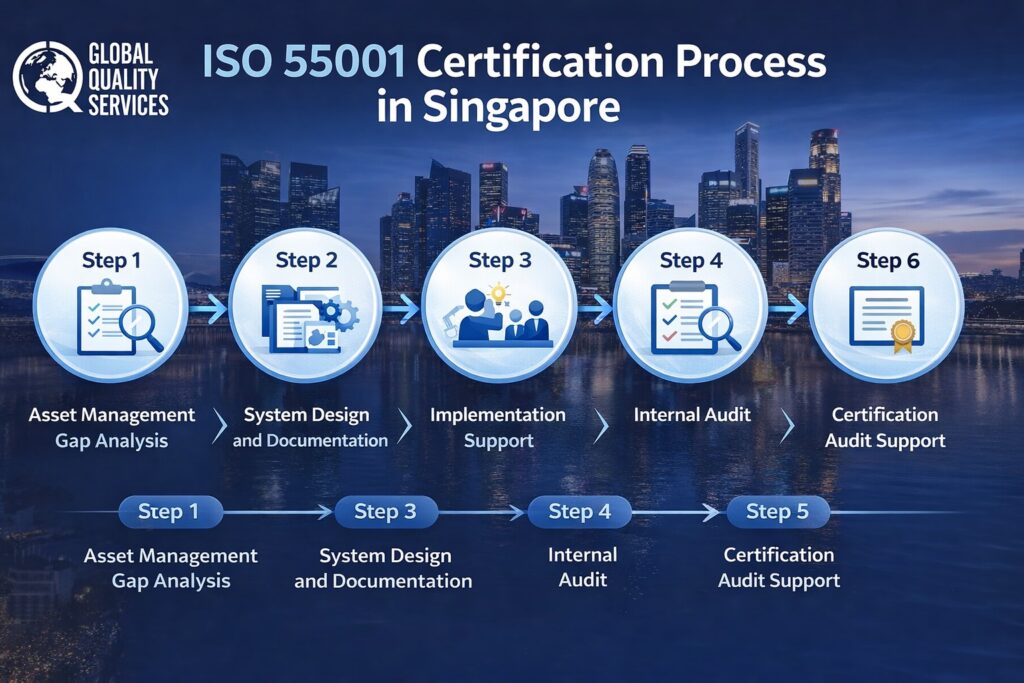
Global Quality Services follows a structured certification support methodology:
Step 1: Asset Management Gap Analysis
We evaluate existing asset practices against ISO 55001 requirements to identify gaps and improvement areas.
Step 2: System Design and Documentation
Development or alignment of asset management policies, procedures, plans, and records.
Step 3: Implementation Support
Guidance on integrating asset management processes into daily operations and decision-making.
Step 4: Internal Audit
A full internal audit to assess system effectiveness and readiness for certification.
Step 5: Certification Audit Support
Support during Stage 1 and Stage 2 audits conducted by an accredited certification body.
Step 6: Certification Issuance
Successful organizations receive ISO 55001 (ISO 55001) certification upon audit closure.
Documents Required for ISO 55001 Certification
Common documentation includes:
-
Asset Management Policy & Objectives
-
AMS Scope
-
Asset Register
-
Risk & Compliance Records
-
Asset Management Plan
-
Operational & Maintenance Procedures
-
Performance/KPI Reports
-
Internal Audit & Management Review Records
-
Corrective Action Records
-
Document Control Procedures
Our focus is on usable documentation that supports real asset decisions.
Benefits of ISO 55001 Asset Management Certification
ISO 55001 Certification delivers long-term operational, financial, and governance benefits.
- Improved Asset Performance and Reliability: Organizations gain better control over asset condition, availability, and performance, reducing downtime and failures.
- Better Lifecycle Cost Control: ISO 55001 enables informed decisions across acquisition, operation, maintenance, and disposal stages, lowering the total cost of ownership.
- Stronger Risk Management: Structured risk assessment improves resilience against asset failures, safety incidents, and service disruptions.
- Alignment Between Strategy and Assets: Asset decisions are directly linked to business objectives, ensuring investments support organizational priorities.
- Enhanced Governance and Accountability: Clear roles and data-driven processes improve transparency and stakeholder confidence.
- Regulatory and Stakeholder Confidence: Certification demonstrates responsible asset stewardship to regulators, investors, and partners.
- Competitive Advantage in Tenders: Many infrastructure and service contracts favor or require certified asset management systems.
Why Choose Global Quality Services?
Choosing the right ISO 55001 consultant is critical because asset management certification is not just about documentation—it is about embedding governance, risk control, and lifecycle thinking into real business decisions. Global Quality Services supports organizations in Singapore with a practical, audit-ready, and business-aligned approach to ISO 55001 Asset Management Certification.
FAQ’s
1. What is ISO 55001 Asset Management Certification?
ISO 55001 Asset Management Certification is an international standard that provides a structured framework for managing assets throughout their lifecycle. It helps organizations balance cost, risk, and performance while ensuring asset decisions align with business objectives.
2. Is ISO 55001 Certification mandatory in Singapore?
ISO 55001 Certification is not legally mandatory in Singapore. However, many asset-intensive organizations pursue it to strengthen governance, meet stakeholder expectations, and improve transparency in asset-related decision-making, especially in regulated or infrastructure-driven sectors.
3. Which industries benefit most from ISO 55001 Certification?
ISO 55001 is particularly beneficial for organizations in utilities, infrastructure, transport, manufacturing, energy, facilities management, public sector operations, and Airports. Any organization that relies heavily on physical or financial assets can benefit from implementing the standard.
4. How long does it take to achieve ISO 55001 Certification?
The certification process typically takes between 8 and 16 weeks, depending on asset complexity, organizational size, and existing management systems. Organizations with structured maintenance or risk systems may complete certification faster.
5. How often is ISO 55001 Certification audited?
ISO 55001 Certification follows a three-year cycle with annual surveillance audits. These audits verify that the asset management system is maintained, effective, and continuously improved throughout the certification period.