Singapore technology and financial services companies are facing two simultaneous pressures. From the Monetary Authority of Singapore, the Technology Risk Management Guidelines create a rigorous, evidence-based framework for how financial institutions and their technology service providers must manage cybersecurity risk. From the US, UK, and Australian enterprise buyers, a SOC 2 Type 2 report has become the standard vendor security qualification document, and without one, Singapore-based SaaS companies, fintech firms, and technology outsourcers are being removed from enterprise shortlists before commercial discussions begin.
MAS TRM Guidelines are regulatory requirements specific to Singapore financial institutions and are legally enforceable, while SOC 2 and ISO 27001 are voluntary frameworks. The underlying control objectives overlap significantly.
That overlap is commercially important: implementing SOC 2 builds the same control foundation that MAS TRM inspections examine, meaning Singapore companies that invest in SOC 2 readiness are simultaneously strengthening their MAS compliance posture rather than running two separate programs.
Global Quality Services provides end-to-end SOC 2 readiness consultancy for technology companies, fintech firms, SaaS providers, and financial services organizations in Singapore. We prepare your control environment, policies, and evidence-collection processes so that, when an independent AICPA-licensed auditor arrives for formal attestation, your organization is fully ready.
What Is SOC 2 Certification
SOC 2 is not a certification issued by a government body or international standards organisation. It is an attestation standard developed by the American Institute of Certified Public Accountants (AICPA), and the final SOC 2 report is issued by an independent, AICPA-licensed CPA firm, not by a certification body as with ISO 27001 certificates.
What this means for a Singapore company is that the consultancy work and the audit work are performed by separate parties. Global Quality Services prepares your organisation, builds your control framework, and gets you audit-ready. An independent CPA firm then conducts the formal attestation. Our job is to ensure nothing in that audit surfaces as a surprise.
SOC 2 Type 1 vs SOC 2 Type 2
For Singapore companies entering enterprise vendor qualification processes, the distinction matters before scoping any engagement.
- SOC 2 Type 1 assesses whether your security controls are suitably designed at a specific point in time. It is faster to obtain, typically three to six months from readiness start, and is used by companies that need to demonstrate a security baseline to a buyer while the Type 2 observation period runs.
- SOC 2 Type 2 assesses whether your controls are suitably designed and operating effectively over a defined observation period, typically six to twelve months. SOC 2 Type II has been specifically cited by respondents to the Cyber Security Agency of Singapore’s public consultation as an equivalent to the Cyber Trust Mark for cybersecurity standards recognition. This is the report that US enterprise procurement teams, MAS-regulated institutional clients, and regulated-sector buyers require. A Type 2 report carries significantly more weight than a Type 1 in any Singapore enterprise sales cycle.
Most Singapore companies begin with a Type 1 to close an immediate buyer qualification requirement and move to Type 2 within the same engagement timeline.
The Five Trust Service Criteria
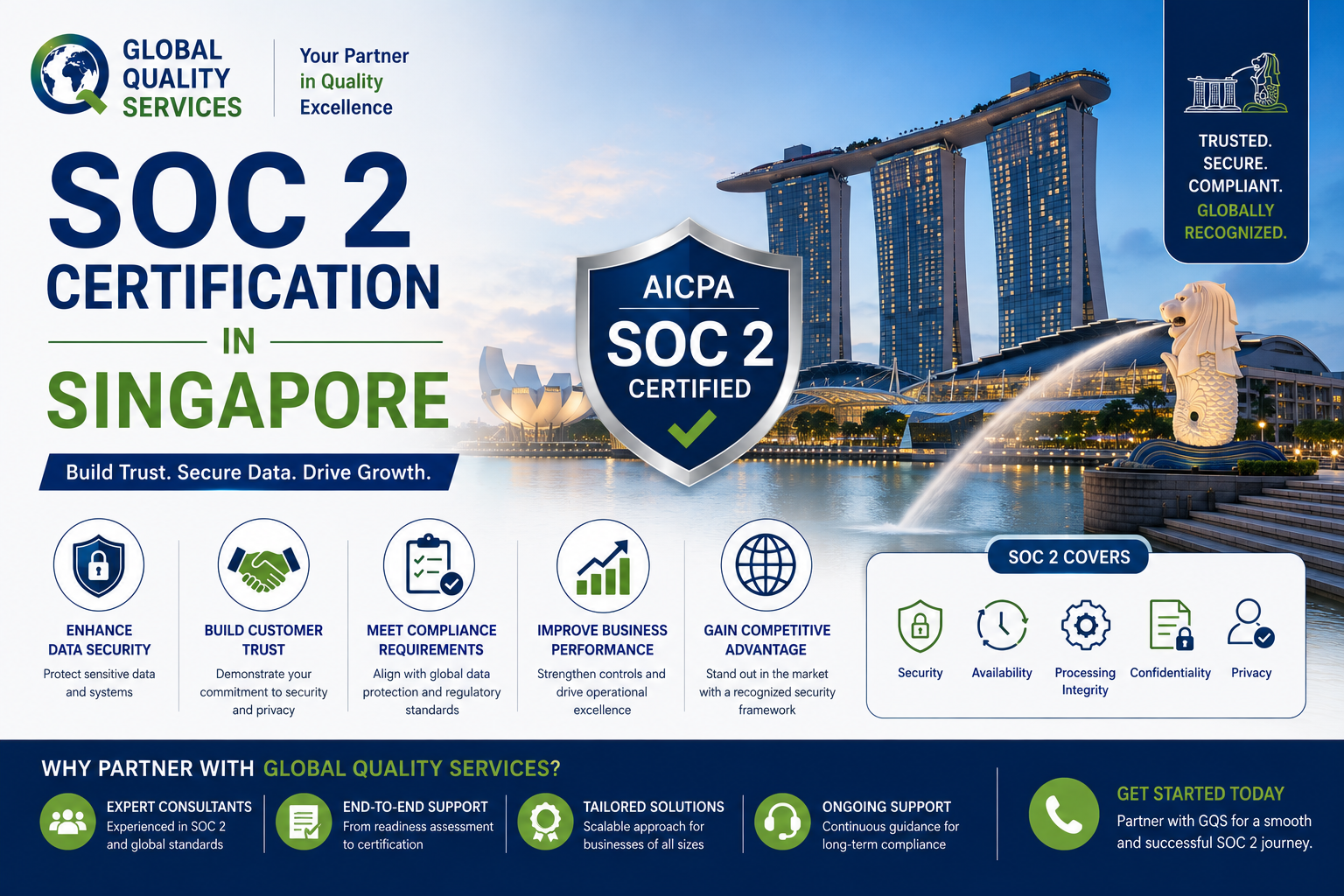
SOC 2 is organized around five Trust Service Criteria. Security is mandatory for every engagement. The remaining four are selected based on your service profile and what your buyers and regulators require.
- Security. Mandatory. Covers protection of systems and data against unauthorized access, disclosure, and damage through 64 Common Criteria covering logical access, change management, risk assessment, monitoring, and incident response. This is where the MAS TRM overlap is deepest.
- Availability. Covers whether systems are available for operation as committed. Directly relevant for Singapore SaaS platforms, financial technology services, and any service with uptime SLA obligations to enterprise or institutional clients.
- Processing Integrity. Covers whether processing is complete, valid, accurate, timely, and authorized. Relevant for Singapore payment processors, financial calculation engines, and trading system operators.
- Confidentiality. Covers whether information designated as confidential is protected as committed. Relevant for professional services, legal technology, and advisory firms handling commercially sensitive client data.
- Privacy. Covers the collection, use, retention, and disclosure of personal information. Directly aligned with Singapore’s Personal Data Protection Act obligations enforced by the Personal Data Protection Commission (PDPC).
Why Singapore Companies Need SOC 2 Certification
Singapore’s regulatory and commercial environment creates a distinct SOC 2 demand profile that differs from those of other markets in the region.
- MAS TRM Guidelines for financial institutions and their suppliers. The Monetary Authority of Singapore expects every licensed financial institution to manage technology risk and third-party outsourcing under a board-approved framework, with documented controls covering cyber hygiene, system resilience, data confidentiality and vendor concentration. Technology companies supplying MAS-regulated banks, insurers, and payment providers face these requirements indirectly through their clients’ vendor management frameworks. SOC 2’s Common
- The criteria cover exactly the control categories that MAS inspectors examine: logical access, change management, risk assessment, monitoring, and incident response.
CSA Cyber Trust Mark recognition. CSA mandates Cyber Trust Mark certification for Critical Information Infrastructure Owners by end-2027, CII auditors by end-2026, and licensed cybersecurity service providers by end-2026. Industry respondents to CSA’s 2026 public consultation specifically called for SOC 2 Type 2 to be recognized as equivalent to the Cyber Trust Mark for cybersecurity standards. While CSA has not yet finalized the equivalence list, Singapore technology companies with a current SOC 2 Type 2 report are ahead of any formal recognition of equivalence and can proceed without waiting. - US and Australian enterprise buyer qualification. Singapore is one of Asia’s largest technology export and outsourcing hubs. SaaS companies, data management firms, and technology service providers selling into US and Australian enterprise accounts face SOC 2 as a standard procurement gate. Without a current report, a Singapore company with technically strong products is functionally excluded from those sales processes.
- PDPC enforcement and PDPA compliance evidence. The PDPC has taken enforcement action against organizations that failed to implement adequate data protection measures. SOC 2’s Privacy Trust Service Criterion provides independently verified evidence of PDPA-aligned data handling controls, which carries significantly more weight in a PDPC investigation than a self-assessment.
SOC 2 and MAS TRM: Where the Controls Overlap
Singapore companies often ask whether implementing SOC 2 helps with MAS TRM compliance. The answer is yes, but with an important qualification.
Compliance with either ISO 27001, SOC 2, or PCI DSS has already been achieved in many organizations. It takes effort to comprehend how those frameworks fit MAS TRM, and with the wrong assumptions, gaps in compliance may occur.
The overlap is substantial. SOC 2’s Common Criteria address access management, change control, risk assessment, monitoring, and incident response, which are the same control areas MAS TRM inspectors examine most closely. The most common audit findings cluster around vendor due diligence, patch management, and incident reporting, where one-hour notification clocks are missed because operations teams did not know the threshold, and board reporting is presented without context or remediation status. Many firms also under-invest in identity governance: leaver access not revoked within 24 hours remains the single most common deficiency in MAS inspections.
A well-implemented SOC 2 control framework addresses most of these deficiencies, as the same controls that satisfy SOC 2 auditors also satisfy MAS inspectors. What SOC 2 does not cover is MAS-specific governance requirements around board reporting, third-party concentration risk, and operational resilience planning.
SOC 2, Risk Assessment, and TVRA
SOC 2’s Security Trust Service Criterion requires a formal risk assessment process that identifies threats, vulnerabilities, and risks to your systems and data, and documents how controls are selected and applied in response to that assessment.
For Singapore technology companies and financial institutions, this risk assessment requirement connects directly to Threat, Vulnerability and Risk Assessment (TVRA), the structured methodology for systematically identifying and quantifying cybersecurity threats across your technology environment. A TVRA provides the evidence base required for a SOC 2 risk assessment and is also a core component of MAS TRM compliance for financial institutions and their critical technology service providers.
Global Quality Services delivers Threat, Vulnerability and Risk Assessment (TVRA) services as a standalone engagement and as part of integrated SOC 2 and MAS TRM readiness programs. For Singapore companies running a combined SOC 2 and MAS TRM compliance program, completing a TVRA first provides a documented, methodology-based risk assessment that satisfies both frameworks simultaneously, rather than running two separate assessments.
Who Needs SOC 2 in Singapore
- SaaS and technology companies selling into US, UK, or Australian enterprise markets where SOC 2 Type 2 is a standard vendor qualification requirement
- Fintech and payment service providers under MAS Payment Services Act licensing whose enterprise clients or banking partners require documented, independently attested security controls
- Technology service providers and outsourcers supplying into MAS-regulated financial institutions where vendor management policies include SOC 2 in their third-party risk qualification frameworks
- Cloud service providers whose enterprise clients require evidence of availability, security, and confidentiality controls beyond a self-certification or marketing claim
- Regional headquarters of multinational technology companies using Singapore as their Asia-Pacific base and selling to US enterprise buyers who require SOC 2 as a standing contract condition
- Licensed cybersecurity service providers navigating CSA’s Cyber Trust Mark requirements, where SOC 2 Type 2 has been proposed as a recognized equivalent certification
Our SOC 2 Readiness Consultancy Process for Singapore Companies
Step 1: Scoping and Trust Service Criteria selection. We confirm which Trust Service Criteria are relevant to your Singapore services and what your target clients specifically require. For most Singapore technology and financial services companies, Security is the mandatory baseline, with Availability and Confidentiality the most commonly added criteria. We also map MAS TRM requirements against your selected criteria at this stage to identify where the two frameworks share coverage.
Step 2: Readiness assessment. Your current control environment is reviewed against the SOC 2 Common Criteria and your selected Trust Service categories. A written readiness report identifies gaps by control domain and prioritizes remediation by audit risk. For companies also targeting MAS TRM compliance, we flag MAS-specific gaps separately.
Step 3: Control design and policy development. We build or update your information security policies, access management procedures, change management controls, vendor management program, incident response procedures, and monitoring and logging framework to satisfy SOC 2 control requirements.
Step 4: TVRA and risk assessment documentation. We conduct or coordinate a Threat, Vulnerability and Risk Assessment that produces the documented, methodology-based risk assessment required by SOC 2’s Common Criteria and MAS TRM. This stage ensures your risk assessment is not a spreadsheet exercise but a structured, evidenced evaluation that satisfies auditors and MAS inspectors.
Step 5: Evidence collection framework. SOC 2 Type 2 requires continuous evidence that controls operated effectively over the observation period. We build your evidence-collection processes so that audit artifacts are gathered continuously rather than assembled under pressure before the audit window closes.
Step 6: Gap remediation support. Identified technical and process gaps are closed through direct support to your engineering, IT, and operations teams, covering vendor risk management, penetration testing coordination, and security awareness training.
Step 7: Type 1 and Type 2 audit support. We coordinate your engagement with an AICPA-licensed CPA firm for the formal attestation, support your team through auditor queries, and manage any management response requirements in the final report.
Benefits of SOC 2 Certification for Singapore Companies
A current SOC 2 Type 2 report delivers measurable outcomes across five areas that directly affect how technology and financial services companies in Singapore grow, remain compliant, and win enterprise contracts.
Opening US and Australian Enterprise Sales Cycles
A current SOC 2 Type 2 report removes the single most common obstacle to security qualification that Singapore technology companies face when selling to US and Australian enterprise buyers. It replaces lengthy security questionnaires and third-party risk assessment requests with a single, independently attested document that procurement teams accept on first submission.
Strengthening MAS TRM Compliance Posture
SOC 2’s Common Criteria cover logical access, change management, monitoring, and incident response at a level of evidence rigor that aligns directly with what MAS inspectors examine. A Singapore company with a current SOC 2 Type 2 report has already documented and tested the controls that MAS TRM requires evidence for.
Positioning Ahead of CSA Cyber Trust Mark Requirements
CSA is mandating Cyber Trust Mark certification for CII owners, CII auditors, and licensed cybersecurity service providers with deadlines running from end-2026 through end-2027. With SOC 2 Type 2 named in CSA’s public consultation as a proposed equivalent, Singapore companies holding a current SOC 2 Type 2 report are positioned ahead of any formal equivalence recognition rather than behind it.
PDPA and PDPC Compliance Evidence
SOC 2’s Security and Privacy Trust Service Criteria provide independently verified evidence of the access controls, monitoring, data handling, and incident response practices that the PDPC expects under the PDPA’s reasonable security standard. A current SOC 2 Type 2 report is substantially more defensible in a PDPC investigation than a self-assessment or internal policy document.
An Integrated Foundation for ISO 27001 and MAS TRM
For Singapore companies pursuing ISO 27001 alongside SOC 2, the control frameworks overlap significantly. Global Quality Services structures engagements to maximize overlap so that the two programs share documentation, internal audit cycles, and management review processes, rather than duplicating work across parallel tracks.
Why Choose Global Quality Services
Global Quality Services has supported management system certification and compliance projects across Singapore and the Asia-Pacific region for over two decades. Our SOC 2 readiness engagements are built for the specific regulatory and commercial environment in which Singapore technology and financial services companies operate: MAS TRM obligations running alongside US enterprise buyer requirements, CSA Cyber Trust Mark developments, and PDPC enforcement expectations under the PDPA.
We understand how SOC 2 aligns with ISO 27001, ISO 22301 (business continuity), MAS TRM, and the TVRA methodology within the Singapore compliance landscape. Every engagement is scoped to build a control framework that satisfies multiple requirements simultaneously rather than treating SOC 2 as a standalone project disconnected from the other compliance obligations your organization carries.
Contact Global Quality Services to begin your SOC 2 readiness assessment in Singapore.
Frequently Asked Questions
Is SOC 2 mandatory in Singapore?
No. SOC 2 is voluntary and not mandated by MAS, CSA, or the PDPC. However, US, UK, and Australian enterprise buyers increasingly require it as a standard vendor qualification condition.
How does SOC 2 relate to MAS TRM Guidelines?
The control objectives overlap significantly. SOC 2 covers access management, change control, risk assessment, monitoring, and incident response, the same areas MAS inspectors examine most closely. It strengthens your MAS TRM posture but does not replace MAS-specific governance requirements.
What is the connection between SOC 2 and CSA’s Cyber Trust Mark?
Industry respondents to CSA’s 2026 public consultation specifically called for SOC 2 Type 2 to be recognized as equivalent to the Cyber Trust Mark. CSA has not finalized the equivalence list, but companies with a current Type 2 report are well positioned ahead of any formal recognition.
How long does SOC 2 Type 2 take for a Singapore company?
Most companies complete the process in twelve to eighteen months including the observation period. Those with mature security controls or an existing ISO 27001 system typically move faster.
What is the role of TVRA in SOC 2 readiness?
SOC 2’s Common Criteria require a formal, documented risk assessment covering threats, vulnerabilities, and risks to your systems. A Threat, Vulnerability and Risk Assessment provides the structured evidence base that satisfies this requirement and supports MAS TRM compliance simultaneously.