Information has transcended its role as a supportive element to become the primary driver of corporate value. However, with this value comes significant vulnerability. For organizations operating within the Republic, the mandate for security is not merely an internal preference but a regulatory necessity, driven by the Personal Data Protection Act (PDPA) and the rising standards of the Cyber Security Agency (CSA) Singapore.
At the center of any robust security posture lies the ISO 27001 Asset Inventory. This document is the cornerstone of the Information Security Management System (ISMS). Without a meticulously maintained inventory, an organization remains unaware of its attack surface, making effective risk management an impossibility. This guide provides a formal, comprehensive examination of the requirements, implementation strategies, and regulatory intersections of asset management under the ISO/IEC 27001:2022 standard.
Defining the Scope: What Constitutes an Asset?
The updated ISO 27001:2022 (Control 5.9) adopts a more holistic view of assets than its predecessors. Historically, asset management was often conflated with IT inventory—a list of hardware components. Today, the standard recognizes that “information” itself is the asset, and the physical or digital entities that handle it are “associated assets.”
1. Information Assets (Intangible)
These represent the core data sets that drive business operations.
-
Customer Databases: NRIC numbers, contact details, and transaction histories (directly regulated by the PDPA).
-
Intellectual Property: Proprietary algorithms, source code, and strategic business plans.
-
Operational Records: Financial statements, payroll data, and legal contracts.
2. Software Assets
Software serves as the processing layer for information.
-
SaaS Platforms: Cloud-based tools such as CRM systems (Salesforce), accounting software (Xero), and communication platforms (Slack).
-
Internal Applications: Custom-built software and proprietary tools used for niche business functions.
3. Physical Assets
These are the tangible hosts and conduits for information.
-
Hardware: Laptops, servers, iPads, and mobile devices provided to employees.
-
Infrastructure: Routers, switches, firewalls, and storage media (e.g., encrypted USB drives).
4. Support Services
ISO 27001:2022 emphasizes the security of services that facilitate information processing.
-
Cloud Hosting: Infrastructure-as-a-Service (IaaS) such as AWS or Azure, specifically focusing on data residency within Singapore regions.
-
Managed Services: Third-party IT support or security operation centers (SOC).
The Essential Components of an ISO 27001 Asset Register
A formal ISO 27001 Asset Inventory is not a static list; it is a dynamic record that provides clear accountability and traceability. To satisfy a certification body such as BSI, TÜV SÜD, or SGS, the register must include several key metadata fields for every identified asset.
1. Unique Identification and Description
Every asset must be assigned a unique identifier (e.g., SG-LAP-2026-001). This ensures that during an audit, a specific physical device can be mapped directly to its entry in the digital register. The description should clearly state the asset’s function and the type of data it processes.
2. Designated Asset Ownership
Control 5.9 mandates that every asset must have a designated “Owner.” In a corporate context, the owner is typically a senior manager or department head who has the authority to make decisions regarding the asset’s security, access rights, and disposal.
-
Note: The “User” is the person utilizing the device, but the “Owner” is the individual accountable for its compliance.
3. Classification of Information
Assets must be classified based on their sensitivity and the potential impact of a breach. A typical Singaporean corporate classification scheme includes:
-
Public: Information intended for general disclosure (e.g., marketing materials).
-
Internal: Information for general staff use but not for external disclosure.
-
Confidential: Sensitive information (e.g., client lists) that requires restricted access.
-
Restricted: Highly sensitive data (e.g., NRIC data or board-level strategies) that could cause irreparable damage if compromised.
4. Physical and Logical Location
For physical assets, the location must be documented (e.g., Headquarters, Server Room A). For digital or cloud assets, the logical location—such as the specific cloud region or server cluster—is required. This is particularly vital for demonstrating compliance with cross-border data transfer rules under the PDPA.
Integrating Singapore’s Regulatory Landscape
For organizations in Singapore, the ISO 27001 Asset Inventory is the primary vehicle for demonstrating compliance with the PDPA’s Accountability Obligation.
The PDPA Intersection
The PDPA requires organizations to implement “reasonable security arrangements” to protect personal data. If an organization cannot prove it knows where its personal data is stored (via an asset inventory), it is fundamentally failing its Protection Obligation.
-
Data Inventory Maps: Many Singaporean firms combine their ISO asset register with a “Data Inventory Map.” This allows them to track the flow of personal data from collection to disposal, ensuring that every touchpoint (asset) is secured according to its classification.
-
Mandatory Breach Notification: In the event of a data breach, the Personal Data Protection Commission (PDPC) will scrutinize the asset inventory. A well-documented inventory allows for a faster response, potentially mitigating the severity of financial penalties.
The Asset Lifecycle: From Procurement to Disposal
A compliant ISO 27001 Asset Inventory tracks the entire lifecycle of an asset. Gaps often occur during transitions, specifically when an asset is introduced or retired.
1. Acquisition and Onboarding
Assets must be recorded the moment they enter the organization’s control. This includes installing required security software (e.g., MDM or Endpoint Protection) and ensuring the user agrees to the Acceptable Use Policy (Control 5.10).
2. Maintenance and Monitoring
Assets must be periodically reviewed. Hardware ages, and software becomes obsolete. An annual or bi-annual “re-verification” of the asset inventory ensures that “ghost assets”—items that have been lost or forgotten but still appear on the network—are identified and removed.
3. Asset Return (Control 5.11)
When an employee exits the organization, a formal process must be in place to ensure all assets are returned. This includes not only physical hardware but also the revocation of access to information assets (cloud folders, databases).
4. Secure Disposal (Control 8.10)
Disposing of assets is a high-risk activity. ISO 27001 requires that information on decommissioned assets be rendered unrecoverable.
-
Physical Media: Hard drives must be shredded or degaussed by certified vendors.
-
Digital Data: Cloud instances must be securely wiped according to the provider’s best practices.
-
Evidence: Organizations must maintain a “Certificate of Destruction” for all disposed high-sensitivity assets to present during an audit.
Strategic Implementation Checklist
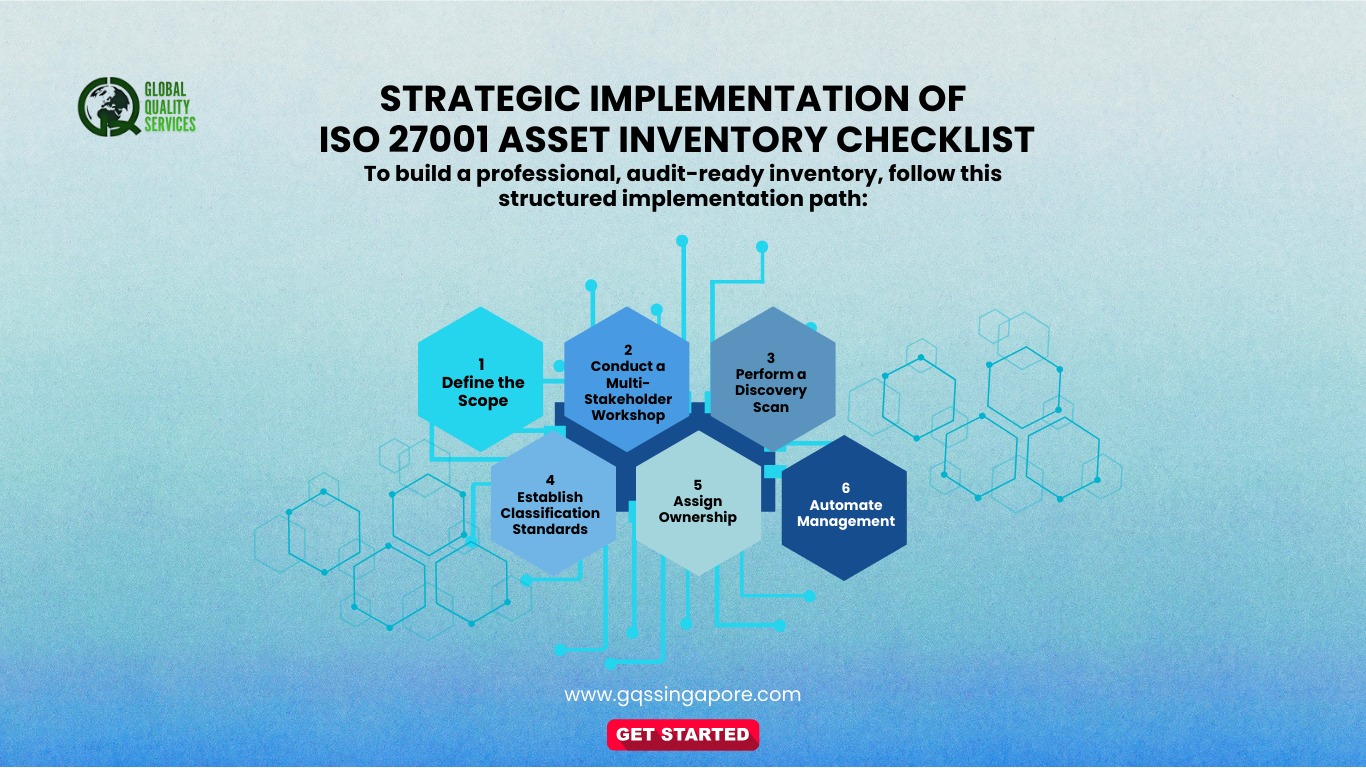
To build a professional, audit-ready inventory, follow this structured implementation path:
-
Define the Scope: Determine which departments and physical locations are included in the ISMS.
-
Conduct a Multi-Stakeholder Workshop: Bring together IT, HR, Legal, and Finance. Finance knows what was purchased; IT knows where it is; HR knows who has it; Legal knows the sensitivity of the data.
-
Perform a Discovery Scan: Use network discovery tools to identify all IP-connected devices. Compare this “technical” list with the “manual” list from Finance.
-
Establish Classification Standards: Draft a clear classification policy so owners know how to label their assets.
-
Assign Ownership: Formally document managers as owners and ensure they understand their accountability under the ISO framework.
-
Automate Management: Transition away from manual spreadsheets to a dedicated Asset Management System or ISMS platform to ensure real-time accuracy and ease of auditing.
Accountability as a Business Metric
The ISO 27001 Asset Inventory is far more than a checklist for compliance. It is a strategic tool that provides the visibility required to defend a modern enterprise. In Singapore’s stringent regulatory environment, being “Accountable” is a prerequisite for trust. Organizations that invest in a high-integrity asset management framework find themselves better prepared for audits, more resilient against cyber threats, and more attractive to high-value global partners.
Achieving this level of precision requires a deep understanding of both international standards and local Singaporean requirements. Navigating these complexities is where strategic partnership becomes invaluable.
For expert guidance on establishing a robust ISMS, conducting gap analyses, or implementing a compliant ISO 27001 Asset Inventory in Singapore, contact Global Quality Services as your strategic CTA.