
The global electronics lifecycle is no longer linear. Devices and IT assets move across refurbishers, resellers, recyclers, smelters, data destruction providers, and logistics partners before reaching end-of-life. In such a chain, one weak link can introduce regulatory risk, data leakage, uncontrolled exports, or environmental harm. The R2 Standard was developed to prevent that by defining how certified facilities must manage equipment responsibly and prove that their downstream partners are equally compliant. These downstream partners are known as Downstream Vendors (DSVs).
For companies in Singapore—especially those handling cross-border ITAD, medical equipment, defense electronics, and data-bearing assets—the R2 Downstream Vendor requirements are becoming a cornerstone of responsible recycling and ESG disclosure. With Singapore positioning itself as a regional data hub, a smart nation, and a sustainability leader under the Green Plan 2030, regulators, enterprises, and international customers increasingly expect electronics to be handled under traceable and compliant frameworks. This makes understanding DSV obligations not just a certification formality, but a commercial requirement for winning contracts and participating in global circular supply chains.
Understanding the Role of Downstream Vendors (DSVs)
A Downstream Vendor is any party that receives material from an R2-certified facility. This includes:
• Asset recovery companies
• Repair and refurbishment centers
• Resellers and brokers
• Component harvesters
• Plastics and metals recyclers
• Smelters and refineries
• E-waste scrap processors
• Logistics and export handlers
• Data destruction subcontractors
• Final disposal facilities
In practice, the R2 facility remains accountable for what happens to its material even after it leaves the building. Vendors cannot operate as dumping grounds, export loopholes, or data risk points. Instead, the R2 Standard forces transparency across the entire lifecycle and across borders.
Why DSV Requirements Exist in the First Place
R2’s downstream requirements were created to solve real-world failures in the electronics sector:
1. Environmental Harm
Uncontrolled export of e-waste to informal recycling markets has led to pollution, child labor, and hazardous exposure in parts of Africa and Asia. DSV controls ensure materials end up in lawful, environmentally sound facilities.
2. Data & Security Risks
Devices containing sensitive information can leak confidential data if passed through vendors without certified sanitization capability. Singapore’s PDPA regime makes this especially risky for banks, telcos, and government-linked entities.
3. Worker Safety
Processes such as de-soldering, shredding, or smelting can expose workers to lead, mercury, cadmium, and other toxins unless properly controlled.
4. Compliance & Border Control
Electronics are often classified as Basel Waste or Controlled Goods; improper export can lead to customs violations and seizure of containers.
5. Supply Chain Traceability
Enterprises increasingly require chain-of-custody evidence for ESG disclosures and procurement audits.
DSV requirements are the mechanism R2 uses to enforce accountability beyond the four walls of the certified facility.
Core R2 Requirements for Downstream Vendors
Under the R2 Standard, downstream vendors are not treated as equal; they must meet specific requirements based on the type of material they handle and the risks associated. The key requirements include:
1. Verification of Environmental, Health & Safety Practices
R2 facilities must verify that DSVs manage materials under conditions that:
• Do not harm the environment
• Do not expose workers to hazardous substances
• Comply with national and international regulations
Verification is not a checkbox. It requires document review, risk assessment, and—when material risk is high—physical audits or third-party certifications. For Singapore operators, these requirements align well with existing Environmental Public Health and Workplace Safety regulations, but they must also extend across borders, where many refurbishers and recycling plants operate.
2. Proper Handling of Data-Bearing Devices
Data is treated as a distinct risk category in R2. DSVs that receive:
• Storage media
• Servers
• Laptops
• Medical imaging devices
• Networking equipment
• Telecom hardware
• Smart IoT devices
must demonstrate the ability to sanitize, destroy, or non-recoverably render data inaccessible based on the R2 Data Sanitization Appendix. This matters in Singapore’s context because sectors such as fintech, healthcare, defense, and banking handle regulated data and are subject to PDPA, MAS guidelines, and international contractual requirements.
If a DSV cannot demonstrate data capability, the asset cannot be shipped to them without sanitization being performed first.
3. Material Classification & Destination Controls
Every device or component must be classified into one of R2’s material categories such as:
• Reusable
• Repairable
• Scrap for recovery
• Hazardous waste
• Final disposal
R2 facilities must ensure that DSVs receiving the material are approved to handle that category and positioned correctly in the chain (e.g., a repair vendor should not receive cathode-ray tubes or lithium batteries). This prevents misrouting and externalization of risk.
4. Legal Compliance & Basel Alignment
DSVs must comply with all applicable:
• Import/export regulations
• Basel Convention controls
• Customs declarations
• Transboundary movement rules
• Country-specific hazardous waste laws
For Singapore—which is a Basel Party and a major logistics hub—improper routing can trigger regulatory penalties. R2 facilities must document the legality of every material transfer and ensure the DSV has the right permits.
5. Monitoring, Auditing & Corrective Action
R2 does not allow “trust without verification”. Downstream vendors must be monitored at a frequency proportionate to:
• Material risk
• Destination geography
• Prior performance
• Volume of transactions
This may involve:
• Annual audits
• Documentation reviews
• Environmental reporting
• Certificates of processing
• Corrective action plans
Facilities cannot continue sending material to non-compliant DSVs even if commercially convenient.
6. Traceability & Chain-of-Custody Evidence
Chain-of-custody is a mandatory documentation requirement. R2 facilities must be able to demonstrate:
• What material was shipped
• To which DSV
• For what process
• Under what legal classification
• With what final outcome
End destinations must be known—not “sold to broker”.
7. DSV Qualification Based on CRT, Batteries & Hazardous Streams
Not all electronics are equal. Streams such as:
• Lithium-ion batteries
• CRT glass
• Mercury lamps
• PCBs with heavy metals
• Medical electronics
carry higher safety and disposal risks. R2 assigns additional controls to DSVs that handle them, such as demonstrating final recovery pathways (e.g., smelters or refineries).
How Singapore Companies Are Impacted
Unlike countries that export to informal recycling markets, Singapore imposes strong regulatory discipline across its handling of hazardous waste and IT assets. This aligns well with R2’s intent. However, Singapore operators still face distinct implications:
1. Cross-Border Logistics
Singapore has limited heavy smelting or final materials recovery infrastructure. This means scrap metals, CRT glass, lithium batteries, and PCBs often move to:
• South Korea
• Japan
• OECD Europe
• Australia
• North America
R2 requires these movements to be audited, legal, and documented under DSV obligations.
2. PDPA + Sectoral Data Rules
Banks, telecoms, and healthcare providers require proof that data-bearing devices are sanitized before they leave custody. DSVs without data sanitization capability must be excluded, which restricts vendor selection.
3. ESG & Procurement Requirements
Global multinationals increasingly require R2 participation for supply chain compliance. For Singapore’s export-oriented economy, the absence of R2-qualifying DSVs can disqualify companies from enterprise and government-linked RFPs.
4. Green Plan 2030 & Circular Economy Alignment
Singapore’s waste reduction targets and circularity ambitions create both regulatory and commercial incentive to demonstrate responsible downstream handling.
Why DSV Requirements Benefit Stakeholders
Contrary to the perception of certification as paperwork, DSV controls produce measurable benefits:
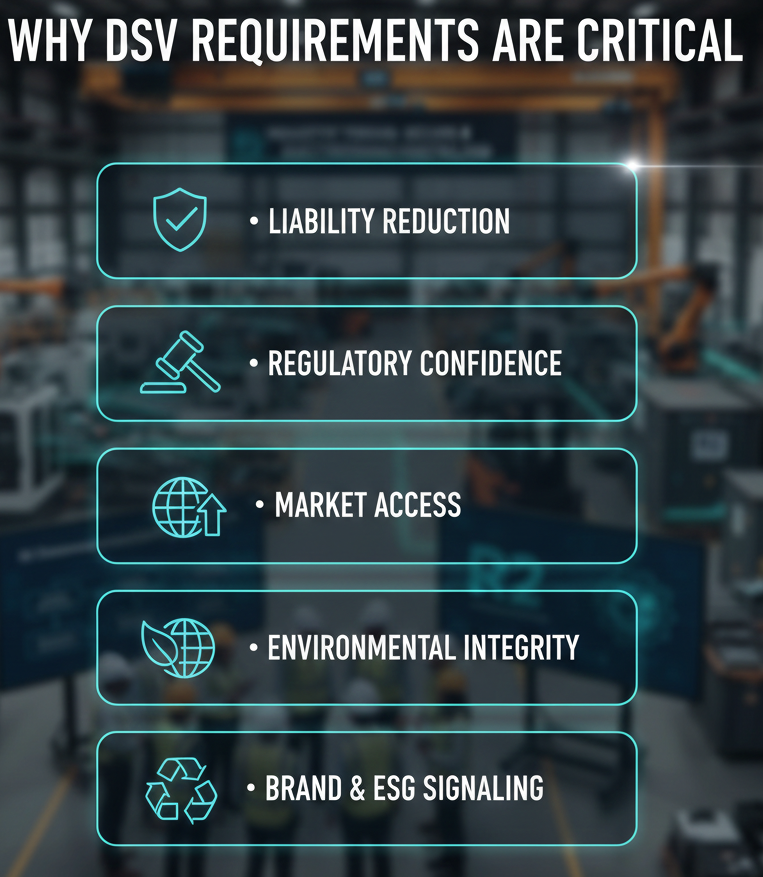
Downstream compliance is now intertwined with commercial outcomes.
Summary
R2’s Downstream Vendor requirements exist to close the accountability gap in the global electronics lifecycle. For Singapore—where cross-border ITAD, regulated data, and advanced recycling models intersect—DSV qualification ensures that IT assets and e-waste are handled with environmental responsibility, data security, and legal compliance across borders.
Companies pursuing R2 certification, participating in ESG-sensitive supply chains, or managing regulated electronics will find that strong DSV governance is no longer optional. It is part of the price of admission to the circular economy and the global refurbishment-to-recycling marketplace.