Malaysia is one of Southeast Asia’s largest destinations for technology outsourcing, shared services, and SaaS delivery. More than 500 multinational companies have established shared service centres and BPO operations here, and a growing fintech and homegrown SaaS ecosystem is actively selling into US, UK, and Australian markets. Every one of these companies eventually faces the same client question: do you have a SOC 2 report?
SOC 2 is the attestation standard that US enterprise buyers use to verify that a service provider’s information security, availability, and data handling controls are not just documented but independently tested and proven over time. For Malaysian technology companies, BPO operations, and financial technology providers, a SOC 2 Type 2 report is increasingly the difference between being shortlisted for a contract and being removed from consideration before the conversation begins.
Global Quality Services provides end-to-end SOC 2 readiness consultancy for technology companies, BPO operations, and financial services firms in Malaysia. We prepare your control environment, policies, and evidence-collection processes so that when an independent AICPA-licensed auditor arrives for formal attestation, your organization is ready.
What SOC 2 Is — and What It Is Not
SOC 2 is not an ISO certification and it is not issued by a government or international standards body. It is an attestation report developed by the American Institute of Certified Public Accountants (AICPA), and the final SOC 2 report is issued by an independent, AICPA-licensed CPA firm — not by a certification body in the way ISO 27001 or ISO 9001 certificates are issued.
This means that consultancy and audit work are performed by different parties. Global Quality Services prepares your organization, builds your control framework, and gets you audit-ready. An independent CPA firm then conducts the formal attestation. Our job is to ensure nothing in that audit comes as a surprise.
SOC 2 Type 1 vs SOC 2 Type 2
Understanding the difference is important before scoping any engagement.
- SOC 2 Type 1 assesses whether your security controls are suitably designed at a specific point in time. It is faster to obtain, typically three to six months from readiness start, and is useful for companies that need to show a client they are on the path to full SOC 2 compliance while the Type 2 observation period runs.
- SOC 2 Type 2 assesses whether your controls are not only suitably designed but also operating effectively over a defined observation period, typically six to twelve months. This is the report that most US enterprise buyers, institutional clients, and regulated sector customers require. A Type 2 report with a twelve-month observation window carries significantly more weight than a Type 1 in competitive client qualification processes.
Most Malaysian companies pursuing SOC 2 for the first time begin with a Type 1 to establish a baseline and then move to Type 2 within the same engagement timeline.
The Five Trust Service Criteria
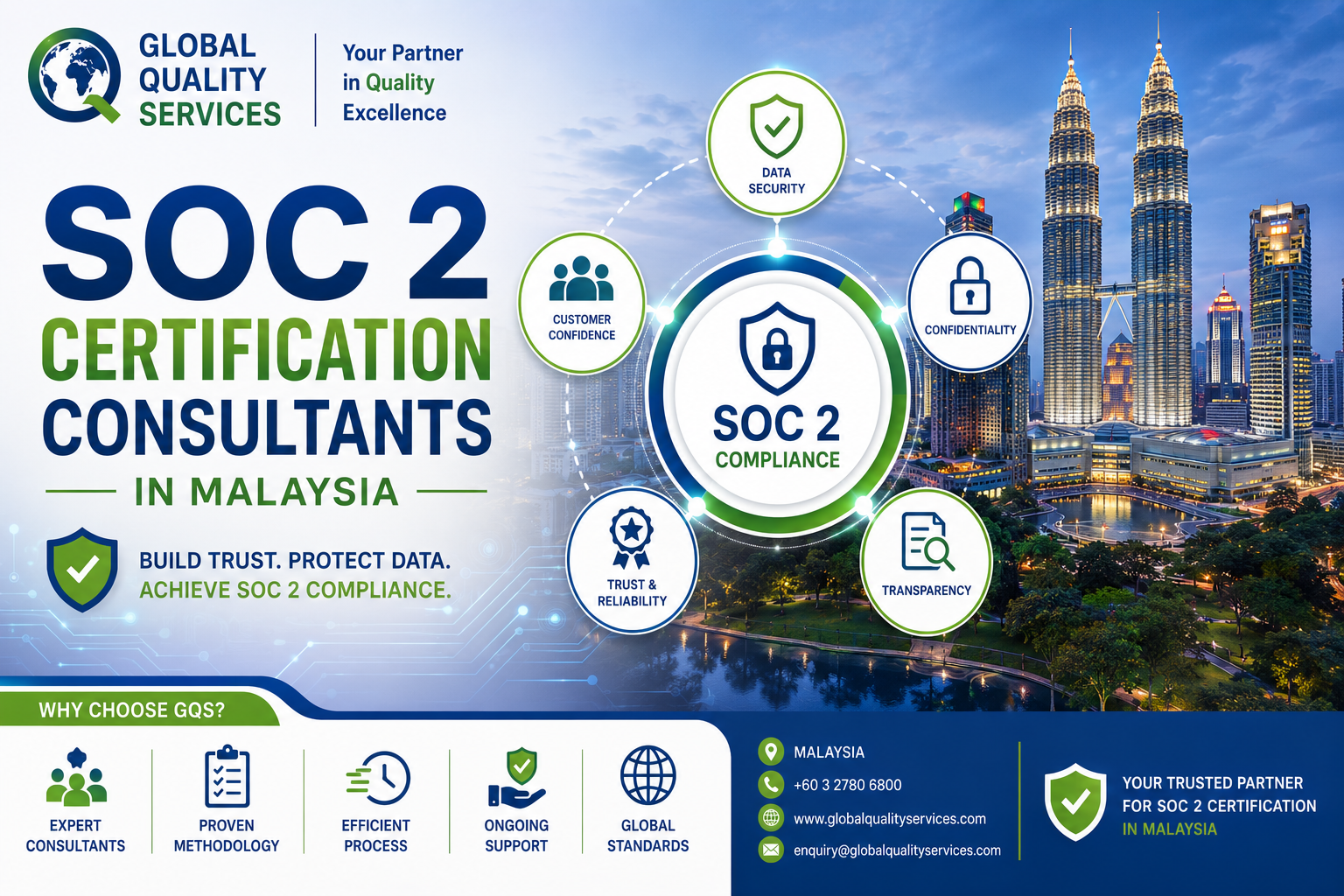
SOC 2 is organized around five Trust Service Criteria. Security is mandatory for every SOC 2 engagement. The remaining four are selected based on what is relevant to your services and what your clients require.
- Security. Mandatory. Covers protection of systems and data against unauthorized access, disclosure, and damage. Maps to 64 Common Criteria drawn from COSO and NIST frameworks covering logical access, change management, risk assessment, monitoring, and incident response.
- Availability. Covers whether systems are available for operation and use as committed. Relevant for SaaS platforms, cloud infrastructure providers, and any service with uptime SLA obligations.
- Processing Integrity. Covers whether system processing is complete, valid, accurate, timely, and authorized. Relevant for payment processors, data transformation services, and financial calculation engines.
- Confidentiality. Covers whether information designated as confidential is protected as committed. Relevant for professional services firms, legal tech, and any organization handling commercially sensitive client data.
- Privacy. Covers the collection, use, retention, disclosure, and disposal of personal information in line with the organization’s privacy commitments. Relevant for any service handling personal data, and directly aligned with Malaysia’s PDPA obligations.
Why Malaysian Companies Need SOC 2
The demand for SOC 2 in Malaysia is being driven from two directions simultaneously: client requirements from overseas buyers and regulatory expectations building from within.
US and International Enterprise Client Requirements
While not mandated locally, SOC 2 complements PDPA expectations and boosts market credibility for Malaysian companies serving international clients. US enterprise buyers in financial services, healthcare, and technology sectors routinely include SOC 2 Type 2 as a vendor qualification requirement in their procurement processes. A Malaysian SaaS company or BPO operation without a current SOC 2 report is effectively excluded from these procurement processes regardless of how strong its technical capabilities are.
BNM RMiT Alignment for Fintech and Financial Services
Bank Negara Malaysia’s Risk Management in Technology framework mandates specific security controls and annual penetration testing for financial institutions. For Malaysian fintech companies and technology service providers supplying into BNM-regulated financial institutions, SOC 2’s Common Criteria overlap significantly with the security controls RMiT requires. Implementing SOC 2 controls positions a technology provider for RMiT-aligned third-party assessments more effectively than an unstructured security program.
Malaysia’s Cybersecurity Act 2024
NACSA (National Cyber Security Agency Malaysia) has identified cloud security as a priority area under the Cyber Security Act 2024. The Act introduces licensing requirements for cybersecurity service providers and strengthens obligations around critical information infrastructure. For technology companies in Malaysia’s digital economy, a SOC 2 report provides independent, third-party evidence of the effectiveness of security controls that complements NACSA’s emerging certification landscape.
PDPA Compliance Evidence
Malaysia’s Personal Data Protection Act requires organizations to implement appropriate security measures to protect personal data. SOC 2’s Security and Privacy Trust Service Criteria provide a structured, independently audited framework for demonstrating that those measures exist and work. A current SOC 2 Type 2 report gives a Malaysian company verifiable PDPA security compliance evidence rather than a self-assessment.
Who Needs SOC 2 in Malaysia
- SaaS and technology companies selling into US, UK, Australian, or enterprise Southeast Asian markets where SOC 2 is a standard vendor qualification requirement
- BPO and shared services operations in Kuala Lumpur, Cyberjaya, and Penang handling client data for multinational principals with SOC 2 requirements in their supply chain policies
- Fintech companies subject to BNM RMiT oversight or supplying into regulated financial institutions that require third-party security attestation
- MSC Malaysia status companies whose US and European clients include SOC 2 in their technology vendor qualification frameworks
- Healthcare IT and medical data processors handling patient data for US or Australian healthcare organizations with HIPAA and security attestation requirements
- Cloud and infrastructure providers whose enterprise clients require evidence of availability and security controls beyond a self-certification
Our SOC 2 Readiness Consultancy Process for Malaysian Companies
Step 1: Scoping and Trust Service Criteria selection. We confirm which Trust Service Criteria are relevant to your services and what your target clients specifically require, since pursuing all five criteria when clients only ask for Security and Availability adds cost and audit time without commercial benefit.
Step 2: Readiness assessment. Your current control environment is reviewed against the SOC 2 Common Criteria and the additional criteria for your selected Trust Service categories. A written readiness report identifies gaps by control domain and prioritizes remediation by audit risk.
Step 3: Control design and policy development. We build or update your information security policies, access management procedures, change management controls, vendor management program, incident response procedures, and monitoring and logging framework to satisfy the SOC 2 control requirements.
Step 4: Evidence collection framework. SOC 2 Type 2 requires evidence that controls operated effectively over the observation period. We build your evidence-collection processes so that audit artifacts are gathered continuously rather than assembled under pressure just before the audit window closes.
Step 5: Gap remediation support. Any technical or process gaps identified in the readiness assessment are closed through direct support to your engineering, IT, and operations teams, including vendor risk management, penetration testing coordination, and security awareness training.
Step 6: Type 1 and Type 2 audit support. We coordinate your engagement with an AICPA-licensed CPA firm for the formal attestation, support your team through auditor queries, and manage any management response requirements in the final report.
Benefits of SOC 2 Certification for Malaysian Companies
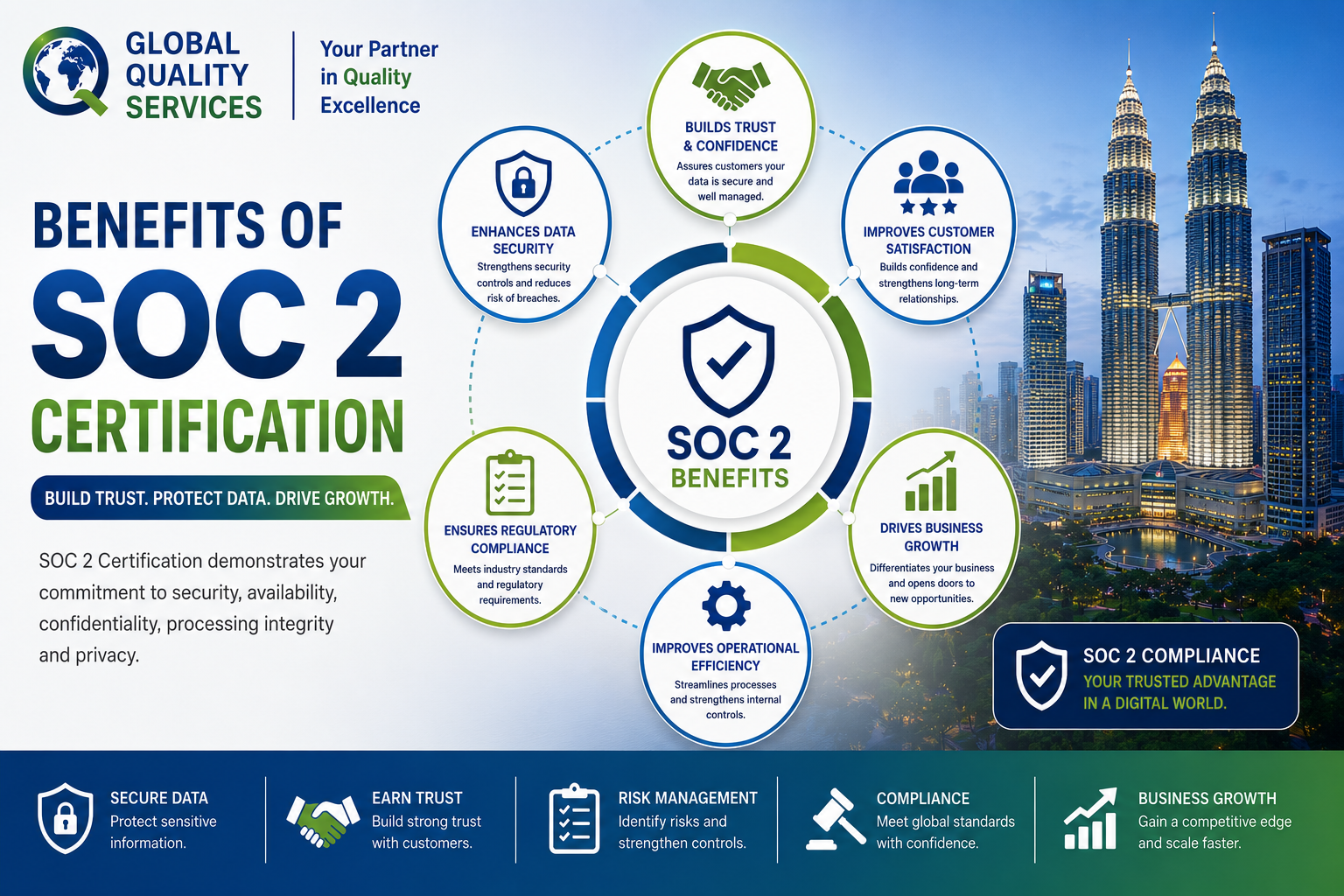
Winning and Retaining US Enterprise Clients
A current SOC 2 Type 2 report removes the single most common security qualification obstacle Malaysian technology companies face in US enterprise sales cycles. It replaces lengthy security questionnaires, third-party risk assessment requests, and point-in-time security reviews with a single, independently attested document that auditors and procurement teams accept.
PDPA and BNM RMiT Alignment in One Framework
SOC 2’s Common Criteria cover logical access, change management, risk assessment, monitoring, and incident response, control categories that map directly to both PDPA’s security principle and BNM RMiT’s technology risk requirements. Implementing SOC 2 controls builds compliance infrastructure that satisfies multiple regulatory expectations rather than treating each one as a separate project.
Competitive Differentiation in the MSC Malaysia Ecosystem
Malaysia’s MSC status technology companies compete for contracts with global clients who evaluate multiple vendors across the region. A SOC 2 Type 2 report in a competitive shortlist signals not just that security controls exist but that they have been independently tested over time, a meaningfully stronger position than a competitor with ISO 27001 alone or no third-party security attestation at all.
Faster Sales Cycles
Enterprise clients that require SOC 2 include it in their standard vendor due diligence checklist. Without a current report, that checklist item triggers additional questionnaires, interviews, and potentially a customer-conducted audit, all of which extend the sales cycle by weeks or months. A current SOC 2 Type 2 report closes that item on first submission.
A Security Program That Scales With the Business
SOC 2 implementation builds repeatable, evidence-generating security processes rather than a one-time compliance exercise. As your Malaysia operation grows, the control framework scales with it, and subsequent annual Type 2 audits become progressively less disruptive as evidence collection becomes embedded in normal operations.
Why Choose Global Quality Services
Global Quality Services has supported management system certification and compliance projects across Malaysia, Singapore, and the Asia-Pacific region for over two decades. Our SOC 2 readiness engagements are tailored to the specific commercial environment of Malaysian technology companies: export-oriented SaaS businesses, BPO operations serving US and European principals, and fintech companies navigating both international client requirements and BNM RMiT obligations.
We understand how SOC 2 sits alongside ISO 27001, PDPA, and BNM RMiT in the Malaysian regulatory and client qualification landscape, and we scope every engagement to build a control framework that satisfies multiple requirements rather than optimizing for SOC 2 alone. For companies also pursuing ISO 27001 information security certification, the overlap between the two frameworks is significant, and we structure engagements to maximize that overlap rather than duplicate work.
Contact Global Quality Services to begin your SOC 2 readiness assessment in Malaysia.
Frequently Asked Questions
Is SOC 2 mandatory in Malaysia?
No. SOC 2 is a voluntary attestation standard developed by the AICPA in the United States. It is not mandated by Malaysian law, BNM, or NACSA. However, it is increasingly required by US enterprise clients, multinational principals, and regulated-sector buyers of Malaysian technology vendors as a condition of supply.
What is the difference between SOC 2 and ISO 27001?
ISO 27001 is an international management system certification that assesses whether an organization has implemented and maintains an information security management system. SOC 2 is a US attestation standard that assesses whether specific security, availability, processing integrity, confidentiality, and privacy controls are in place and operate effectively within a service organization. Many Malaysian companies pursue both: ISO 27001 for international management system credibility and SOC 2 for US client qualification. The control frameworks overlap significantly, and Global Quality Services structures engagements to maximize that overlap.
How long does SOC 2 Type 2 take for a Malaysian company?
SOC 2 Type 2 requires a minimum six-month observation period during which controls must operate effectively and evidence must be collected. From readiness start to final Type 2 report issuance, most Malaysian companies complete the process in 12 to 18 months, depending on the maturity of existing security controls and the length of the observation period selected. Companies pursuing SOC 2 Type 1 first can receive their Type 1 report in three to six months.
Does SOC 2 help with PDPA compliance in Malaysia?
Yes. SOC 2’s Security and Privacy Trust Service Criteria cover the access controls, monitoring, incident response, and data handling practices that PDPA’s security principle requires. A current SOC 2 Type 2 report provides independent evidence of those controls rather than a self-assessment, which is more defensible in the event of a PDPA inquiry or data breach investigation.
Which AICPA-licensed CPA firm conducts the actual SOC 2 audit?
The formal SOC 2 attestation must be conducted by an independent, AICPA-licensed CPA firm. Global Quality Services does not conduct the formal audit but prepares your organization and coordinates your engagement with an appropriate audit firm based on your budget, timeline, and industry sector.