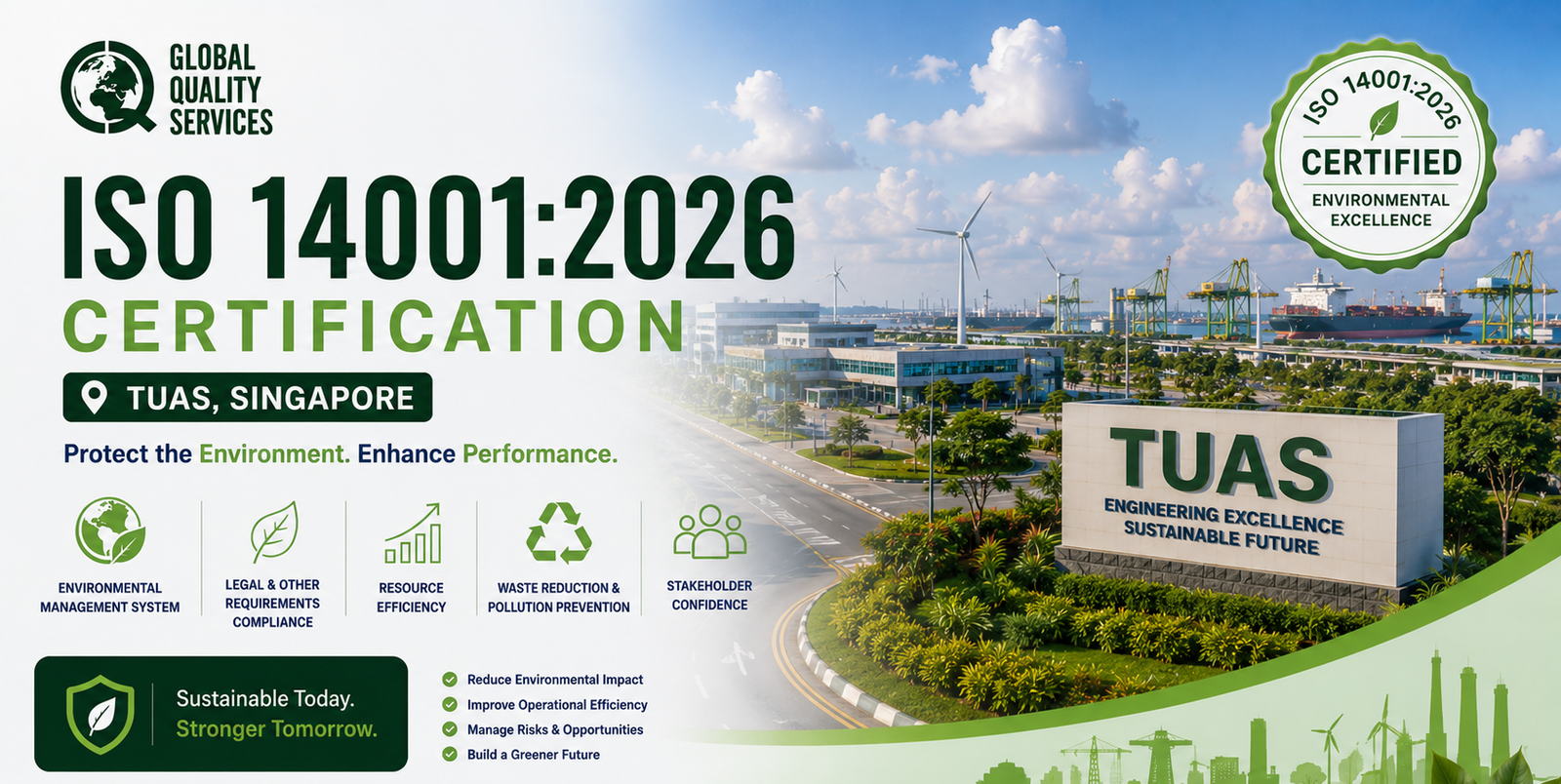
Tuas is Singapore’s most environmentally consequential industrial address. Once a quiet fishing village resettled and reclaimed beginning in the 1970s to make way for heavy industry, Tuas today hosts significant concentrations of petrochemical processing, precision engineering, and waste management operations, including two of Singapore’s four municipal waste incinerators and a world-scale renewable diesel plant.
With the Tuas Mega Port progressively absorbing Singapore’s entire port operations through 2040, and the Tuas Biomedical Park hosting global pharmaceutical leaders, environmental management here is not a compliance afterthought — it is central to how Tuas operates.
This page will explain what ISO 14001:2026 certification will involve for companies based in Tuas, why it will matter given the area’s industrial character, and how GQS will support certification once the standard takes effect.
Why ISO 14001:2026 Will Matter Specifically for Tuas
Few industrial districts in Singapore carry environmental stakes as concentrated as Tuas. The area’s petrochemical processing and chemical manufacturing operations, its waste incineration infrastructure, and its expanding reclaimed coastline all fall within an environmentally sensitive zone closely monitored by Singapore’s National Environment Agency (NEA), which oversees pollution control, hazardous substance management, and industrial emissions standards nationwide.
Companies here will need to demonstrate, more rigorously than almost anywhere else in Singapore, that their environmental management systems can genuinely control pollution, manage hazardous waste, and protect surrounding marine and water catchment areas — not simply pass a documentation check.
Tuas is also home to a genuinely diverse industrial base, developed and managed by JTC Corporation, Singapore’s statutory board for sustainable industrial estates.
From oil and gas, precision engineering, and general manufacturing tenants, to global pharmaceutical and MedTech leaders operating within Tuas Biomedical Park, each sector will carry a different environmental risk profile once ISO 14001:2026 certification becomes relevant, but all will need to meet the same core requirements around pollution prevention, resource use, and regulatory compliance.
What ISO 14001:2026 Certification Will Involve
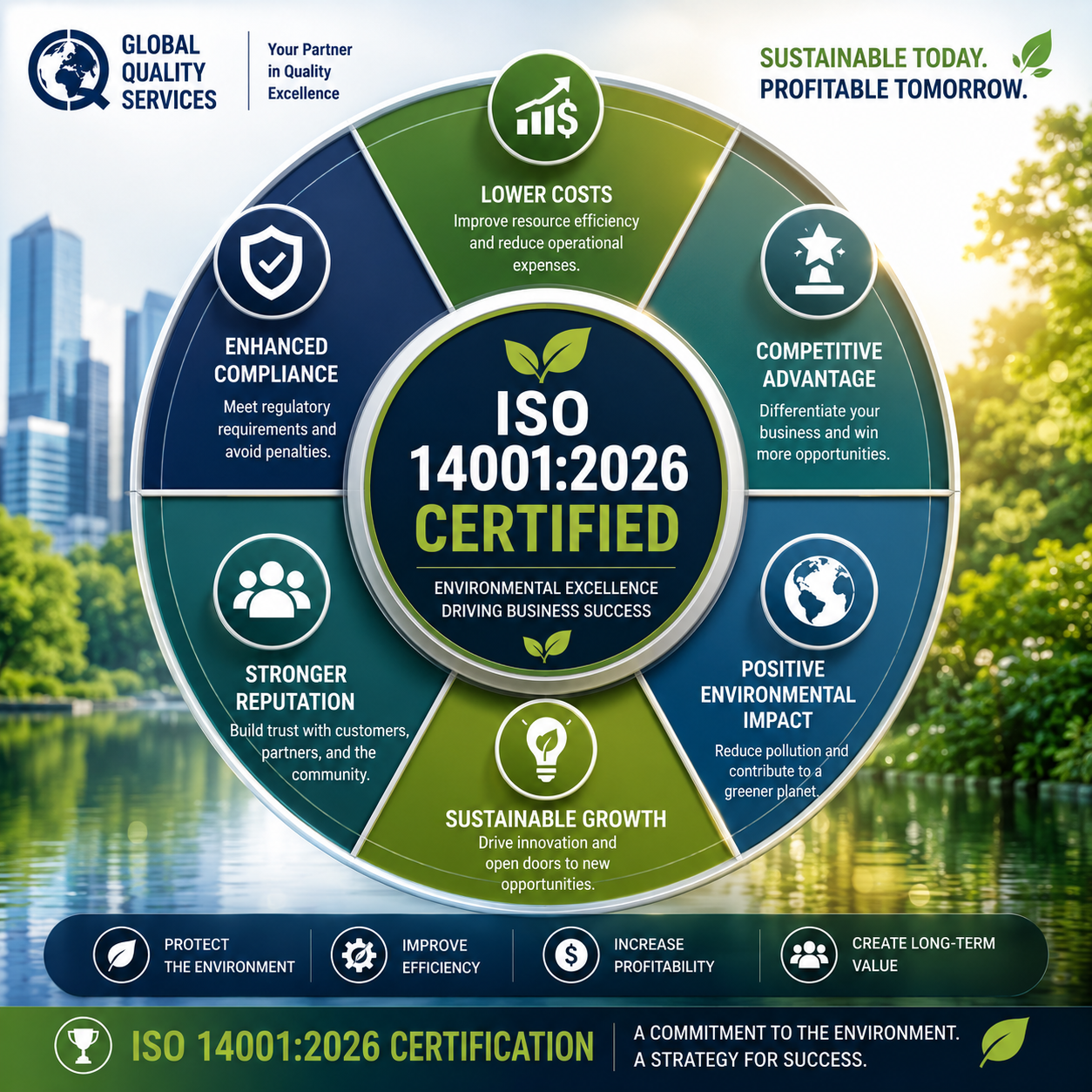
ISO 14001:2026 will provide the internationally recognized framework for establishing, implementing, and continually improving an Environmental Management System (EMS). For Tuas-based operations, certification will typically involve:
- Environmental context analysis — identifying how your operations interact with Tuas’s surrounding coastal and reclaimed land environment, including water catchment proximity and marine boundary considerations
- Legal and regulatory compliance mapping — aligning your EMS with NEA’s environmental permitting, pollution control, and hazardous substance management requirements, as well as guidance from the Ministry of Sustainability and the Environment (MSE)
- Environmental risk and impact assessment — evaluating risks specific to your sector, whether that is chemical spill prevention for a petrochemical operation, emissions control for an incineration facility, or wastewater management for a pharmaceutical manufacturer
- Pollution prevention and resource management planning — documenting how your facility manages emissions, effluent, waste disposal, water consumption, and hazardous materials in a heavily industrialized, environmentally monitored district
- Environmental performance monitoring and audit readiness — establishing internal review processes, monitoring of environmental objectives, and emergency preparedness procedures that will satisfy third-party certification body assessment
Certification Timeline — What to Expect
Once ISO 14001:2026 is formally published, companies in Tuas pursuing certification will move through a structured, time-bound process. A typical certification journey will unfold across roughly four to seven months, depending on facility complexity and existing environmental management maturity:
- Months 1 to 2 — Gap analysis and scoping. Your existing environmental practices will be assessed against ISO 14001:2026 requirements, with particular attention to sector-specific risks relevant to Tuas, such as chemical handling, emissions, or wastewater discharge.
- Months 2 to 4 — EMS documentation and development. Environmental policies, aspect and impact registers, operational controls, and emergency response procedures will be developed or updated to reflect your facility’s actual processes and its surrounding environmental context.
- Months 4 to 5 — Implementation and staff training. Your team will be trained on environmental procedures and monitoring responsibilities, with systems put in place to track emissions, waste, and resource use in real time.
- Months 5 to 6 — Internal audit. A structured internal environmental audit will surface any remaining gaps before the formal certification audit, allowing time for corrective action without delaying your certification timeline.
- Months 6 to 7 — Certification audit and issuance. Your accredited certification body will conduct a two-stage audit covering EMS documentation review and on-site environmental performance verification, after which your ISO 14001:2026 certificate will be issued, with ongoing compliance maintained through annual surveillance audits.
Heavier, more complex operations — particularly petrochemical processing and waste incineration facilities — should plan for the longer end of this range, while smaller precision engineering or light manufacturing tenants may move through certification more quickly.
Who in Tuas Should Pursue ISO 14001:2026 Certification?
- Petrochemical and chemical processing companies operating within Tuas’s heavy industry cluster
- Precision engineering and general manufacturing tenants based in integrated JTC-developed facilities
- Pharmaceutical and MedTech companies operating within Tuas Biomedical Park, where wastewater and chemical byproduct management is closely scrutinized
- Waste management and incineration facility operators managing Singapore’s municipal waste infrastructure
- Logistics and port-adjacent companies positioning themselves around the expanding Tuas Mega Port
- Multinational subsidiaries required by overseas parent companies to demonstrate certified environmental governance at the facility level
How GQS Will Support Your ISO 14001:2026 Certification in Tuas
- Conduct a facility-specific environmental gap analysis calibrated to your sector, whether petrochemical, pharmaceutical, precision engineering, or waste management
- Develop EMS documentation that genuinely reflects Tuas’s environmental context, including coastal proximity, water catchment sensitivity, and heavy industry density
- Deliver staff training on pollution prevention, waste handling, and emergency response, scheduled around shift patterns common across Tuas operations
- Coordinate certification audits with accredited bodies in a way that minimizes disruption to ongoing production or port-related activity
- Support facilities also pursuing ISO 9001:2026 or ISO 45001 in aligning all certification work into a single coordinated roadmap
- Liaise with overseas parent companies or regional EHS teams where certification timelines need to be synchronized across multiple facilities
Tuas was built, reclaimed, and developed for one purpose: serious industry. The environmental management systems operating beneath that industry deserve to be just as rigorous. Contact Global Quality Services today to start planning your facility’s ISO 14001:2026 certification in Tuas.
Frequently Asked Questions
1. Has ISO 14001:2026 been published yet, and does this timeline apply now?
No, ISO 14001:2026 has not yet been officially published. The certification timeline described here will only become applicable once ISO formally releases the standard, and certification bodies will not audit against it until then.
2. Why will ISO 14001:2026 certification matter more for Tuas than for other Singapore districts?
Tuas’s concentration of petrochemical processing, waste incineration, and coastal reclaimed land creates higher environmental stakes and regulatory scrutiny than most other industrial areas in Singapore, making certified environmental management particularly valuable.
3. Will pharmaceutical companies in Tuas Biomedical Park need a different certification approach than heavy industry tenants?
Yes, GQS will calibrate the environmental gap analysis and EMS documentation to your sector, since environmental risks in pharmaceutical manufacturing, such as wastewater and chemical byproduct management, differ significantly from those in petrochemical or waste incineration.
4. How long will ISO 14001:2026 certification take for a Tuas-based facility?
Most facilities should expect a four- to seven-month process once the standard is published, with larger or more complex heavy industry and incineration operations likely needing the longer end of that range.
5. Will GQS coordinate certification work with overseas parent companies operating facilities in Tuas?
Yes, GQS will liaise directly with regional or global EHS and environmental teams to ensure your Tuas facility’s certification timeline aligns with broader corporate environmental governance strategies.