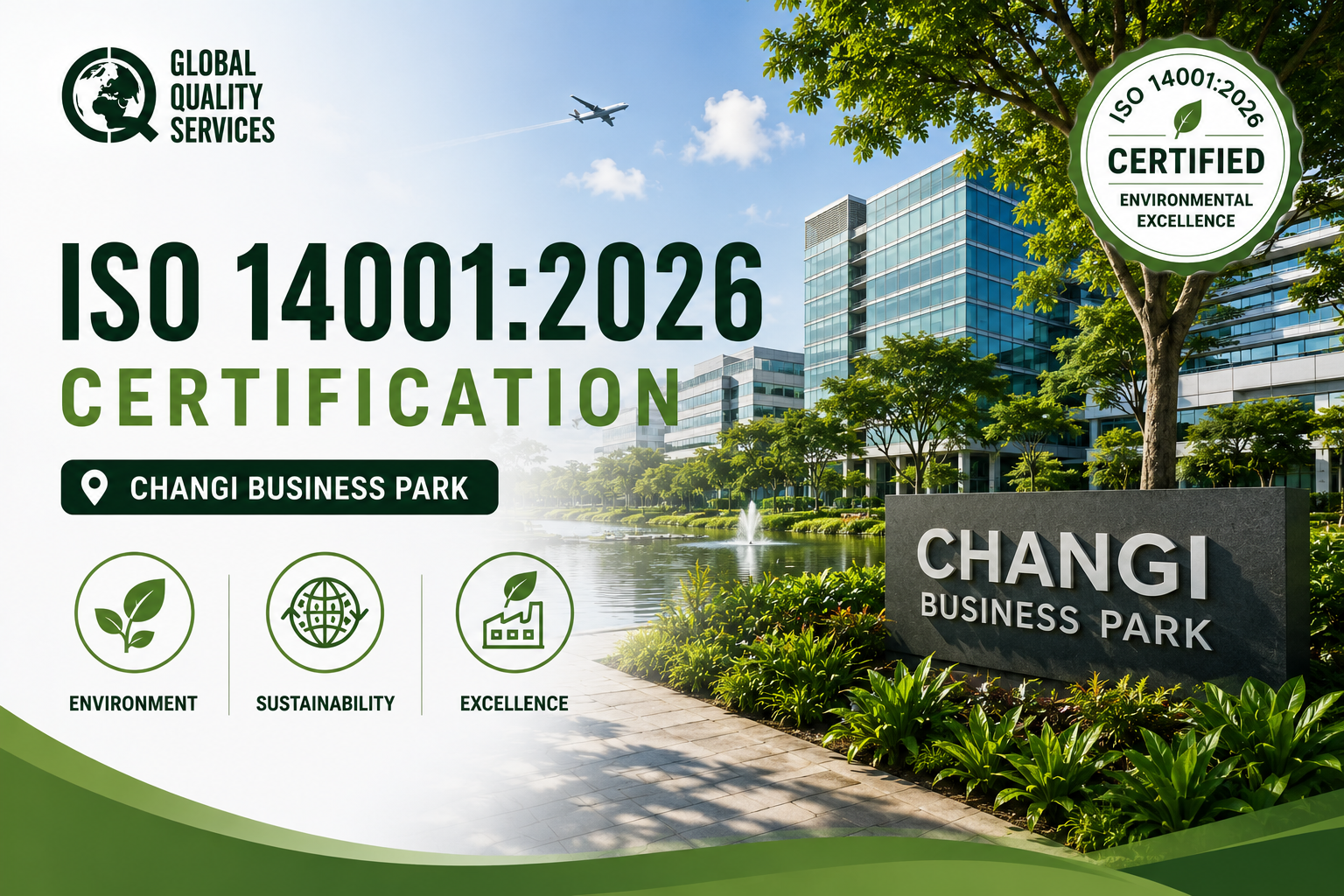
ISO 14001:2026 certification in Changi Business Park means implementing and auditing an environmental management system against the current ISO standard, tailored to a high-tech, R&D, and corporate back-office environment rather than a factory floor. Global Quality Services (GQS) certifies banks, technology firms, data-driven operations, and R&D facilities based in Changi Business Park, building its system around energy use, IT hardware lifecycle, and supply chain impact rather than production-line pollution controls.
Why Changi Business Park needs a different approach to ISO 14001:2026
Changi Business Park (CBP) is not a manufacturing estate. It was developed by JTC Corporation as Singapore’s second business park, and under the Urban Redevelopment Authority’s Master Plan it is zoned specifically for high-technology offices, R&D laboratories, and knowledge-intensive activities, with limited ancillary retail use. Tenants include global bank technology and operations hubs, data-driven enterprises, and research institutions working alongside Singapore University of Technology and Design. This changes what an environmental management system actually needs to cover:
- Energy intensity: Office towers, trading floors, and on-site server rooms or data halls consume far more electricity per square meter than a typical light industrial unit, making energy management a central rather than peripheral issue.
- IT hardware lifecycle: Laptops, servers, networking equipment, and data center infrastructure generate a steady stream of e-waste subject to Singapore’s regulated disposal framework.
- Outsourced and cloud infrastructure: Banks and tech firms in CBP often rely on third-party data centers and cloud providers, which ISO 14001:2026’s expanded life-cycle scope now expects to be accounted for in the organization’s environmental footprint.
- Corporate ESG mandates: Multinational tenants such as bank technology and operations centers frequently certify because their global headquarters require ISO 14001 across all major sites, not because of a local regulatory trigger.
- Building-level sustainability: Many CBP towers already pursue the Building and Construction Authority Green Mark ratings, and ISO 14001:2026 provides tenants with a management-system layer that sits atop building-level sustainability features.
What changed in ISO 14001:2026 that’s relevant to a business park setting
ISO 14001:2026, published in April 2026 to replace ISO 14001:2015, kept its core clause structure but sharpened several requirements that map directly onto how CBP businesses actually operate:
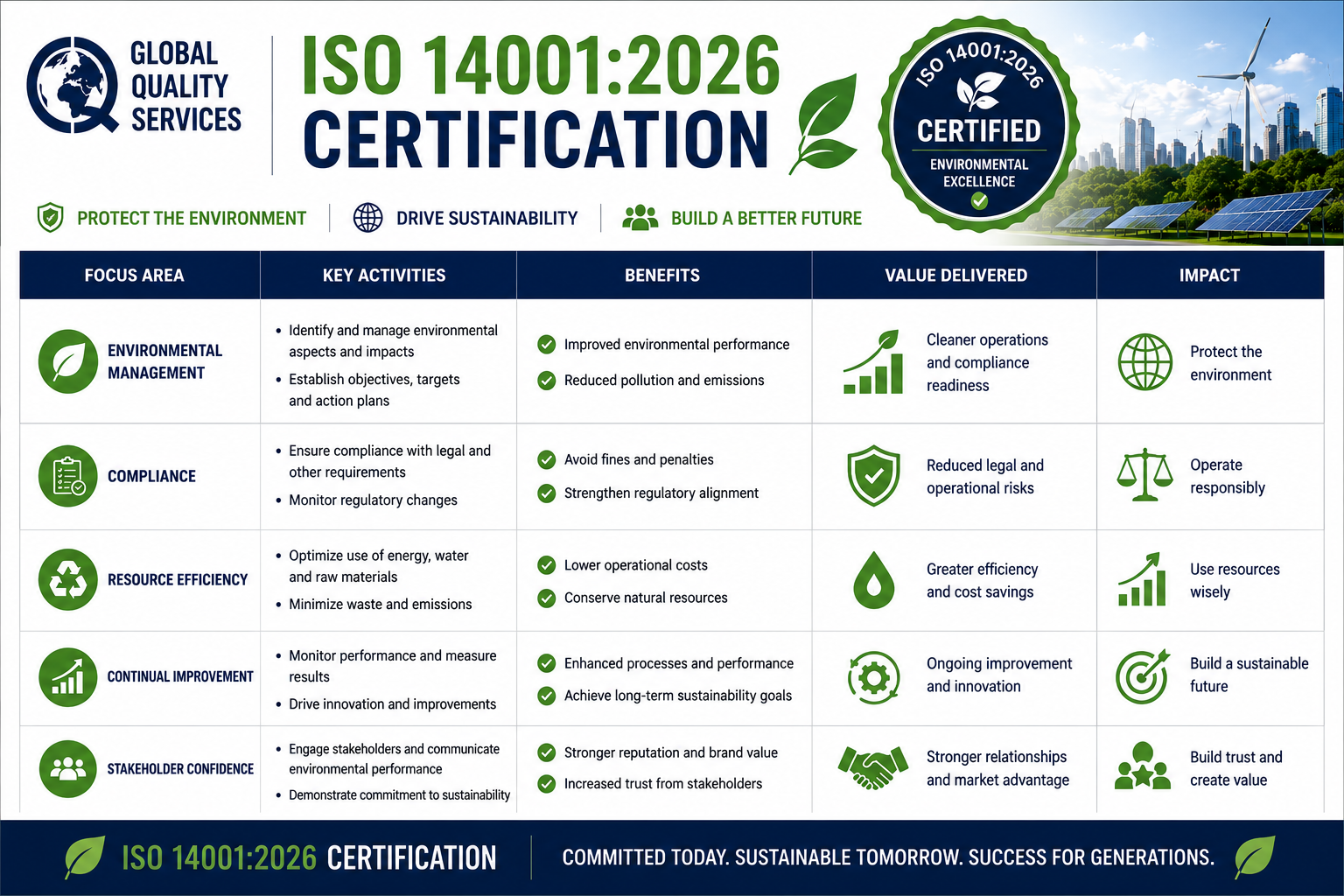
- Climate risk in business planning. Organizations must assess whether climate change is relevant to their context, which, for a bank technology hub, increasingly means flagging climate-related operational and reporting risks rather than physical site risks alone.
- Resource and energy scrutiny. Greater emphasis on resource use puts data center cooling, server room energy draw, and overall building energy intensity squarely within the system rather than treating them as a facilities-management side issue.
- Life-cycle thinking extended outward. Environmental aspects now explicitly cover externally provided processes, products, and services, which is directly relevant when core infrastructure is hosted by a cloud provider or a co-location data center outside CBP itself.
- Planning for change, formally. A new clause requires an environmental impact assessment before implementing planned changes, which is relevant when CBP tenants migrate systems, swap vendors, or refresh hardware fleets.
- Transition deadline. ISO 14001:2015 certificates remain valid until April 2029; after that, recertification must be against ISO 14001:2026.
Why are CBP tenants certifying now
Three drivers show up repeatedly among Changi Business Park clients. First, global ESG and sustainability reporting requirements from overseas headquarters, particularly for bank operations and technology centers, require every major site to be certified to a common standard.
Second, vendor and client due diligence, in which enterprise customers and regulators increasingly ask technology and financial services providers to demonstrate environmental governance, not just information security. Third, energy and infrastructure accountability, given that the Energy Market Authority regulates how new data centre capacity is approved and allocated in Singapore, making documented energy management a practical asset for any CBP tenant operating or hosting server infrastructure.
How GQS certifies businesses in Changi Business Park
GQS runs a gap analysis built around office, R&D, and data-driven operations rather than a generic manufacturing template. For most CBP clients, this means mapping energy consumption , documenting e-waste disposal through licensed recyclers under NEA’s e-waste management framework, and incorporating outsourced data center or cloud provider environmental commitments into the aspects register.
We then build the management system documentation, train relevant staff, run internal audits, and prepare the organization for the certification body’s assessment.
For banking, fintech, and technology tenants that also need an information security management system, GQS can run ISO 14001:2026 alongside ISO 27001 certification, since both now follow a similar high-level management-system structure.
Multi-site organizations with operations in Jurong Industrial Estate or Woodlands can also consolidate certification across all locations under one program. Ready to scope ISO 14001:2026 for your Changi Business Park operation? Contact GQS Singapore to start a gap analysis tailored for an office, R&D, or technology hub environment.
Frequently asked questions
Does a Changi Business Park office or R&D facility actually need ISO 14001:2026 if it doesn’t manufacture anything?
Yes. The standard applies to any organization’s environmental impact, including energy use, e-waste, and supply chain. CBP tenants without a factory floor still generate measurable environmental impacts through IT infrastructure and outsourced services.
How does ISO 14001:2026 treat outsourced data centers and cloud services?
It extends environmental aspects to externally provided processes, products, and services. A CBP tenant relying on a third-party data center needs to document and review that provider’s environmental practices as part of its own system.
Is the certification process different for a bank’s technology hub compared to a factory?
Yes. The gap analysis focuses on energy management, IT hardware lifecycle, and vendor oversight rather than emissions, effluent, or restricted-trade controls, though the underlying ISO 14001:2026 clause structure is identical.
How long does certification take for a CBP-based organization?
Most Changi Business Park clients complete certification in three to five months, often faster than at manufacturing sites since there are fewer physical processes to document, though multinational sign-off chains can extend the timeline.