Tuas occupies a unique position in Singapore’s food manufacturing landscape that no other industrial location can match. Food Ascent, the new eight-storey ramp-up food factory at Tuas South Avenue 1, is strategically located between the Tuas Mega Port and Tuas Second Link, serving as a seamless gateway for international exports and imports. For a food manufacturer operating here, the proximity to Singapore’s next-generation container terminal is not just a logistics advantage. It is the reason FSSC 22000 certification matters more urgently in Tuas than almost anywhere else in Singapore.
Export-oriented food manufacturers require GFSI-benchmarked certification as a non-negotiable buyer qualification for entry into retail and food service supply chains across Japan, the European Union, the United States, and Australia. A food business in Tuas shipping finished products through the Mega Port into those markets without a current FSSC 22000 certificate is handing buyer qualification to a competitor that has one.
Beyond the ramp-up food factories at Tuas South, Tuas Biomedical Park spans approximately 370 hectares and hosts global pharmaceutical manufacturers including Pfizer, Novartis, GlaxoSmithKline, and Lonza, several of whom produce nutraceuticals and health food products alongside pharmaceutical APIs. Nutraceutical and health food production falls within the scope of FSSC 22000, not pharmaceutical GMP alone, and companies at Tuas Biomedical Park producing functional foods, dietary supplements, or fortified products require a certified food safety management system to satisfy the food-side qualification requirements of their retail and healthcare channel buyers.
Global Quality Services provides end-to-end FSSC 22000 certification consultancy for food manufacturers, nutraceutical producers, cold-chain operators, and food packaging companies in Tuas. We deliver the full engagement from initial gap assessment through system implementation, internal audit, and final third-party certification, with every food safety management system built around the actual processes, products, and export requirements of your Tuas facility.
What Is FSSC 22000?
FSSC 22000 (Food Safety System Certification 22000) is the world’s most widely adopted GFSI-benchmarked food safety management system certification scheme. It is built on three interlocking elements: ISO 22000:2018 for food safety management, the ISO 22002 series of sector-specific Prerequisite Programs, and the FSSC 22000 Additional Requirements, which cover food defence, food fraud, allergen management, environmental monitoring, and food loss and waste.
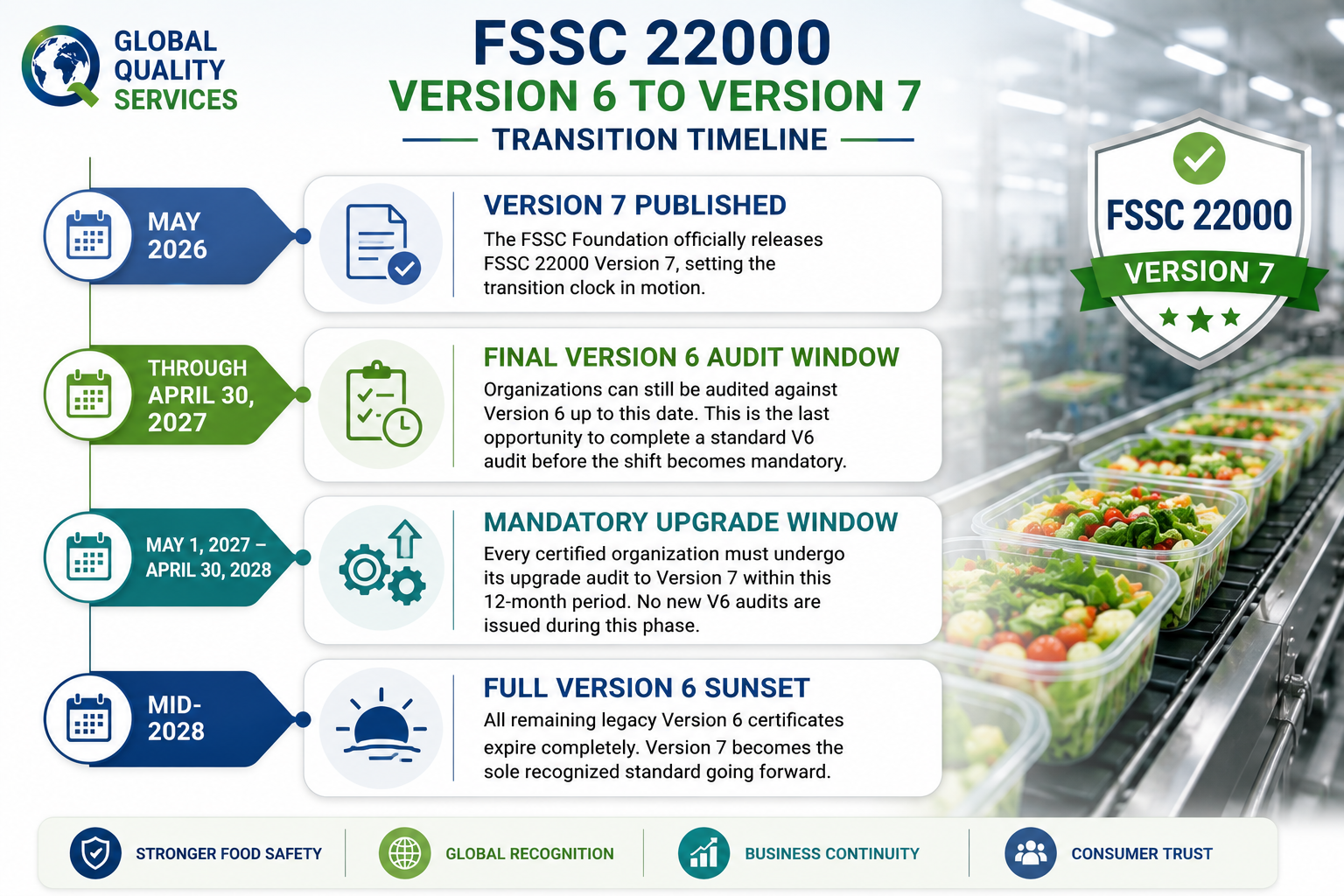
The current version is FSSC 22000 Version 7, released in May 2026. Version 7 introduces mandatory allergen management plans, food loss and waste reduction policies with measurable targets, updated food fraud and food defense plans, and alignment with the new ISO 22002-100:2025 umbrella standard. Organizations currently certified to Version 6 must transition within an 18-month window at their next regular audit.
The Singapore Food Agency recognizes FSSC 22000 as an approved Food Safety Management System standard under its regulatory framework. Holding a current FSSC 22000 certificate directly supports your SFA licensing compliance and qualifies your food establishment for Grade A attainment under the Safety Assurance for Food Establishments (SAFE) Framework introduced in January 2026.
Which Businesses in Tuas Does FSSC 22000 Cover?
FSSC 22000 Version 7 defines distinct scope categories that cover the full range of food manufacturing and food-adjacent activities in Tuas. The categories most relevant to Tuas businesses are:
Category CI – CIV: Ambient and Chilled Food Manufacturing. Covers thermal processing, dried goods, preserved foods, baked products, edible oils, beverages, chilled or ambient ready meals, and shelf-stable packaged foods. Applicable to the food processors, central kitchens, and multi-product manufacturers operating in Food Ascent and the broader Tuas South food factory cluster.
Category C0: Animal Primary Conversion. Slaughter and primary conversion of animal-derived products, introduced as a standalone category in Version 7. Applicable to meat and seafood primary processors in the Tuas industrial corridor.
Category D: Nutraceuticals and Functional Foods. Nutraceutical and health food manufacturing, including dietary supplements, fortified foods, and functional beverages, falls within the food manufacturing categories under FSSC 22000. For Tuas Biomedical Park companies producing nutraceuticals alongside pharmaceutical APIs, FSSC 22000 provides the food-side certification layer that pharmaceutical GMP alone does not cover.
Category G: Storage and Distribution. Cold-chain operators, third-party logistics providers, and ambient storage facilities handling food products. Directly applicable to the cold storage and food distribution businesses operating in Tuas given its positioning adjacent to the Tuas Mega Port.
Category I: Food Packaging Manufacturing. Producers of food-contact packaging materials including films, foils, containers, and disposable packaging items, with explicit scope boundaries added in Version 7.
Category F: Food Ingredients and Additives. Covers the production of food additives, flavors, enzymes, and processing aids, applicable to ingredient manufacturers supplying into the food manufacturing cluster at Tuas South.
Confirming the correct scope category for your Tuas facility is the first step of every FSSC 22000 engagement we conduct, since the applicable Prerequisite Program standard and audit time allocation are both determined by category.
Benefits of FSSC 22000 Certification for Tuas Food Businesses
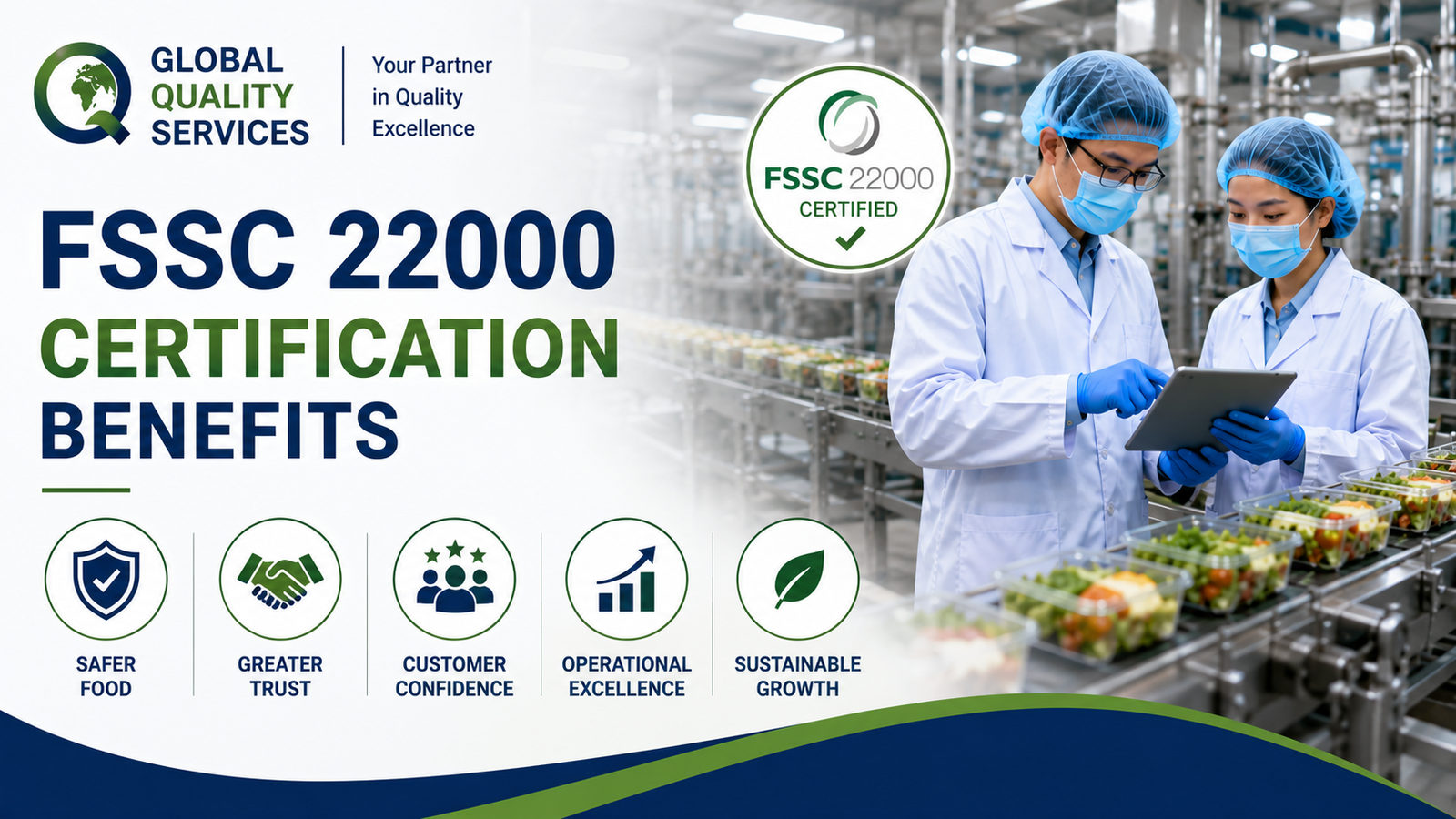
Export Market Access Through the Tuas Mega Port. A current FSSC 22000 certificate satisfies buyer qualification requirements for retail and food service supply chains across Japan, the EU, the United States, and Australia simultaneously. For a Tuas food manufacturer shipping through the Mega Port into multiple export markets, one GFSI-benchmarked certificate replaces repeated market-by-market buyer audits.
SFA Compliance and SAFE Framework Grade A. The Singapore Food Agency recognizes FSSC 22000 as an approved FSMS standard. Under the SAFE framework effective January 2026, food establishments with a certified FSMS qualify for the fast-track Grade A pathway, reducing inspection frequency and strengthening your standing with Singapore’s food safety regulator.
Nutraceutical and Health Food Buyer Qualification. For Tuas Biomedical Park companies producing nutraceuticals or functional foods, FSSC 22000 provides the certified food safety management layer that pharmaceutical GMP does not. Retail pharmacy chains, health food distributors, and direct-to-consumer channels selling into regulated markets require GFSI certification from their nutraceutical suppliers, and FSSC 22000 is the most widely accepted scheme.
Systematic Hazard Control Across the Cold Chain. FSSC 22000 combines ISO 22000’s HACCP methodology with sector-specific Prerequisite Programs to identify and control food safety hazards at every point in the production and distribution process, including the temperature-sensitive cold chain operations that connect Tuas food manufacturers to the Mega Port loading dock.
Reduced Recall Risk. Mandatory allergen controls, food fraud vulnerability assessments, and contamination prevention programs under Version 7 significantly reduce the likelihood and severity of product recalls, which carry disproportionate reputational and commercial consequences for a Tuas manufacturer whose products are already in export markets.
Enterprise Development Grant Eligible. Singapore SMEs may recover up to 50% of qualifying consultancy and certification costs for first-time FSSC 22000 certification through Enterprise Singapore’s Enterprise Development Grant under the Standards Adoption project category.
Our FSSC 22000 Certification Process for Tuas Facilities
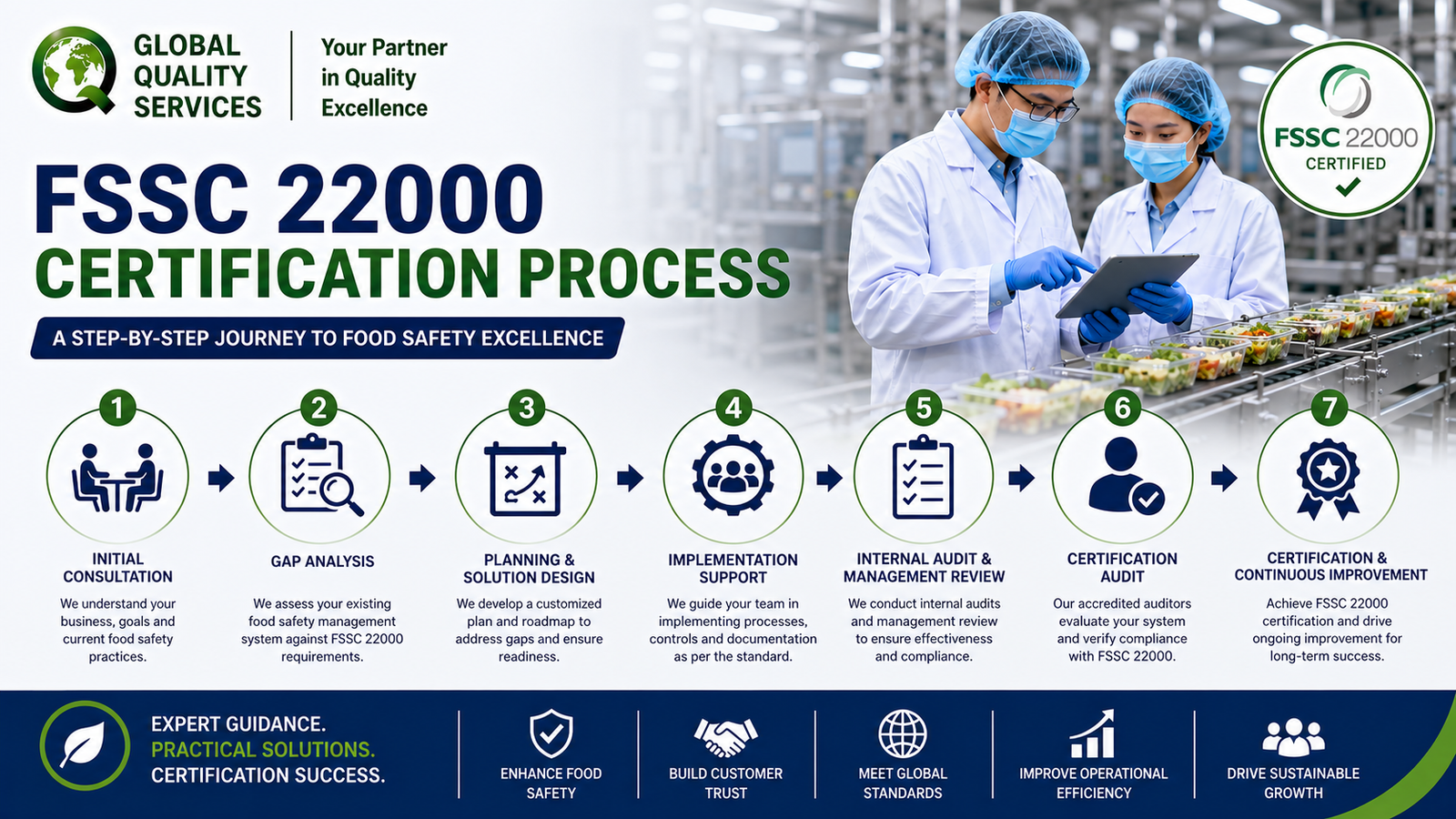
Step 1: Free Gap Assessment. A Global Quality Services food safety consultant conducts an on-site or remote review of your existing food safety practices against FSSC 22000 Version 7 requirements, benchmarks your HACCP plan, Prerequisite Program documentation, and management system against all clause-level requirements, and produces a prioritized gap report.
Step 2: Scope and Category Confirmation. We confirm the correct FSSC 22000 scope category for your Tuas facility, whether food manufacturing, nutraceuticals, cold storage, or packaging; define the certification boundary; and prepare a realistic project timeline aligned with your next scheduled audit window or Version 7 transition deadline.
Step 3: Food Safety Management System Implementation. Our consultants work directly with your food safety team to develop or upgrade all FSMS documentation, including your hazard analysis and HACCP plan, allergen management plan, food fraud vulnerability assessment, food defense plan, food safety culture program, and all Prerequisite Programs required under ISO 22002 for your scope category. All documentation is prepared for submission to the GoBusiness portal where SFA mandates it.
Step 4: Staff Training and Awareness. We deliver targeted training sessions for production, quality assurance, and management teams covering food safety culture expectations under FSSC Version 7, allergen control procedures, and individual roles within the FSMS, aligned with SFA’s joint food safety responsibility guidelines.
Step 5: Internal Audit and Management Review. Global Quality Services conducts a full internal audit against all FSSC 22000 Version 7 requirements and facilitates the mandatory management review. All non-conformities are closed before the external certification audit, ensuring your facility enters the audit in the strongest possible position.
Step 6: Certification Audit Support and Ongoing Surveillance. We coordinate with your chosen accredited Certification Body for Stage 1 documentation review and Stage 2 on-site audit, support your team through audit interactions, and manage post-audit corrective action plans. Post-certification, we provide ongoing support for annual surveillance audits to keep your certificate current throughout the 18-month Version 7 transition window.
Singapore Government Resources for Tuas Food Businesses
SFA: Safety Assurance for Food Establishments (SAFE) Framework — Singapore’s risk-based inspection and grading framework for food establishments, effective January 2026. Holding a certified FSMS such as FSSC 22000 qualifies your establishment for the fast-track Grade A pathway under this framework.
SFA: Food Safety Management Systems — The Singapore Food Agency’s authoritative page listing approved FSMS certifications including FSSC 22000, and explaining the HACCP and Prerequisite Program framework underpinning Singapore’s food safety regulatory structure.
Enterprise Singapore: Enterprise Development Grant (EDG) — Singapore SMEs may claim up to 50% of qualifying consultancy and certification costs for first-time FSSC 22000 certification under the EDG Standards Adoption category. Global Quality Services assists with EDG application documentation as part of every engagement for eligible companies.
JTC: Tuas Biomedical Park — JTC’s page covering the infrastructure, facilities, and ecosystem of Tuas Biomedical Park, home to the nutraceutical and pharmaceutical manufacturers for whom FSSC 22000 provides the food-side certification layer.
GoBusiness Singapore — The government’s digital portal for food business license applications and FSMS documentation submission. Global Quality Services prepares all documentation in the format required for submission to GoBusiness.
Migration For FSSC 22000 from Version 6 to Version 7
Most of the FSSC 22000 Version 6 to Version 7 transition is documentation work. One requirement is different: the food safety and quality culture clause.
Version 6 expected organizations to promote a food safety culture. Version 7 requires top management to set measurable objectives for food safety and quality culture, track progress against them, and demonstrate during the certification audit that quality culture is actively managed, not assumed.
 For food manufacturers supplying into Japanese retail, MNC group procurement, or enterprise food service chains, this is not a new concept. These buyers have been asking about quality culture informally for years through supplier questionnaires and second-party audits. What Version 7 does is put that expectation inside the certification itself so it becomes auditable evidence rather than a narrative answer on a questionnaire.
What measurable quality culture objectives actually look like
- Staff food safety training completion rates tracked quarterly with a defined target percentage
- Near-miss and deviation reporting rates used as a positive indicator of reporting culture rather than a failure metric
- Internal audit finding closure rates with defined turnaround time targets
- Management review frequency and attendance records demonstrating active top management engagement
- Cross-functional food safety team meeting records showing that quality ownership extends beyond the QA department
Most Version 6 facilities already track some of these data points informally. Version 7 requires them to be formalized as objectives, monitored against targets, and reviewed at management level with documented outcomes.
Why this matters beyond the audit
A food manufacturer that has genuinely embedded quality culture objectives into its management system is running a fundamentally different operation from one that passes an audit based solely on documentation. Fewer deviations surface as non-conformances because people are reporting them earlier. Corrective actions close faster because ownership is clear. Audit preparation takes less time because records are maintained continuously rather than assembled before an inspector arrives.
Global Quality Services works with your leadership team and QA function to develop food safety and quality culture objectives that satisfy the Version 7 audit requirement and reflect how your facility actually operates, so the clause adds real management value rather than becoming another document to maintain for inspection purposes.
Why Choose Global Quality Services for FSSC 22000 Certification in Tuas
Global Quality Services has supported food safety and management system certification projects across Singapore and the Asia-Pacific region for over two decades. We understand the specific food manufacturing environment of Tuas: export-oriented processors shipping through the Mega Port, cold-chain operators handling temperature-sensitive products across the Tuas South food factory cluster, and nutraceutical manufacturers at Tuas Biomedical Park operating at the intersection of food and pharmaceutical regulatory requirements.
We do not apply generic food factory templates to every engagement. Your HACCP plan, allergen management plan, food fraud vulnerability assessment, and Prerequisite Program documentation are developed around your actual products, your specific production processes, and your export market obligations, and prepared in the GoBusiness-ready format SFA requires from day one.
For Singapore SMEs, we manage the Enterprise Development Grant application on your behalf, accurately capturing qualifying consultancy and certification costs to qualify for up to 50% grant support under the Standards Adoption category.
Certification is not where the relationship ends. We stay engaged through your annual surveillance audits, your Version 7 transition if you are currently certified to Version 6, and any production, product, or scope changes that need to be reflected in your certified food safety management system. For a Tuas food manufacturer whose export contracts and Mega Port logistics depend on an active, current FSSC 22000 certificate, that continuity is not optional.
Contact Global Quality Services to begin your FSSC 22000 certification in Tuas. In addition to FSSC 22000 Certification, we also provide consultancy/guidance for PCQI (Preventive Controls Qualified Individual) in Training and Certification to help food manufacturers comply with the U.S. FDA FSMA requirements.
Frequently Asked Questions
Is FSSC 22000 recognized by the Singapore Food Agency as a valid food safety management system?
Yes. The Singapore Food Agency officially recognizes FSSC 22000 as an approved Food Safety Management System standard, equivalent in standing to ISO 22000:2018, SS 444:2018, and BRC Global Food Standards.
What is FSSC 22000 Version 7 and does my Tuas facility need to transition?
FSSC 22000 Version 7 was released in May 2026 and introduces mandatory allergen management plans, food loss and waste reduction targets, updated food fraud and defense requirements, and alignment with ISO 22002-100:2025. If your facility is currently certified to Version 6, you must transition at your next regular audit within the 18-month transition window. New certifications proceed directly under Version 7.
Does FSSC 22000 apply to nutraceutical manufacturers at Tuas Biomedical Park?
Yes. Nutraceutical and health food production, including dietary supplements, fortified foods, and functional beverages, falls within the food manufacturing categories of FSSC 22000. For Tuas Biomedical Park companies producing these products alongside pharmaceutical APIs, FSSC 22000 provides the food-side certification layer that pharmaceutical GMP does not cover, and it is required by retail pharmacy chains and health food distributors in most major export markets.
Can Singapore SMEs get government funding to offset FSSC 22000 certification costs?
Yes. Singapore SMEs may claim up to 50% of qualifying consultancy and certification costs for first-time FSSC 22000 certification through Enterprise Singapore’s Enterprise Development Grant under the Standards Adoption project category. Global Quality Services assists with EDG application documentation as part of every eligible engagement.
How long does FSSC 22000 certification take for a Tuas food manufacturing facility?
Most Tuas food manufacturing facilities complete the end-to-end certification process in four to nine months, depending on the maturity of existing food safety documentation and whether a functioning HACCP system is already in place. Facilities with an established HACCP plan and basic management system infrastructure can typically complete the process in four to six months.